

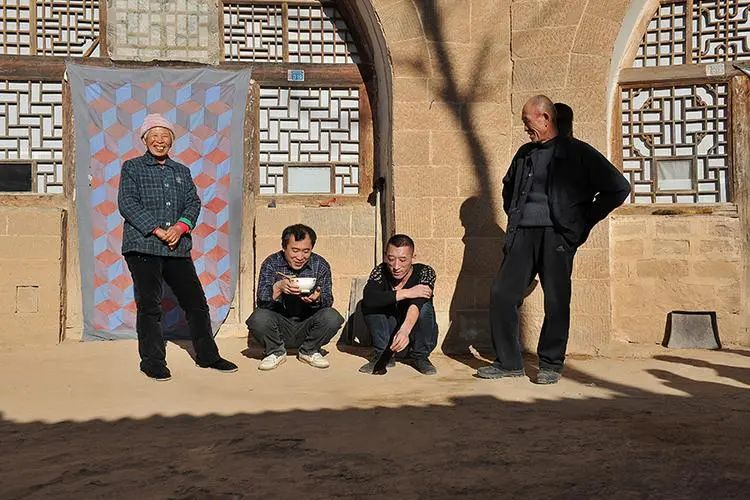
Under the apricot trees in the Western Regions, the farmers opened their big mouths, smiling: "The policy of the Party Central Committee is Yakexi!" The ongoing National People's Congress and the Chinese People's Political Consultative Conference announced that the minimum basic pension for urban and rural residents will be increased by another 20 yuan! 20 yuan! The villagers told each other, and laughter spread throughout the villages. Since the beginning of history, Chinese farmers have never received such generous benefits!
You know, 20 yuan may only be the price of a bowl of beef noodles, but in addition to looking at the absolute number, you also have to look at the increase!
According to the current standard of 140 yuan in Gansu, an increase of 20 yuan means an increase of 14%!!! The "Guiding Opinions of the State Council on Carrying out Pilot Programs for the New Rural Social Pension Insurance" promulgated on September 1, 2009, started at 55 yuan/month, and by 2024, it will increase to 123 yuan, with an average increase of 4 yuan and 5 cents per year. In terms of the increase, the annual compound growth rate is about 5.4%.
Moreover, this kind of happiness cannot be measured by money at all - farmers truly become the masters of the country. When voting for representatives, they are not like before, when 8 farmers were equivalent to one citizen; they also have it when receiving pensions. Moreover, in order to add these 20 yuan to the farmers, the already tight finances have to take out 60 billion yuan every year! Li Chuanliang, the former deputy mayor of Jixi City, was involved in corruption of 3 billion yuan. This is equivalent to catching 20 deputy-department-level mayors like Li every year to squeeze out this huge sum of money!
The following basic pension standards (yuan/month) fully demonstrate the true status of Chinese farmers and how much they are cared for:
1 Shanghai 1490
2 Beijing 961
3 Tibet 245
4 Zhejiang 220
5 Jiangsu 228
6 Qinghai 200
7 Guangdong 200
8 Shandong 188
9 Hainan 190
10 Inner Mongolia 185
11 Heilongjiang 163
12 Chongqing 160
13 Guangxi 160
14 Fujian 160
15 Sichuan 163
16 Ningxia 170
17 Xinjiang 180
18 Shaanxi 148
19 Henan 148
20 Hubei 158
21 Hunan 151
22 Guizhou 153
23 Yunnan 143
24 Anhui 135
25 Jiangxi 140
26 Hebei 140
27 Shanxi 140
28 Jilin 145
29 Liaoning 154
30 Gansu 140
31 Tianjin 322
I was born in 1976. When I was in middle school, I had to carry 80 catties of wheat for 25 miles of mountain roads to exchange shoulders to pay public grain. In addition to lining up to say good things and ask the grain station to identify the qualified ones, I was most afraid of being "burned" because of insufficient relationships - maybe because of the insufficiently plump wheat grains, maybe because I didn't work enough, maybe because a clod of soil was mixed in, you had to pay at the market price and let the grain station help you purchase the qualified grain and hand it in - this money may be the entire annual cash income of our family...
Even offering tributes was to be made difficult, and the humiliation in the middle, you cannot imagine.
When I grew up and read "Dream of the Red Chamber", Wu Jinxiao, the head of the village who sent New Year's goods to the Jia family, although he spoke politely, was far less humble than when I paid grain. Even because he actually managed the village, the young masters of the Jia family had to be polite to Wu Jinxiao.
Of course, compared to the old society, today's life is sweeter than honey. Since the township head in Jiangxi sacrificed his life, the government has been Yakexi, and farmers no longer need agricultural tax and no longer need to pay public grain.
Even in 2009, farmers were also receiving pensions.
This is the system change and system confidence that amazes the world!
My father calculated that adding these 20 yuan just offset the additional 20 yuan for the individual payment of cooperative medical care.