

Wen | Cai Jiaxin
Editor | Wang Yiran From northeast to southwest, the 369 bus route almost runs through half of Shenzhen. The huge bus body travels between skyscrapers and high-speed overpasses: it will pass through Longgang, where factories are densely packed, and it will also pass by the "Window of the World." But Master Ma knows that his son will hardly see these scenes completely—most of the time, this little boy, who is just over 10 years old, will be swaying with the bus, and will soon fall asleep.
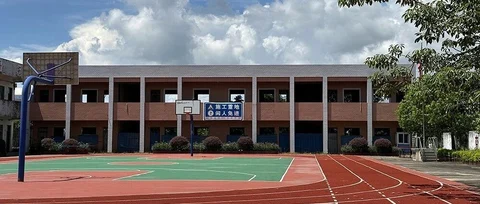
Usually, it takes about an hour and a half for the 369 bus to arrive at its 32nd stop: Baishizhou Station—this is also Master Ma's son's final stop. The boy looks very thin, and the black backpack on his shoulders is almost half a person tall. After getting off the bus, he still has to walk a few hundred meters to reach his destination, Xinghe Primary School.
Speaking of his youngest son's last days of studying in Shenzhen, 48-year-old Master Ma remembers the 369 bus route most clearly. Every morning at 5:30, Master Ma gets up to make breakfast, prepares his son's lunch, and then calls him to get up, wash up, and eat. The bus stop is across the road from his home, and he needs to go through a flyover—this is the Longgang district, where factories are densely packed. The morning traffic is heavy, and Master Ma is worried, so he simply takes his son to the bus stop every day until the 369 bus arrives and the child gets on the bus. Then he walks back alone.
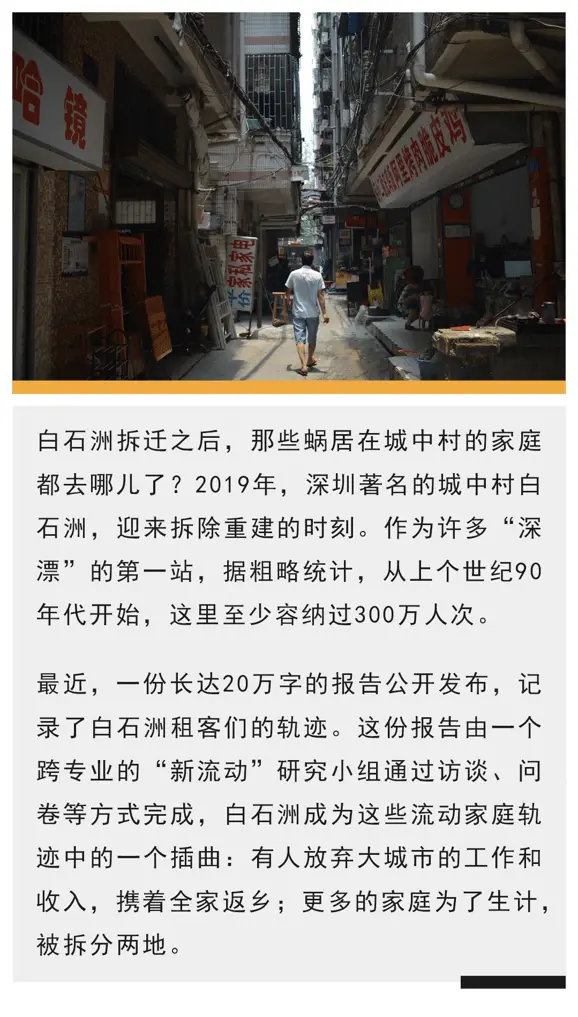
The way to school shouldn't have been so tortuous. In the spring of 2013, Master Ma brought his whole family to Shenzhen, and Baishizhou was their first stop. After learning the craft for two months, Master Ma sold the homestead in his hometown of Gansu, borrowed 260,000 yuan from friends, and rented a shop in Baishizhou to specialize in making noodles. At that time, Shennan Avenue, which spans the "artery" of Shenzhen, was adjacent to the "Window of the World," and Baishizhou became the first stop for many "Shenzhen drifters." According to public data from the Shenzhen Commercial Daily in 2017, this land of only 0.6 square kilometers had more than 2,000 rental houses and 140,000 migrant workers.
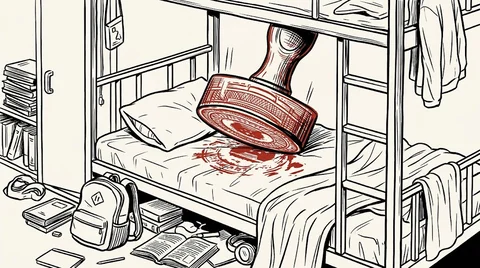
Studying is not a difficult problem either. In 2013, Shenzhen, which was short of school places, began to pilot an enrollment policy based on points, with household registration, housing, rental contracts, and social security all being key factors affecting school places. Baishizhou is located in the urban area of Shenzhen, and many wealthy families around send their children to private schools, so the public schools around are not short of school places. According to media reports at the time, after the point-based enrollment system was implemented, it was possible that more than 200 points in other areas would not be able to enroll, but in Baishizhou, more than 30 points were enough.
Master Ma, who had just arrived, lost the opportunity to enter public schools because he lacked the "accumulation" in this city. But the inclusive Baishizhou also provided more choices for these children of migrant workers, such as the private school Xinghe Primary School at the time.
At first, the tuition fee for his son was 2,500 yuan per year. In Master Ma's impression, the tuition fee increased every year after that, and by the fourth grade, it had already increased to more than 7,000 yuan. But Master Ma was still very satisfied. The school was only seven or eight hundred meters away from the store. Master Ma only picked up and dropped off his son for the first two weeks, and then let his son go to and from school alone.
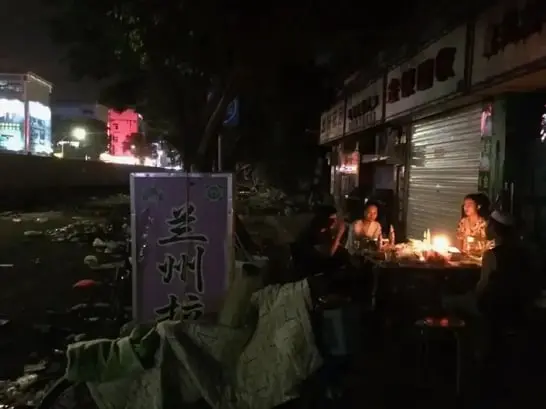
● Before the demolition, friends accompanied Master Ma's family to celebrate the Mid-Autumn Festival in Baishizhou. Photo by Deng Shijie In the old renovation plan of Baishizhou, the Shahe Industrial Zone West, where Master Ma's shop is located, began urban renewal earliest. He also became one of the first batch of Baishizhou tenants to be "cleared" out. From then on, his business, residence, and the convenience and daily life of studying in Baishizhou were also changed.
In the pace of urban renewal, tenants are one of the groups most affected. Until June 2019, the pace of old renovation moved towards the east of Shahe Industrial Zone, and large-scale rent clearance began. Taking the four villages in the north of Baishizhou as an example, official data shows that there were 83,000 original residents. After three months of rent clearance, by September of that year, a total of 28,000 people were reduced. In the early stages of demolition, because of the interruption of residence and livelihood, the tenants' emotions also had a strong rebound. In that year, the reports about Shenzhen, the story of Baishizhou occupied a large part—the streets and alleys were full of clearance sales, and the figures of protest and moving were also everywhere.
The most intense expression was the children's schooling problem. Independent urban and rural researcher Deng Shijie recalled that the expression included pulling WeChat groups, joint signature initiatives, and contacting media reports, etc. He used to work in the media at the Shenzhen Urban Design Promotion Center. In June 2019, he participated in the research of the "New Mobility" group in Baishizhou. In his memory, the initial ideas about the research mainly stayed on the housing problem and the study of urban villages. "The problem that children couldn't go to school was actually beyond all of our expectations." Five years later, the research data and results of that year were presented in a report entitled "Improving the Competitiveness of Post-Industrial Cities—Starting from the Understanding and Reconstruction of the Population Flow of Organic Cities" (hereinafter referred to as the "Report"). This report is as long as 200,000 words, and it discusses the impact of the old renovation plan of Baishizhou on these external migrant populations, as well as various civil practices and participation at that time.
In 2019, the authorities repeatedly mentioned that the demolition did not involve the demolition of schools, and students' schooling was not affected. But in the observation of Deng Shijie and others, with the old renovation and rent clearance, the impact of enrollment penetrated into reality: In the report, a vegetable market merchant said, "I prepared for two years, and finally my child got into Xiangshanli (Primary School). Now it's going to be demolished, and the rent nearby is ridiculously high. It's expensive, but the problem is that there's no house to rent (live)." Losing the "protection" of Baishizhou, with the same rent, these families can only live in remote areas. They cannot transfer their children to school in a short period of time. What lies before these families is the choice of living costs, time costs, and educational resources. "There are no houses nearby, and the rent has also increased. It takes a lot of time for children to go to and from school. How to solve the problems of sleep and safety?" a parent in the report said.
In the impression of Dong Qi, a member of the "New Mobility" group, during that time, how to communicate with children in the face of sudden changes became a problem for parents. On the one hand, within the family, they were torn by self-blame and guilt, "I didn't work hard enough, so I couldn't give my child a better life." On the other hand, in the face of external turmoil, it was difficult for them to explain the operation and laws of this society. Therefore, along with the pain of change, silence became the norm for these families.
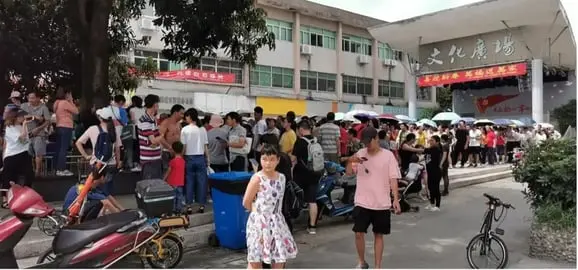
● July 8, 2019, the scene of registering children's schooling problems. Source: The "Report" in the text Many people call this the "pain" in the process of urban old renovation. On September 1 of that year, Baishizhou even specially opened three old renovation special bus lines to pick up and drop off those children who lived far away from school. But specifically to the individual, a family's life or even the trajectory of fate may be changed from then on.
For Master Ma, who runs a noodle restaurant, this "pain" lasted at least three years. Recalling that time, he said, "It was like a dream, I don't know how I got through it." The noodle restaurant invested all his savings, and he could only be a "nail householder." With the help of Deng Shijie and others, Master Ma reopened a noodle restaurant in Buji, 30 kilometers away; then came the problem of his child's schooling. He ran to more than a dozen schools nearby, but was rejected because "there were no school places."
Master Ma could only continue to let his child study in Baishizhou. He never thought of sending his child back to his hometown of Gansu. He hoped that his child could receive education in a big city like Shenzhen, and he also didn't want his child to become a left-behind child. But many times, Master Ma couldn't wait for his son to get out of school in the store. He opened the watch positioning and found that his son was taking the 369 bus to the terminal—he had overslept.
Later, in the afternoon, Master Ma would become anxious. He habitually looked up at the time and occasionally opened the positioning to see where his child was. "I'm busy and watching." About three or four stops away, he quickly called his son's watch phone, "Don't sleep, you're about to go home."
Every day, the round trip is nearly 60 kilometers. The 13-year-old son has no complaints. His grades are average, but he is very sensible. For those summer camps that require money, he always hesitates to tell Master Ma, "I need 200 yuan, should I go?" Master Ma always comforted him, "Go, at least you can broaden your horizons and play outside."
On the 369 bus, Master Ma's son once brought back a letter, which was entrusted to him by a stranger to pass on to Master Ma. Master Ma remembers the general content of the letter: Hello, parent, your child takes the bus for such a long time every day and sleeps on the bus, which is not good for the child's cervical spine. It's too far and it's easy to have an accident. You have to find a way to solve your child's schooling problem.
Speaking of this letter, Master Ma was both amused and annoyed. When the school held a parent-teacher meeting, he took the 369 bus all the way there, and he also fell asleep. "That car stops and goes, it's very hard, and the parents also feel sorry for the child." But he had no choice. "People are also kind, but I really can't do anything."
The reality is that some of the people who were "cleared" out of Baishizhou are far less "lucky" than Master Ma. Many children had to be sent back to their hometowns. Langtou, who was 40 years old at the time, was once an engineer at a mobile phone company in Shenzhen. Relying on the convenience of Baishizhou, his son obtained a school place at Xiangshanli School in Shenzhen.
After the demolition and renovation of Baishizhou, Langtou's family was forced to move away. In the subsequent point competition in the area where they lived, because his wife took care of the family full-time, they lost a social security quota point, and his daughter could not obtain a school place in a public school. The high tuition fees of private schools were unaffordable, and Langtou's wife could only take her two children back to Baise, Guangxi, her hometown. Langtou also began to consider job opportunities in his hometown. "If Baishizhou is still there, I don't need to consider this. Even if the job will be changed and the salary is lower, as long as the children can study here and live here, I will persist."
In May 2020, the research team where Deng Shijie was located made a phone call back to the families of the former Baishizhou students. Most of them had already moved away from Baishizhou. They believed that the interview was "useless." "For people like us, it's actually quite powerless. I see that you have also published a lot about the difficulties we have in finding a house, but it still doesn't make much sense." Langtou sounded more frustrated. In the schools in Shenzhen, his son was very popular and also liked this city. The schools in his hometown were remote, and there were many left-behind children. He belonged to "being forced to go back." He refused Deng Shijie's request for an interview. "It's not ideal for the child to go back, and I don't want to think about it anymore."
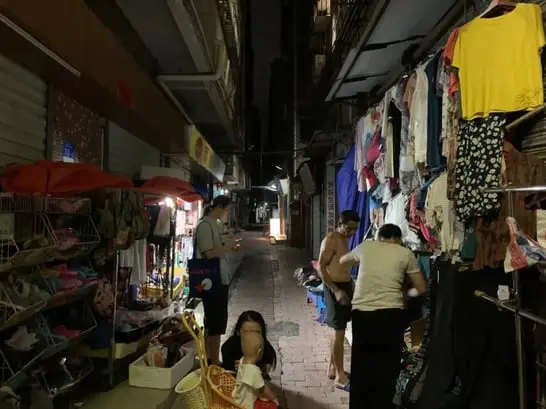
● September 2020, a shopkeeper's grocery store retreated to the wall of the alley. Photo by Deng Shijie The son of Master Ma, who runs a noodle restaurant, couldn't make it to the high school entrance examination. In the second year of junior high school, in order to prepare for the high school entrance examination, he followed his uncle and boarded the train back to his hometown. After that, Master Ma could see his son only a handful of times each year. In the few meetings each year, he found that his son, who used to be outgoing and cheerful, seemed to be less willing to contact others.
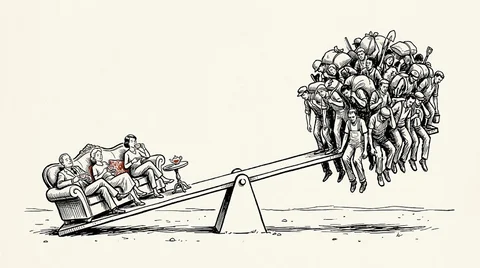
In the wave of urban renewal, the migrant families and children who have lost their homes are still bearing the "aftermath." In a certain sense, the people who rent in the urban villages represented by Baishizhou belong to the disadvantaged groups in society, and even represent a certain gray area in the city. Deng Shijie said that during the demolition and rent clearance process, because of the lack of certain social care and the lack of a buffer period, the presentation of contradictions and conflicts may also be more intense.
At the practical level, the problem of Baishizhou students also presents a broader dilemma: in the wave of urban renewal, how to face the migrant population and their corresponding public services, such as the enrollment problem of children of migrant workers under the household registration system.
During the research process, Deng Shijie often faces a question, that is, in the process of demolition and renovation, whether the tenants have the right to object, and how their rights should be recognized? Many people use the concept of law to explain the legitimacy of "rent clearance," but in Deng Shijie's view, this is a "shallow" social concept, because in the education system they have received, they "did not include the specific 'people'."
Before the old renovation, as a "landmark" of Shenzhen, Baishizhou not only attracted a large number of migrant and migrating populations, becoming the destination of many new urban immigrants, but also formed a diversified economic structure, such as personalized craft bars, coffee shops, etc.
The group's published research report mentioned that when it was written in 2021, small-scale urban village "enclaves" could still be seen in areas such as Luohu, Futian, and Nanshan. There was no place that could be like Baishizhou in the past, "so large in scale" and "so diversified in economic structure." The report explained that after expelling a large number of tenants and individual businesses, the Shenzhen urban form of "post-Baishizhou" officially announced the end of Shenzhen's special era of complementing the city and "urban villages."
Until now, Baishizhou has not been completely demolished. The Baishizhou area south of Shennan Avenue still retains the form of an urban village. After the demolition and renovation, "urban villages" have become scarce resources. Some tenants say that the rent here has more than doubled compared to before the demolition. North of Shennan Avenue, with the progress of bulldozers, the manufacturing plan of high-end residential areas, hotel office buildings, and immigration museums has begun to take shape, and it is difficult to find the shadow of the old Baishizhou. (Some content is excerpted from "Improving the Competitiveness of Post-Industrial Cities—Starting from the Understanding and Reconstruction of the Population Flow of Organic Cities")
Copyright statement: All the content of this article is copyrighted by the Ji Zhou Studio. Without written permission, it is not allowed to be reproduced, excerpted, or used in other forms, unless otherwise stated. - END -