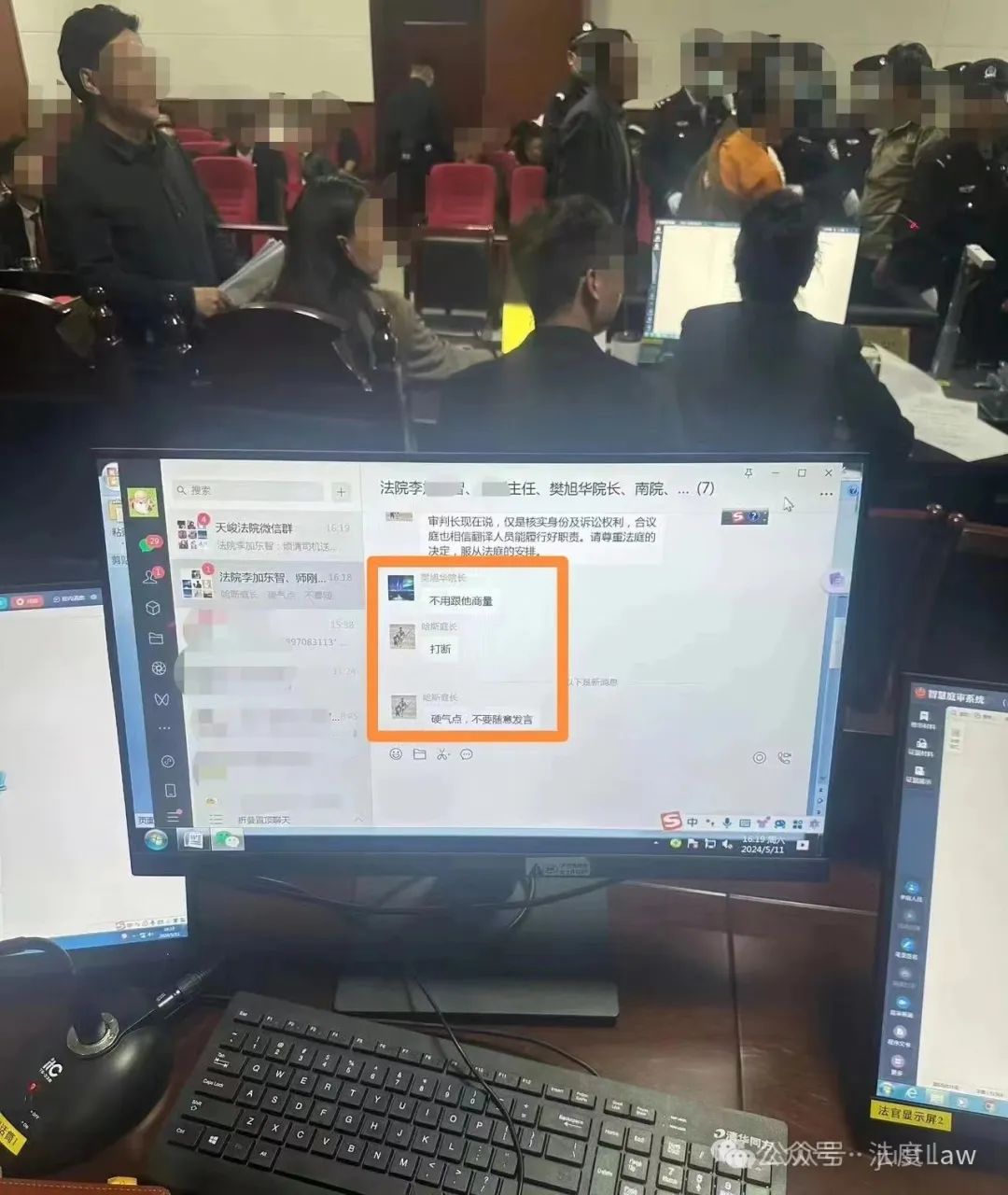
“Don’t discuss it with him,” “Interrupt,” “Be assertive, don’t speak casually”… On May 11, when the People’s Court of Tianjun County, Qinghai Province, publicly tried the retrial of a case involving Suo and others suspected of provoking incidents, during the recess, the defense lawyers discovered that the original second-instance presiding judge of the case, Haixizhou Intermediate People’s Court Criminal Division Director Ha Si, and Tianjun County Court President Fan, were remotely controlling the trial in real-time through a WeChat group.
According to a report by New Yellow River, on May 13, the Qinghai Provincial High People’s Court responded that the court was verifying and investigating. In addition, the Qinghai Provincial People’s Procuratorate has also intervened.
This case of provoking incidents occurred in November 2020. In November 2021, the People’s Court of Tianjun County made a first-instance judgment, determining that Suo and 12 others constituted the crime of provoking incidents. In February 2023, the Haixizhou Intermediate People’s Court, after a hearing, ruled to revoke the original judgment and remand for retrial.
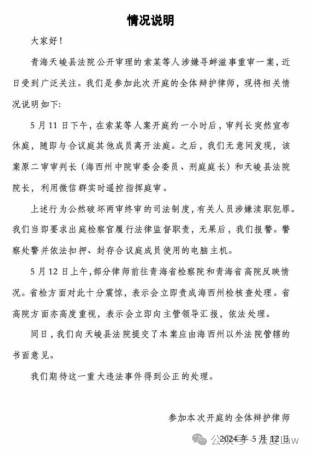
Previously, a “Statement of Circumstances” showed that all the defense lawyers who participated in this trial stated that on the afternoon of May 11, about an hour after the trial of the case involving Suo and others began, the presiding judge suddenly announced a recess and then left the court with other members of the collegiate bench. Afterwards, the defense lawyers inadvertently discovered that the original second-instance presiding judge of the case (member of the Haixizhou Intermediate Court’s Trial Committee and Director of the Criminal Division) and the President of the Tianjun County Court were remotely controlling the trial in real-time through a WeChat group.
Photos circulating online show that in a WeChat group consisting of President Fan, Director Ha Si, and 5 other people, President Fan said, “Don’t discuss it with him,” and Director Ha Si successively said, “Interrupt,” “Be assertive, don’t speak casually.”
 |
The defense lawyers immediately requested the attending prosecutor to perform their legal supervisory duties, but to no avail, and then reported the case to the police. The police handled the case and seized and sealed the computer hosts used by the members of the collegiate bench.
On May 12, the defense lawyers reported the situation to the Qinghai Provincial Procuratorate and the Qinghai Provincial High Court and were informed that they would investigate and handle the case according to law. The lawyers also submitted a written opinion to the Tianjun County Court stating that the case should be under the jurisdiction of a court outside of Haixizhou.
In order to understand the specific situation, before the article was published, “Fadu Law” contacted the first-instance judge Dawa Ji, but did not receive a response.
 |
The defense lawyers in the case confirmed the authenticity of the “Statement of Circumstances” and the photos to “Fadu law”. In addition, at dawn on May 13, the Tianjun County Court notified that the court would not be in session this morning, and the court would discuss the issue of jurisdiction.
The incident has attracted attention from the legal community. Professor He Bing of the Law School of China University of Political Science and Law mentioned that the legal issue raised by this incident is: when the lawyers discover evidence of collective illegal acts by the judges during a court recess, can they immediately collect evidence?
He Bing believes that in order to ensure the implementation of the law, China’s law grants lawyers the right to collect evidence. Although lawyers do not have the right to compulsory evidence collection, their right to collect evidence is consistent with the purpose of the public security, procuratorial, and judicial organs’ right to collect evidence, which is to maintain the correct implementation of the law.
In this incident, if the lawyers do not immediately collect evidence, the evidence may never be obtained. The judges are collectively illegally manipulating the court,
The facts are extremely clear. In order to maintain the correct implementation of the law, lawyers have the right and should immediately collect evidence.
He Bing said that the judges do not have the power to transcend the law and exempt others from collecting evidence of their illegal acts. “The judges don’t, and neither does anyone else.”
Lawyer Wang Cailiang, Honorary Director of Beijing Cailiang Law Firm, believes that the above-mentioned incident seriously undermined the two-instance final judgment system of criminal proceedings, and the defense lawyers’ criticism, accusation, and appeal are all based on the law.
Lawyer Wang Cailiang said that for a long time, the superior courts’ guidance responsibility to the lower courts is not only in the field of criminal trials, but also in the fields of administrative and civil trials, which has also been alienated. The judges of the superior and lower courts have become brothers and sisters, and the supervisory relationship at work has become a group relationship. This is also an important reason why many wrong cases are not corrected in the second instance after being wrong in the first instance, and they go through retrials and appeals. It’s just that this kind of grouping is more hidden, and it hasn’t been exposed and caused a major social impact, and over time it has become a bad habit.
Now that the problem has been exposed, it is a good thing. It is hoped that the court system will truly listen to the lawyers’ opinions, not only correct the case, but also draw inferences from it, seriously handle cases in accordance with the litigation procedures, and seriously safeguard the legitimate rights and interests of the defendants. If this cannot be done, our country should abolish the litigation legal system, and administrative cases should be decided by administrative organs, criminal cases should be decided by the police, and civil cases should be decided by the village committees and neighborhood committees. This will also reduce the financial burden and reduce the burden on taxpayers.
However, China’s rule of law is the general direction and is irreversible, and only when the people’s courts take the lead in seriously implementing the Constitution and criminal laws can the rule of law have hope.
Lawyer Wang Fei of Beijing Zebo Law Firm also mentioned that for the judges and leaders of the superior courts, this is a naked interference in the trial activities of the lower courts. Imagine, if they can directly direct how to deal with lawyers in court, can they also direct the lower courts on how to make substantive judgments?
Wang Fei said that for the judges who preside over the trial on the spot in the lower courts, this is the real-time dissemination of trial activities. The court rules explicitly prohibit the dissemination of trial activities through the Internet during the trial process without permission. This applies to the participants in the litigation, and even more so to the trial personnel, unless the trial is broadcast live, allowing all parties to the litigation and the public to see the trial activities and supervise the judiciary. Otherwise, the judges can disseminate it privately while the participants in the litigation cannot, which violates basic fairness and justice.
Wang Fei believes that the judiciary is not a private matter of anyone, nor is it a private matter of any court, but a state instrument, a major matter involving citizens’ personal freedom and even life, and cannot be allowed to be messed up by certain judicial organs and judicial personnel. The reason why the state law stipulates that the people’s courts independently exercise the power of trial and are not subject to interference from administrative organs, social organizations, and individuals is to avoid judicial injustice caused by interference. This interference includes interference in the name of individuals and in the name of organizations.
According to the Court Organization Law, the superior and lower courts are a supervisory relationship rather than a leadership relationship. The superior courts can only conduct level supervision through statutory procedures such as appeals and appeals (retrials), and cannot personally take action to directly direct the lower courts on how to specifically handle cases. The purpose is also to ensure judicial fairness and independence, and to avoid the various levels of courts becoming a monolithic block, thereby hollowing out the level supervision mechanism.
Our country has a two-instance final judgment system, which means that if you are not satisfied with the first-instance judgment of the lower court and file an appeal, you have the right to obtain the right to be supervised and corrected by the superior court through the second-instance procedure. However, if the first-instance judgment itself is made under the direction of the second-instance court and lacks independence, then what is the significance of the second instance? How can ordinary people achieve fairness and justice?
Lawyer Wang Fei believes that this incident is a serious violation of the two-instance final judgment system. If this trend is not rectified, it will be a devastating blow to judicial fairness. It is hoped that the Qinghai High Court, the Qinghai Provincial People’s Procuratorate, and the Supreme People’s Court and the Supreme People’s Procuratorate will attach great importance to this, take this as an opportunity, reaffirm the basic judicial concept that the people’s courts independently exercise the power of trial and the superior courts must not participate in or direct the handling of lower-level cases, safeguard the procedural fairness and substantive fairness of the judiciary, reassure the people, and give the people peace of mind.
—End of the article—
Discover more from 自由档案馆
Subscribe to get the latest posts sent to your email.