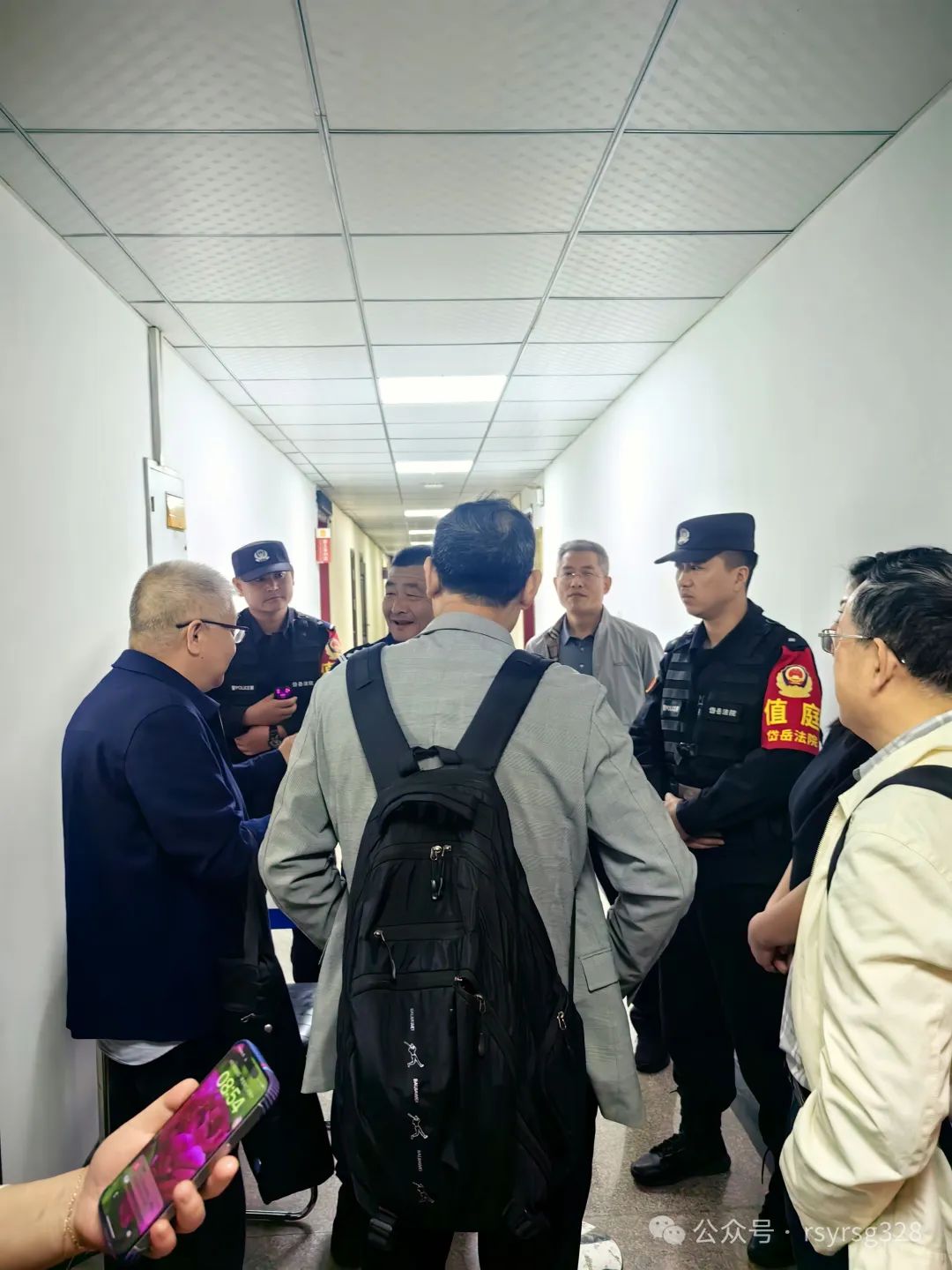
On the morning of April 18, 2024, at 9:30 a.m., the third public hearing of the case of female lawyer Gao Bingfang, who was accused of false litigation for seeking wages for migrant workers, was held for the third time in the Third Trial Court of the Taiyue District Court of Tai’an, Shandong.
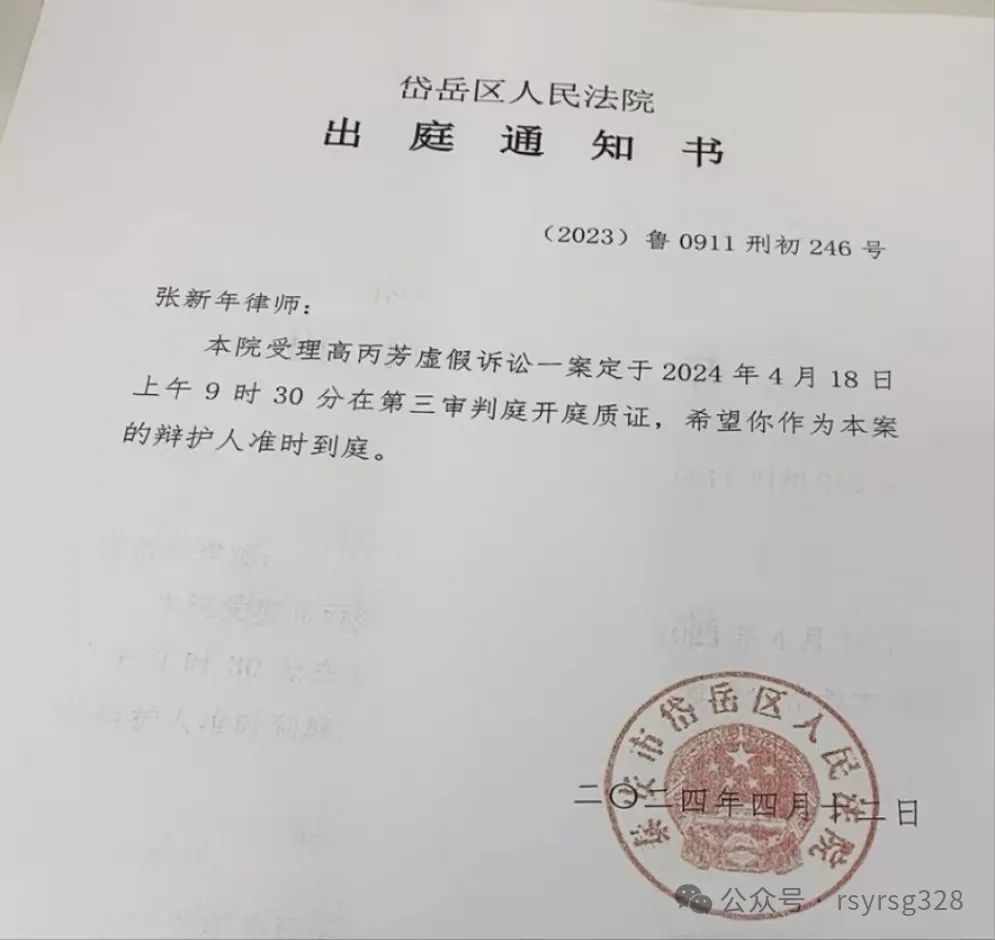
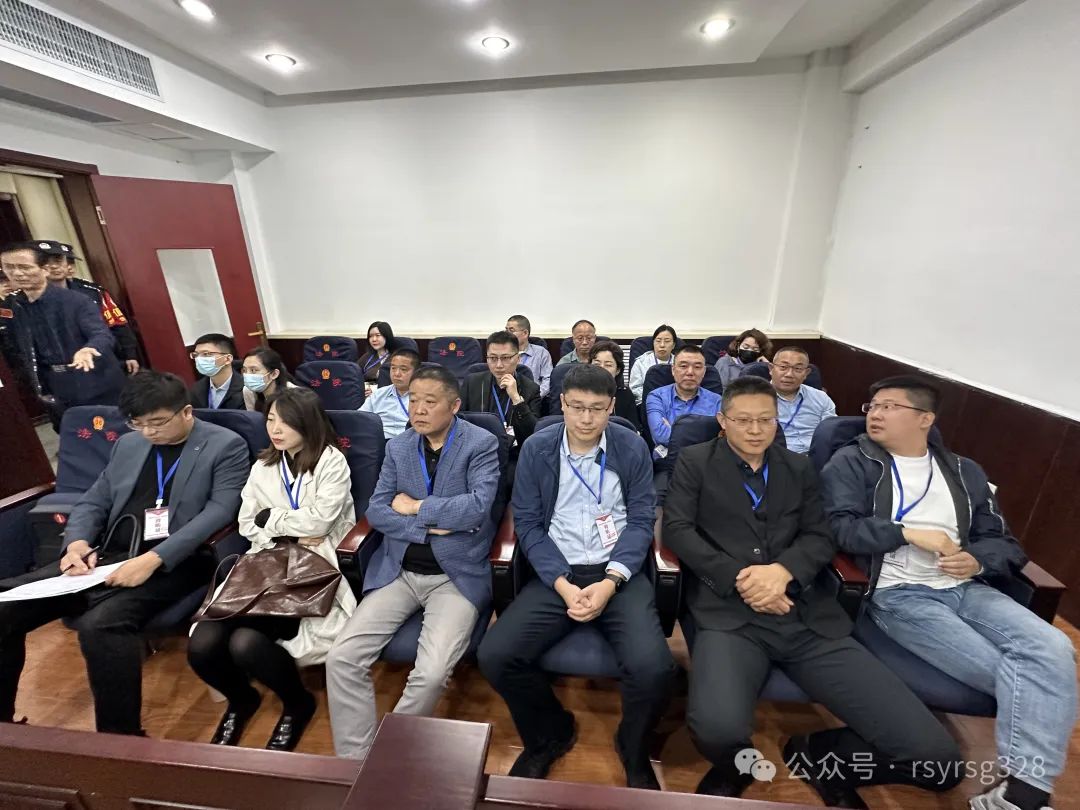
The Third Trial Court is a small court, and there are only 17 seats available in the three rows of spectator seats, excluding many broken chairs. However, lawyers from all over the country and the families of the parties involved were blocked outside the court. This was because the court was already filled with “occupancy” personnel arranged by the court. Only four spectator seats were reserved for the families of the parties involved.
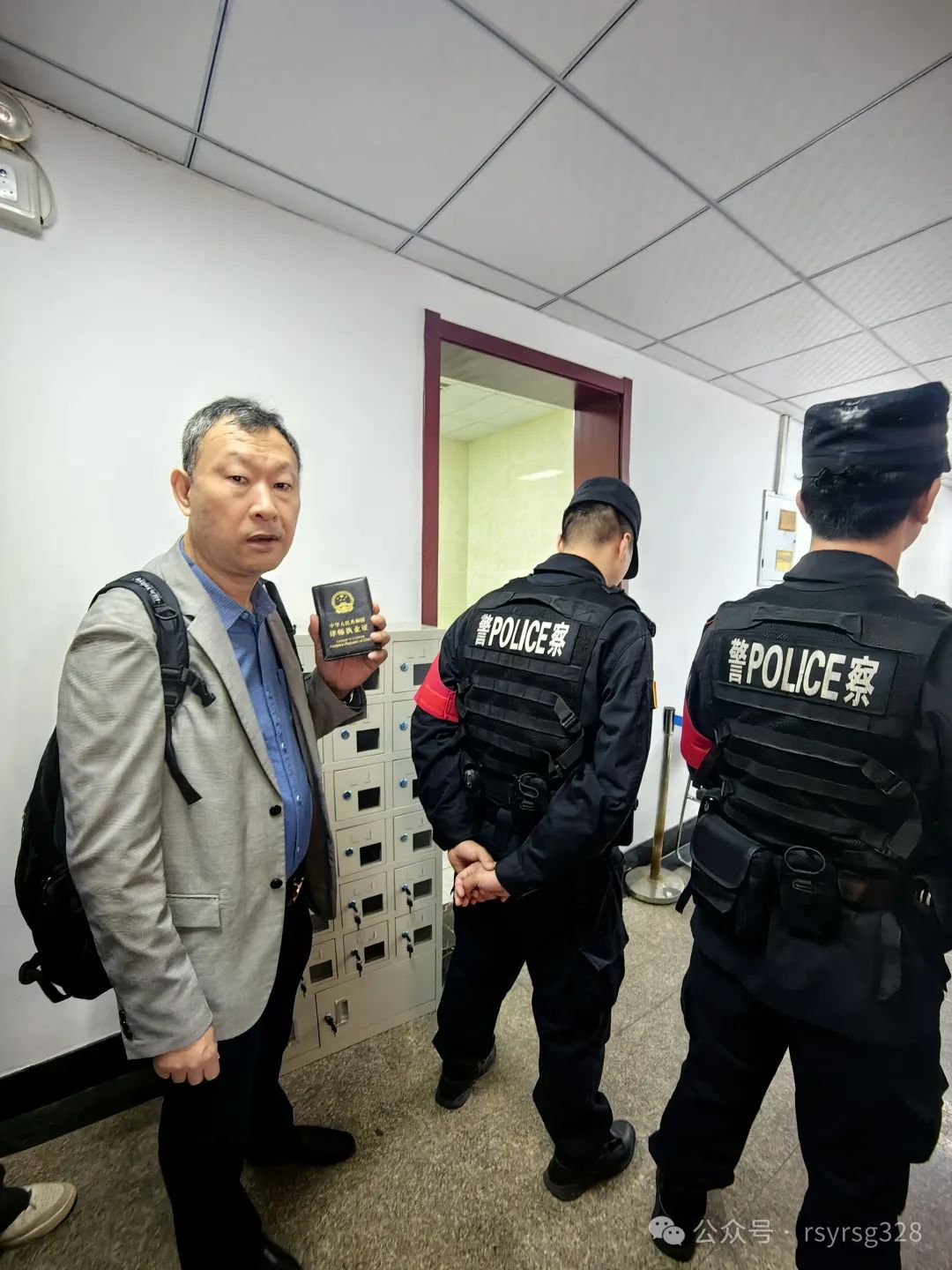
Lawyers could only look at the court with their lawyer’s certificates, and even Wang Cailiang, the former director of Cailiang Law Firm, who came all the way from Beijing, could not enter the court even after repeatedly stating to the court that he was commissioned by the All China Lawyers Association to attend the hearing, let alone ordinary people.
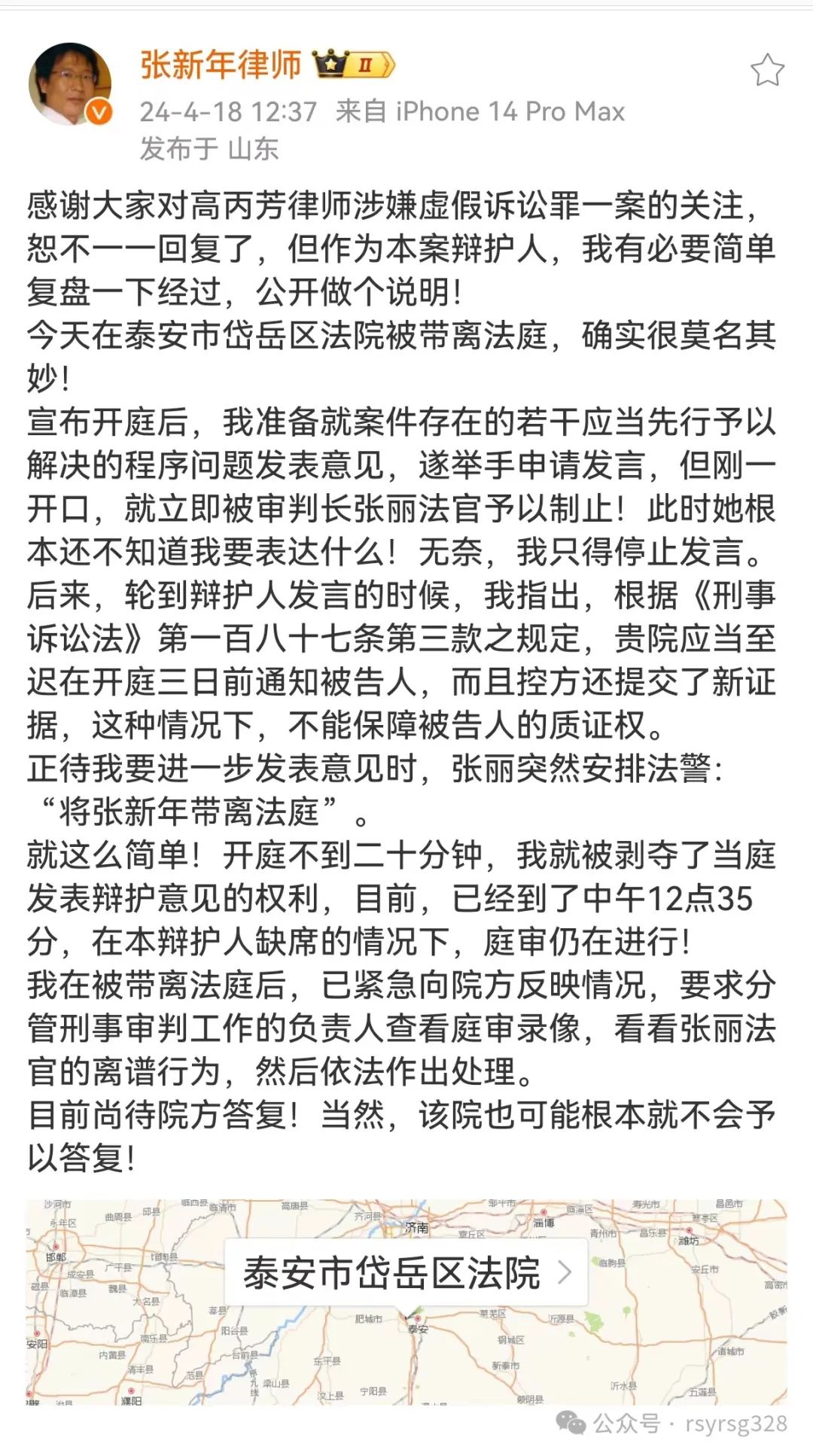
Outside the court, Beijing lawyer Du Zhaoyong was still “popularizing the law” to the on-duty police officers, trying to make them understand the meaning of “open trial” by talking about the “Ma Xiwu trial method.” Inside the court, Zhang Xinnian, Gao Bingfang’s defense lawyer, was expelled by the chief judge just five minutes after the trial began! At 12:37 p.m., lawyer Zhang Xinnian posted on Weibo:
As the defense attorney in this case, I find it necessary to briefly review the process and make a public statement! It was really inexplicable that I was taken away from the court in Tai’an City, Daiyue District Court today! After the announcement of the trial, I was going to express my opinions on several procedural issues that should be resolved first, so I raised my hand to apply for a speech, but as soon as I opened my mouth, I was immediately stopped by Judge Zhang Li! At this time, she didn’t even know what I wanted to express! Helplessly, I had to stop speaking. Later, when it was the defense attorney’s turn to speak, I pointed out that according to the provisions of Article 187, paragraph 3 of the Criminal Procedure Law, your court should notify the defendant no later than three days before the trial, and the prosecution also submitted new evidence. In this case, the defendant’s right to cross-examine cannot be guaranteed. Just as I was about to further express my opinion, Zhang Li suddenly arranged for the police: “Take Zhang Xinnian out of the court.” It’s that simple! Within twenty minutes of the trial, I was deprived of the right to express my defense opinions in court. Currently, it is 12:35 p.m., and the trial is still going on in the absence of this defense attorney! After being taken out of the court, I have urgently reported the situation to the court and asked the person in charge of criminal trial work to check the trial video and see Judge Zhang Li’s absurd behavior, and then make a decision in accordance with the law. The court’s reply is still pending! Of course, the court may not even reply at all!
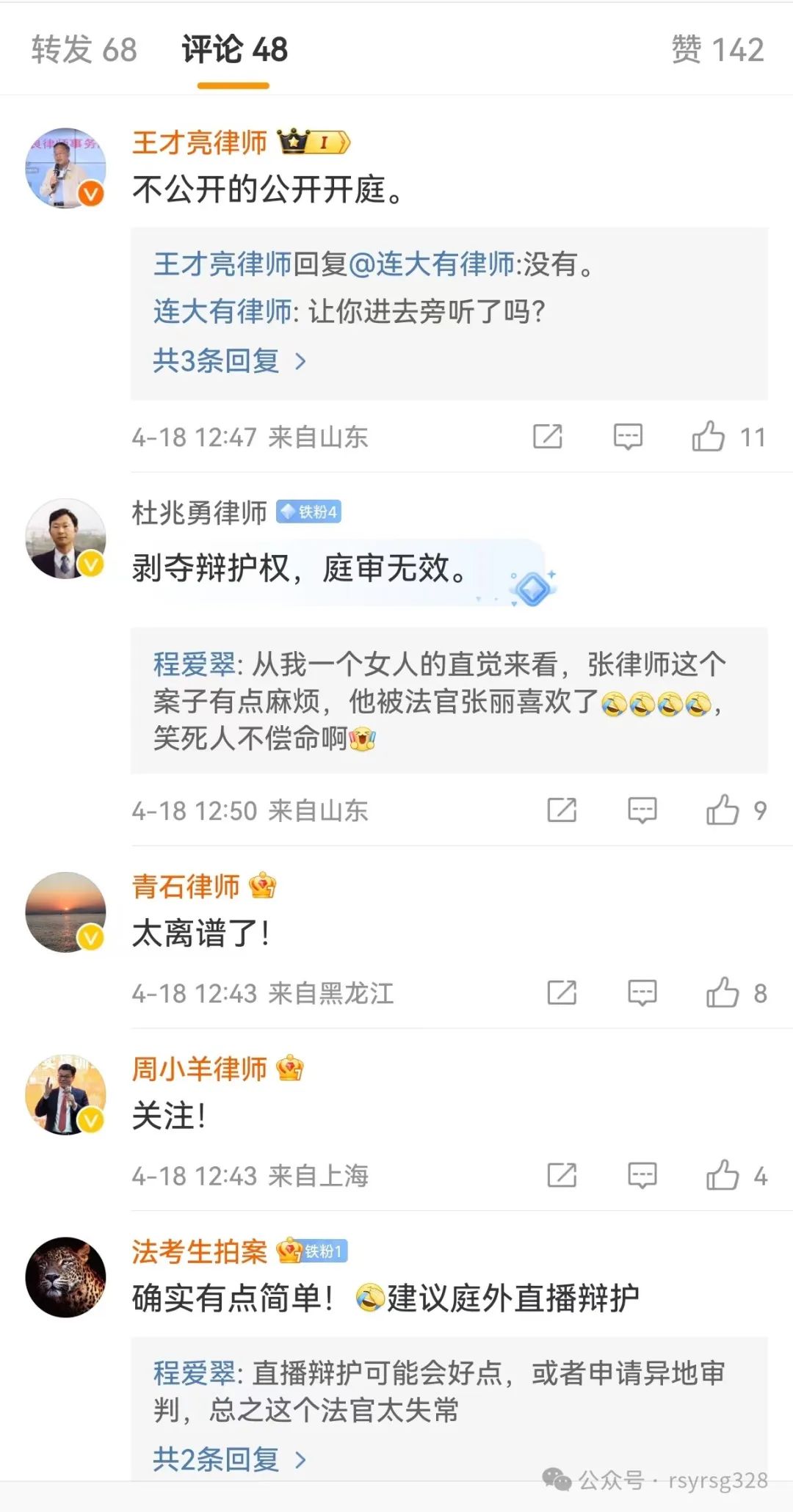
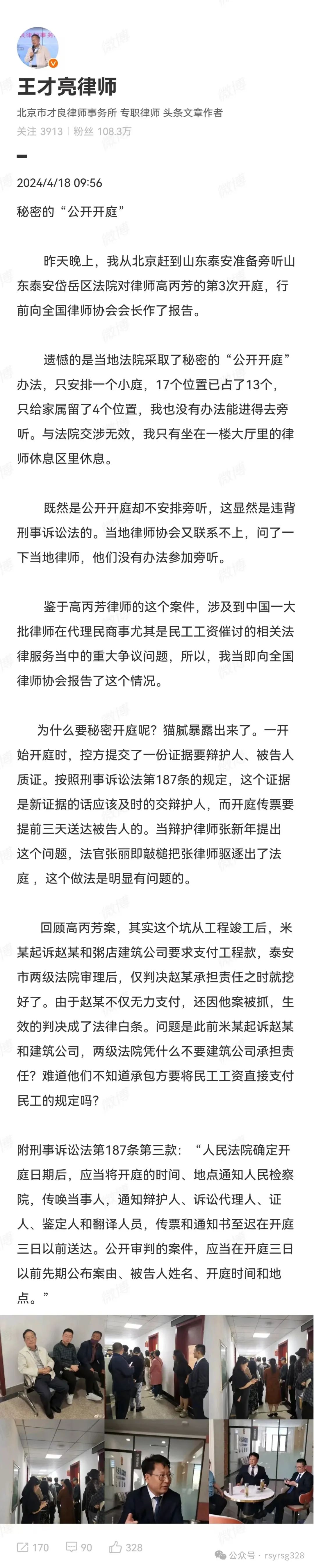
This trial was called a secret “open trial” by the great lawyer Wang Cailiang.
Lawyer Wang said that last night, I came from Beijing to Tai’an, Shandong, to prepare to attend the 3rd trial of lawyer Gao Bingfang by the Taiyue District Court of Tai’an, Shandong, and reported to the president of the All China Lawyers Association before the trip.
Unfortunately, the local court adopted the method of a secret “open trial”, only arranging a small court, with 13 of the 17 seats already occupied, and only 4 seats left for the families, and I had no way to attend the hearing. After ineffective negotiations with the court, I could only sit in the lawyer’s rest area in the lobby on the first floor to rest.
Since it is an open trial but no hearing is arranged, this is obviously in violation of the Criminal Procedure Law. The local lawyers association could not be contacted, and after asking the local lawyers, they had no way to attend the hearing.
In view of this case of lawyer Gao Bingfang, it involves major controversial issues in the legal services of a large number of Chinese lawyers in the agency of civil and commercial affairs, especially the collection of wages for migrant workers, so I immediately reported this situation to the All China Lawyers Association.
Why hold a secret trial? The tricks were exposed. At the beginning of the trial, the prosecution submitted evidence for the defense attorney and the defendant to cross-examine. According to the provisions of Article 187 of the Criminal Procedure Law, if this evidence is new evidence, it should be submitted to the defense attorney in a timely manner, and the trial summons should be delivered to the defendant three days in advance. When defense lawyer Zhang Xinnian raised this issue, Judge Zhang Li immediately knocked the gavel and expelled lawyer Zhang from the court, which is obviously problematic.
Looking back at the Gao Bingfang case, in fact, this pit was dug after the completion of the project, when Mi sued Zhao and the Zhoudian Construction Company for payment of the project funds. After the Tai’an City courts at two levels heard the case, they only ruled that Zhao should bear the responsibility. Because Zhao was not only unable to pay, but also arrested for another case, the effective judgment became a legal IOU. The problem is that before Mi sued Zhao and the construction company, why did the two levels of courts not require the construction company to bear the responsibility? Don’t they know the regulations that the contractor must directly pay the migrant workers’ wages to the migrant workers? Attached to Article 187, paragraph 3 of the Criminal Procedure Law: “After the people’s court determines the date of the trial, it shall notify the people’s procuratorate of the time and place of the trial, summon the parties, and notify the defense attorney, the litigation agent, the witnesses, the appraisers, and the translators. The summons and the notice shall be delivered no later than three days before the trial. In cases of public trial, the case, the defendant’s name, the time and place of the trial shall be announced in advance three days before the trial.”
People’s Daily: Why expel lawyers from the court
People’s Daily, January 28, 2015, page 18
At the recently concluded National High Court Presidents’ Meeting and National Procurators’ Meeting, the two top leaders of the two highest courts mentioned lawyers in unison: Zhou Qiang, President of the Supreme People’s Court, said that he could not understand why judges always expel lawyers from the court; Cao Jianming, Procurator-General of the Supreme People’s Procuratorate, demanded that “opinions that lawyers do not constitute a crime must be reviewed in a timely manner, especially to strictly implement the ‘Regulations on Protecting Lawyers’ Rights to Practice’ formulated by the Supreme People’s Procuratorate, and strictly prohibit the abuse of ‘particularly serious bribery cases’ to restrict meetings”.
Compared with the previous general discussions on protecting lawyers’ rights to practice at many meetings, the signals openly conveyed to the society by the two highest courts this time directly named the two highly sensitive issues of “death penalty review cases” and “particularly serious bribery cases”, giving lawyers a clear stance. At the same time, taking the two most difficult “hard bones” as examples to illustrate the matter also has the meaning of “lifting heavy objects to show the light”.
In reality, due to the irrational behavior of some “die-hard” lawyers and the long-standing prejudice against lawyers by some judicial organs, some case handlers often have a sense of distrust in the process of dealing with lawyers. Some believe that lawyers are “speaking for bad people”; others feel that the involvement of lawyers has increased the difficulty of handling cases and affected judicial “efficiency”.
This has led to some judicial organs in judicial practice making things difficult for lawyers, and “abusing ‘particularly serious bribery cases’ to restrict meetings” is a typical example. In bribery cases, lawyers always encounter “legally” difficulties when meeting with the parties, because while the Criminal Procedure Law allows defense lawyers to meet with criminal suspects during the investigation period, it also leaves a loophole: lawyers’ meetings during the investigation period of particularly serious bribery criminal cases should be approved by the investigation organ. Since the Criminal Procedure Law does not explicitly define “particularly serious bribery criminal cases”, in the judicial practice of various places, some procuratorial organs often dismiss lawyers with the phrase “particularly serious”.
However, in fact, the reasons for making things difficult for lawyers are untenable. On the one hand, the Criminal Law clearly states that its purpose is to “crack down on crime” and “protect human rights”. If one-sidedly emphasizing the convenience and efficiency of judicial organs in handling cases, it will become a lame leg; on the other hand, adhering to strict procedures and implementing the protection of the legitimate rights of criminal suspects is also a protection for the judicial organs themselves. The case of Hu Gejile, who was recently exonerated, is closely related to the fact that the investigation organs were eager to solve the case at that time, and the trial organs did not listen to the defense opinions of the lawyers. The more developed the society, the more complicated the case will be. Faced with a complex situation, sometimes the truth seems obscure and difficult to understand. Without strict legal procedures and the protection of rights as a reliance, isn’t it equivalent to “burying mines” for oneself?
In the modern judicial environment, the involvement of lawyers itself has the dual functions of restricting and supervising the behavior of the case-handling organs and protecting the rights of criminal suspects. It cannot be simply regarded as a “troublemaker”, but should pay attention to the balancing role of lawyers in the construction of the entire judicial ecology – under the background of comprehensively promoting the rule of law, while the judicial organs use case handling to put power in a cage, they cannot quietly release their own power from the cage. (People’s Daily, January 28, 2015, page 18)
Comprehensive sources: Lawyer Zhang Xinnian, Lawyer Wang Cailiang, Uncle Tao’s review, Yuelu.com, People’s Daily
Discover more from 自由档案馆
Subscribe to get the latest posts sent to your email.