Original Weibo content: (Not a complete screenshot)
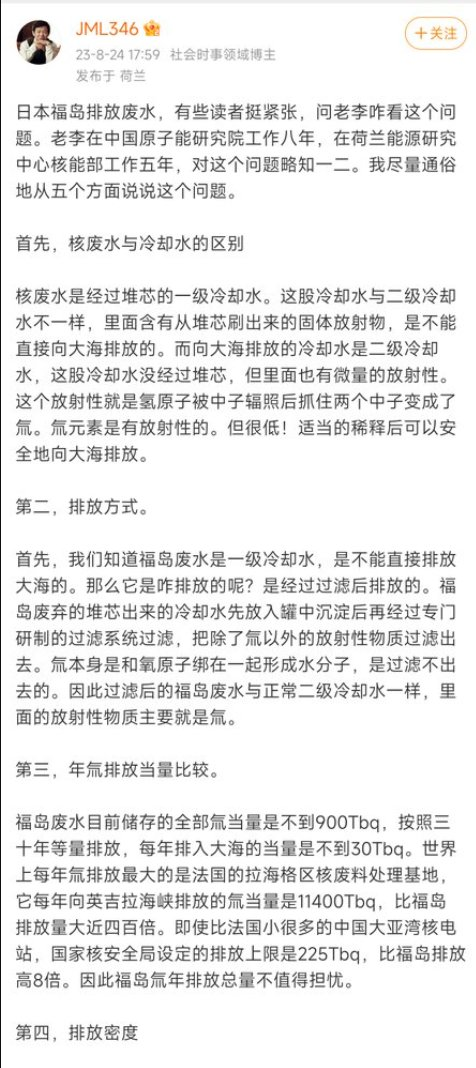
The full text is as follows:
@JML346: Regarding the discharge of wastewater from the Fukushima nuclear plant in Japan, some readers are quite concerned and asked Lao Li for his opinion. Lao Li worked at the China Institute of Atomic Energy for eight years and at the Nuclear Energy Department of the Netherlands Energy Research Centre for five years, so he knows a little about this issue. I will try to explain this issue in five aspects in a simple way.
First, the difference between nuclear wastewater and cooling water
Nuclear wastewater is the primary cooling water that has passed through the core. This cooling water is different from the secondary cooling water; it contains solid radioactive substances brushed out from the core and cannot be directly discharged into the sea. The cooling water discharged into the sea is secondary cooling water, which has not passed through the core, but it also contains trace amounts of radioactivity. This radioactivity is tritium, which is formed when a hydrogen atom captures two neutrons after being irradiated by neutrons. Tritium is radioactive. But it’s very low! It can be safely discharged into the sea after proper dilution.
Second, the discharge method.
First, we know that Fukushima wastewater is primary cooling water and cannot be directly discharged into the sea. So how is it discharged? It is discharged after filtration. The cooling water from the abandoned core of Fukushima is first put into a tank for sedimentation and then filtered through a specially developed filtration system to filter out radioactive substances other than tritium. Tritium itself is bound to oxygen atoms to form water molecules and cannot be filtered out. Therefore, the Fukushima wastewater after filtration is the same as normal secondary cooling water, and the main radioactive substance in it is tritium.
Third, the comparison of annual tritium discharge equivalent.
The total tritium equivalent currently stored in Fukushima wastewater is less than 900Tbq. According to the equal discharge over thirty years, the annual equivalent discharged into the sea is less than 30Tbq. The largest annual tritium discharge in the world is the La Hague nuclear waste treatment base in France, which discharges 11,400Tbq of tritium into the English Channel each year, nearly four hundred times more than Fukushima’s discharge. Even the Daya Bay Nuclear Power Plant in China, which is much smaller than France, has a discharge limit of 225Tbq set by the National Nuclear Safety Administration, which is 8 times higher than Fukushima’s discharge. Therefore, the total annual tritium discharge from Fukushima is not worth worrying about.
Fourth, discharge density
In addition to the annual discharge equivalent, discharge density is also an indicator. If your discharge density exceeds the standard, the water in the discharge area will exceed the radioactivity standard before it can be diluted. Then the fish swimming through this area will be contaminated. Therefore, the wastewater needs to be diluted before discharge. To what standard is the Fukushima wastewater diluted? Diluted to 1500bq per liter. How much is that? The Japanese national safety standard for drinking water is 60000bq. In other words, Fukushima wastewater needs to be diluted to 1/40 of the Japanese drinking water standard before being discharged into the sea.
Some people may ask: “Since you dilute it to be safer than drinking water, why not drink it?” Answer: “Seawater is used for dilution, and humans cannot drink seawater, but fish have no problem. Furthermore, there is a psychological issue. For example, you know that a pile of feces, after being filtered and treated by a waterworks, does not harm people, but that doesn’t mean you can defecate in the waterworks’ pool. That’s disgusting and makes everyone afraid to drink water.”
Fifth, the supervision issue
Many readers are not confident in the credibility of the Japanese: “You say it so nicely, but how can I believe you?” Answer: You don’t need to trust the Japanese, you only need to trust the United Nations International Atomic Energy Agency (IAEA). The IAEA has specially established a special observation team to supervise the Fukushima discharge. The members of the team include experts from other countries, and specifically include a Chinese expert and a Korean expert. The experts from these two countries will never allow the Japanese government to deceive or engage in any deception. Before the discharge, the IAEA has taken samples from the wastewater and sent them to laboratories in various countries for independent testing. The test results are posted on the IAEA’s official website, and readers who are concerned can go and read them.
在排放前,IAEA已经从废水中取样送往各个国家实验室进行独立测试。测试结果就放在IAEA官网,不放心的读者可以去查找阅读。
Discover more from 自由档案馆
Subscribe to get the latest posts sent to your email.