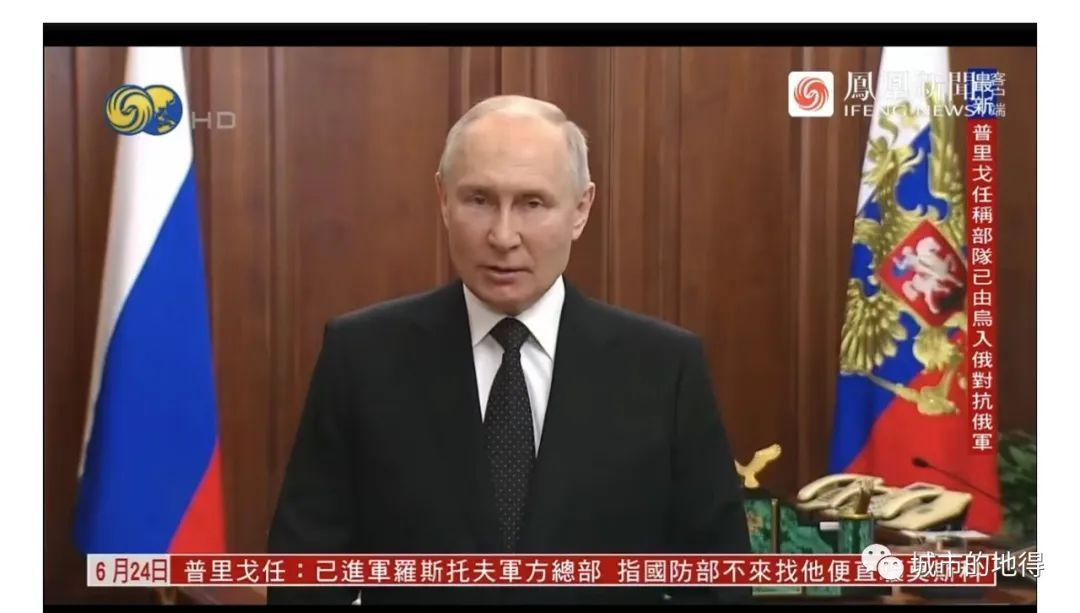
Putin’s public speech was delayed by about an hour from the announced time. However, this hour didn’t help him much, and the writing team didn’t come up with a strong narrative for him.
He called for Russian unity and also compared the current crisis to 1917. For the Chinese, this analogy is a bit awkward: in 1917, someone took advantage of the war to stir up trouble, and that person was Lenin. Therefore, I noticed that the Beijing News, The Paper, and Beijing Daily didn’t mention this analogy, only Phoenix provided the full text of the speech.
Putin’s analogy puts himself in the position of the Tsar, which is not very harmonious either.
He vowed to crack down on those who incite rebellion, but he also mentioned that it is now a war against the outside world, facing aggression from the Western world, and Russians should put aside personal grievances—this also acknowledges that this “rebellion” is due to internal problems.
It can be said that Putin’s speech was unremarkable and had nothing special. After his speech, Wagner leader Prigozhin quickly responded on social media, questioning Putin:
What have you brought to the veterans? 3700 per month? Why don’t you answer the veterans’ questions? Why do you only see your own problems? You can’t see what’s happening on the periphery.
He also immediately held a press conference, exposing more scandals on the Russian front lines, such as the concealment of the number of deaths, and that many people died from hygiene problems, rather than directly from artillery fire. These contents, in the eyes of some Russians, were originally rumors fabricated by “Western media”, because Putin’s speech a few days ago was still talking about victory after victory.
Prigozhin’s speech was full of pathos and more convincing than Putin’s. He is very smart, and something like “only giving those veterans who go to the front lines 3700 per month” is extremely damaging, because what he said is not only the truth, but also the suffering of life that many ordinary people can feel.
If there is a true “Russian spirit”, Prigozhin is closer to the Russian spirit than Putin. His speech, if spread in Russia, will make Putin more uncomfortable. Putin calls for unity, but in fact, regardless of the outcome of the war, he will become more isolated.
This is a chaotic day. Chinese netizens’ public opinion compares Prigozhin and Wagner’s rebellion to the An Lushan Rebellion of the Tang Dynasty. Although it’s a bit funny, it’s also very apt: what happened in Russia looks more like something from an agricultural society, which seems absurd when viewed in 2023.
From the perspective of dissemination, Prigozhin is now in a more advantageous position. Putin’s press secretary, Peskov, repeatedly emphasized that “the president already knows” and “various strong departments are reporting to Putin around the clock”, but from Putin’s speech, he not only doesn’t know what’s happening on the battlefield, but also doesn’t know what the reality of Russia is.
This is a contest between two worlds. The social media of the Ukrainian Ministry of Defense has a sense of detachment, which is behind their sense of reality and battlefield perception. People still remember how Zelensky posted on social media every day. Wherever the fighting was intense, he would go there and make videos, making himself infinitely close to reality.
And Putin is in another state. The words surrounding him are “reporting” and “delivering important speeches”, and it seems that he still lives in the pre-internet era. People have reason to believe that he may be one of the people in Russia who knows the least about the real world. “Around-the-clock reporting” has actually created a cage for him.
Discover more from 自由档案馆
Subscribe to get the latest posts sent to your email.