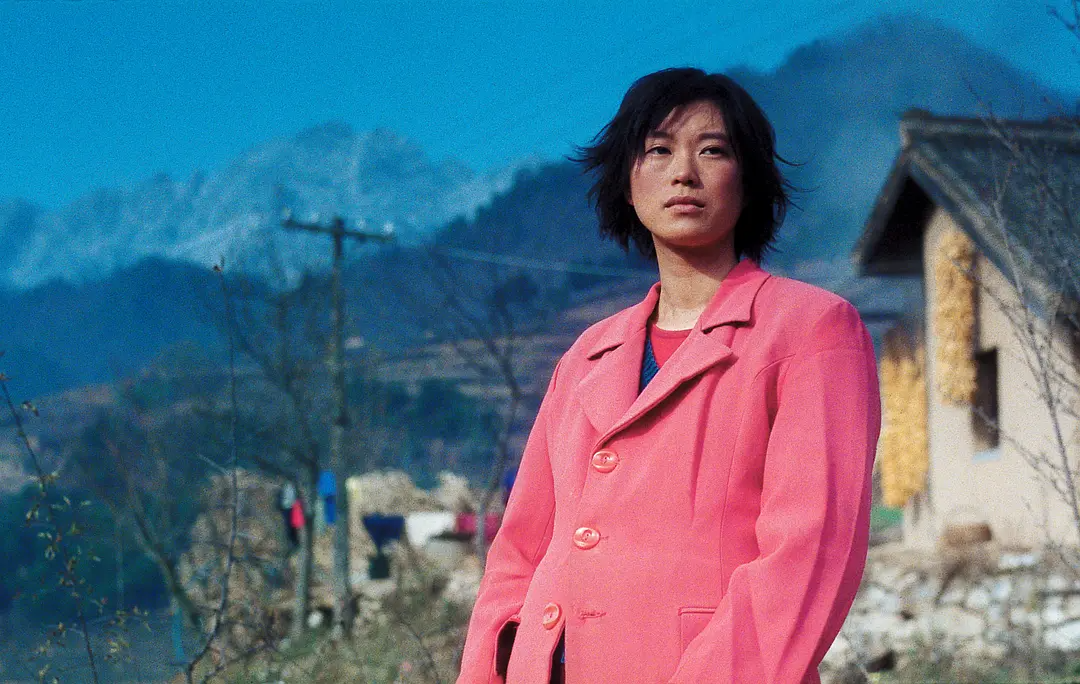
A still from the movie “Blind Mountain” (from Douban)
The highly anticipated “Feng County Chain Girl Incident” was publicly pronounced in the first instance. The Intermediate People’s Court of Xuzhou City, Jiangsu Province, determined that the defendant Dong Zhimin was guilty of the crime of abuse, sentenced to six years and six months in prison, and guilty of the crime of illegal detention, sentenced to three years in prison. With multiple crimes, it was decided to execute a prison term of nine years; the other five people were guilty of the crime of trafficking in women and were sentenced to imprisonment and fined.
Although Xinhua News Agency released an official notice “The first instance of the “Feng County Eight-Child Woman” incident and related cases: Dong Zhimin was sentenced to nine years in prison” and a response “Six questions about the first instance and follow-up of the “Feng County Eight-Child Woman” incident and related cases”, the public still has several important questions:
1. Why was the defendant Dong Zhimin not convicted of rape?
2. Is Dong Zhimin’s sentence of nine years too low?
3. Are the relevant judicial and administrative organs not without their unshirkable responsibilities?
A year ago, we published the article “How many Feng County are there in China? | Search for Source”, stating: “The high degree of public attention to the “Feng County Eight-Child Woman” incident is because this is not an individual event, but a systemic disease, a tumor that Chinese people must bravely face and cut off.” We therefore loudly asked: How many Feng County are there in China? What should we do after rescuing this chained woman?
We looked back at the sources we found last year based on these questions and found that this judgment still fell into the old systemic problems, so we picked out the relevant information and asked again: How many Feng County are there in China?
- Research on the deficiencies in legislation and law enforcement against trafficking in women
- The Internet needs to have memory
- The excavation of data on trafficking in women in Xuzhou and the whole country
- Rescue of trafficked women
- Research on the causes of women being trafficked
Research on the deficiencies in legislation and law enforcement against trafficking in women
1. “Data Analysis Report on Judicial Cases of “Trafficking and Purchasing Women and Children”
Source: Peking University Law Database
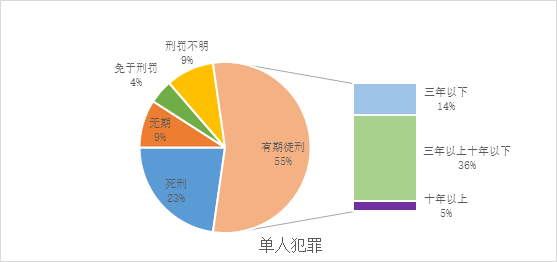
The sentencing of defendants in cases of trafficking in women and children
This article was published in April 2019. The study selected 72 major typical cases of trafficking in women and children as samples, and analyzed the judicial practice of such criminal cases from three aspects: publication, trafficking objects, and types of sentences. Researchers analyzed that China’s sentencing for trafficking and purchasing women and children is **relatively low, and most defendants are sentenced to imprisonment of more than three years but less than ten years.**
2. “A Brief Analysis of the Judicial Situation of the Crime of Purchasing Trafficked Women – Taking 400 Judgments as the Observation Object”
Source: WeChat public account “Yan Shuo Fa”
The article was published on February 5, 2022. The study selected 477 judgments on the crime of purchasing trafficked women, and analyzed them from the aspects of the time and space distribution of the cases, the level of the court, the types of sentences, other crimes (such as rape, illegal detention, and organizing prostitution) that were punished in conjunction with the act of purchasing, and the purpose of the crime.
The study focused on the mental state of the trafficked women. The statistical results show that in the 477 judgments, 81 articles involved the mental illness of the victims, accounting for about 18%. Among them, some judgments clearly recognized the causal relationship between the criminal act and the victim’s mental disorder, that is, the criminal act caused the victim’s mental disorder. However, in some cases, the aforementioned causal relationship is difficult to prove; in a few practices, there have also been situations where the victims are mentally disabled and the defendants have confessed and pleaded guilty, and the circumstances of confession are considered for lenient punishment; in addition, there are also differences in whether to sentence the defendant for the crime of rape for victims with mental disorders and without self-defense capabilities.
3. “Should the Sentence Be Increased? – An Empirical Study of the Crime of Purchasing Trafficked Women Based on 665 Judgments”
Source: WeChat public account “Xiao Baogong”
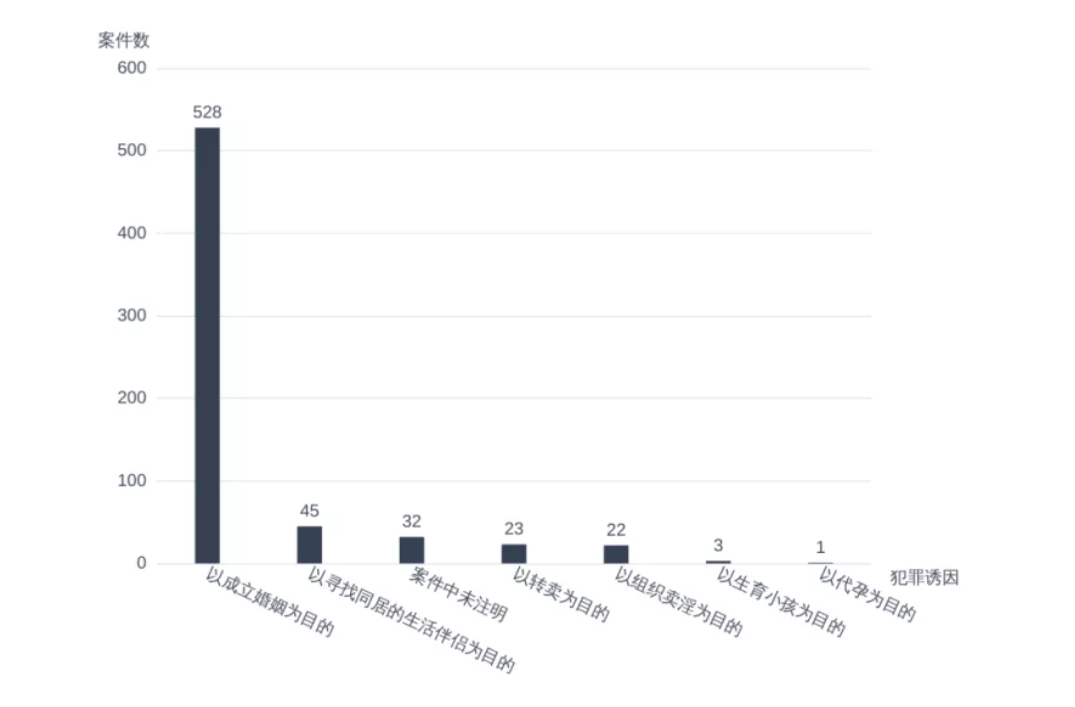
Statistics on the criminal motives of the defendants in the cases of purchasing trafficked women
The article was published on February 11, 2022. The study selected 665 judgment documents on the crime of purchasing trafficked women as samples, with a time range of 2009 to 2021. The main findings are as follows:
- The transaction amount for the trafficking of women is mainly concentrated in the range of 10,000-50,000 yuan (accounting for 36.5%) and 50,000-100,000 yuan (accounting for 25.6%);
- There were 532 cases with the purpose of the crime being “marriage/having children”, accounting for 81.4%;
- Most of the defendants are low-educated people at the bottom of society, with 60.2% of the defendants not having received nine-year compulsory education; 30.41% of the defendants received nine-year compulsory education, and the two combined accounted for 90.61%;
- The cases in which the defendants were prosecuted for multiple crimes only accounted for 10.86%; the probability of being prosecuted for other serious criminal acts after purchasing trafficked women is small;
- There were 62 cases in which the trafficked women were willing to continue living with the purchasers, accounting for 9.48%; there were 592 cases in which they were unwilling to continue living with the purchasers, accounting for 90.52%;
- In 654 samples, there were 49 cases in which the victims successfully rescued themselves, accounting for 7.49%. After screening, it was found that: in these 49 cases, there were only 8 cases in which the victims successfully escaped before suffering substantial harm.
- “Research on Trafficking in Women and Children in Yunnan Province, China: A Rapid Assessment”
Source: International Labour Organization (ILO)
Report cover
In 2000, the International Labour Organization conducted an assessment of the current situation of trafficking in women and children in Yunnan and studied the causes of trafficking.
The study pointed out two legislative loopholes. First, even if the marriage is forced, the buyer husband and his family can obtain the right to be the father of the child born in the marriage; second, although the victim’s family can sue the traffickers for economic losses, the compensation they can claim is limited to the direct economic losses caused by the criminal activities, and they cannot claim for mental distress or indirect losses. Moreover, such cases are often under the jurisdiction of the court where the defendant resides, and the victims and their families often face a long and expensive ordeal.
The Internet needs to have memory
1. Archive of articles related to the Feng County incident: Volunteers
Volunteers compiled and archived articles related to the “Feng County Eight-Child Woman” incident that appeared on WeChat public accounts from January 29 to February 18, 2022. The author used the “Internet Archive Wayback Machine” and Archive.today to back up these articles and continuously update them. The problems exposed by the Feng County incident, such as women’s rights, human trafficking, the lack of supervision by news media, and loopholes in legislation and law enforcement, should not disappear with a single notice. The public needs to continue to track them until real changes occur in society.
2. “Insufficient Reporting – Symptoms of the Journalism in the “Feng County Eight-Child Woman” Incident”
Source: WeChat public account “Xiao Yiliangjie”
The article reviewed the reporting of the “Feng County Eight-Child Woman” incident by 8 central media, 8 mainstream media in the industry, and 3 local media in Jiangsu from January 28 to February 11, 2022, and found that from January 28 to February 7, only a few media reported on the incident; after February 7, the media began to report in large numbers, especially on February 10.
Overall, the media reports mainly focused on the dates of the four official notices, and there were no media reports on the blank dates in between. And from the content of the reports, the media almost all stayed on the reproduction and interpretation of the official notices, without in-depth or even detailed reports on the incident.
Unfortunately, the article is no longer available.
Excavation of data on trafficking in women in Xuzhou and the whole country
1. “Analysis of the Social Phenomenon of Buying and Selling Women in China”
Author: Zhuang Ping, Department of Sociology, Shandong University
The article was originally published in the 5th issue of “Sociological Research” in 1991. The article mentions that “from 1985 to 1988, 25,347 women from other places flowed into Xuzhou City (6 counties) in Jiangsu Province, of which 5,991 were trafficked, accounting for 23.6%; in 1988, Xuzhou City successively seized 94 criminal gangs of human trafficking, with 349 members, accounting for 72.7% of the total number of human trafficking criminals seized that year. Hunyuan County, Shanxi Province, in the second half of 1988, 23 out of 28 townships had 509 women from other places flowing in, 456 of whom were trafficked, accounting for 89%.”
The author also mentioned some areas with serious cases of purchasing women: “Judging from the flow of women into the purchase, it has been found in recent years that such phenomena have occurred in Shandong, the southern half of Hebei, northern Jiangsu, and Henan. Quyang County, Hebei Province, is a county with a more serious problem of buying and selling women. In recent years, more than 500 women have flowed into this county, most of whom come from the southwestern provinces. For example, Gaoqing County, Shandong Province, before 1986, 551 women flowed in, 20 in 1987, and 109 in 1988, totaling 860 people, of whom about a hundred were trafficked. Most of the women who were bought and sold came from Yunnan Province, and some townships bought more than 20 women from the south.”
Related sources:
2. “Case Study of the Inflow of Unmarried/Deceived Women/Children from Yunnan/Guangxi to Five Provinces in East China”
Author: Wang Jinling, Institute of Sociology, Zhejiang Academy of Social Sciences
The article was originally published in the 4th issue of “Zhejiang Journal” in 2005. The article points out that since 1970, Zhejiang, Fujian, Jiangsu, Shandong, and Anhui are the main inflow provinces among the inter-provincial trafficking/deception of population in mainland China; Yunnan, Guizhou, Guangxi, Sichuan, and Xinjiang are the main outflow provinces. Among them, the inflow process of trafficked women in Jiangsu can be divided into four stages: initial (early 1980s), development (1985-1993), rolling development (1993-2000), and shrinking (after 2000).
In the development stage, Jiangsu gradually became an important buyer’s market for trafficked women. The phenomenon of Yunnan women being trafficked/deceived through marriage into Jiangsu increased rapidly, and reached a peak in 1988-1990. At the peak, 2,000-3,000 women who migrated to Xuzhou from other places for marriage were trafficked in a year.
3. Number of cases of trafficking in women cracked by public security organs nationwide
Source: National Bureau of Statistics
Cover of “2020 Statistical Data on Women and Children in China”
The “Statistical Data on Women and Children in China” records the number of cases filed and solved by public security organs nationwide against trafficking in women and children from 2010 to the present. Readers can consult Chapter 9 “Legal Protection”. The data shows that from 2010 to 2019, the number of cases filed by public security organs nationwide against trafficking in women and children was 112,703, of which 20,319 cases of trafficking in women were solved.
Currently, this information cannot be obtained through free channels, but readers can find the number of cases filed against trafficking in women and children over the years in the “Twenty-four, Public Management, Social Security and Social Organizations -\>Criminal Cases Filed by Public Security Organs and Their Composition” in the “2021 China Statistical Yearbook”.
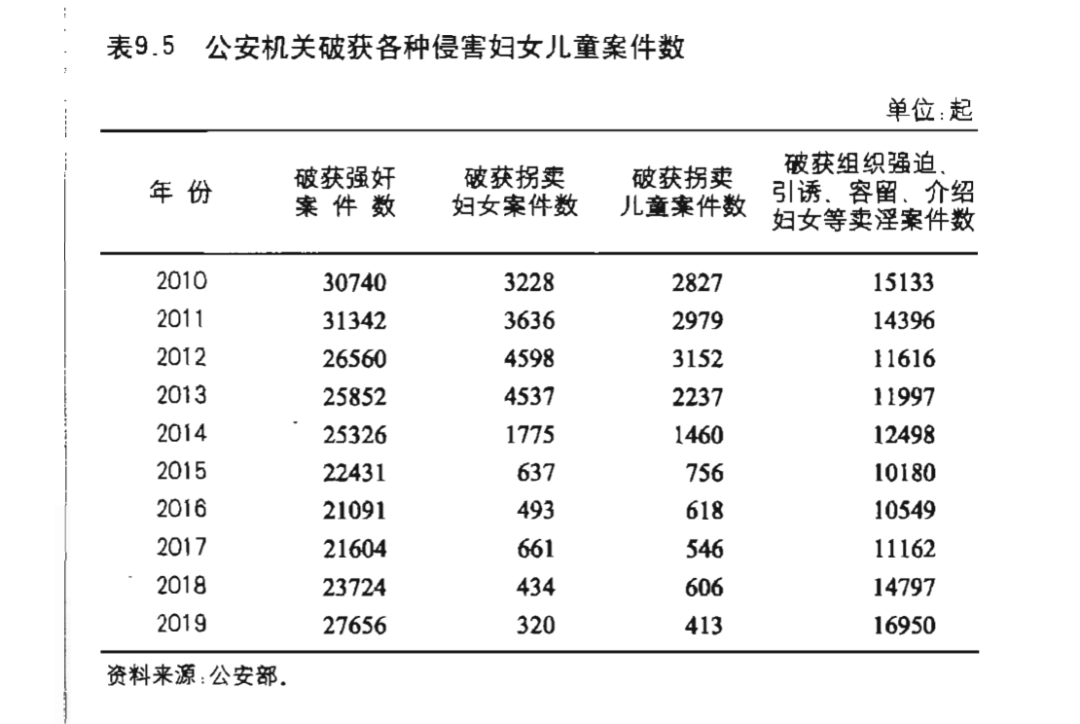
2020 Statistical Data on Women and Children in China
Research on the causes of women being trafficked
- “Does the Shortage of Marriageable Women Induce the Trafficking of Women for Forced Marriage? Evidence From China”
Author: Wanru Xiong, Princeton University, USA
Does the shortage of marriageable women induce the trafficking of women for forced marriage? This study selected 1,215 cases of trafficking in women and forced marriage, spanning from 2010 to 2018, involving 26 provinces in China, and combined with local socio-economic and demographic data for analysis. The author analyzed that the shortage of women of marriageable age is not a direct cause of trafficking in women; even in areas where the ratio of men and women in the marriageable age group is balanced, there may be phenomena of purchasing women to achieve the purpose of marriage.
Researchers analyzed that the patriarchal concept of favoring sons over daughters leading to a high sex ratio at birth, gender migration caused by unbalanced regional economic development, and marriage squeeze faced by men at the bottom due to the shortage of marriageable women are the fundamental reasons for the phenomenon of trafficking in women for forced marriage.
2. “Estimates of Missing Women in Twentieth Century China”
Authors: Quanbao Jiang, Shuzhuo Li, Marcus W. Feldman and Jesús Javier Sánchez-Barricarte
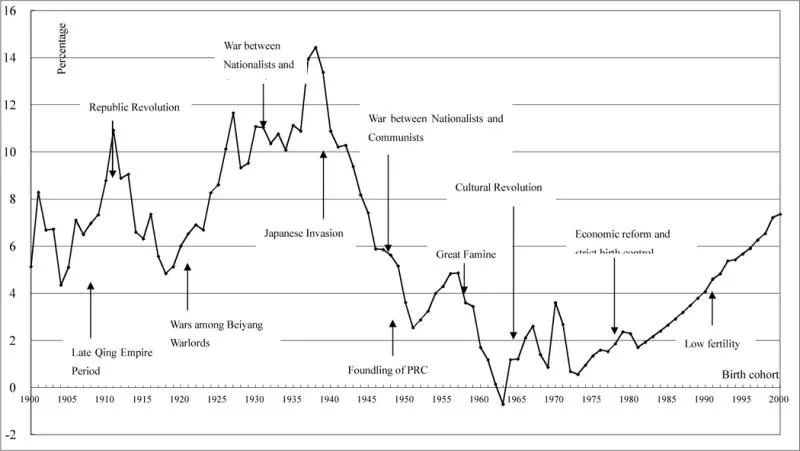
Percentage of “missing women” by birth cohort in the population census from 1900-2000
The paper was published in 2012 in the biomedical and life sciences journal archive PMC of the National Institutes of Health National Medical Library (NIH/NLM). The phenomenon of “missing women” refers to the imbalance of the sex ratio at birth caused by selective abortion, infanticide of female infants, early death of female infants due to poor medical care, and underreporting and misreporting of female infant births. This study estimated the number and trend of “missing women” in the population born in China in the 20th century: before 1949, the proportion of “missing women” was relatively high; from 1949 to 1980, the proportion of “missing women” fluctuated, but generally remained at a low level below 4%; after 1980, with economic reform and the strict implementation of family planning, the proportion of “missing women” began to rise again.
The study believes that the phenomenon of “missing women” reflects the idea of favoring sons over daughters. This gender discrimination leads to an imbalance in the sex ratio of the Chinese population. As the birth cohorts with an imbalanced sex ratio gradually reach marriageable age, the marriage pressure faced by men is also increasing. This problem is particularly prominent in poor areas and may lead to more social problems, harming the well-being of the entire society and harming the long-term sustainable development of the Chinese population and society.
Discover more from 自由档案馆
Subscribe to get the latest posts sent to your email.