Free Archive | Wuhan homosexual police officer accused of using the public security system to "hunt" and assault others, the official "no punishment" triggered administrative litigation
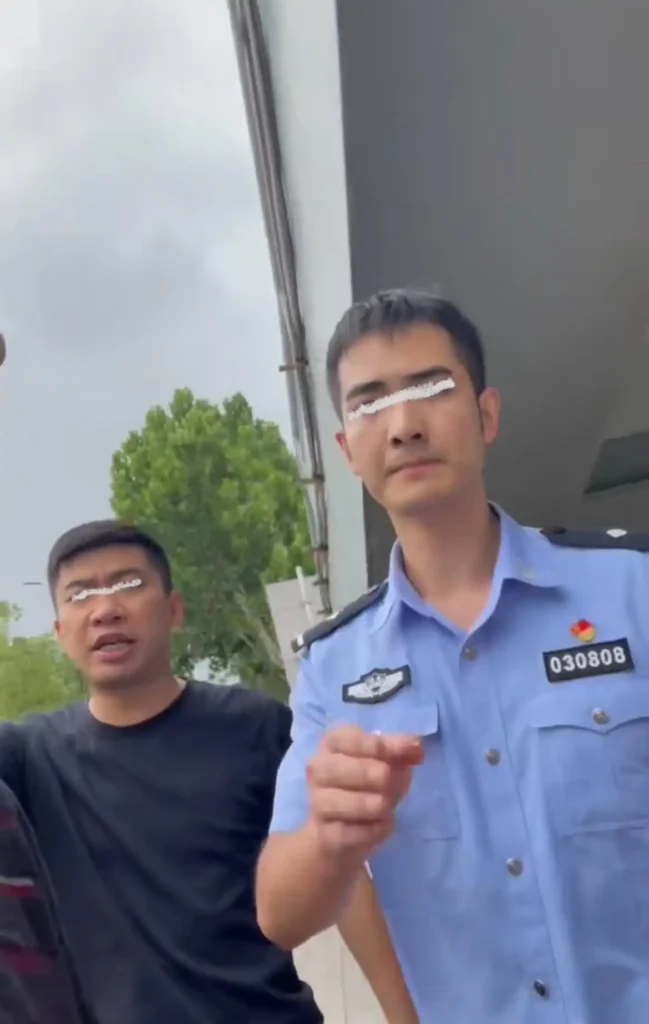
A report about police officer Cheng of the Hanyang Branch of the Wuhan Municipal Public Security Bureau is circulating online. The victim alleges that the police officer used the internal public security system to illegally obtain personal information of specific men for harassment, and assaulted the victim during a dispute, causing two minor injuries. However, in the subsequent case handling, the Hanyang Public Security Bureau decided not to impose administrative penalties on the police officer involved, citing "physical entanglement" and "insufficient evidence." Currently, the victim has filed an administrative lawsuit with the court. This case exposes deep-seated loopholes in local public security organs in data security supervision, complaint handling mechanisms involving police, and the fairness of "internal self-investigation."
According to the clues and evidence provided by the victim, Mr. Zhang, the incident originated from the private life of police officer Cheng of the Yongfeng Police Station in Hanyang District, Wuhan City. Mr. Zhang alleged that after Cheng came into contact with men he was interested in, he would use his position to directly query and obtain detailed personal privacy information of the other party through the internal public security system, using the victim's name, face photo, or license plate number. Cheng once admitted in a conversation with Mr. Zhang that he had obtained his personal information through his license plate number.
The conflict escalated on December 5, 2025. Surveillance video shows that police officer Cheng performed a series of violent acts against Mr. Zhang in the corridor and elevator entrance of the apartment, including pulling his collar, choking his neck, twisting his arm, pushing and hitting him against the wall, and pulling him to the ground, and at one point restricted Mr. Zhang's personal freedom.
Subsequently, Mr. Zhang went to the police station to report the case. The injury assessment report showed that Mr. Zhang had multiple soft tissue contusions all over his body, with a cumulative contusion area of 227.9 square centimeters, constituting two minor injuries. In contrast, police officer Cheng, who was involved in the incident, also applied for an injury assessment without any obvious injuries on his body. The final result was a "zero" report, confirming that he was not injured in the conflict.
"Self-investigation by one's own people": The controversial decision of the Hanyang Branch
As the undertaking unit of the case, the Hanyang Branch of the Wuhan Municipal Public Security Bureau is the work unit of the police officer Cheng involved. This structure of "the parent bureau investigating its subordinates" has triggered strong doubts from public opinion and legal professionals about the subsequent handling results.
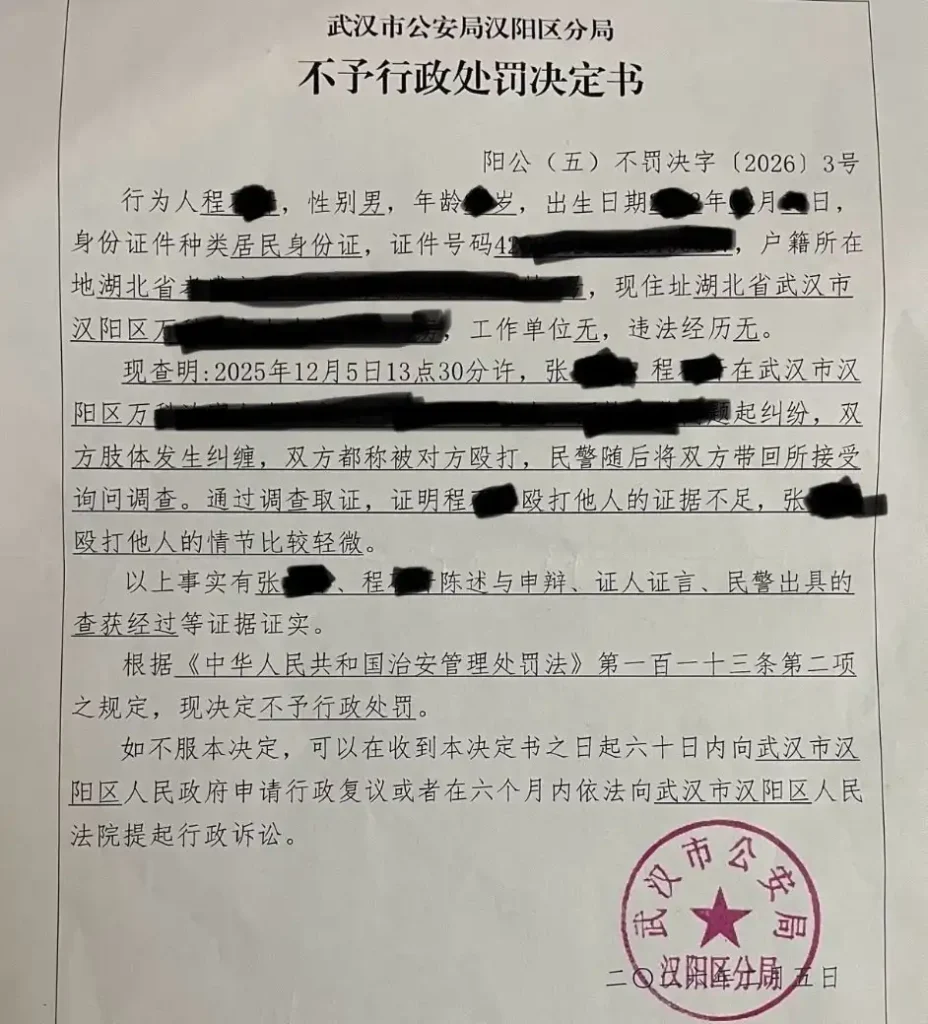
The Hanyang Branch eventually issued a "Decision on Not Imposing Administrative Penalties," and its core definition and handling logic have the following four obvious contradictions:
Ambiguous Definition: The decision described the clearly visible unilateral violent behavior in the surveillance video as "physical entanglement" in a rhetorical way.
Doubtful Evidence: In the case where Mr. Zhang holds clear surveillance video and has a report of two minor injuries, the Hanyang Branch still decided not to impose administrative penalties on Cheng, citing "unclear facts and insufficient evidence."
Unfounded Determination: Without any evidence indicating that Mr. Zhang fought back or assaulted, and with Cheng's injury report being blank, the Hanyang Branch determined in the document that "Mr. Zhang assaulted Cheng with minor circumstances."
Free Archives Observation: This handling method is not uncommon in complaints involving police. Diluting obvious unilateral violence into "disputes" or "physical conflicts," and then closing the case with "each side taking fifty blows" or "insufficient evidence" is often the usual logic of local public security organs to protect internal personnel and quell internal scandals.
Why is this incident worth recording?
This case, which seems to be an individual conflict, reflects several core systemic problems under the intersection of China's grassroots governance and digital authoritarianism:
1. "Public use for private purposes" and regulatory vacuum of internal public security data
Big data and facial recognition systems have given grassroots police officers great social control power. However, the fact that police officers can arbitrarily query citizens' privacy through license plates and photos, just because of "personal interest," reveals that the audit mechanism for internal public security data access rights is just a formality. When the state machine's investigative tools become private soldiers for personal "hunting" and harassment, ordinary citizens are almost naked in the face of technological totalitarianism.
2. The erosion of judicial justice by the "silo" case-handling system
When a public official is suspected of violating the law, it is natural that there is a conflict of interest for the same administrative organ to conduct the investigation. The Hanyang Branch's "no penalty" decision in this case once again proves that the "self-investigation" without an independent third-party supervision agency is prone to being a formality, and ultimately evolves into institutional protection of public power.
3. The separation of official narratives and factual evidence
From "unilateral violence" to "physical entanglement," from "minor injury assessment" to "insufficient evidence," the rhetoric of official documents has formed a huge gap with objective evidence such as surveillance and forensic assessments. The construction of this discourse system aims to legitimize unfair handling results through the shell of procedural compliance.
Currently, the victim, Mr. Zhang, has formally filed an administrative lawsuit with the People's Court of Hanyang District, Wuhan City, attempting to revoke the handling decision of the Hanyang Public Security Bureau through legal means. Under the current judicial environment, administrative litigation (people suing officials) faces extremely high invisible thresholds and the obstruction of local protectionism, and the outcome of the litigation is still full of uncertainty.
This case is not only a blood and tear history of an ordinary citizen's rights protection, but also a slice of the alienation of public power, the abuse of technology, and institutional protection. "Free Archives" will continue to follow up on the judicial progress of this case. These recorded surveillance records, assessment reports, and administrative decisions are important micro-samples for observing the current situation of grassroots rule of law in contemporary China.