

Did you ever give it your all for something during your middle school years?
Besides the test papers filled with formulas and the secret crushes on classmates you dare not confess to, for many people, the answer also includes pooping.
Those teenagers who repeatedly teeter on the brink of constipation often only poop once or twice a week. Not only do they have to endure the pain of their anus feeling like it’s being cut by a knife during bowel movements, but they also have to face the embarrassment of “not pooping at all, but when you do, it’s earth-shattering,” and even frantically pressing the flush button can’t get rid of the gigantic turd.
But logically speaking, people who are older are often more prone to constipation [1]. How is it that middle school students, who are still in their prime, have lost their “pooping freedom”?
Middle school students, pooping is more difficult than studying
For middle school students, constipation is by no means a joke, but a hidden part of their daily lives.
Sometimes, dragon fruit and prune juice are used in rotation, perhaps to provide temporary relief. But facing the “old, aged poop” that has accumulated in the intestines and stomach for a long time, even a few enemas may not be effective. When pushed to the point of desperation, directly intervening with fingers sounds explosive, but it can work wonders.
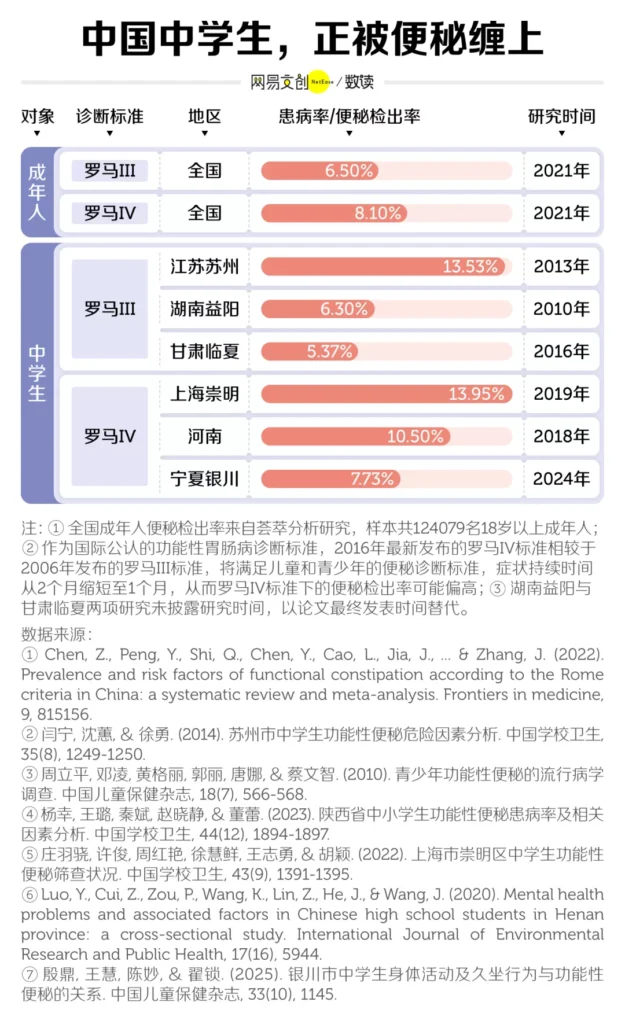
Medically, there are clear standards for the diagnosis of constipation. The most authoritative Rome IV criteria for functional gastrointestinal disorders, when revised in 2016, shortened the duration of symptoms for children and adolescents from two months to one month, helping to identify children with long-term defecation difficulties earlier [2].
Due to the lack of a large-scale survey targeting middle school students nationwide, we have compiled research on constipation among middle school students in different regions and found that according to the Rome IV criteria, the detection rate of constipation among middle school students in Chongming, Shanghai is 13.95%, and for high school students in Henan, it is 10.5% [2][3]. Converting this to a class of 40 people, there are approximately 4-6 “pooping-challenged” individuals.
Even according to the earlier Rome III criteria, the detection rate among middle school students in Suzhou still reached 13.53%, and in Linxia, Gansu, it was 5.37% [4][5].
In contrast, a meta-analysis that included 120,000 Chinese adults showed that the prevalence of constipation among Chinese adults is approximately between 6.5% and 8.1% [6]. It can be seen that middle school students, who are in the peak of their growth and development, but are struggling with constipation, are not necessarily less affected than adults.
This large-scale hidden disease, which affects every young man and woman, is a physiological torment that is difficult to express.
When the dry and hard stool scrapes against the intestinal wall, if you pull gently, you can only feel an airtight blockage; if you use too much force, you will sweat from the pain, and the huge stool can stretch the anus almost to the point of splitting.
Ideally, morning bowel movements are the smoothest, but spending too much time in the toilet will affect breakfast, and after eating, you have to attend morning reading, so you can only suppress the urge to poop back into your stomach. Sometimes, you finally wait for the intestines to rumble, but after trying hard in the toilet for half a day, you only manage to squeeze out a fart.
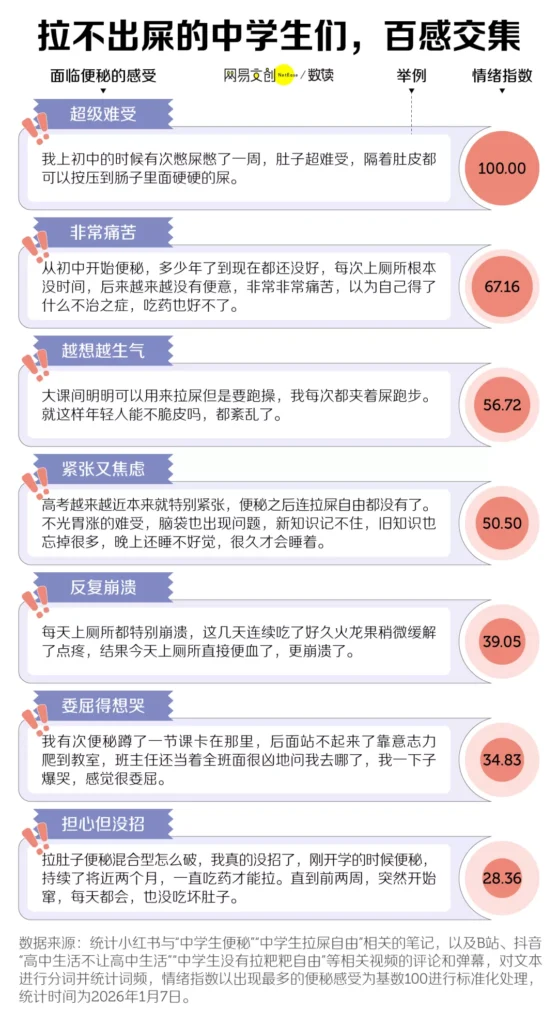
This extreme physical struggle makes many middle school students feel anxious. Especially during the crucial stage of preparing for the middle and high school entrance exams, the tense nerves combined with constipation can also significantly affect their study state.
Not to mention frequently running to the toilet, which may also be misunderstood by teachers as a clumsy excuse to avoid studying, and being labeled as restless.
Moreover, according to a report in Southern Weekend, among the patients seen by a doctor specializing in constipation at the Children’s Hospital of Hebei Province, those with severe constipation were basically boarding middle school students whose time was strictly controlled, “They often defecate once a week, or even longer” [7].
For middle school students who feel like the sky is falling if their exam rankings drop a few places, not being able to poop is not only physical pain, but also makes the most basic physiological needs a luxury, causing long-term psychological burden.
Constipated middle school students, how are they made?
During middle school, it should be the age when the body is most resilient, even after running a thousand meters, they can adjust their breathing and sit back in the classroom for class within a few minutes. Logically, their intestines and stomachs should also be “young and strong”, but how were they so severely controlled by a single stool?
Published in the Chinese School Hygiene, a study that surveyed nearly five thousand middle school students in Chongming District, Shanghai, found that unhealthy lifestyle habits are to blame for constipation among middle school students [2].
Among them, the most significant impact is the daily dietary structure. The higher the proportion of spicy food and the more frequent the consumption, the more prone to constipation. In contrast, students who actively consume vegetables every day have significantly fewer cases of constipation.
Equally important is the frequency of exercise. The time middle school students can be active, besides the unchangeable running exercises during the break between classes, there are also two or three physical education classes when the “weak and sickly” physical education teachers are not forced to take leave.
But for middle school students who are glued to their chairs for more than ten hours a day, this amount of exercise is really a drop in the bucket if they want to promote intestinal peristalsis and help with bowel movements.
The study also found that the detection rate of constipation among students in model high schools is 18.23%, which is five percentage points higher than that of ordinary high schools, which may be due to the pressure of the college entrance examination, heavy academic pressure, and less sleep [2].
During the ten-minute break between classes, in the gap between teachers extending the class and returning to their seats quietly, sprinting, queuing, and grabbing a spot have become compulsory courses. When they finally squat down, the pre-bell rings and they only manage to pull out half a piece, the stool is scared back, and they can only hurriedly pull up their pants and rush to the classroom.
Even after the lights are out in the dormitory, pooping in the dark may also be criticized on the bulletin board for violating dormitory regulations. In order not to deduct points for the class, students can only be forced to learn to be “understanding” and hold it in.
The tight schedule is one aspect, and what is more hidden is that many students will also fall into “pooping shame”. It takes a lot of courage to report to the teacher to go out during class, because this is equivalent to announcing in public: I’m going to poop.
After class, the toilets are not only crowded like the morning and evening rush hours on the subway, but if you encounter a cubicle without a door, some mischievous students will also gather around and make unrestrained mockery.
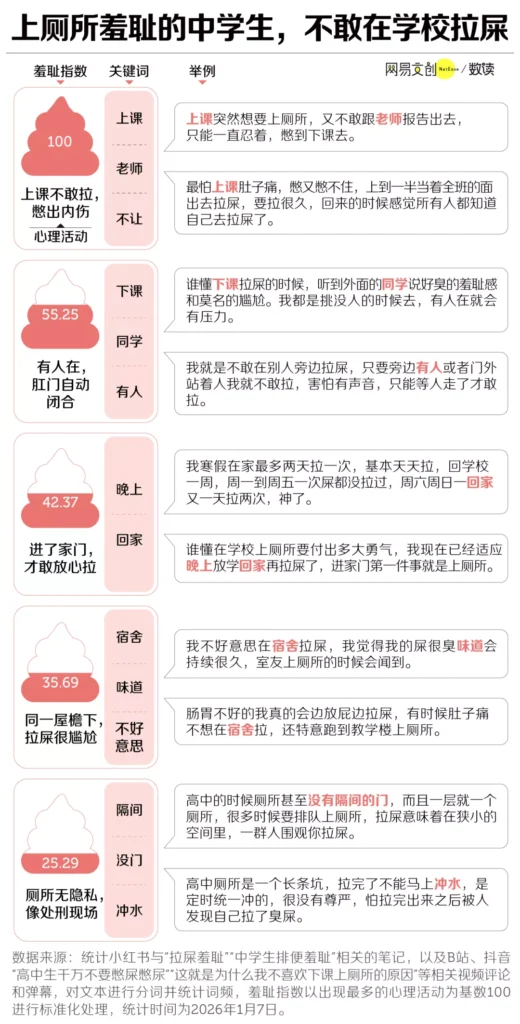
The few-square-meter dormitory toilet also has no place for a stool. Because the powerful stool will not only stink for five meters around, but will also stick to the toilet bowl and not flush away, one must have strong psychological qualities to withstand the roommates’ frowns and nose-covering.
In order to avoid this embarrassment, boarding students who only go home once every one or two weeks will hold it in with their thoughts until the holidays, even if they are “stool” to the point of urgency. At the moment of seeing the toilet, both the body and the stool have a sense of freedom.
The poops that are held back have become invisible traumas
More seriously, middle school students who are defeated by the shame of pooping often face more fragile psychological conditions, and in the long run, defecation will only become more difficult.
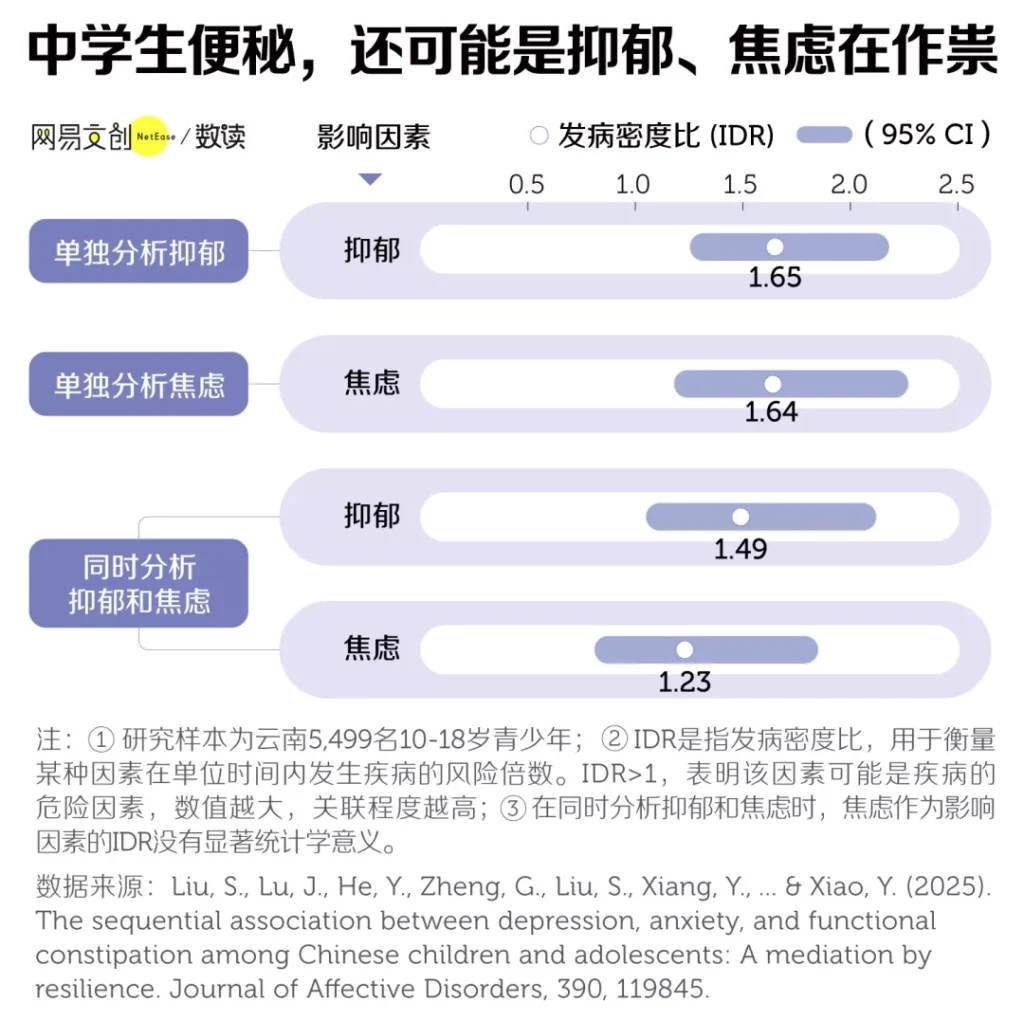
A study published in the Journal of Affective Disorders pointed out that students with depression and anxiety have a 1.65 times and 1.64 times higher risk of constipation than ordinary students, respectively [8].
A reasonable explanation is that psychological stress may interfere with the intestines by affecting immune and nerve signals. When a person is in a state of anxiety for a long time, the brain’s perception of intestinal signals will become abnormally sensitive and even misjudge, thereby disrupting the normal rhythm of bowel movements [8].
This interference is often mutual. Bad moods will block the intestines, and conversely, the intestines’ signal of a strike will also be transmitted to the nervous system, affecting mental health.
A study by Xi’an Jiaotong University on high school students in Henan showed that 60.5% of students with constipation had psychological health problems, while this proportion was only 26% among students with normal bowel movements [3].
Constipation brings a set of hidden combination punches to adolescents.
A review study from University College Dublin, Ireland, that included Chinese samples pointed out that adolescents with constipation have more obvious somatization manifestations, and in addition to abdominal bloating, they are often accompanied by nausea, vomiting, or dizziness [9].
Due to the proximity of the rectum and bladder, the accumulated feces will also compress the bladder, not only leading to bladder overactivity, but also changing the frequency of urination, making the already tight class break life even more difficult [10].
In order to reduce the number of times they go to the toilet, many students will consciously restrain their desire to drink water. But this is precisely poking the “hornet’s nest” of constipation. Insufficient water intake will make the stool even drier and harder, increasing friction and making it more difficult to excrete.
More difficult to endure than physical pain is psychological pressure. During the sensitive adolescence, the embarrassment of using the toilet can easily trigger social anxiety and even be ridiculed by peers. This invisible pressure will not only weaken the self-esteem of young people, but may also indirectly lead to a decline in academic performance [9].

Even so, in the fast-paced campus, when discomfort comes, putting down the test paper that is half-finished to poop will still be regarded as a waste of time. The most basic survival needs must unconditionally give way to academics at this stage.
However, the reality is that we, who have entered universities and even the workplace, are still skipping breakfast for the sake of commuting, and compressing lunch to ten minutes in order to complete KPIs.
The young man who once sprinted to grab a spot during the break between classes, in the blink of an eye, has become an adult in the office building’s restroom, squatting and replying “received”.
Discover more from 自由档案馆
Subscribe to get the latest posts sent to your email.