

This road is not easy to walk.
This article was first published on Toutiao, please do not reprint
Text | Zhou Tutu
Editor | Lu Yi
On the evening of New Year's Day, Zhang Wanquan finally returned to Zigong, Sichuan. He sat at a table with his relatives, and the hot air of the mutton hot pot in front of him was rising. He held a cigarette in his mouth, took a sip of hot soup, and let out a long sigh of relief - this was the first time he felt at ease from the bottom of his heart since he had been drifting.
But just 20 days ago, his life coordinates were completely different: after narrowly escaping from the telecommunications fraud park, he drifted to a simple residence in a Chinese hotel in Phnom Penh, Cambodia, where he met Han Defa, who also spoke Sichuan dialect. The two had never met before, but were closely linked by highly similar experiences - they were both lured by the promise of "high salary" and "adventure", and embarked on a foreign journey with expectations, but became the bottom prisoners in the fraud park, suffering inhuman torture between high walls and electric fences, and both escaped by accident, relying on the most primitive survival desire and the kindness of strangers to come here.
More importantly, they both wanted to go home.
But this road is not easy to walk: the two of them came by smuggling, their documents had already been taken away, and they only had a mobile phone and 20 yuan RMB. To return to China, they first had to pay a fine and imprisonment of several thousand US dollars - according to local law, if foreigners enter Cambodia by deception or other means, they must be imprisoned for 3-6 months before being deported.
In fact, from the beginning of leaving home, every step of the way home has a price. In the desperate situation, a tragic thought was born at the same time: starting from Phnom Penh, walking through the Cambodian-Vietnamese border, and walking back to China.
Towards the Cage
50-year-old Han Defa decided to "take a gamble" in Cambodia.
He is from Longchang, Sichuan. He has been divorced for many years and has been raising his son alone by driving a ride-hailing car. His life is stable, but it is so plain that he can see the end at a glance.
"There are opportunities in Southeast Asia. If you can use a mobile phone and type, you can get a salary of tens of thousands of yuan." When such news came, his unwilling to be mediocre heart was instantly ignited, "If you don't try again, you really won't have a chance."
Han Defa had long heard that telecommunications fraud was rampant in Myanmar, and there were many cases of people being deceived as "piglets" under the guise of "overseas high-paying recruitment", but he thought that he was going to Cambodia anyway, so he packed a simple luggage and set off on the journey.
In June 2025, starting from the Guangxi border, a van carrying seven or eight people began a long and strange journey: to cross Vietnam and other places, the car was changed again and again, and the license plate was changed again and again. Every time they reached the checkpoint, the driver handed out a stack of cash, and the heavy iron gate slowly opened, "It will pass soon."
Han Defa later realized that this unimpeded "release" was the beginning of the road to the cage.
A week later, they arrived at their destination: the Osma fraud park in Poipet, Cambodia. It is adjacent to Thailand and is a gathering place for telecommunications fraud gangs, and it is also constantly breeding new criminal hotbeds - the telecommunications fraud industry that once occupied northern Myanmar could not be cleared, and tens of thousands of people transferred to Cambodian cities such as Poipet via Thailand, the scale was beyond imagination, "There are tens of thousands of people, mostly Chinese, and also Pakistanis and Indians."

On January 12, the Chinese Embassy in Cambodia issued a reminder on its official website.
Here, high walls are entwined with electric fences, security guards are everywhere, and even the gate guards are armed with guns, constructing an airtight and closed world. Han Defa once secretly planned to escape by hanging under the car when no one was paying attention, but he never found a chance.
Soon after arriving, he witnessed a woman who tried to escape being beaten to the point of being on the verge of death, and her screams echoed in the park, becoming a "welcome ceremony" for every newcomer. There was also a veteran who didn't say a word when his legs were beaten, only his pants were quickly soaked in blood.
In the Osma park, the company where Han Defa worked specialized in "killing pigs" targeting Europe and the United States. They first pretended to be overseas military soldiers, multinational executives, cryptocurrency investors, etc., and targeted groups with assets and strong emotional needs. They cared for them every day, pretending to be "soul mates", and then created difficulties such as family members falling ill after a month to gain empathy. At the same time, they used translation software, AI face-changing technology, and fabricated related accounts to build a social closed loop. When trust was established, they used the high returns of cryptocurrency as bait to implement fraud.
Once, a "colleague" defrauded tens of millions of RMB at one time, and was allocated more than ten million according to the proportion, and immediately bought land and built a house in the local town, and then returned to the park to continue "working".
Here, the value of a person is only a cold dimension: whether it is "useful". Han Defa does not speak English and cannot type on a computer. He cannot be a "dog pusher" who deceives victims' emotions and money with rhetoric, so he is arranged to be "personnel", and his core task is to lure more compatriots to come. If he fails to complete the "recruitment" target, he will be reprimanded or even dragged into the "small dark room" to be punished.
The first time he was beaten, "They heard that I was 50 years old, so they 'halved the treatment' and only hit five sticks." The iron rod hit his buttocks, and he could only grit his teeth and endure it. Then came the electric baton, and Han Defa held his breath and endured it. He had heard people say that if you don't breathe in or out, you won't be too numb. In fact, it still hurts in the end, but it just distracts your attention by lack of oxygen.
According to the US "2025 Trafficking in Persons Report", there are 350 similar telecommunications fraud parks in Cambodia, and at least 150,000 people are sold to the parks to engage in telecommunications fraud activities. These people are called "walking gold", and their coming and going can bring huge cash flow to the "company" - even foreigners on the road have been kidnapped to the park in extreme cases, and the "price" per person ranges from tens of thousands to hundreds of thousands of RMB.
The park managers are proficient in a set of cruel "humanized assessment systems". People like Han Defa who cannot participate in fraud will generally be resold to other parks, and then resold repeatedly, or even harmed. Those who are lucky will be thrown at the door of the embassy or on the side of the road.
Han Defa was lucky. He repeatedly emphasized "I can't do it, I want to go back to China", and after more than two months, he was arranged to be a cook in the kitchen.
Even when cutting watermelon in the kitchen, he could see the absurd two sides of this dark world: externally, the shells of the Thai-Cambodian border conflict fell into the nearby forest, and the "company" operated as usual after a brief panic, and the "killing pigs" continued; internally, the beatings and scolding of the employees never stopped, but once a huge sum of money was defrauded, the celebratory fireworks would soar into the night sky, blooming dazzling light in the darkness.
In early November, after multiple rounds of bargaining, the "company" agreed to release him, but he needed to pay a "compensation fee", usually ranging from 100,000 to 400,000 yuan, including management fees, accommodation fees, and smuggling fees. When Han Defa called home, the "company" learned that his 70-year-old mother had fallen and her medical expenses had already cost 170,000 yuan. In the end, the "compensation fee" for leaving the park was reduced to 38,000 yuan - this was equivalent to his income from driving a ride-hailing car for more than half a year. He paid this "discount" with his only savings of more than 10,000 yuan plus more than 20,000 yuan remitted from home. After the park returned his mobile phone, he bought a ticket to Phnom Penh.
Rare Freedom
When Han Defa left the Osma park, Zhang Wanquan, also from Sichuan, had just arrived in Poipet.
51-year-old Zhang Wanquan is from Zigong. He has been doing odd jobs at construction sites for a long time. He can weld and install doors and windows. His income is not high and can only barely make ends meet. Until 2024, his fellow villager Xiao Fei, whom he had known since childhood, provided him with a new opportunity: "There is a steel structure project in Mengbo, Myanmar, and there is a shortage of welders." Zhang Wanquan believed it, and at the end of summer in 2025, he and another fellow villager went together.
When they arrived in Mengbo, they realized that the so-called "project" was just a bait, and it didn't exist at all. At that time, the local park was being cracked down on, and telecommunications fraud was cleared, and most of the surrounding projects were also suspended. Zhang Wanquan could only make a living by doing odd jobs. When he had no income, he even pretended to be a gambler to go to the casino for a free meal (Note: local casinos generally provide three meals a day for free, so some people pretend to be gamblers to eat inside).
Later, Xiao Fei went to Poipet, Cambodia. He contacted Zhang Wanquan again, saying that there were many people in Poipet, there were many opportunities, and there were steel structure projects to do. The settlement was in US dollars, and the income was much higher than in China, "You can prepay the project payment in advance.". Zhang Wanquan had been deceived once, and although he had doubts, considering that it was not easy to find a job after returning to China, after much hesitation, he still followed others to smuggle.
As soon as he arrived in Poipet and saw the walls, Zhang Wanquan's heart sank, "It's over." He saw three cars driving out of the walls, and more than a dozen security guards rushed down and dragged the three of them in. And Xiao Fei never showed up.
His mobile phone and ID card were confiscated, and the three of them were handcuffed to three beds. Three security guards were on duty 24 hours a day, and someone was watching even when they were sleeping. The people in the park told him: "You were bought with money, don't even think about leaving."
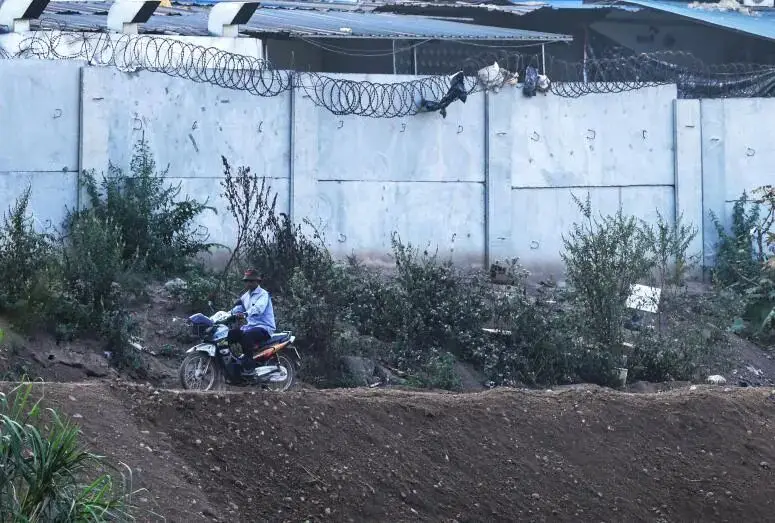
Many telecommunications fraud parks have metal nets on the outer walls of the buildings to prevent escape.
You can leave too, just pay.
The next day, a companion was redeemed by a friend for 15,000 yuan. Because of the cost of food and accommodation, this was slightly higher than the cost of smuggling them from the park.
On the third day, Zhang Wanquan passed a simple test and was deemed "useless" because he "couldn't type", and the park decided to resell him. As for how much he was sold for, he didn't know himself.
Unexpectedly, during the escort, the car encountered an inspection by the Cambodian gendarmerie - the gendarmerie is directly under the Ministry of National Defense and is responsible for public security and combating crime. Telecommunications fraud personnel are one of their key targets. The escorts were frightened and abandoned the car and fled, leaving him alone on the side of the road.
Zhang Wanquan was free. He planned to go to Phnom Penh, 400 kilometers away, to seek help from the Chinese Embassy. But he only had 20 yuan RMB, his ID card had been taken away, and his mobile phone had long been gone. Fear enveloped him like a tide, and the language barrier became the biggest obstacle. He could only gesture with his hands and feet, interspersed with occasional Chinese to ask for directions, and walked in the general direction.
Fortunately, he met a Chinese-owned seafood restaurant. The owner took pity on him, not only took him in, but also helped him open a room. That night, Zhang Wanquan was full of fear, fearing that the people in the park would come after him, and did not dare to move easily.
At two o'clock in the morning, he set off in the dark, walking seven or eight kilometers on foot by instinct. He finally stopped a car, and the driver drove him for forty kilometers. When he arrived at a gas station, he didn't dare to continue on the road, nor did he dare to sleep in the dark, but only dared to doze off next to the gas station lights: "There are surveillance cameras there, I feel safer."
That night, he made do with dry grass - fortunately, the weather was not cold enough to freeze him. Early the next morning, Zhang Wanquan begged at the gas station nearby, and received a lot of cold eyes and evictions. Fortunately, the shopkeeper of the nearby small shop gave him a pack of instant noodles and two bottles of water. After he wolfed them down, he followed the road signs and walked onto National Highway 5.
Due to tourism needs, there are a small number of Chinese road signs on local roads. From Poipet via Siem Reap, and then turning onto National Highway 6, is the only route to Phnom Penh. Zhang Wanquan walked more than ten kilometers on foot, the scorching sun made him dizzy, and he repeatedly failed to ask for directions. Fortunately, he also received a lot of kind assistance from local people along the way: an elderly person taking children and a van owner took the initiative to give him a ride for five kilometers, a young shop owner who had just returned from practicing in the temple gave him two rice cakes and a bottle of water, and someone saw that he had handcuff marks on his wrist and gave him a free shortcut, helping him bypass the Siem Reap checkpoint.
The journey was more than halfway through. Zhang Wanquan sometimes took a ride, and sometimes hid in the straw by the side of the road - in addition to the pursuers from the park, he also had to avoid the patrols of the Cambodian gendarmerie and police, but the latter were often lax, and sometimes even wore slippers to catch people. Zhang Wanquan was very aware of avoiding them, and was not discovered along the way.
He took a pickup truck and a truck in succession. The former owner was a Chinese working in Cambodia. After hearing about his experience, he not only gave him a free ride for 100 kilometers, but also gave him biscuits and water. The latter was a Cambodian driver who believed in Theravada Buddhism. He also gave him a ride for seventy or eighty kilometers and treated him to a full meal.
At the last stop south, he found a bus stop and wanted to hitch a ride to Phnom Penh, but the driver asked for 10 US dollars. A local elderly person who passed by kindly helped him communicate, but it was still unsuccessful. Fortunately, a tourist bus stopped, and the driver wearing Buddhist beads had a kind thought and took him to the Phnom Penh bus station. With his feet and the kindness of strangers, this 400-kilometer road to freedom was finally completed.
In fact, unlike what the outside world imagines, Cambodia is a country where the whole country believes in Buddhism, and many young people are practicing in temples. The folk customs are simple and kind. Even in the past ten years or so, the telecommunications fraud industry has rapidly entered Cambodia, and few local people participate, and they dare not catch fugitives in the street.
A Thousand-Mile Journey Home
Near the Chinese Embassy in Phnom Penh, the Chinese boss Yuan Yuan took in Zhang Wanquan.
Yuan Yuan is also from Sichuan. She came to Phnom Penh in 2019 to do intermediary business and also runs a hotel. The hotel she and her husband run together has six floors and covers more than a thousand square meters. In addition to normal hotel business, they also handle various certificates. For those who smuggle into Cambodia, they can help with the return certificate and coordinate with the Cambodian Immigration Bureau not to detain them or to detain them less. In Phnom Penh these years, this place has taken in many people with similar experiences to Zhang Wanquan.

Yuan Yuan's hotel (provided by the interviewee).
With the boss's mobile phone, he called his family. Two years later, the other end of the phone was even colder: both parents had passed away, his wife had passed away last year, and his brother and other distant relatives were unable to help themselves. His hometown, in his real world, had almost nothing to worry about.
But in this hotel, Zhang Wanquan met Han Defa. "Were you also deceived by 'high salary'?" "Were you also beaten?" A few simple questions confirmed each other's experiences. In a foreign country, the two fellow villagers, who were only 60 kilometers apart, comforted each other. They had only one thought in their hearts: to go home.
In order to go home, they must apply for documents from the Cambodian Immigration Bureau, but due to the act of smuggling, they must first be punished: generally speaking, smugglers need to be detained in the repatriation center for one month, during which they also have to pay a fine and living expenses of two or three thousand US dollars - but according to many people living in Cambodia, the transparency index of the Cambodian administrative department is not high, corruption is rampant, and the arbitrariness of many punishments is very strong, and the scope of discretion is very large, and no one can explain the local punishment standards.
Han Defa and Zhang Wanquan had no money, and it was difficult to find their families to raise money for repatriation in a short time. Three days later, they decided: plan to walk through the Cambodian-Vietnamese border in two months and walk back to China.
On November 12, the two set off on their way home. The bread and water stuffed by Yuan Yuan were all their luggage.
Before the trip, they used Han Defa's only remaining mobile phone to plan the route: from Phnom Penh to the border of Takeo, about 150 kilometers, and finally to Fangchenggang, Guangxi via Vietnam. This route, with a straight-line distance of more than 2,000 kilometers, is the route they believe is "the closest and most realistic". They also considered going north from Phnom Penh and returning to China via Laos. This is a route with a shorter straight-line distance, but "to go to Laos, you have to cross the Mekong River, which is four or five hundred meters wide and three hundred meters narrow. People can't cross it, and they don't have money to take a boat." The two finally gave up.
That night, the two set off in the dark - to avoid the police, pursuers, and kidnappers, they generally chose to travel at night, and hid deep in the forest away from the road when the sun came up at 7 o'clock in the morning. "It's not cold to sleep during the day, and it's relatively safe."
But the road home was too difficult. The first day's journey gave them a blow: the two walked 13 kilometers on the bumpy dirt road, and the whole way was unfamiliar villages and dense trees. The mobile phone navigation often went wrong because the map was lagging behind. What was worse was that the food they brought ran out that day.
On the second day, the two stopped to rest for a while after walking for an hour or two, and then walked about 20 kilometers. The high-intensity walking for two consecutive days made Zhang Wanquan's feet overwhelmed. Early on the third day, he felt a tingling sensation on the soles of his feet. When he took off his shoes and looked, his feet had already worn out several blisters.
When they were really hungry and dizzy, they entered "please give me something to eat" in the mobile phone translation software, and showed it to passers-by after translating it into Khmer. A hostess saw their plight and scooped out half a bowl of rice, and also gave them 10,000 Cambodian riels (about 17.4 yuan RMB) - in Cambodia, where the consumption level is relatively low, this amount of money is enough to pay for snacks from roadside stalls, a few bottles of water, or a short trip by motorcycle. Later, they met a passing truck, and the driver treated them to a full meal and also handed them 40,000 Cambodian riels. This unexpected kindness was like a shot in the arm, supporting them to walk another 30 kilometers, and they didn't dare to find a patch of grass to rest until dark.
Due to differences in physical strength and personality, the two occasionally had disagreements on the way: Han Defa felt that Zhang Wanquan was slow and lazy, while Zhang thought that Han was reckless and not cautious, and he also relied on him to ask for directions and beg for food. Although they complained to each other, they still continued to move forward because of their common goal.
Entering the fourth day, Zhang Wanquan's feet were swollen and he walked extremely slowly. The midday sun was also scorching and dazzling. When he was about to be unable to hold on, he found a shady coconut grove. In front of the small stall by the side of the forest, a dark-skinned female boss was selling coconuts. Zhang Wanquan tentatively asked for help, and the boss immediately brought out two bowls of steaming chicken porridge, and also gave them 20,000 Cambodian riels, and helped them point the way. Recalling this experience, Zhang Wanquan was full of gratitude.
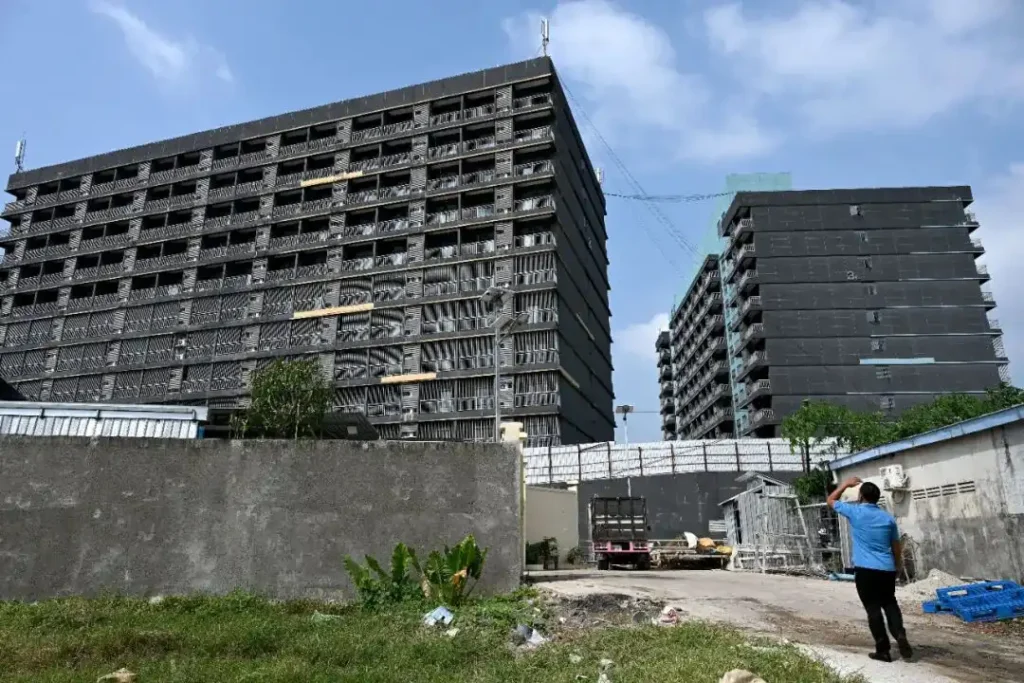
On January 15, 2026, a man watched the telecommunications fraud park in Sihanoukville, Cambodia from the outside.
But the foreign land is not always kind. On the way, a local stopped them and claimed that he could take them to find a bus. After the two communicated with the translation software, the man helped them stop a taxi. But in the car, when the two asked about the specific place name, the other party's eyes dodged and stammered, and the ambiguity in his tone made them feel scared. After walking more than ten kilometers, the route had seriously deviated from the mobile phone navigation. After repeated questioning, the other party finally stopped the car. The two immediately jumped out of the car and got into the dense grass forest by the side of the road. They didn't confirm that it was safe until they walked more than ten kilometers in the dark.
On the fifth day, they hid in the haystack all day long and didn't dare to show their faces. They ate a few bites of bread when they were hungry, and drank a few sips of water from the ditch by the side of the road when they were thirsty. They didn't set off again until it was completely dark, and followed the path to the town (sound). At this time, they were only one or two kilometers away from the Cambodian-Vietnamese border.
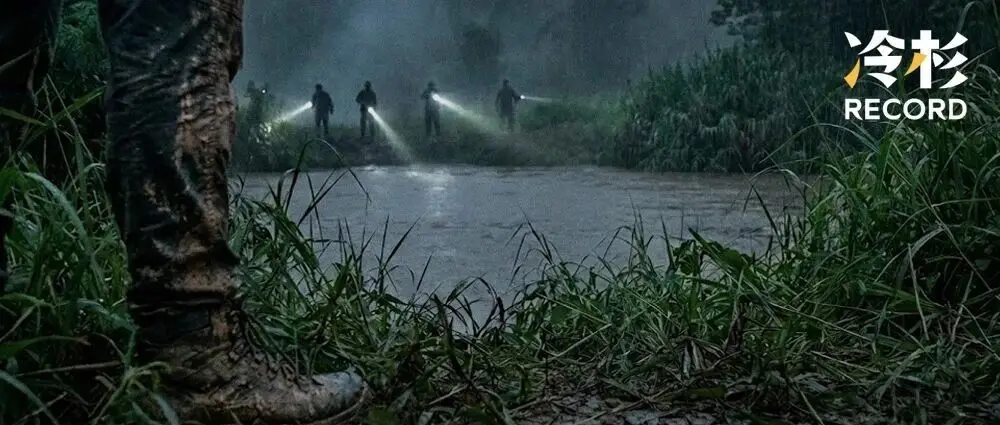
But a small river lay in front of them, and there were large rice fields and fish ponds by the river. They squatted in the nearby grass, and originally wanted to wait for the villagers who were harvesting rice to leave before secretly crossing the river. However, there were people watching the pond patrolling with flashlights from time to time by the fish pond, "The beam of light swept back and forth in the dark, and they were so scared that they didn't dare to breathe."
Until around 11 o'clock at night, the pond watchers went home to rest, and there was only the sound of insects and water around. The two tiptoed to the river, and waded across it, stepping on the pebbles at the bottom of the river. The winter in Cambodia is not cold, with an average temperature of around 20-30°C. This is a good weather for tourists to travel, but for the two who had been running for days, the river water was cold and reached their lower legs, "They were shivering with cold, but they didn't dare to slow down."
In the darkness, Han Defa, who was in better physical condition, "waded twice" and crossed the river. He wanted to continue walking, but Zhang Wanquan, who was small in stature, followed him across the river and was ready to rest. At this time, the contradictions that had accumulated along the way finally broke out, and the two parted ways.
Zhang Wanquan didn't have a mobile phone, and he didn't dare to shout loudly, so he walked forward alone in the knee-deep paddy field. Before long, he was soaked all over, and the blisters on his feet had also burst, and the pain was piercing. He turned around in place for a night, and the sky soon brightened. When he walked out of the rice field, a local elderly person he met told him in broken Chinese: "It's not far to Vietnam."
He was relieved, and lit a fire by the side of the road to dry his clothes and pants. Unexpectedly, the fire attracted the patrolling police, and he was eventually taken away. To his surprise, the police did not make things difficult for him, but instead gave him a full meal, and then sent him to the Immigration Bureau. In the face of the staff's inquiry "What are your plans next", he truthfully replied: "Walk back to China, no money."
The Immigration Bureau asked him where he could go, and Zhang Wanquan had nowhere to go, and the only place he could think of was the hotel in Phnom Penh. In the end, they drove Zhang Wanquan back to the vicinity of the hotel, and also gave him 20,000 Cambodian riels for a taxi. A journey of more than 100 kilometers, which was a long and arduous journey, returned to the starting point.
Go Home Early
Han Defa also came back.
After parting with Zhang Wanquan, he walked for a while in the rice field, and saw a few people on motorcycles slowly approaching in the distance. Fear instantly gripped him - he was afraid of being kidnapped, and even more afraid of being caught back to the park. He immediately lay down and hid in the rice field, holding his breath.
Staying in place was not a solution. In order not to be discovered, he ran up the mountain with all his strength by the faint light. The night was dark, and he didn't see a stone cliff five or six meters high in front of him. He stepped on the air in the dark, and the whole person fell down. "There were stones all around, and fortunately I fell on the sand in the middle." This fortunate buffer saved his life, but his waist was in severe pain, and he couldn't stand up.
The slippers on his feet had long been lost. Han Defa lay on the ground, took out the only remaining sock on his body, and put it on his feet to barely keep warm. In the desperate situation, he had no choice but to call the police.
After receiving the help request, the local police dispatched more than a dozen people, and carried him out of the valley with a simple stretcher, and sent him to the hospital for intravenous infusion treatment.
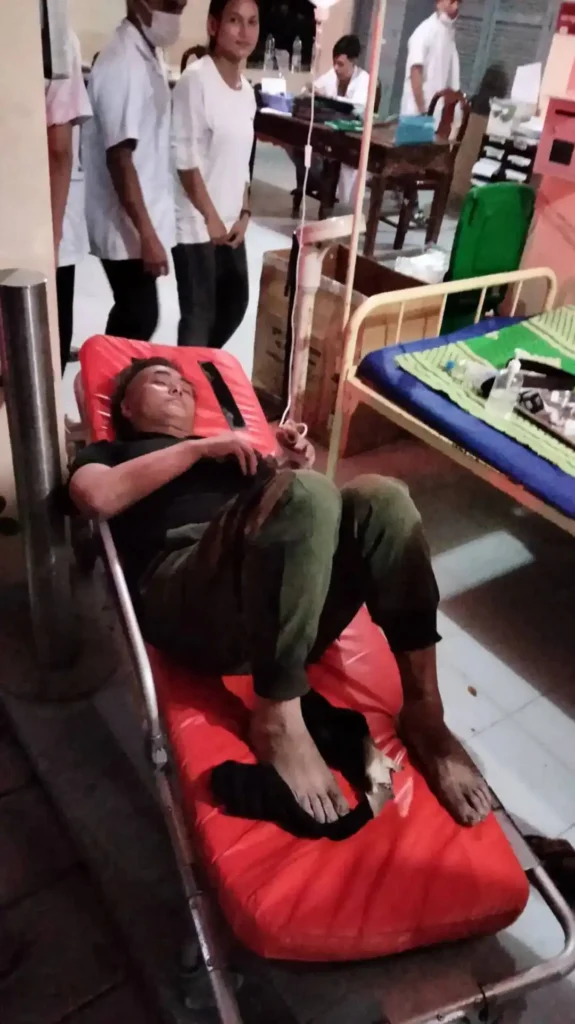
Han Defa was sent to the hospital for treatment (provided by the interviewee).
The pain in his body was still continuing, but the high medical expenses were even more frightening, "The medical conditions here are not good, and it often costs thousands of US dollars." Han Defa guessed that he was seriously injured, but he could barely support himself, and decided to get better treatment after returning to China. The next day, a police car took him back to Phnom Penh. Worried that the bumps would aggravate his injuries, the driver drove slowly for three or four hours for the seventy or eighty kilometers.
Han Defa and Zhang Wanquan, who had nowhere to go, met again in Yuan Yuan's hotel. "Just want to go home early." The two sat by the window, looking north - that was the direction they came from, and also the place they longed to return to.
After a week of detention, Han Defa was able to go home - his family in Sichuan worked hard to raise money, prompting him to surrender to the border port, and paid tens of thousands of yuan in fines and travel expenses for him. At the end of 2025, he completed the formalities and boarded the flight back to China. He is currently being treated for lumbar spine injuries in a hospital in Sichuan, and the hospital has performed surgery on him.
Zhang Wanquan, on the other hand, seemed more isolated and helpless. His way home was once stuck on the Immigration Bureau's fines and the living expenses and air tickets during his detention. With the help of many parties and kind people, his situation was finally brought to attention. After being detained in the repatriation center for 20 days, he set off on his way home before New Year's Day.
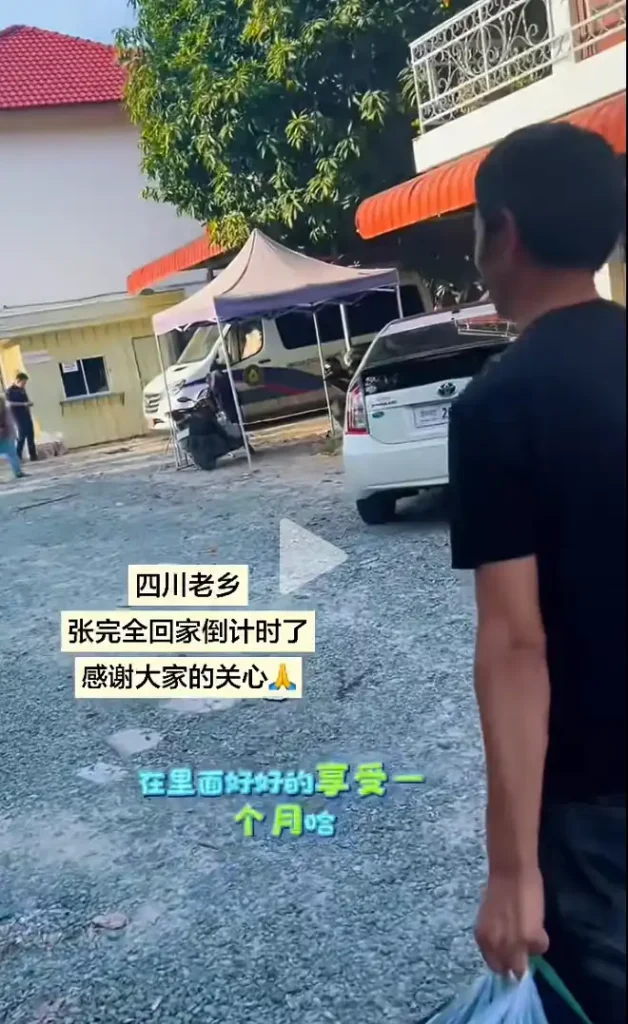
In December 2025, Zhang Wanquan surrendered to the Cambodian Immigration Bureau under the escort of Yuan Yuan (online screenshot).
In Yuan Yuan's view, such stories are not unique in Cambodia. In Phnom Penh these years, her hotel has become a special "transit station", taking in one injured fugitive after another. There is still a 57-year-old Chinese man staying in the hotel. He has been staying for more than two months, but his family's financial situation is limited, and he doesn't want to manage it. "Our ability is limited, but at least we can give them a bed and a meal, so that they can feel a touch of warmth in a foreign land."
On the eve of his return to China, the Thai-Cambodian border was once again at war. Many of the Osma parks where Han Defa was located were continuously bombed, and videos of a large number of "dog pushers" fleeing with their luggage were widely circulated on social media. After learning this news, he sighed: "Fortunately, I escaped, otherwise it would have been really unpredictable."
(Thanks to Huang Yan of "Phnom Penh Live" for his contribution to this article, and the interviewees in the article are all pseudonyms.)
Operation / Huang Xinyue Proofreading / Li Baofang Art Design / uncle Mary