



The application for childcare subsidies nationwide opened in early September, and I don't know if any readers have already received them.

However, a netizen from Liuan, Anhui recently reported that her second-child subsidy was recovered after she gave birth to her second child.
This news originated from a netizen's post:
"When the second-child subsidy in Anhui Province was about to reach me, the Health Commission called and said that all second-child subsidies in the province would be recovered, and those that had been issued would be deducted from the childcare allowance, and those that had not been issued would be directly intercepted."

On November 6, a staff member from the Anhui Health Commission responded that the subsidies were indeed being recovered, but this was due to adjustments in the old and new policies, and Anhui's subsidies would follow the new national regulations.
Because the amount of the second-child subsidy in the old policy was 2,000 yuan, and the new policy proposed a second-child subsidy of 3,600 yuan, in order to avoid confusion caused by the difference, the issuance of the second-child subsidy was suspended.
And further explained: The relevant materials have been submitted to the state, and after approval, they will be issued to various cities and counties for implementation, and it is expected to complete the relevant procedures before the end of 2025.
I think many people have a question: before 2000, now 3600, why not directly make up 1600, why recover it?
In fact, there is a small detail here.
The 2,000 yuan childcare subsidy before this was a fertility policy introduced by the local government, and the money came from the local government.
And the 3,600 yuan fertility subsidy, the central government subsidizes 90%, and the local government bears 10%, the main part is mainly from the central government.
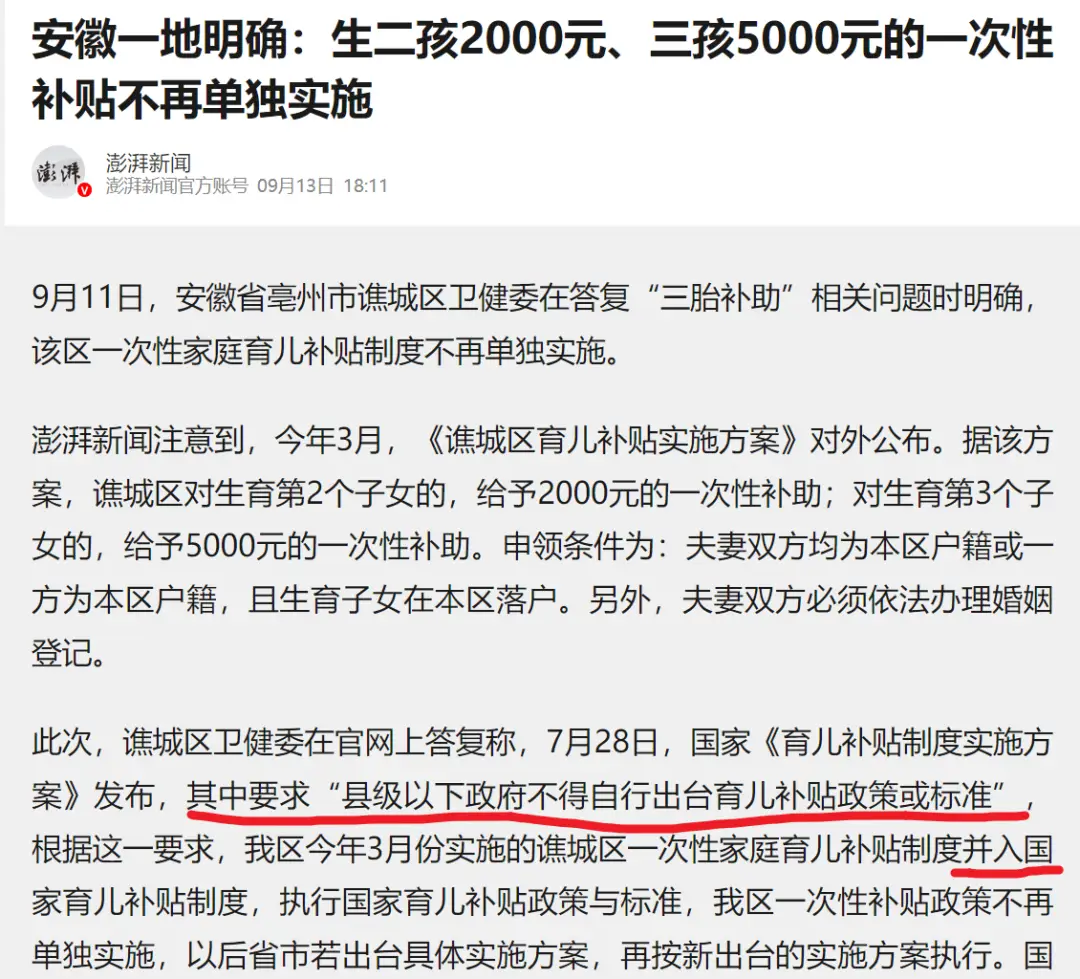
Secondly, after the state's "Implementation Plan for Childcare Subsidy System" was released, some local fertility subsidy policies were no longer implemented separately, because the implementation plan required that "governments below the county level shall not independently introduce childcare subsidy policies or standards".
However, even if there are adjustments to the old and new policies, should the previously issued livelihood funds be recovered?
It's like historical documents have no practical significance, just playing games here?
If we calculate it this way, now we encourage the birth of a second child, then the fines paid for giving birth to a second child before, should they also be refunded?
Unlikely.
Although the birth rate has been declining year by year, we still maintain a super-strong strategic determination.
A little-known fact is that the current fertility policy opens up "two children" and "three children" instead of "two children";
If the first child is a family of triplets, and then gives birth to a second child, the fourth child is in violation of regulations;
Family planning still exists, but the current social environment encourages people to have children, and those who violate it are not punished.
At the legal level, it is not free childbirth, but "can" have three children, and those who have more than three children need to "meet the conditions stipulated by laws and regulations, and can request to arrange for the birth of children".
In addition, all fertility encouragement and subsidy policies are up to three children.
If you want to have more, sorry, you won't get any subsidies, which is actually a kind of family planning.
So it's no wonder that many people like to make comments like this: maybe they just want a low birth rate? Because it doesn't seem like the country is in a hurry at all.
Before the state's childcare subsidies were introduced, various places had launched "childcare subsidies" to varying degrees, but they were often squeezed out.
Some places are normal to issue less, late, and insufficient amounts, and what's even more outrageous is that some cities followed others to issue documents, but when it came to applying for subsidies,
they said that they were still formulating relevant details and had no budget, which was quite embarrassing.

There are also many so-called "fertility subsidy" policies in many areas, and the subsidy content is mostly linked to housing subsidies, which is mainly about wanting both a house and a child.
These are barely acceptable, but it's really... rare to recover subsidies that have already been issued.
As Teacher Jiang Kun said: If you have nothing to say, it's better to promote family planning...

The current situation in neighboring Japan and South Korea has long told us that it is easy to make the birth rate collapse, and it is a pipe dream to bring it back.
Our best opportunity window was fifteen years ago, then ten years ago, and even five years ago, if we started to subsidize with real money, we might still hear some response.
Secondly, the biggest experience and lesson of the developed countries' fertility support system is precisely: don't have too much hope, and the later you act, the more money you spend, and the worse the effect.
Our current situation is that we can't even touch the stones that can be touched, because there is no precedent for developed countries to start saving the market when the birth rate is so low.
Japanese writer Miura Zhan pointed out in "The Fourth Consumption Era": "When society transfers all childcare costs to the family, civilization will wither due to the backlash of selfish genes."
This sentence sounds a bit academic, but the reality it describes can be felt by every young person.
If a society's operating mechanism makes young people feel like they are a machine that can't stop, and they are exhausted every day between mortgages, KPIs, and an uncertain future, then fertility, this once instinct, will become a luxury, a risk investment that needs to be repeatedly weighed.
You want the horse to run, but you don't give the horse grass to eat, and you even want the horse to clear the stones in front of it, then we may not really be surprised that one day our birth rate data will be more dismal than South Korea's.
They are reluctant to invest in young people, but instead push young people to take over various plates.
Can't the economic problems of every era be handled by the same group of people?
You don't say, you really don't say...

-END-