

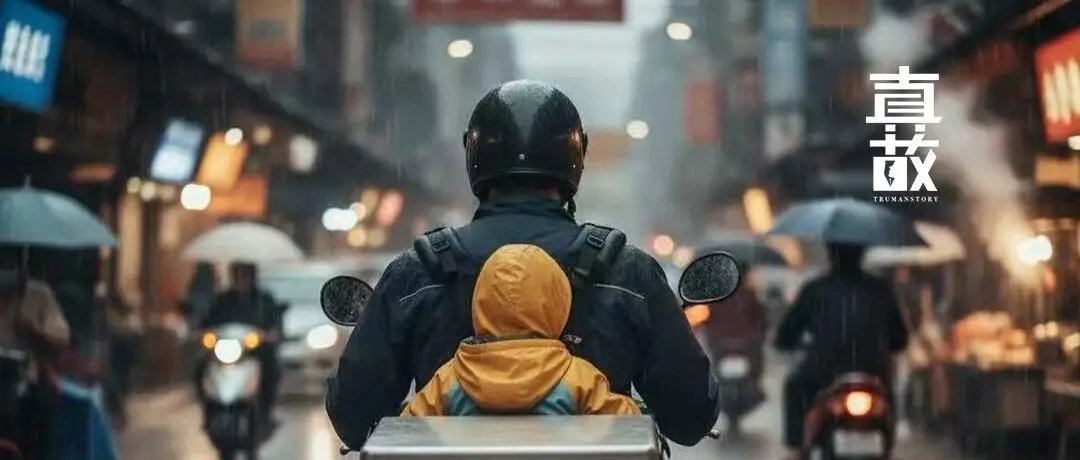
On the day that Yiyi was just a month old, Chen Ping, a single father, completed a special "travel preparation" for her: he used a stone slab to level the footrest of the electric vehicle, and the baby carrier could be placed steadily inside—this simple "seat" would carry his youngest family member to begin a struggle for survival.
Yiyi has since become a member of the "second generation of riders." This electric vehicle is a moving, small fortress that her father has carved out for her in the vast city with all his might.
Food Delivery Baby
At 2 a.m., on the streets of Chongqing, Liu Ying, wearing a blue windbreaker, was riding on the slopes of Chongqing. Liu Ying heard that her daughter, Qiuqiu, who was wrapped in a back strap, started crying again due to the bumps.
But Liu Ying dared not brake. She held her daughter in her arms, gently patted her back, and waited for her to calm down from the fear brought by the sudden storm—otherwise, the order would be overdue.
She sang to her child in the wind: "Little rabbit, open the door. Hurry up, Qiuqiu, don't cry, we'll go home after we finish this order." As she hummed, she felt that her daughter on her back gradually calmed down, and the humming sound gradually diminished.
Qiuqiu is a 2-and-a-half-year-old girl. Every night from 10 p.m. to 3 a.m., she lies on her mother Liu Ying's back and follows her to deliver food.
The unit price for delivering food at night is high, and Liu Ying can earn more than 100 yuan in four or five hours. However, the weather in Chongqing is unpredictable. When it suddenly rains, Liu Ying, who hasn't finished delivering the orders, temporarily covers the child with a plastic sheet and squinting her eyes, continues to ride in the rain. She is afraid that Qiuqiu will catch a cold, and the medical expenses and medicine will cost several hundred yuan, and it is not worth earning a few dozen yuan, but if the last few orders are not delivered, a night's order will be in vain.
When 2-and-a-half-year-old Qiuqiu is lying on the back strap of her food delivery mother, in Huizhou, Guangxi, 3-year-old Yiyi is also living such a "temporary life" on her father Chen Ping's food delivery electric vehicle.
In 2022, before her daughter was born, Chen Ping set up a mobile barbecue stall in Huizhou. When Yiyi was just a month old, Chen Ping began to worry about how to work and take care of Yiyi at the same time. He saw a portable baby carrier on an online shopping platform that could be picked up at any time. He immediately decided to deliver food.
Every morning, Chen Ping sets off with the baby in the carrier—a carrier about 70cm long, 30cm wide, and 20cm high is placed on the front pedal position of the car. The pedal is slippery, so Chen Ping specially customized a stone slab that matches the size of the carrier to be placed underneath—the increased friction can make the daughter in the carrier more firmly placed at his feet.
But this kind of stability is mostly just a beautiful hope. He remembers the embarrassment when he first took care of his daughter alone. He set an alarm to feed his daughter every four hours. At first, he didn't pay attention to the amount of milk, and after feeding, he had to ride the car, and he didn't have time to burp the child, so Yiyi always vomited milk. Later, he learned to feed her small amounts many times.
The body of the electric car is more than one meter long, but every corner of the car is filled by Chen Ping little by little: milk powder, water bottles, wet wipes, and scattered toys are stuffed in the trunk or the space under the seat. The diapers that are often used are packed in plastic bags and hung in front of the car. A 1.5-liter bottle of water is also hung on the bumper at the rear of the car—every time he changes the diaper, Chen Ping uses clean water to wash his daughter to avoid eczema.
For children like Yiyi, from birth to three years old, from a baby carrier of less than half a cubic meter to a child seat when she grows up, her body bends, stretches, and grows in a limited space. This is a microcosm of the children of some food delivery workers, who spent their childhood in less than 1 square meter of space on electric vehicles.
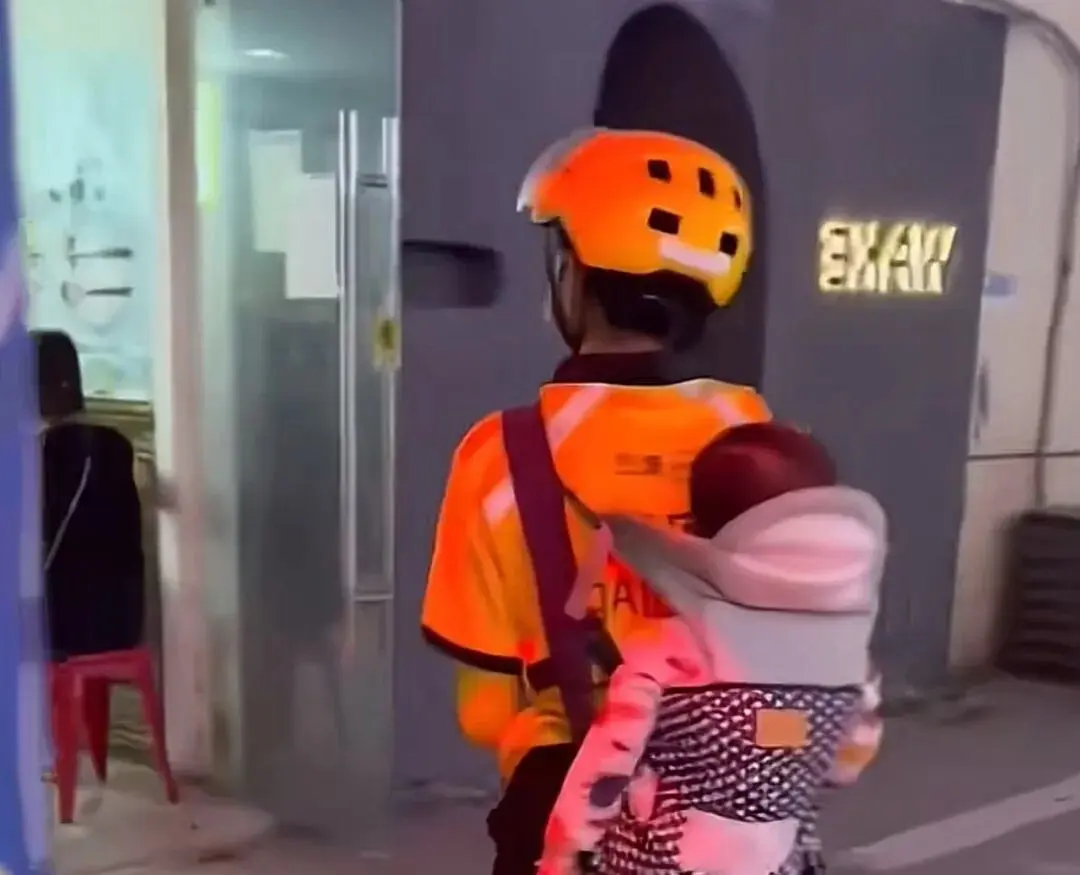
Image source network|Food delivery riders carrying children to pick up meals
In Shenzhen, Xiao Ze, who was just one year old, also spent six months of nights on an electric vehicle with his father.
On April 8, Li Xijian registered as a rider with his son on his back and began his life of delivering meals at night. The sun in Shenzhen is scorching during the day. Li Xijian, 35, works from 5 p.m. to 2 a.m. every day. Every time he goes out, he uses a back strap to firmly tie his child in front of him. When the night wind gets cooler, Li Xijian puts a baby hat on his son, but the child always pulls it off with his little hands. In just one month, Xiao Ze lost at least twenty hats.
In the spring of 2024, Ren Xuemin, a mother from Jinan, Shandong, also started taking her one-and-a-half-year-old son Fufu to deliver food. At first, she was overwhelmed by various worries—especially the safety of her child. In the old residential buildings without elevators, what if something happened or even someone took the child away if she left the child alone downstairs? She also tried to use a waist stool to fix the child in front of her, but she was short and her waist couldn't bear the long-term weight.
Ren Xuemin is 42 years old, divorced, and has a son and a daughter with her ex-husband. She always smiles and has a kind of tenacity. She used to work in the construction industry, and after the project fell into a triangular debt, she joined the food delivery rider industry.
Fufu often falls asleep in the car. For this reason, Ren Xuemin also specially installed a baby anti-collision pad on the dashboard to avoid him bumping. Sometimes he is woken up when he arrives at the delivery point, and he will be irritable and cry in a half-dream and half-awake state, and he will not let his mother leave no matter what.
Ark of Life
The food delivery riders who built these homes of less than 1 square meter have similar life experiences: they come from rural areas, have low education, and left home to work hard in their early years. The sudden changes in life—divorce, serious illness of the child, sudden unemployment—pushed them to the edge of fate: they must hold up their livelihood with one hand and hold their young children tightly with the other.
In fact, the lives of these food delivery riders and their babies are passively shrinking on this food delivery vehicle.
Chen Ping's daily income is not high. Taking a child who is less than one year old to run orders requires stopping from time to time to change diapers, feed milk, and deal with some unexpected situations. Once, a stream of urine and feces suddenly flowed out of the child's body and splashed on him. He realized that the diaper could no longer hold it because it hadn't been changed for too long. He hurriedly called the customer, explained the reason, and discussed whether the meal could be placed in the elevator and let the customer pick it up at the elevator entrance. The customer was puzzled and questioned him why he was taking the child to deliver food?
According to statistics, about four-fifths of food delivery workers work outside their registered residence. Their occupational situation and rights protection have attracted widespread attention, but the difficulties of raising and moving of food delivery riders and their children who have family life have rarely been written about.
Chen Ping's parents divorced when he was a child, and his father remarried. He was raised by his grandfather. At the age of 15, Chen Ping left home to work, drifting in Inner Mongolia, Guangdong, Zhejiang and other places, until he settled in Huizhou more than ten years ago.
Three years ago, when the child's mother gave birth to Yiyi, he frankly said that the reason for wanting a child at that time was very realistic: "I was afraid that no one would bury me when I got old. If I had a child, at least I wouldn't rot at home." But in the delivery room, when he first took over the 7.5-pound little princess, Chen Ping's hands trembled. That was a feeling of a certain home.
Soon after Yiyi was born, he had to separate from the child's mother. He once begged his stepmother to help take care of her, and he was willing to pay monthly, but his stepmother did not agree.
He chose to take his daughter with him and start learning to be a father from scratch. There are very few jobs that can take care of his daughter. He has been doing barbecue for five or six years and thought about continuing to set up a barbecue stall, putting the stroller aside when setting up the stall, and regular customers would occasionally help take care of it. Unfortunately, after the epidemic, his business was sluggish, and he gave up this idea.
He saw the baby carrier on the shopping platform. After repeatedly confirming the load-bearing capacity with the customer service, he thought that delivering food might be a new way out for him and his daughter.
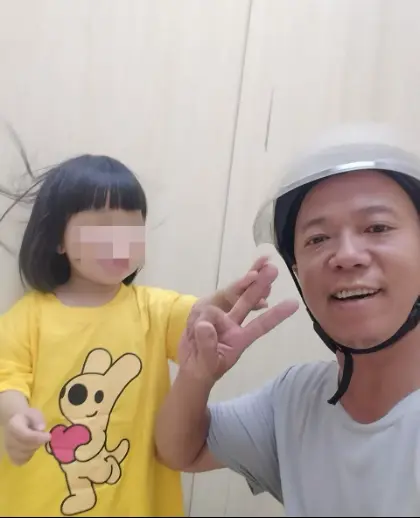
Picture|Yiyi follows her father's food delivery car, from 1 month old to 3 years old
Yiyi drinks five cans of milk powder a month, 280 yuan per can, plus diapers and clothes, the child's monthly expenses exceed 3,000 yuan. All of this has to be earned by him one order at a time.
He also feels sorry for Yiyi, especially when it is windy and rainy, or when the weather is cold. He tried to entrust Yiyi to a familiar merchant, but in less than half an hour, the phone追了过来: "Come back quickly! Your daughter is crying her heart out." He also tried to go out secretly after the child fell asleep, but Yiyi was like wearing a sensor. As long as he got up, even if she was sleeping soundly, she would wake up immediately and cry loudly.
For Li Qian, a food delivery rider from Hengyang, Hunan, taking her 5-year-old daughter to work is also to balance her livelihood and childcare. Last October, her son Xixi was diagnosed with leukemia, and the peaceful and happy life of the four-member family was broken.
To pay for her son's medical expenses of tens of thousands of yuan per day in the PICU, she and her husband emptied their savings. The whole family couldn't even afford the kindergarten tuition for their five-year-old daughter.
Children with leukemia need all-day, meticulous care. The doctor clearly told Li Qian: "You can't work for five years." Her husband stayed in Guangdong to cut marble and became the only economic pillar of the family. However, after her son's condition stabilized, under the heavy pressure of life, Li Qian could not feel at ease to "stay idle." She said: "I must do something for my son."
After accidentally seeing the information that "riders have free time" in a short video, Li Qian became a food delivery rider. She delivers food for eight hours a day, earning eighty or ninety yuan, which can at least help her earn a day's grocery money. Her daughter repeatedly begged to go with her mother to deliver food, but Li Qian couldn't persuade her, so she had to agree.
She still remembers the scene of her first food delivery. On New Year's Eve last year, she was not familiar with the route, and she spent more than an hour looking around outside a residential area. In the end, the customer called: "I see you have been staying on the road, did something happen?"
After delivering that order, she rode her bike back to the hospital. It was almost midnight, and the electric car ran out of power. She pushed the car and walked across the Yinpenling Bridge. At that time, fireworks were blooming on both sides of the Xiangjiang River. She heard the blessings of "Happy New Year" from the crowd watching the fireworks on the bridge. She stopped in the middle of the bridge and thought of the child and her husband in the ward—if her son hadn't gotten sick, they should also be cheering in the crowd at this moment.
In a certain sense, the electric food delivery car temporarily caught their lives. For some of them, the food delivery car has almost become their ark of life in a foreign land, a tool for them to make a living, and it also carries the bumpy childhood of their children.
Delivering food is the last job of Liu Ying, a single mother born in the 90s. She chose this night shift job because the unit price for delivery at night is slightly higher, and she can earn more than a hundred yuan in four or five hours. She also sets up stalls to sell cold noodles and balloons. Behind all the choices, there is only one hope: flexible time, and she can take her child with her at the same time.
"There is no one behind me, I am my own support." Liu Ying describes her current state.
She left her hometown of Kaizhou, Chongqing at the age of 15 and went to Guangdong to work alone. For more than ten years, she went from a small sister in a clothing stall, to studying English and doing foreign trade, and even worked as a part-time clothing model. After getting married, her biggest dream was to buy a "old and broken small" house in Guangzhou and let the family settle down steadily. But now, she only has two things in her life: taking care of her daughter and making money.
Her daughter Qiuqiu was diagnosed with "adenosine cyclase gene disease" when she was more than half a year old, a rare disease characterized by motor and cognitive impairment. There is no specific medicine, and it can only be delayed by long-term rehabilitation training. If she does not persist in systematic rehabilitation, the child may never be able to walk independently and will also face serious risks such as joint deformities and difficulty swallowing and breathing.
To treat her daughter's illness, the couple moved to Shandong and Beijing, and finally returned to Chongqing. The rehabilitation expenses are like a bottomless pit. Qiuqiu's father couldn't hold on and wanted to give up, and even proposed to send the child to a welfare home. The two finally divorced. Liu Ying said that she never expected Qiuqiu to support her in her old age, "Giving birth and raising her is a mother's responsibility."
Liu Ying was raised by her grandparents since she was a child. She lost her father at the age of 13, and her relationship with her mother became estranged after her mother remarried. She has never experienced complete maternal love, but she wants to give Qiuqiu a "mother who loves her wholeheartedly."
Now, she only sleeps four or five hours a day. After carrying her child to deliver food for a long time, her waist has been strained and often aches, but she seems to have become numb to the pain in her body. She is used to this pace of life, and she is also used to showing a strong and optimistic side in front of others—that is both a decent appearance to outsiders and an encouragement to herself.
In 2024, the first Spring Festival after the divorce, Ren Xuemin's account only had more than 2,000 yuan in savings. She had to find a way to make money. On New Year's Eve, she took her two children to deliver food together. When she picked up and delivered orders, her daughter watched her son waiting for her by the electric car. In this way, after the end of the Spring Festival, the economic crisis was slightly alleviated.
Now, Fufu has been following his mother to deliver food for more than a year, growing from a baby who could only babble to a little chatterbox, with an outgoing and cheerful personality. He even regards this busyness as his own "job"—he likes to enter the elevator and press the elevator floor the most, and occasionally snatches his mother's phone, runs into the store, and shouts "take the meal" in a tender voice. He returns to the electric car, climbs onto the child seat neatly, and firmly sticks the phone on the bracket.
"Click the blue button!" Under his mother's guidance, he clicked to complete the "meal pick-up." Ren Xuemin smiled as she watched her son's serious appearance. In his tender voice of "Let's go," Ren Xuemin turned the handlebar and rejoined the traffic.
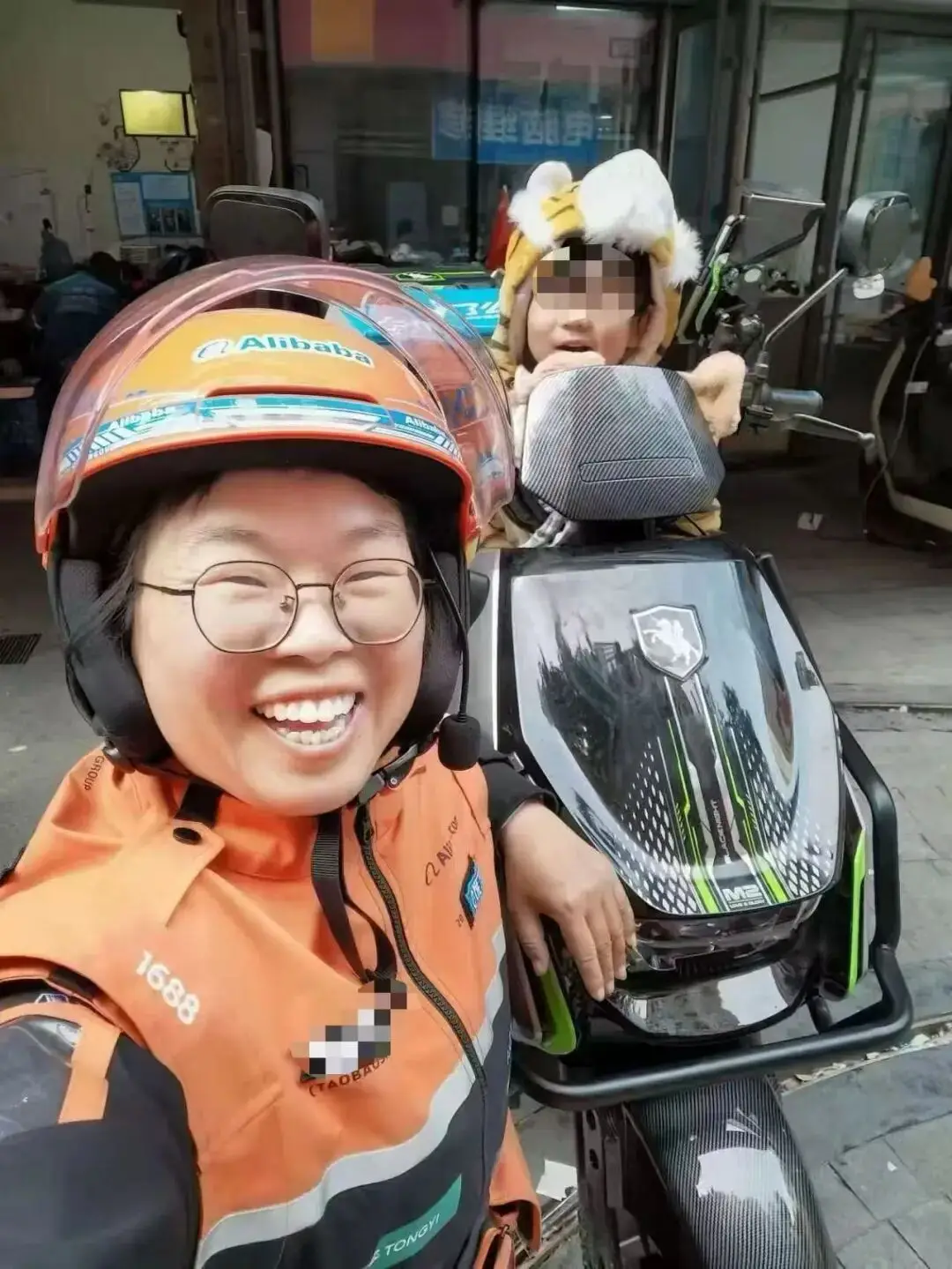
Picture|Ren Xuemin takes Fufu to deliver food
Live in the Moment
Chen Ping often says that others take care of their children step by step, but he himself is like crossing the river in the dark, "wading" step by step.
In the past few years, he has been dependent on his daughter, and he describes it as "pain and happiness coexist."
When Yiyi was more than one year old, she grew taller, and her legs couldn't stretch in the baby carrier. Chen Ping changed her to a child seat; and last year, it was upgraded to a safer, rainproof and sun-proof model. Yiyi looks like him, is very healthy, has a rosy complexion, and has thick hair. But Chen Ping, 37, looks "old," and sometimes passers-by think he is Yiyi's grandfather.
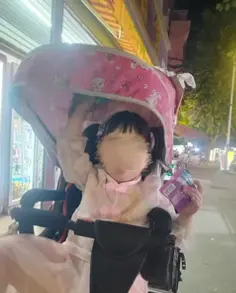
Picture|Last October, Chen Ping spent more than 200 yuan to upgrade Yiyi's child seat
He is very proud to be able to raise his child to three years old by himself. But he also said: "Only I know the taste of it."
When he is extremely tired, he feels like "a machine that delivers food," and he is either running orders or taking care of his child, and he doesn't have a moment to himself. During the National Day, many local people in Huizhou traveled and stayed at home, and the food delivery orders decreased, and the income became more and more unstable. Sometimes he couldn't earn a hundred yuan even after running for eight or nine hours, which increased his anxiety about the future. He is afraid of heights, but he always dreams of standing on the edge of a cliff when he closes his eyes, and he can't sleep all night after waking up.
In the three years of taking care of his child alone, he has experienced too many "firsts" in life with Yiyi—the first Children's Day, the first time going to kindergarten, the first parent-teacher conference. "All the important moments in her world, I was there. That feeling is really wonderful." He said this, and his tone softened unconsciously. Yiyi spoke a little later than children of the same age. When the word "Dad" was first called out of her mouth, Chen Ping was so happy that he almost shed tears.
Yiyi doesn't have her mother's company, and Chen Ping tries to fill a missing part with double the love. As Yiyi gradually grows up, new troubles also quietly emerge. "Girls should avoid their fathers." From the age of three, Chen Ping began to consciously teach her to take a bath herself. This man, who lives quite roughly, still feels that he needs to learn carefully and cautiously when facing the topic of raising his daughter.
Recently, 3-year-old Yiyi has begun to show her self-awareness as she grows up. She doesn't like to listen to Chen Ping and prefers to play by herself and make her own decisions. One morning, Chen Ping found that the toothbrush and toothpaste were gone after getting up. He looked down and saw that the whole tube of toothpaste had been squeezed on the bathroom floor, and the toothbrush had been thrown into the toilet. This was Yiyi's masterpiece. He felt both angry and funny, and he had to deliver food. He quickly went to the small shop to buy a new one.
Of course, there are also difficult times. On weekends, he wants to take Yiyi to deliver food together, but the child sometimes doesn't want to—she also knows that delivering food is hard work. Chen Ping will first encourage her with toys and snacks, and if he can't help it, he will also lose his temper.
After losing his temper, he regrets it. It is not easy for a single father to take care of his daughter, especially in the days when she is gradually growing up. And what he can do is to continue to accompany her, step by step, and continue to "wade" down this road that no one has guided.
The understanding of strangers encountered on the road of delivering food is the glimmer of light that shines into the difficult life. On the eighth day of Li Xijian's food delivery, a lady saw that he was too tired to carry his child alone and insisted on giving him a red envelope. After he repeatedly refused, the other party chased him to the electric car and pulled out the car keys to force him to accept it.
In Ren Xuemin's food delivery box, there will often be some extra things—a cup of milk tea, a few bags of snacks, or even children's toys. That was specially sent to Fufu by the customer. Some residential areas do not allow electric vehicles to enter. The security guards will silently open the door for her when they see her with her child. These moments of warmth make her believe that life can go on.
Ren Xuemin remembers that her daughter once said to her twice: "Mom, I think I'm very happy now." Once was when the three of them were chatting on the bed, and once was when her daughter was leaning on her shoulder in the back seat of the electric car. At that moment, Ren Xuemin's heart finally fell—she was always worried that divorce would hurt her children, so she was particularly cheerful and strong in front of the children, but when it was late at night, she had hidden in the quilt and cried a few times.
Now, she can support this small family steadily with her own efforts. Ren Xuemin is very satisfied and proud. She originally planned to send Fufu to kindergarten this year and found a suitable kindergarten near her home, but she was suddenly told that the kindergarten had closed down before the start of school at the end of August.
In order to earn more money, she switched from crowd-sourcing to exclusive delivery, and her monthly income gradually stabilized at more than 5,000 yuan. She hopes that her children can get rid of the life of wind and sun as soon as possible and return to their peers.
Ren Xuemin often says that her life seems to be always pushed forward by reality, and she can rarely make choices that truly follow her heart. In the bumpy days, she gradually learned a set of simple life philosophies: focus on the present, and when you encounter a problem, calm down and solve it.
Liu Ying occasionally thinks of her imagination of the future when she was pregnant: she would return to work in the clothing stall after her maternity leave, hand over the child to her mother-in-law, and work hard to lose weight and dress up both mother and daughter beautifully. She once wanted to be a fashionable hot mom and be a good girlfriend who could talk to her child about everything.
But now, these all sound very far away. On the wall of the rental house where the mother and daughter live, there are several big characters prominently posted—"Qiuqiu's Ten-Year Plan to Get Better." The plan is very simple—to insist on giving Qiuqiu rehabilitation for ten years as usual, until Qiuqiu can speak, can walk by herself, and can see the outside world.
For the future, Liu Ying doesn't dare to have too many fantasies. The only thing she is sure of is that she can't stop, "If I stop, there is no hope."
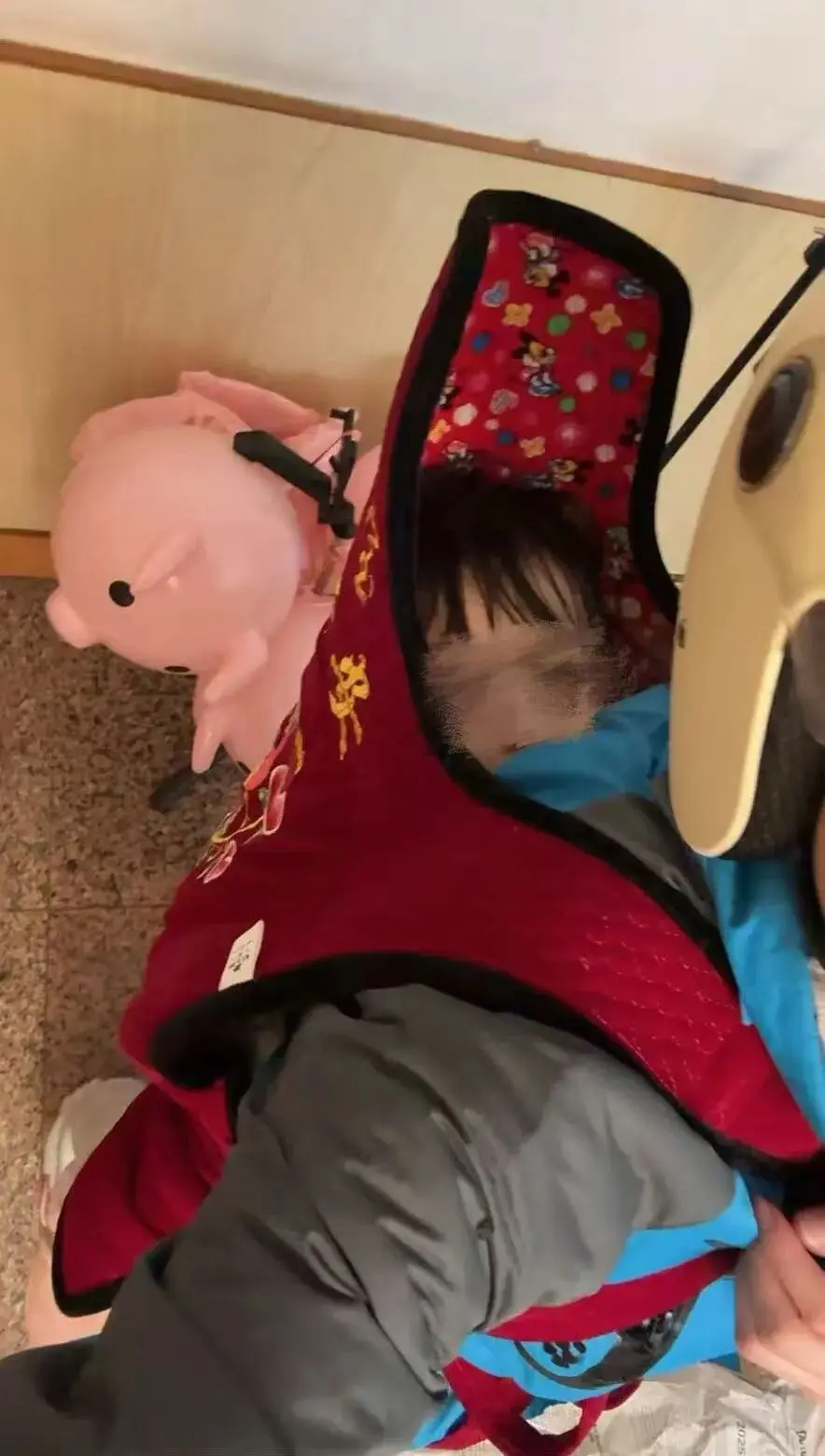
Picture|Qiuqiu and her mother are together
At the request of the interviewees, the personal information has been appropriately blurred.