

Two years ago, I switched jobs to a financial media outlet and became a full-time agricultural reporter. I thought this was a job closer to the land and food, which could reconnect news reporting with real life. Unlike food writers who write about flavors, I wrote about feed prices, pig slaughtering, and grain price fluctuations, and interviewed people who plant, raise livestock, and promote agricultural technology... In short, I reported on the food supply system, trying to sort out its production chain, circulation structure, and price logic.
However, I soon found that our topics often came from announcements and financial reports of listed companies. Performance required me to produce more than a dozen articles every month, which led to most of my articles being based on phone or WeChat interviews, and I had to finish writing them on the same day. Only occasionally would I go on field trips for interviews.
Therefore, not surprisingly, even though I write about the issue of "eating" every day, I still can't see food—the financial reports of large companies only describe the macro situation. This description is quite general, and it's impossible to explain how food is produced, processed, and consumed, and how it is discarded in the middle, just by relying on the three tables in the financial reports (Note: the three major financial statements of the financial system, the balance sheet, the income statement, and the cash flow statement). I often wonder, am I really a journalist??
1. Invisible Pig Abscess Meat
The first time I deeply realized that I "couldn't see" food was when I was researching where the pigs of a famous pig farming company were sold. This company claimed to provide pork for 100 million people every year. But in real life, I didn't see any pork being sold under the name of this company. I asked an analyst about the problem. He said that the company only needed to sell the pigs to the slaughterhouse, and they didn't need to face consumers to build a brand.
I still wanted to find out where their pork went, so I continued to look for information, and unexpectedly stumbled upon a clue.
On a short video platform, someone complained: "The front legs of his pigs have endless abscesses." — referring to that company. Someone replied in the comments, "Too many injections." Others said, "Take the abscess meat back to feed the dogs."
Their identities are not difficult to guess, basically they are people from the slaughterhouse. In the process of pig slaughtering, there is a step called white strip trimming. The parts of the live pigs that are not suitable for consumption are cut off in this step and become waste meat. Some supermarkets and pork vendors will further refine the pork before selling it.
"Injections" refer to vaccinations. If the vaccine has not been completely absorbed, the pig will be slaughtered, and it will have abscesses on its body. This is inevitably the result of the breeding company's excessive pursuit of breeding efficiency, and increasing efficiency is the way for the current breeding industry to maintain its own profits during the downturn of the cycle.
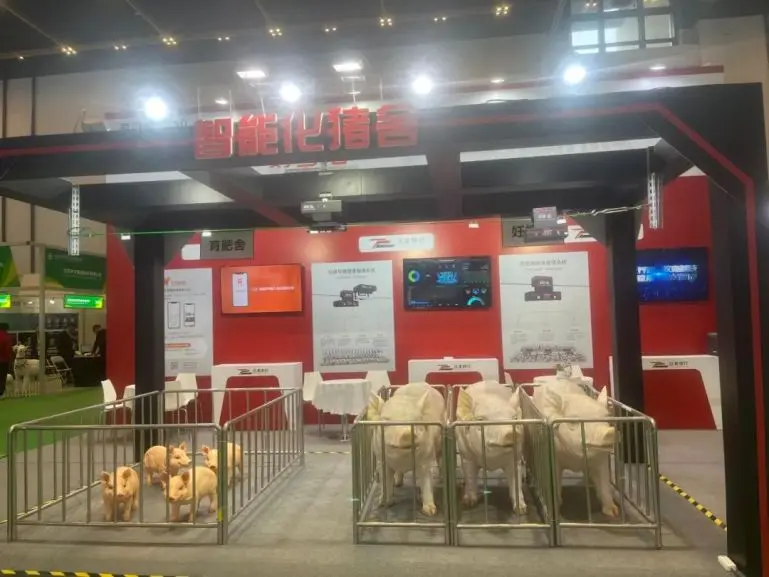
◉ At the agricultural exhibition, various pig companies are keen to show their intelligent level in order to reduce costs and improve production efficiency. Picture|Xie Xiaodan
I found a picture and looked at the so-called abscesses, which looked like lumps growing on the pork. Meat with abscesses cannot be eaten and is not normally sold to consumers, but it is also unclear whether the remaining pork has health risks. But the article at hand did not need to supplement the above information—it was a very regular and ordinary article, involving only the company's recent business development, the trend of the pig cycle, and its performance fluctuations, etc. Even among the many reports on the company, it is extremely ordinary.
I didn't have the energy to follow up for a while. So, I chose to put it aside for the time being and hand in this article first.
In those two years, I spent most of my time writing such macro agricultural articles. Writing about large companies is indeed a good professional training. Tracking business changes and market challenges every day can quickly understand the industry trends, and business is also an important part of understanding how society operates.
However, after writing too many articles about large companies, I am a layman in agriculture, and many reports ultimately cannot break through the framework of macro data analysis and supply and demand discussion.
So when I discovered the "abscesses", I was actually excited. No one had written about this clue. Even from a utilitarian point of view, if I could figure out the problem, maybe I could get the company's public relations to look at me differently—in the past, it was always difficult for me to communicate with this company. They were like "living dead" in my address book. No matter how I called or sent WeChat messages, they wouldn't pay attention. Later, after a colleague wrote an article that "touched" them, we barely established a communication relationship with that company.
But in the end, I still didn't pursue my own clues, probably because I was afraid of difficulties. In any case, the resources at hand could not support me to find people on the slaughter chain to interview, or to really enter a slaughterhouse to find answers. And the deadline for the next article was coming soon.
2. When the Journalist Himself Encountered a Downturn Cycle
After becoming an agricultural journalist, the first topic was to write about the decline in the price of beef and mutton. After interviewing a herder in Inner Mongolia, we became friends. After that, the price of beef fell for a long time, and when I went to see him for the second time, there was nothing to ask. Instead, he asked me if there was any good news recently? I said no. It's really not. In the past two and a half years, most of my topics have more or less involved industry downturns and price declines. The only exception might be the price increase of badminton, and many badminton enthusiasts were therefore lamenting that they couldn't afford to play. However, the price increase of badminton was because the cost of feathers increased, and the cost of feathers increased because the vendors couldn't get the feathers—duck farming was losing money, and many farmers had withdrawn from the market. This clue allowed me to occasionally find a little connection between food and people between data and research reports.
Another example is that in the duck meat industry chain, duck meat is not as valuable as by-products. Because it is not valuable and needs a market, some people will use it to impersonate beef and mutton for sale. A report also said that a lot of duck meat eventually flowed to the group meals of construction sites. In this era when meat, eggs, and milk are not scarce, I realized for the first time that the consumption of meat, eggs, and milk can also be divided into groups.
From this perspective, if I hadn't become an agricultural journalist, I might not have paid attention to the price fluctuations in the vegetable market, nor would I have thought about where these ingredients came from and who they were sold to when buying vegetables online and ordering takeout. However, to question why people no longer buy milk, and why some people eat cheap duck meat, is not necessarily "let them eat cake".
We have a set of commonly used reporting frameworks, one of which is to observe price fluctuations. Price is a very direct handle, which is related to the macro market and can also reflect everyone's daily consumption. Price fluctuations are often due to an imbalance between supply and demand. Coincidentally, the timing when I entered the agricultural field was just the cycle of price decline, which is characterized by oversupply and consumption decline. The surplus comes from the optimistic expectations in the upward cycle. People seem to think that the market will be infinitely large, and almost everyone is increasing investment, looking forward to high returns in the future. But the cold reality is that the upward cycle will end, and people will downgrade their consumption.
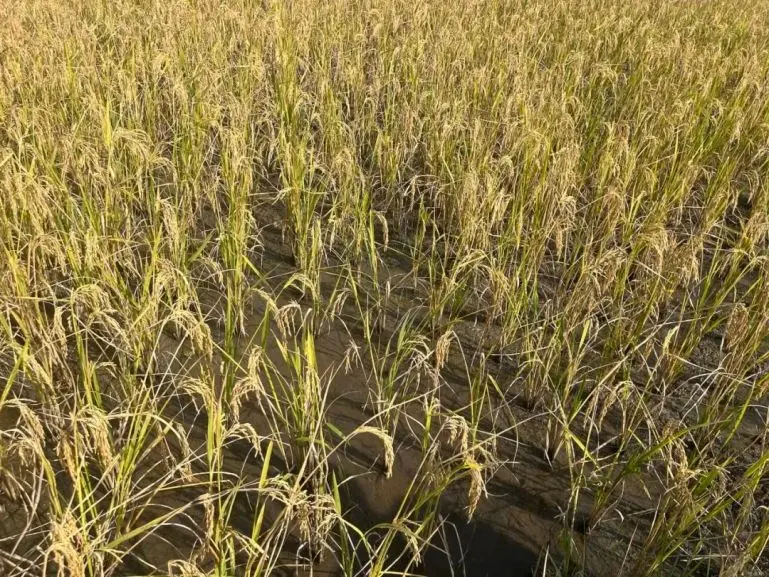
◉ Rice experimental field. Picture|Xie Xiaodan
In the past few years of writing about agriculture, I can see the industry's downturn, and reality often makes me feel low. What's worse, having learned this set of business analysis logic, I can't help but think about my own industry and company. Is being a journalist still a good career? Everyone will almost think about this question and try to find a way out. If the situation in my own line is good, things might be better, like the teachers in the technology media will probably have a better life. The media must protect itself, and it must find more placements and cooperation, and it must also pay more attention to those thriving industries and companies. Even, in recent years, many heavyweight long agricultural articles on the official accounts of mainstream media often come from the soft articles of several Internet companies: how an e-commerce company participates in rural revitalization; how a short video platform promotes agricultural product live streaming with goods; how a large factory uses new technologies to make agriculture look more like a high-tech industry.
But the real farming and pig farming agriculture is obviously not in this list. Every year during the financial report season, the revenue of those agricultural companies is not even as good as the profits of technology and industrial companies. Agricultural companies mostly do not directly face consumers, and they don't need to build brands, so they don't need to cooperate with the media. Plus, my articles, which are just picking up other people's ideas, are really not read by many people, and the traffic is always at the bottom, so I eventually didn't keep my job.
3. Can Standardization Solve All Problems?
In fact, in agricultural reports, there are also many inspiring narratives. A blueberry company introduced to me how to standardize blueberries. Standardization, in simple terms, is to use sensors to continuously monitor data, then use equipment to assist in adjustment, and finally ensure that the fruit trees can get consistent light, water, fertilizer conditions.
This overcomes the problems of traditional agriculture's reliance on the weather and non-standard products, and reduces their operational difficulty. And for consumers, standardization means that buying fruit is no longer like opening a blind box, and the taste will not be good this time and different next time.
I have also seen similar orchards in Zhaotong, Yunnan, and Pinggu, Beijing. The spacing between the trees is not only uniform, but even the shape of the trees is trimmed the same, like a military formation, so that each fruit can get the same sunlight. The fruits also have standard grading, and there are specific machines to sort the fruits, which can ensure the uniformity of size, shape, and even sweetness.
I even experienced a million-dollar smart tractor. When we were still debating whether autonomous driving in the city was safe, this technology had already found a good landing scenario—large-scale farmland. If Clarkson didn't buy a Lamborghini tractor, but bought a tractor with intelligent driving assistance, he wouldn't have plowed the land crookedly at the beginning.
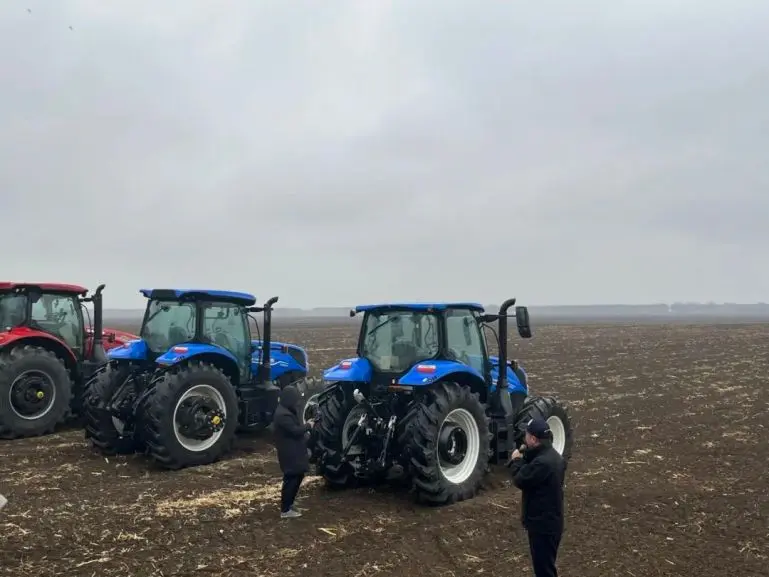
◉ Staff members introduce the million-dollar tractor on the black soil of Northeast China to visitors. Picture|Xie Xiaodan
The same is true for the breeding industry. Today's breeding companies can even accurately know how much feed each pig has eaten through sensors, and then calculate how much meat these feeds can make them grow. This refined operation can effectively reduce feeding costs.
When I first entered agricultural reporting, I was also full of excitement about these stories, thinking that with technological means, agriculture could overcome reliance on the weather, overcome all uncertainties, and ultimately eliminate hunger and make everyone eat better.
In fact, Chinese urban consumers have enjoyed this convenience: living in Beijing, there are stable fresh fruits and vegetables all year round, you can choose to have vegetables delivered to your door, you can choose takeout if you don't want to cook, or you can find a restaurant nearby to solve the problem...
The survival needs seem to be easily met, but the real "eating" is becoming more and more light, neither seeing food nor seeing the production process of food, and waste is no longer something that needs to be ashamed of. "Who knows that the food in the plate is hard-earned" has become a moral constraint that is easily broken, and needs to be educated by the government's "Clean Plate Campaign".
As a consumer, perhaps anxiety can be relieved by more transparent information. But as a journalist, as a link in information transmission, I am even more powerless. Companies will talk about scale, talk about direct sourcing from the origin, talk about order agriculture, talk about QR code traceability... Most of the time, I can only believe their business judgments and solutions, and become a tool for their market education.
But I can't fully embrace that business world. Even from a logical point of view, large-scale production does not really mean safety, it only means that problematic food will appear on a larger scale. Coupled with the huge agricultural product circulation system, the scope involved will be wider.
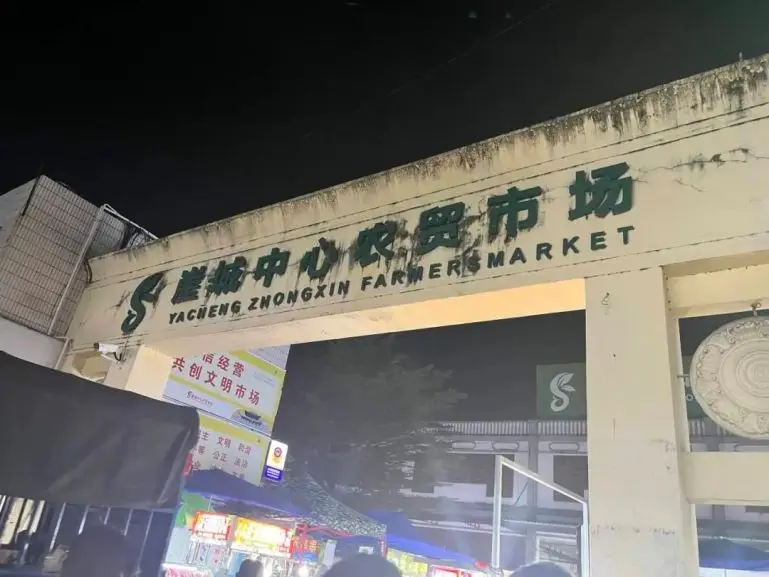
◉ Every city has a few such agricultural markets to meet the needs of citizens' lives, but it is only a hub in the agricultural product circulation system. Picture|Xie Xiaodan
The original intention of the agricultural product circulation system design is to connect scattered small farmers with the huge consumer market. Therefore, starting from the crops on a piece of land, it has to go through origin brokers, fairs, origin wholesalers, and then cross the first-level wholesale market and second-level wholesale market in the sales area, and finally reach supermarkets, agricultural markets or catering companies before reaching the consumers' tables. There are information gaps that cannot be filled between each link. If consumers are troubled by food safety today, every link in this may have done its part. Moreover, this system is too long, and the price increases layer by layer make it difficult for farmers and consumers to benefit.
I also have a kind of unease. In the past, the friend who raised cattle told me that in his hometown, Darhan Mumingan United Banner, Baotou City, many people took returning home to raise cattle as a haven. Today, "returning home to farm" is also a topic that the media likes to do. But after they return home, if they operate agriculture in this way, the cost will be extremely high, and they will have to experience the cyclical fluctuations in agricultural product prices. Is returning home to farm really a way out? If small farmers all withdraw from agriculture, will there really be a better life in the city?
4. My Experimental Field
When writing agricultural articles, I encountered many moments of "let them eat cake" and being a layman. So I changed my way of learning: last year, I rented 10 square meters of land in a shared farm near my residence. After solving the problems of what to plant and how to plant, and finally sowing the seeds into the land, I became anxious again and began to worry about not being able to recover the cost of renting the land.
Of course, the cost cannot be recovered, but it can deepen my understanding of my reporting field a little bit more by taking action.
In late July, when the crops were growing best, I went on a business trip for a total of 9 days. Before leaving, I also asked a friend to help water the plants. Later, I looked at the weather forecast, and it was going to rain continuously in Beijing during that period, so I simply told my friend not to go.
After returning, it rained continuously in Beijing, and the land became particularly muddy, making it impossible to step on it, so I couldn't check the situation of that small piece of land for about half a month. I thought that God would take care of those vegetables for me.
But what I faced was a mess: all the leafy vegetables were dead, the peppers were soaked, and a few tomatoes survived, which could only be said to be barely alive. Only the mint and perilla, which had not been long-term domesticated and cultivated by humans, were still full of vitality after the heavy rain.
In August, it was hot and rainy, and even if I replanted, no vegetables survived. Not only me, but because of the weather, vegetable growers suffered the same heavy losses as me. Last summer, the price of vegetables soared. In the face of climate change, both novices and veterans were almost equally vulnerable.
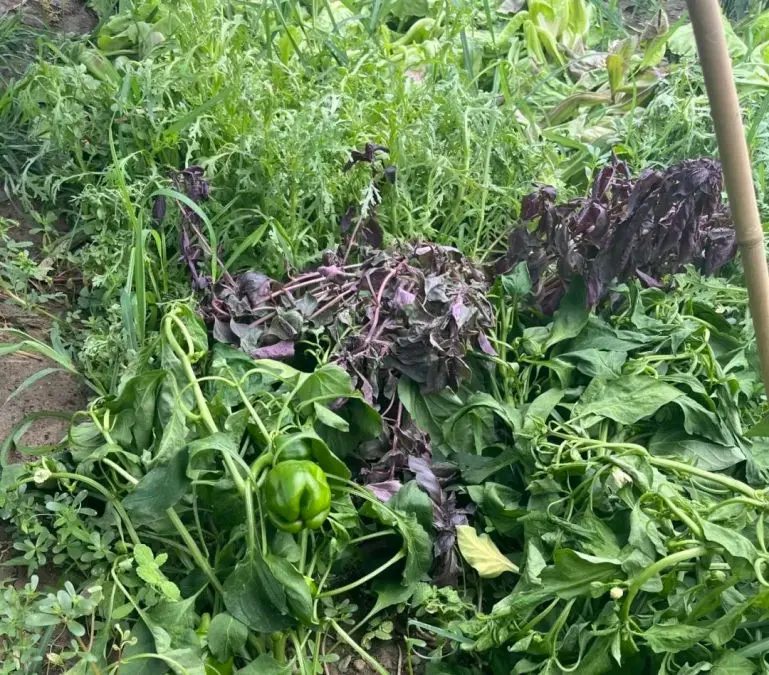
◉ After the high temperature and heavy rain in Beijing in the summer of 2024, the peppers, crown daisies, and lettuce were all wiped out and could not be saved. Picture|Xie Xiaodan
I not only encountered the challenges of the weather, but my body was also devastated by farming.
At the beginning of farming, I decided not to remove the weeds, because I heard that retaining weeds can provide more coverage for the soil, and retaining the roots can also reduce the damage to the growth environment of microorganisms in the soil.
But almost everyone who passed by would ask, why don't you remove the weeds? One day, an old neighbor also stopped and asked me, and I enthusiastically shared the knowledge I had learned.
As a result, he retorted, did you see it on Douyin? His implication was very clear, I was deceived by Douyin. So I continued to argue, but it annoyed him. I failed to repair the neighborly relationship, and after meeting him again on the farm, he never paid attention to me again.
Later, I couldn't resist the pressure and fought with the weeds for a long time. Because of squatting on the ground to remove weeds, my knees suffered from pain, and it was not until this summer that I completely recovered.
Farming, in addition to psychological healing, is of no help to agricultural journalists. In the end, I still have to go back to the business level to think about my own answers.
There are also some new topics in the agricultural field: new farmers returning home, consumer companies intervening in the upstream of planting, and even new agricultural products appearing in hot pot and tea drinks... There are many such topics. However, can these topics really carry agriculture?
When writing about Sun-Kissed Roses, I met an aunt. After I finally convinced her that I was a journalist, she immediately became emotional and scolded the media for being unscrupulous. She said that her family's construction business was cheated out of a lot of money, and she wanted to make a living by growing Sun-Kissed Roses, but she encountered a bad market again. The interview was like adding salt to her wounds.
That day, I messed up the mess, and tried to send her WeChat messages and text messages to remedy the situation, and it took some effort to appease her. She also sent me her husband's number and asked me to talk to him.
I didn't contact them again and deleted all our conversations. At that time, I had accumulated enough planting material, and the topic was also very simple, which was to write about how the Sun-Kissed Rose variety failed, and there was no need to disturb them anymore. Moreover, a light topic could not bear such family pain.
In the past two and a half years, there have been many such moments that have forced me to reflect on what kind of agricultural reports I want to do and how to do it.
Occasionally, I would think of my former leader. He said that our advantage is that we are together with people in the industry every day, so we can understand the changes in the industry more timely. I was touched by this sentence and regarded it as a golden rule.
After coming to agriculture, after writing articles for two and a half years, the face that agriculture presents to me is becoming more and more complex. It is not only a business model, but also a matter of livelihood. It not only has smart agriculture, but also has its traditional side. I am also increasingly unwilling to stay in the framework of business to report on agriculture.
I don't have an answer yet. It's just that I can't write about agriculture in a layman's way anymore. The only method I can think of is the sentence of my former leader, to be with people in the industry every day. I have to get closer.
食通社作者:谢小丹,前农业记者,梦想有一小块地自己种