In a toilet cubicle of less than one square meter, cleaning tools such as mops and brooms lean against the wall in a haphazard manner. Different colored rags, rubber gloves, and clothing hang on the wall. A large black plastic basket is turned upside down on the ground, filled with miscellaneous items, with cardboard on top, holding items such as water cups and lunch boxes. Gray buckets, dustpans, and disinfectant bottles are scattered on the ground. This is where a shopping mall cleaner keeps their tools and rests.
Since March 2025, under the topic of “cleaning staff rest rooms”, these “hidden corners” have been increasingly displayed to people through social media. Besides toilet cubicles, they can also be stairwell corners, washrooms, and power distribution rooms. These spaces are often used by cleaning staff for short breaks, meals, washing, and even sleeping on the floor…
Some netizens said, “Finally I understand why the last cubicle in the toilet is always occupied.” However, more questions followed: “Why aren’t there dedicated cleaning staff rest rooms?” “Why are there security rooms, but no cleaning staff rest rooms?” On the internet, calls for the establishment of cleaning staff rest rooms are overwhelming.
However, whether there is a space to rest may only be the most superficial problem faced by cleaning staff in a systemic dilemma.
“The fundamental right of cleaning staff is not the need for a ‘rest room’, but the right to proper rest, and to increase the hourly wage.” Zhang Xiaoman, the author of “My Mother Does Cleaning”, wrote in a public account post, “But such care is valuable and may more specifically improve the living conditions of a group of people.”
“It smells awful here”**
This is Wang Runjiao’s fourth day of working as a cleaner in a shopping mall in Haidian District, Beijing. When she goes to work, the first cubicle on the left side of the women’s restroom is available for her to use. This tool room was converted from a toilet, with an old toilet in the middle, the water tank has a big hole, the toilet is wrapped with black garbage bags and tape, and various sundries and cleaning tools are placed on the ground in a mess.
Wang Runjiao doesn’t rest here, “It smells awful here.”
58-year-old Wang Runjiao doesn’t mind the hard work. Before the age of 30, she was a primary school teacher. After her husband went to work in the power department, she changed careers to become an electrician, responsible for meter reading and billing. She carried a large ladder and constantly climbed up and down, reading hundreds of households in one morning. “I can endure hardship, it’s just the smell. I’ve never done cleaning in my life. On the first day, I didn’t even eat when I got back.”
She didn’t get used to it at all on the first day, still didn’t get used to it on the second day, and the third day was Saturday, when there were a lot of people, “More than ten people came in at once, and too many people had diarrhea, and they all pooped on the shore, I was so angry that I wanted to cry,” Wang Runjiao said.
Her resting place is a pedestrian passage on the M floor of the shopping mall. During work breaks, she would go there and stand for three or four minutes. Sometimes, when she was really tired, she would pick up a clean piece of cardboard from the trash can and sit on it. Compared to the restroom, she felt that “the smell here is better”. But compared to the bright and clean interior of the shopping mall, the pedestrian passage, which is separated by a wall, has a completely different environment: a small lamp provides the minimum lighting, the black ground doesn’t show its original color, and the walls and stair handrails are covered with stains.
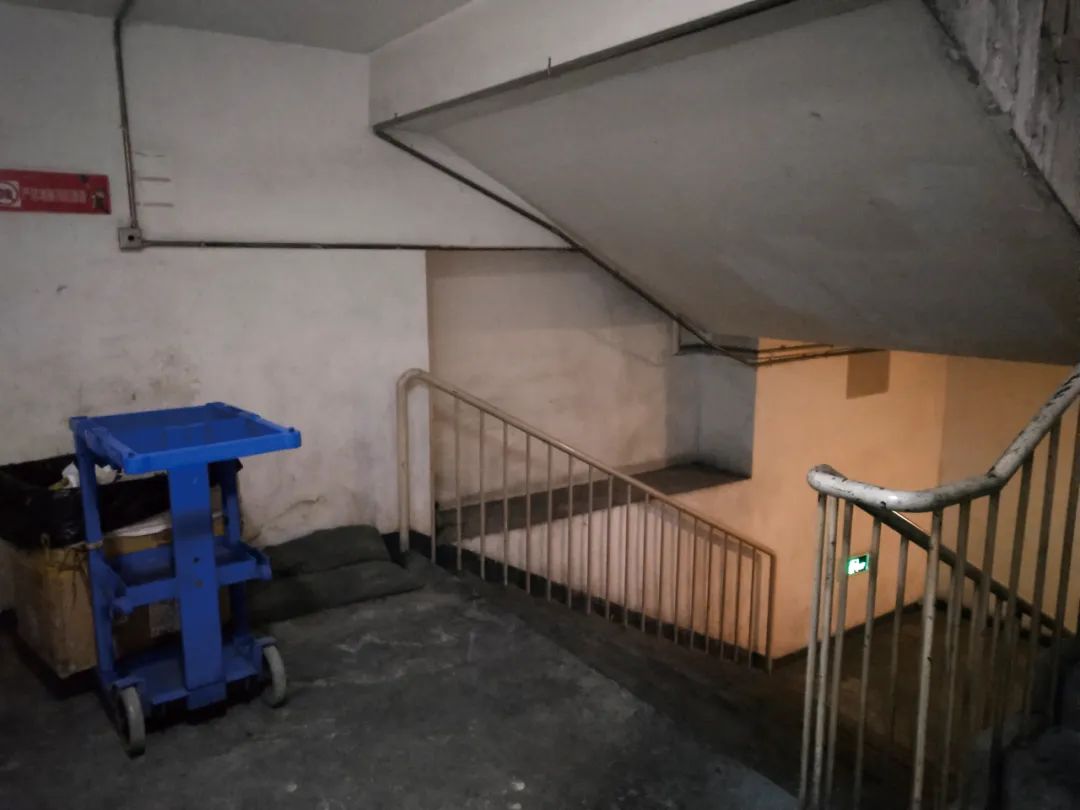
▲ Pedestrian passage where Wang Runjiao rests Photo/Provided by the interviewee
Almost no one goes there, except for colleagues. In addition, sharing this space with Wang Runjiao are the deliverymen who go there to smoke because smoking is prohibited in the shopping mall. Every time she goes to the pedestrian passage to get some air, she will bring a broom and dustpan to clean up the cigarette butts left there. This place also belongs to her scope of work.
60-year-old Liu Na cleans at a university in Haidian District, and she rests in the tool room. This space is hidden behind a small, inconspicuous door next to the tea room, and the fan-shaped area swept by the door is basically the entire area. If someone outside wants to come in, the person inside must stand up before the door can be opened. Liu Na put a small stool behind the door, and although she sat close to the wall, her legs still couldn’t fully stretch. The air in the tool room is stuffy and humid, and a mop is hanging on the washbasin opposite her, still dripping water.
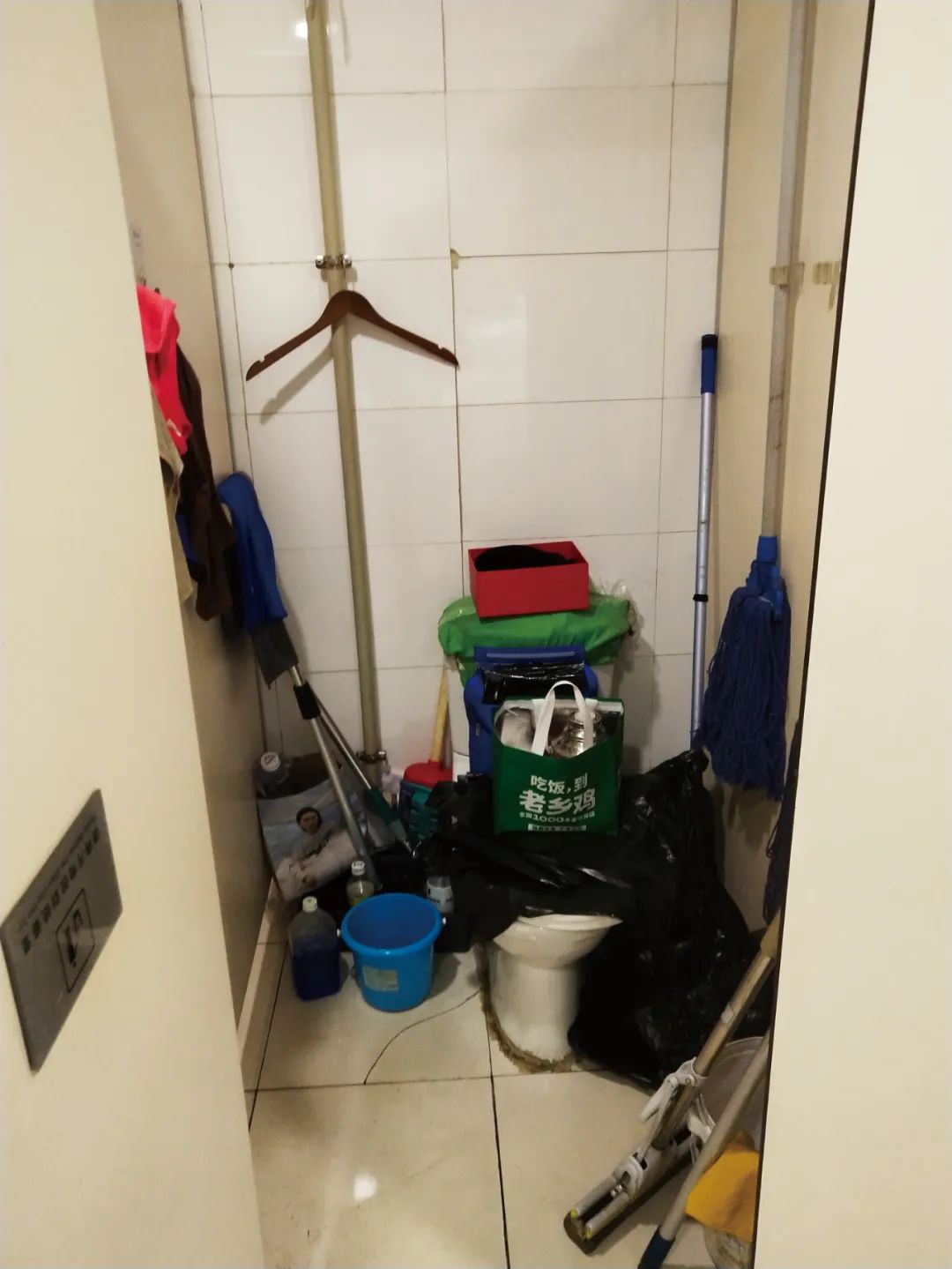
▲ Wang Runjiao’s tool room Photo/Provided by the interviewee
In this multi-functional teaching building, Liu Na is in charge of the fourth floor, and her colleague Huang Bei is in charge of the third floor. “Where do you get to rest? This is the stool I found myself. When I can’t work anymore, I have to sit for a while,” Huang Bei said. According to regulations, the tool room was not originally a place to rest, but everyone turns a blind eye.
Even if the tool room is only used by the cleaning staff themselves, they cannot do as they please. Liu Na previously picked up a piece of soft foam board from the trash can and stuffed it behind the stool to make it more comfortable when leaning against the wall, but the supervisor didn’t allow it. “This is not allowed either, they said it would be rotten and messy,” Liu Na said.
Zhang Xiaoman mentioned in an article on her personal public account that her mother, Chunxiang, had worked as a cleaner in four places in Shenzhen, from shopping malls and government buildings to office buildings, and there were no dedicated rest rooms. “You will find that my mother will use her initiative to find a space to ‘rest’. She doesn’t have much hope for the establishment of a ‘rest room’,” Zhang Xiaoman wrote.
This is the current situation and mentality of most cleaning staff. When asked whether it is possible to set up a rest room, Wang Runjiao instinctively said “Hey” and said lightly, “There isn’t even a place to drink water.” The places to drink water and eat are all on the B2 floor, and Wang Runjiao is in charge of the M floor. Except for lunch and dinner, she doesn’t have time to go down. But she doesn’t plan to fight for it with her superiors either, “Who am I going to talk to? Everyone is the same. One day is one day, why should I offend people?”
Online, people’s vision for “a cleaning staff rest room with dignity” is: equipped with 24-hour hot water and lockable storage cabinets, folding beds with cushions, medicine cabinets and charging sockets, and a microwave oven that can heat lunch boxes. Zhang Xiaoman sent the netizens’ suggestions to her mother, Chunxiang, and her mother’s reply was: Dream on, daughter (Shaanxi dialect, referring to daughter).
Overwork and control
Also working as a cleaner at the university, Huang Bei and Liu Na’s work attendance time is 5:30 in the morning, but they usually arrive 20 minutes earlier so that they can start working on time at 5:30. When they arrive at the floor they are in charge of, the first thing Liu Na has to do is to put all the tables and chairs in the leisure area and classrooms back in their original positions, “Horizontal is fine, vertical is fine, they all have to be arranged in that shape.” After arranging them, she also has to wipe the tables and take out the trash from the table holes, “Those table holes are not easy to take out, some people put everything in them when they eat, it’s a bit troublesome.”
There are more than a dozen classrooms and two leisure areas on one floor. Liu Na designed her own route of action and the order of operations to ensure that she doesn’t waste time.
After doing these things, it’s basically time for breakfast. For three meals a day, their meal times are also very limited. “You go out to eat, and then come back, half an hour at most,” Huang Bei said.
When they come back, they have to start cleaning the toilets. Usually at this time, students have already started to go to the classrooms for self-study. There are four restrooms on one floor, two large and two small. Huang Bei often sweeps the two large ones first, then goes to the small ones. When she finishes the small ones and comes back, the large ones are dirty again. “Can it be done in time? It can’t be done in time at all.”
The strict requirements also make Huang Bei feel miserable. The supervisor’s requirement for the floor is “always bright”, “with very little hair”. Huang Bei pointed to the large blue mop in the tool room and said to me, “With that big mop, I mop four times a day, and it’s full of hair, it’s endless.”
Liu Na told me that mopping the floor is also divided into “big mop” and “small mop”. The “big mop” is used four times a day, and you need to carry a bucket of water and mop while walking. You can only clean the hair with the big mop after mopping, otherwise “it will turn black with one push”. The “small mop” has no fixed number, and you mop wherever it’s dirty. Because there are escalators on the third and fourth floors, the flow of people is particularly large. Huang Bei and Liu Na often clean the floor, and it’s dirty again after being stepped on by passers-by.
Liu Na feels that mopping the floor is “like shoveling the ground in the countryside”, where you have to use force, arms, waist, and legs, “there is no good place”. Liu Na needs to keep bending over, wiping tables, mopping the floor, scrubbing toilets, and picking up trash, and so on. Her eyes will always be fixed on the ground, and when she walks, she often squats down without warning, using her fingers to wipe various unexpected stains on the floor.
Rest can only be done in between. Huang Bei can only sit on the small stool in the tool room for ten minutes at most before she has to go out and “patrol”, “can’t be away from people all the time”. Sometimes the tea leaves in the tea room are full, sometimes the toilet smells, and sometimes the toilet paper in the restroom is gone. “You have to patrol for a while, move for a while, and wipe for a while,” Huang Bei said.
When Liu Na goes to the restroom to change the paper, she always holds a rag in her hand, and wipes the stains and water stains on the washbasin. The “Cleaning Standards” posted on the wall of the restroom are very general. In a nutshell, it is to keep it clean, and the amount of labor that has to be paid behind this cannot be estimated.
These jobs have to last from 5:30 in the morning until 8:00 in the evening, with a working time of more than 12 hours. Huang Bei said that even if she only walks around on this floor, she can reach more than 20,000 steps a day, “My legs are getting thinner from walking.” Liu Na lost weight from 150 catties to 130 catties after working here for a year. She thinks it’s “from exercise”. Another colleague of hers is even more exaggerated, losing 20 catties in two months, “Her back was so wide before, just like this door, but now it’s narrow,” Liu Na gestured.
They have to work seven days a week. The so-called “rest day” is just finding someone to take over the job, and they can have a few hours to go back to the dormitory to tidy up their personal belongings. When she worked at another university, Liu Na could rest for four days a month, and she would travel with her colleagues. Since she came to this school, Liu Na has only been to the nearby shopping mall at the farthest. She also goes back to her hometown in Liaoning less often, “I don’t go home for ordinary weddings and funerals” because it’s troublesome to go back and forth, and it also delays work. She only goes back during the Spring Festival, but they don’t even give statutory holidays here during the Spring Festival, “Anyway, if you don’t work, you won’t get paid.”
Wang Runjiao’s working hours are from 8:00 in the morning to 10:00 in the evening. In addition to the long working hours, there are also various restrictions.
Her scope of work is half of the M floor hall of the shopping mall, plus the women’s restroom and four pedestrian passages. There is a sign-in sheet for each work area, and you have to sign in every hour. It’s not okay if you’re short, long, early, or late. While waiting for the elevator, Wang Runjiao, who had finished dinner, took out her phone and looked at the time. It was already 17:49. She put down her phone and murmured, “I should have left at 45 minutes, and I stayed there for four more minutes.”
There are several people on each floor of the shopping mall taking turns patrolling. Wang Runjiao needs to make sure she is on duty during the inspection. Usually, she doesn’t dare to rest in the pedestrian passage for too long, “I secretly stood there for three or four minutes, and quickly ran away. I don’t dare to leave, once I leave, people will check the duty.” The supervisor notified her to come for inspection at 8:00 in the evening yesterday. After eating at 5:30, she had been mopping and sweeping in the restroom and the hall, but no one came until 9:00.
In these areas, the most important thing is the restroom, followed by the floor of the hall. According to regulations, after the hall floor is mopped with a wet mop, it must be immediately dried with a dry mop to prevent pedestrians from falling. The temperature has been high these days, and the ground dries quickly, so Wang Runjiao didn’t follow the requirements, “I don’t dare to let them see.”
The M floor hall is a corridor. In the area Wang Ruijiao is in charge of, there are clothing stores on the left and beverage stores on the right. Sugary drinks give her a particular headache, as they are very difficult to clean up when spilled on the ground. She heard that there are more food and drinks on the B1 floor and the fourth floor, “I haven’t been there in the past few days, I don’t have time, I’m afraid people will see it and make trouble.”
In fact, there is a dedicated rest area on the M floor, with more than a dozen chairs for people to rest, which is only five or six meters away from the pedestrian passage where she rests. But she never goes to the rest area to rest, or rather, she doesn’t dare to. “There are surveillance cameras there, and you’ll be seen in the surveillance cameras wearing these clothes,” Wang Runjiao said.
“The key problems of cleaning work are overwork and control, which is to make the work completely a drudgery, with no rest time at all.” Zhang Xiaoman wrote in the article.
Love Warm House
Jiang Yixin, a student at East China University of Political Science and Law, recently found that the rest environment of the cleaning staff is far worse than what she has seen with her own eyes.
At school, she has seen cleaning staff resting in various places, such as the narrow corners formed by the stairs and the ground in the dormitory area, behind the electrical boxes in the library, and the public tables and chairs area in the teaching building. Jiang Yixin recalled: “I actually talked to the aunties about this issue before, and they said it was fine for them to eat in this place. I thought they also had the consideration of a private space, so I accepted this answer.”
At first, she didn’t react much to the topic of cleaning staff rest rooms. After various “rest rooms” appeared on social media, she realized that “the situation is very common and very serious”, “many posts were beyond my expectations, and it was very distressing to read.”
Jiang Yixin decided to write a letter to the school’s principal’s mailbox, which is the fastest and most effective way she could think of. She didn’t know how many people around her were paying attention to this matter, “I felt that one person’s power was really small at the time, but it’s better to do it than not to do it, even if there is a little change.” Later, she learned that there were many “like-minded people” who were paying attention to this issue and taking action with her.
What impressed Jiang Yixin the most was a student who delivered a handwritten letter. The letter not only put forward opinions, but also attached observations and interviews with the cleaning staff. In addition to ordinary students, the representatives of the student representative conference of East China University of Political Science and Law also submitted a proposal on the establishment of cleaning staff rest rooms after investigation.
In the past half month, students from universities in Beijing, Zhejiang, Hunan, Guangdong and other places have called on schools to set up rest rooms for cleaning staff, and more and more people in society have joined in.
A netizen from Baotou City, Inner Mongolia, reported that after she proposed to set up cleaning staff rest rooms in public areas on the Inner Mongolia government affairs App, she soon received phone feedback from the local hospital and cinema management departments, indicating that staff had investigated and implemented the equipment of cleaning staff rest rooms.
A netizen from Shanghai posted that after she suggested to her boss, the company immediately set up a temporary workstation for the cleaning aunties in the sanitary napkin self-service area, and the administrative department will also redecorate the empty room into a dedicated rest room.
The speed of the school’s actions also surprised Jiang Yixin. She wrote a letter to the principal’s mailbox on March 12, 2025, and was invited to attend the unveiling ceremony of the rest room on the 21st. The new rest room is located in Building 6 of the dormitory area, which was converted from a classroom and equipped with facilities such as air conditioning, water dispensers, microwave ovens, tables and chairs. “In my concept, the establishment of a rest room must involve multiple parties, and it may take a month or two. I didn’t expect this matter to be implemented so quickly,” Jiang Yixin said.
The rest room in front of her is slightly different from the proposal in Jiang Yixin’s letter. The indoor facilities lack the folding beds and lockable cabinets that “the current regulations do not allow”, but there are more air conditioners and water dispensers.
Another difference lies in the name of the rest room. Jiang Yixin didn’t expect it to be named “Love Warm House”. “We won’t say that the security room is the ‘Love Warm House’ for the security guards, nor will we say that the dormitory management room is the ‘Love Warm House’ for the dormitory aunties,” Jiang Yixin said. “Just call it a cleaning staff rest room, it’s a normal thing. A normal profession needs such a rest space, which is a basic right of a worker.”
After the Love Warm House was put into use, Jiang Yixin found that the cleaning aunties in the dormitory area still habitually rested in the tool room in the corner of the stairs. She speculated that this was because the rest rooms in the dormitory area were still too few, “the aunties have to walk a long way”, and on the other hand, the cleaning aunties sometimes just want to be alone for a while.
Lin Long, a teacher from the logistics department of East China University of Political Science and Law, said in an interview that “Love Warm House” is just the beginning, and there will be plans to solve the rest problems of cleaning staff in other areas.
Jiang Yixin wrote a post about her experience of attending the unveiling ceremony. In the comment section, some netizens called for attention to the salary issue of the cleaning staff. Judging from the cleaning staff recruitment information online, the salary of the cleaning staff is basically between 3,500 yuan and 4,500 yuan, which is similar to the situation of Liu Na and others. Jiang Yixin admitted frankly, “The salary issue involves too many aspects, and it requires everyone’s more attention and action.”
In Jiang Yixin’s view, in addition to providing a place for cleaning staff to rest, the more important significance of establishing a cleaning staff rest room is to “let more people realize the possibility of change and the importance of speaking out”. She believes that “if we improve our sensitivity and pay attention to things outside of our own little world, this matter is very likely to change from a small matter that no one cares about into a major event that causes widespread changes in society.”
She gave an example that if an architect sees this matter, they may realize that the rest area for the cleaning staff is missing in the architectural design, and improve this problem in the next design process. The cleaning staff rest room may be added to the design drawings and eventually become a standard configuration.
“When one thing can be seen, other things have the possibility of being seen. This is a beginning.”
(Wang Runjiao, Liu Na, and Huang Bei are pseudonyms.)
Discover more from 自由档案馆
Subscribe to get the latest posts sent to your email.