

Si Ma Nan, whenever he does a live broadcast, says: I am a Chinese citizen, a Beijing citizen, and a resident of Dongcheng District, Beijing, Si Ma Nan. However, Si Ma Nan is not his real name; his original name is Yu Li. Yu Li was born in the Great Northern Wilderness—Anda County, near Daqing, Heilongjiang. Just hearing this name, one knows he is a descendant of Shandong immigrants who migrated to the Northeast.
Si Ma Nan's youth was difficult. His parents passed away before he was 15, and he and his younger sister depended on each other for survival. After the resumption of the college entrance examination, he was admitted to Heilongjiang Business College. After graduating from university, he was assigned to work in the Education Department of the Ministry of Commerce. After a few years, he transferred to the China Business and Trade magazine under the Ministry of Commerce, where he served as a chief writer and producer. His skill in managing media and public opinion was probably developed during this time.
In the late 1980s, qigong fever and special functions began to rise. Si Ma Nan became famous in society as a fighter against fake practices. Especially in exposing Falun Gong, Si Ma Nan became a household name nationwide. For a long time, many evil and money-making things appeared under the guise of super science or traditional national essence. Now, many people with high academic qualifications still believe in these things. It should be said that Si Ma Nan at that time exposed these liars (many "masters" were backed by high-ranking officials, and even Mr. Qian Xuesen was a believer in special functions) one by one, and he was a hero and a meritorious official of society.
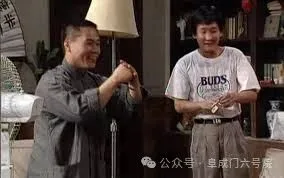
(Si Ma Nan guest-starred in "I Love My Family" to expose the tricks of qigong masters)
In 2003, Si Ma Nan ran for a People's Congress representative of Dongcheng District as an independent candidate, which was actually a challenge to the traditional political system. At this time, Si Ma Nan played the role of a spokesperson for the people's power. Based on his experience in participating in politics, he later wrote the book "40 Articles on Democratic Hutong." The word "democracy" is so striking, and how different it is from Si Ma Nan's later remarks!
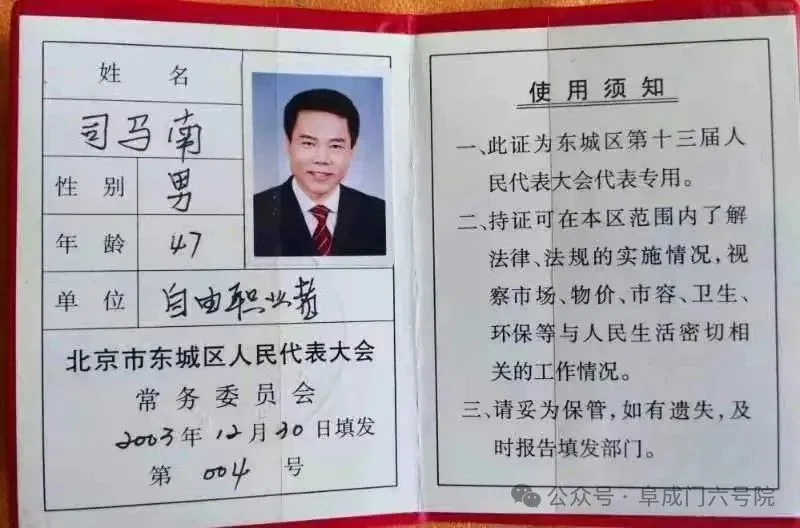
Around the late 2000s, Si Ma Nan's political inclination suddenly took a 180-degree turn and began to follow nationalism. The most famous thing was becoming a cheerleader for the "Chongqing Model." His masterpiece "New Songs of Chongqing" still makes people feel nauseous when reading it. This article excerpts a part for everyone's appreciation:
Chongqing Chongqing, every ninth is fortunate, zero nine sweeps away the darkness, Xi Lai Xi Rang,
Five eight enters Yu, five nine goes forward, why fear a husband, hear its sound.
Citizens secretly rejoice, the outline is clear: Qiu He's weak fire, Xi Lai's whirlwind.
Moral high ground, a gentleman's model, righteousness is overwhelming, Xi City is clear,
The secretary is outstanding, a man's style. Xi Lai Xi Lai, everyone's expectations,
Hope hope, new life new life!
Note: "Five eight enters Yu" refers to someone coming to Chongqing at the age of 58 to take charge.
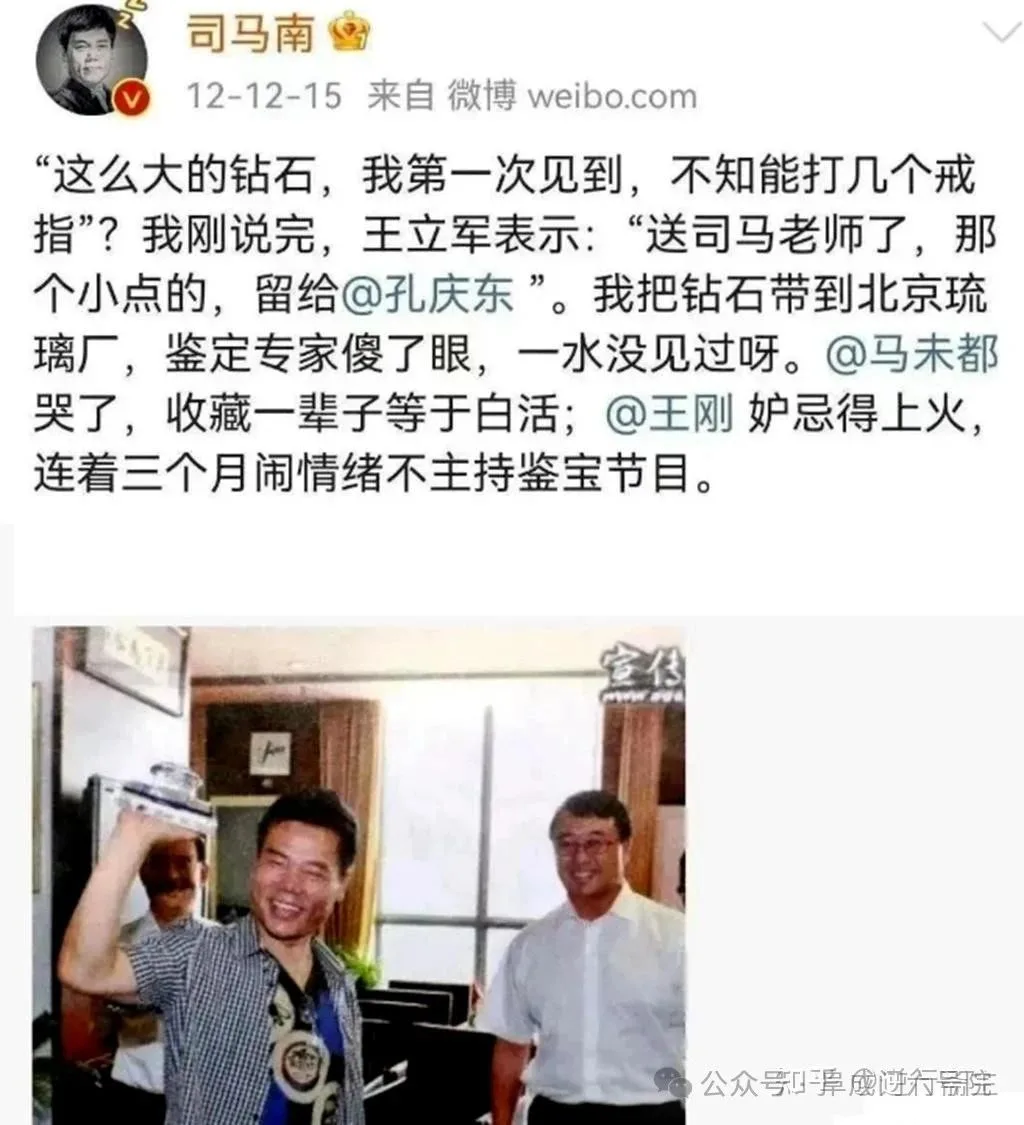
Another magic weapon for Si Ma Nan to earn traffic at that time was to insult Hu Yaobang. Si Ma Nan's father-in-law was Liu Shaotang, a great writer. Our middle school textbook "Elm Money Rice" is his work. Liu Shaotang knew Hu Yaobang in his youth and worked under him. In 1957, he was convicted for his words and was labeled as a rightist, expelled from the party and his position. Hu Yaobang cherished his talent and, without avoiding suspicion, still invited him to talk and encouraged him, telling him: "Take courage, and you will be a good man again after twenty years." In 1962, Liu Shaotang wrote a letter to Hu Yaobang, hoping to go to Beijing Normal University to teach. Hu Yaobang personally wrote a letter to Liu Ren, the secretary of the Beijing Municipal Party Committee, to plead for Liu Shaotang.
Hu was a member of the Central Committee and an old revolutionary. Liu Shaotang was a young man who had just started out and fell into the abyss. Hu treated Liu Shaotang with utmost care. After Hu Yaobang resumed his work in 1977, he invited Liu Shaotang to his home to chat, and he said at the beginning: "I never thought you were a rightist! Nor were Tan Tianrong and others!" And at that time, the Central Committee had not yet rehabilitated the rightists. In 1989, when Hu Yaobang passed away, Liu Shaotang, due to his inconvenience, specially asked his son to come to his home to pay his respects and wrote the elegy "Friend of the People, Friend of Freedom and Democracy, Mr. Hu Yaobang Forever."
Speaking of this digression, let's return to the main topic of this article, Mr. Si Ma himself. Of course, the father's generation and the son's generation, Hu was kind to Liu Shaotang, and we cannot ask Si Ma Nan to repay the kindness. However, Mr. Si Ma should know the moral character of Mr. Hu from his father-in-law and even his wife. However, in the years before 2012, Mr. Si Ma used all his strength to spread rumors and smear Mr. Hu, saying that Mr. Hu messed up China. Isn't he ashamed of his conscience? Is he being instructed by someone? Without this person, Mr. Si Ma's family might still be in the countryside undergoing labor reform.
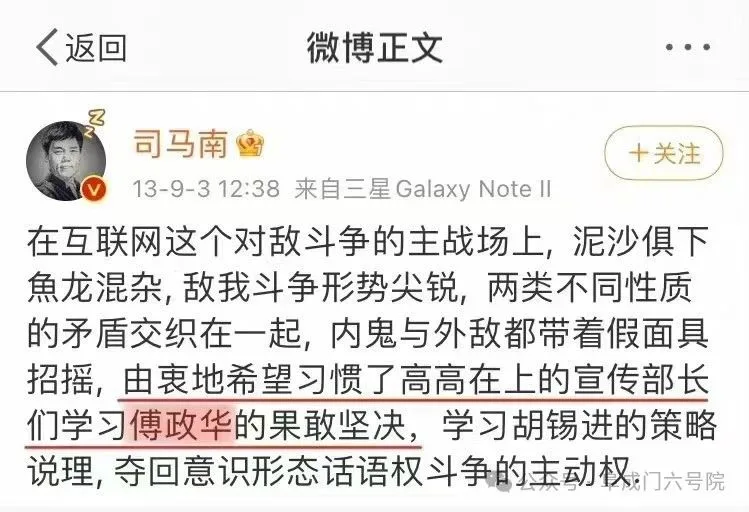
Later, Si Ma Nan made a new high-ranking official friend, whose name was Fu Zhenghua. Si Ma Nan couldn't help but throw a hint to this popular figure when he posted on Weibo. However, ten years later, when Fu Zhenghua was removed from his post, Si Ma Nan wrote several articles to scold him, such as "Sun Lijun, Fu Zhenghua, Wang Like, Didn't Finish a Bowl of Soy Milk" and "Fu Zhenghua's Tragic Thoughts."
Later, Si Ma Nan's fame grew, and his total platform fans exceeded 70 million, even more than Trump. A video would easily get over 100 million views, and he would point out the country every day, quite powerful. Any enterprise or public figure was afraid of being commented on by Si Ma Nan; the stock price would fall for the less serious, and they would become public enemies for the more serious.
He was also given the titles of "flagship figure of the patriotic camp," "spokesperson for the people's interests," and "anti-capitalist fighter." On the one hand, public opinion was calling for everyone to beat him, and on the other hand, some public opinion forces were determined to defend him, even calling him a contemporary "Yuan Chonghuan." If Si Ma Nan was banned, justice in China would not exist.
However, what goes around comes around. Last year, Si Ma Nan was banned from all platforms. Today, major official media outlets jointly reposted the news of the Beijing Taxation Bureau's investigation of his tax evasion. Judging from the public opinion response, the number of reposts definitely exceeded that of the news of corruption investigations of general national leaders, and everyone was in the mood of "a great event that makes people happy" in October 1976, rushing to tell each other about this matter. This shows the people's hearts: everyone does not want populism, does not want alienated patriotism, and does not want hostility. Our society needs to adhere to the bottom line of market economy, reform and opening up, the rule of law, and gentleness and rationality.
However, the Si Ma Nan incident also left many deeper problems, which are worth our consideration:
- According to the amount of tax recovered from Si Ma Nan, he should have made a lot of money in these years, and he might really be able to buy a courtyard in Dongcheng District, Beijing. "Patriotism" is really a good business! If you have tens of millions of fans, your annual income can be more than that of most listed companies. The emotions of the masses are really cheap! Regardless of the fact that everyone exposed that Si Ma Nan was making money in China through live broadcasts and buying houses in the United States and his family obtaining US citizenship, tens of millions of people still love him.
- After Si Ma Nan became popular, many local governments and well-known enterprises invited him to be a local spokesperson. A provincial TV station invited him to recite poems at the New Year's Gala, and some universities gave him honorary professor appointments. Did everyone really not distinguish between good and evil? Were they really disregarding everything for the sake of traffic?
- How should our society create a correct patriotic atmosphere? Many people laugh at patriotism, believing that it is a pre-modern thing, which the author does not agree with. But our patriotism must be based on correct and rational judgment, an independent personality, and a love for the country from the heart, rather than Si Ma Nan's way of completely placing the individual in a subordinate position to the country, or even relying on defining some people as the opposite of not loving the country, and expressing his love for the country through struggle. This kind of aggressive patriotism can only cause social division and harm the country.
- Recently, the social regression in the United States and Europe shows that the biggest risk in the world in the next one or two decades is populism, which may benefit from the contradictions accumulated in the past few decades of human history, and it will carry public opinion and cause great disasters to mankind. Today, in addition to saying "Farewell! Si Ma Nan," what else should we do to safeguard the harmony, stability, and moral bottom line of our society?