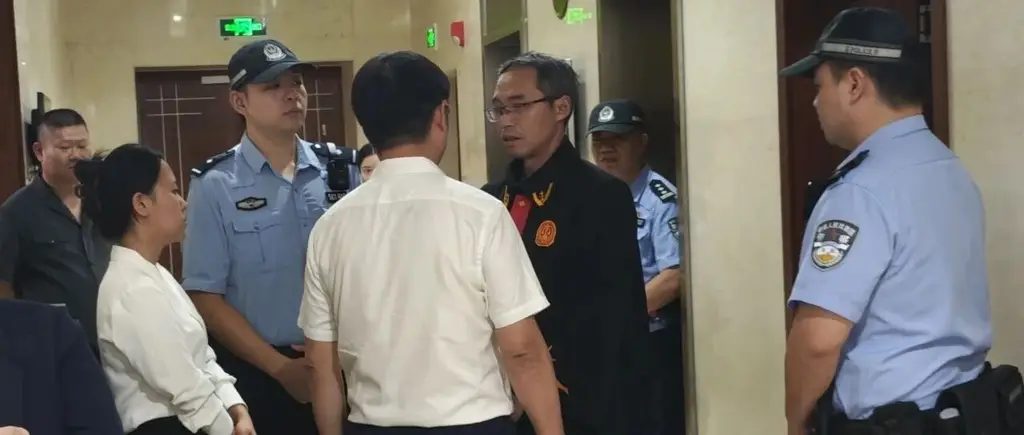
Zhu Hengpeng, the deputy director of the Institute of Economics at the Chinese Academy of Social Sciences, has been arrested. The earliest report of this news came from a Hong Kong newspaper called Sing Tao Daily. It published a message on September 16th, saying that Zhu Hengpeng was arrested for making inappropriate remarks about the central government in a WeChat group. I didn’t quite believe it when I saw this news, because Zhu Hengpeng is considered a scholar of the official type, the deputy director of the Institute of Economics at the Chinese Academy of Social Sciences, a deputy bureau-level cadre. Was he arrested just for making a few remarks about the central government?
I have to say that I am quite familiar with Zhu Hengpeng. I interviewed him several times when I was in China, and we also had meals together. At that time, there were some domestic economic policies, especially his research on health economics, involving issues such as elderly care, and I often consulted him. I also have his contact information, so after seeing this news, I sent him a WeChat message. I asked Director Zhu what was going on, that there were rumors that he had been arrested, but he didn’t reply. I felt something was wrong, so I checked and found that Zhu Hengpeng’s last public appearance this year was on April 25th. He participated in the China Elderly Care Industry Forum organized by Caixin Media and gave a speech at the forum. Then, on May 25th, Tsinghua University held an academic annual conference, and one of the forums was called “Structural Reform and Social Security System.” The prior announcement stated that Zhu Hengpeng would speak, but on May 25th, he did not appear, and his speech was replaced by another scholar.
From then on, Zhu Hengpeng disappeared.
In July, the personnel of the Institute of Economics of the Chinese Academy of Social Sciences, where Zhu Hengpeng worked, began a major reshuffle. First, Wang Lisheng, the Party Secretary of the Institute of Economics, was removed from his position. Wang Lisheng was originally the Party Secretary and Deputy Director, but after being removed, he was left with only the Deputy Director position. So who would be the Party Secretary? Gong Yun, the Party Secretary of the Institute of Finance, was transferred to the Institute of Economics as the Party Secretary. Huang Qunhui, the director of the Institute of Economics, was also transferred to the Institute of Finance as the director. At the same time, Song Hong, the deputy director of the Research Bureau of the Chinese Academy of Social Sciences, was also transferred to the Institute of Economics as the deputy director. People familiar with the logic of the Chinese officialdom know from this personnel adjustment that the Institute of Economics must have had problems, and all the original leadership was replaced.
Against this background, I checked the situation with friends in China. As a result, I learned that Zhu Hengpeng had drunk too much one day this spring and was talking in a WeChat group. He first cursed Putin, calling him a war criminal, and after cursing him, he started talking about Xi Jinping. Although he didn’t directly name Xi Jinping, he used some common domestic substitutes. Because the Chinese economy was very bad this year, as an economic research scholar, he felt that this was caused by Xi Jinping’s policies. So he complained a few times, saying some unpleasant things, and also mentioned life and death issues. After saying these words, he went to sleep.
As everyone knows, the speeches in WeChat groups are now transparent, and the information of WeChat groups with more than five people is all under the surveillance of the CCP. The Beijing police detected that someone in the WeChat group was cursing Xi Jinping, and followed the clues to arrest Zhu Hengpeng. At first, it was just detention, after all, he only said a few words, not a major case. But after an investigation, it was found that Zhu Hengpeng had a special identity, he was the deputy director of the Institute of Economics of the Chinese Academy of Social Sciences, a deputy bureau-level cadre, so the case was reported layer by layer, and finally reported to Cai Qi. After Cai Qi’s instructions, the detention was changed to arrest. After that, the police began to investigate Zhu Hengpeng’s research funding issues. As the deputy director, Zhu Hengpeng controlled a lot of research project funds, and it was not difficult to investigate these. If it is believed that he has problems, then all expenses may be considered as the use of public funds for private use. For example, buying two computers, if there is no problem, it is normal use, but if there is a problem, it is embezzlement of public funds. When traveling on business, if there is no problem, it is an academic report, but if there is a problem, it is the abuse of research funds. In the end, Zhu Hengpeng was charged with abusing research funds. It is not easy for him to find a lawyer now, because the case is difficult to defend. The prosecution will not mention his cursing of Xi Jinping, but will only talk about the research funding issue. If the defense side mentions the cursing of Xi Jinping, then it will definitely not be able to win the research funding issue.
Zhu Hengpeng’s incident reminds me of the systemic risks of CCP think tank scholars. The CCP’s think tanks are divided into two levels, one is the internal party think tank, and the other is the national-level think tank. The highest level of the internal party think tank is the Policy Research Office of the Central Committee of the Communist Party of China, located in Zhongnanhai, and the deputy directors are all ministerial-level officials. The Policy Research Office of the Central Committee of the Communist Party of China is not only a think tank, but also produces high-ranking officials, such as Chen Boda and Wang Huning. Wang Huning, who graduated from Fudan University, was transferred to Beijing by Jiang Zemin to work in the Policy Research Office of the Central Committee of the Communist Party of China, and eventually became a national-level official, the Chairman of the CPPCC. Wang Huning is known as the CCP’s theoretical master, because since the reform and opening up, the Communist Party’s theoretical innovation has basically come from him, such as the scientific outlook on development, the Three Represents, and a harmonious society. In addition, the internal party think tanks also include the China Rural Policy Research Office, etc.
The national-level think tanks are mainly the Development Research Center of the State Council and the Chinese Academy of Social Sciences. The Development Research Center of the State Council was established in 1980 and merged multiple research institutes, including the China Rural Policy Research Office. The Chinese Academy of Social Sciences is also a ministerial-level unit, with a large scale, with 4,000 researchers, of which 3,200 are researchers and associate researchers. The Chinese Academy of Social Sciences is not only an academic institution, but also the CCP’s think tank, and its research level is among the best in China. For example, the journal “Historical Research” of the Institute of History, and the journal “Economic Research” of the Institute of Economics, are all top academic journals in the country.
Due to the dual identity of the Chinese Academy of Social Sciences as both an academic and a think tank, this brings some systemic risks. For example, the Chinese Academy of Social Sciences once had a spy case, the more famous one was the Jin Xide case. Jin Xide was the deputy director of the Institute of Japanese Studies of the Chinese Academy of Social Sciences, and he had been a guest on CCTV many times. Later, he was sentenced to 14 years in prison for espionage for leaking information about the health of North Korea’s Kim Jong-il to Japan and South Korea.
Zhu Hengpeng’s dual identity as a scholar and a think tank ultimately led to his tragedy. He usually studies health economics and elderly care, and has published many high-level papers. As a scholar, he proposed the view that the Sanming medical reform model is unsustainable with an academic neutral attitude, and criticized the practices of lowering drug prices through political force. However, Xi Jinping once personally affirmed the Sanming medical reform, so Zhu Hengpeng’s criticism was tantamount to going against the top leadership.
In Zhu Hengpeng’s last public speech on April 25th, he also put forward his views on the unfairness of China’s pension system. He listed the huge gap between the pensions of urban and rural residents, enterprise retirees, and those in government and public institutions, and pointed out the problems under this unfair system. His research and suggestions, although well-founded, are in great conflict with the CCP’s policies.
In the end, the conflict between Zhu Hengpeng’s identity as a scholar and a think tank, coupled with his drunken remarks in the WeChat group, led to his fate today. The CCP is now using Zhu Hengpeng’s example to warn other scholars, and the academic atmosphere of the Chinese Academy of Social Sciences is gradually declining, and scholars are being asked to become the party’s tools. Zhu Hengpeng’s tragedy is actually a metaphor for the gradual loss of academic independence of the entire Chinese Academy of Social Sciences.
Discover more from 自由档案馆
Subscribe to get the latest posts sent to your email.