
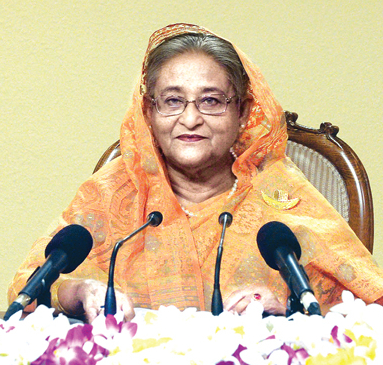
In the political arena of Bangladesh, Sheikh Hasina and her Awami League have dominated the political stage for over a decade. Despite nominally maintaining a democratic system, the rule of Hasina’s government is increasingly leaning towards authoritarianism. Allegations of fraud in elections, suppression of the opposition, and control of the media have made the political environment in this country increasingly harsh. Currently, Hasina has fled to India, and on January 11th of this year, Xi Jinping just sent a congratulatory message to Hasina on her election and re-election as Prime Minister of Bangladesh.
In the past few years, China has injected billions of dollars in loans into Bangladesh through the “Belt and Road” initiative. These loans are mainly used for infrastructure construction, including large projects such as the Padma Bridge rail link and the Karnaphuli River underwater tunnel. On the surface, these projects have improved Bangladesh’s infrastructure level and provided strong support for its economic development. But the problem is that these funds are not free aid, but loans that need to be repaid. And once the current regime collapses, whether the new government will continue to fulfill these loan agreements becomes a huge question mark.
Padma Bridge rail link project: Total amount $2.667 billion.
Karnaphuli River underwater tunnel project: Total amount $705.8 million.
Dhaka-Ashulia Elevated Expressway project: Total amount $1.12 billion.
Single Point Mooring project: Total amount $465.46 million.
ICT infrastructure network project: Total amount $156.56 million.
Southern Comprehensive Development Plan (SIDI): Expected amount $1.5 billion.
These projects only show part of the loans Bangladesh received from China, but may not include all loan projects. Overall, as of 2024, the amount of loan agreements signed between Bangladesh and China is about $8.08 billion, and the amount disbursed is $4.47 billion.
Domestically in Bangladesh, economic development has not benefited everyone. Although some large infrastructure projects have indeed changed the appearance of some areas, the living standards of ordinary people have not significantly improved. High unemployment, increasing inflationary pressures, coupled with the government’s suppression of the opposition, have led to increasingly sharp social contradictions. More and more people are disappointed with the government’s performance and have doubts about the inflow of Chinese funds.

At the same time, the political environment in Bangladesh is also deteriorating. The opposition party is suppressed, and media freedom is restricted. These factors make the society lack effective criticism and supervision mechanisms. For ordinary people, they are more concerned about the stability of daily life and the satisfaction of basic needs, rather than luxurious infrastructure. The government uses large sums of money for seemingly glamorous large projects, but fails to effectively solve grassroots problems. This unbalanced resource allocation has caused widespread dissatisfaction.
For China, the political risks in Bangladesh are obvious. Whether the new government will recognize the existing loan agreements is an unresolved issue. Looking back at the precedents of other countries, some countries have chosen to renegotiate or even refuse to fulfill the loan agreements signed by the previous government after a change of regime, which will cause huge economic losses to China.
In addition, China’s “Belt and Road” projects have also encountered increasing international criticism, being accused of “debt trap diplomacy”, that is, expanding its political and economic influence through loan traps. Regarding the CCP’s lavish spending, there are also complaints within China. Did these policies of the CCP’s lavish spending have the consent of the people?
Discover more from 自由档案馆
Subscribe to get the latest posts sent to your email.