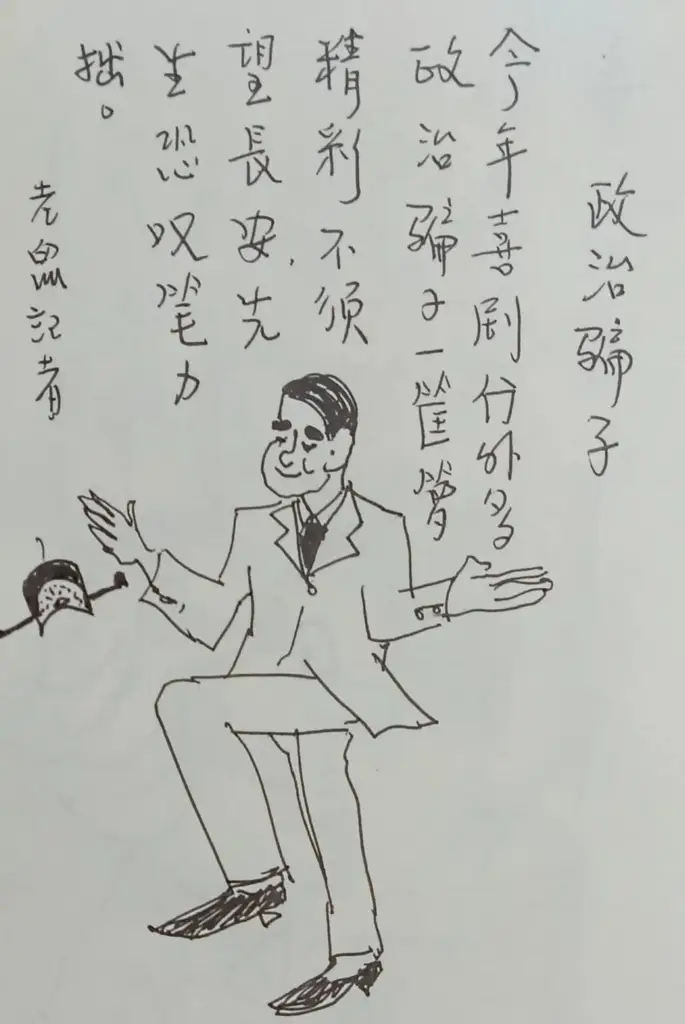
In countless official notices, rectification reports, and news responses, one “soul character” can be seen in almost all of them—it is everywhere, yet elusive; it is repeatedly mentioned, yet never truly appears. This character is: “Relevant departments”.
“Which department exactly?” This is probably the most familiar and also the most helpless question of the contemporary public.

If you observe this language pattern carefully, you will find an astonishing characteristic: there are many abstract words and few specific references.
Two departments shirk responsibility and fail to communicate with each other. They won’t say “they don’t contact each other at all”, but instead say “the coordination mechanism needs to be improved”. The parking lot is clearly built too small, and the parking spaces are severely insufficient. They won’t say “there is no place to park”, but instead say “the supply of public services needs to be strengthened”. The municipal department hasn’t repaired the streetlights for half a year. They won’t say “they have been derelict in their duties”, but instead say “the level of urban refined management needs to be improved”.
See, all the problems are put into a soft, non-angular language bag.
Let’s go back to the most basic definition of responsibility. A complete determination of responsibility includes at least three basic elements:
- Who did something wrong?
- What specific behavior was done wrong?
- What should be done?
But now look again: “The refined level needs to be improved”—Who? Which specific department or person is responsible? What needs to be improved? Is it the lack of funds, the failure of personnel to perform their duties, or a defect in the process? When will it be “to be”? Who will supervise?
Three elements, not one is left.
The subject disappears, the verb is blurred, the timetable evaporates, and the object of accountability becomes an adjective floating in the air. This is not a matter of language expression style; this is the black hole of responsibility.
Why is this kind of rhetoric particularly useful?
The reason why this language pattern is widely chosen is not because it is correct, but because it is easy to use.
For the departments or individuals involved, abstraction means safety. The more specific you are, the easier it is to be caught; the more abstract you are, the more you can explain it as “everyone understands differently” afterwards. A sentence “the coordination mechanism needs to be improved” both acknowledges the problem (appearing responsible) and does not point out whose responsibility it is (actually protecting everyone). It can advance and retreat, and can be called a bulletproof vest in language.
Because once it is specific, it means that someone must be held accountable, dealt with, and publicly criticized. And abstract statements provide a decent “soft landing”—the problem is solved, and everyone’s face is saved.
Thus, this rhetoric is like a language virus, spreading from government notices to enterprise rectifications, from community notices to school announcements, becoming the unspoken “standard answer” of all industries.
However, the more a way of expression becomes popular, the more we need to ask: what deep social needs does it satisfy?
The answer is: a strong need to evade responsibility.
When in a society, the risk of admitting mistakes is higher than lying, the specific cost is higher than ambiguity, and the cost of honesty is higher than shirking—then, abstract rhetoric will grow wildly like weeds.
If you are punished for saying “Xiao Wang of the Third Department has not gone for inspection for three consecutive weeks”, while the person who says “the operation and maintenance mechanism needs to be optimized” is safe and sound, then within a year, everyone will learn the second expression.
Over time, language is no longer a tool for communication, but a shield for responsibility. The more you don’t want to be responsible, the more you have to make your words beautiful and empty.
What we need is “which department”, not “relevant departments”. What the public really needs is never gorgeous rhetoric, but a simple truth: “It is Zhang San of the Municipal Engineering Office who is responsible for this section of streetlights. He missed the repair order. We have ordered him to repair it this week and deduct his monthly performance according to the system.”
See, the subject is there, the facts are there, the measures are there, and the time is there. This is called being responsible.
“Relevant departments” is not a department, but a language trap. It keeps the problem hanging in the air forever, and the responsibility can never find its owner. And when this rhetoric becomes the mainstream expression of society, what is lost is not only the accuracy of language, but also the most basic trust of society.
The next time you hear “the coordination mechanism needs to be improved”, please remember: that is not progress, that is regression. Not comprehensive, is shirking. Not mature, is pathological.
And the only cure for this disease is to force everyone to clarify: which department exactly?
Discover more from 自由档案馆
Subscribe to get the latest posts sent to your email.