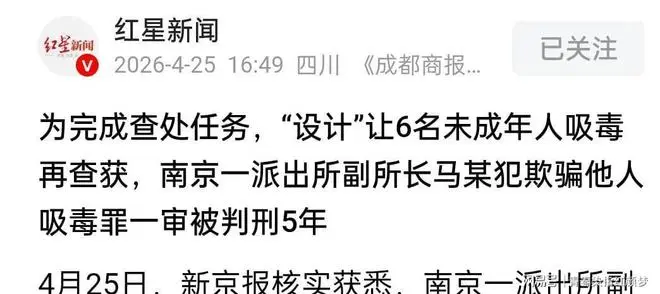
In late April 2026, a judicial case in Nanjing, Jiangsu Province, caused a dramatic social shock. Ma, the former deputy director of a police station, in order to complete drug-related investigation targets and seek personal merit, colluded with social personnel to lure six minors to smoke electronic cigarettes containing the controlled psychotropic drug "etomidate", and then carried out "precise arrests". Currently, Ma has been sentenced to five years in prison for the crime of deceiving others into taking drugs. This case is not only the decline of professional ethics, but also tears open an iceberg of the public power being privatized, instrumentalized, and even socialized under the pressure of grassroots law enforcement assessment.
Event Restoration: From "Protector" to "Setter"
According to the case disclosed by the media, this is not an accidental over-enforcement, but a "case manufacturing" that has been meticulously premeditated. Since October 2023, etomidate has been officially included in the national second-class psychotropic drug catalog, becoming the focus of law enforcement investigations.
Ma, as the deputy director of a grassroots police station, used his position to obtain controlled drugs and organized social personnel to find targets. Finally, six minors who lacked awareness of social dangers were taken to a hotel. Under Ma's behind-the-scenes manipulation, social personnel coaxed these teenagers to smoke electronic cigarettes containing drug ingredients. When the children were in a daze, Ma led the team to "arrive in time" and completed a perfect on-site arrest.
The entire chain—providing drugs, inducing smoking, pre-setting the scene, and timely netting—constitutes a closed loop. In this play, Ma is both the screenwriter, the director, and the leading actor who receives the reward.
Background Deep Dive: The Heavy Pressure of Targets and a Distorted View of Performance
Why would Ma be willing to risk the risk of professional destruction to "create a case"? The core driving force behind it lies in the long-standing **"KPI assessment"** in grassroots law enforcement.
In the grassroots governance logic of some areas, the number of drug-related investigations and the number of cases solved are often directly linked to the unit's ranking and personal promotion. When it is difficult to obtain real case clues, and the assessment pressure is imminent, some law enforcers no longer focus on preventing crime, but instead "cultivate" crime.
Archive Observation: This phenomenon is legally known as the illegal abuse of "entrapment investigation". Normal entrapment investigation is limited to those who already have criminal intentions and must not induce crimes that did not originally exist. Ma's behavior is a typical "crime manufacturing", forcibly dragging innocent minors into the abyss of drugs in exchange for a bright spot in their files.
Power Out of Control: The "Black Zone" of Internal Supervision
The most chilling detail of this case is that Ma, as the deputy director, mobilized social personnel, obtained controlled drugs, and organized arrests, but did not receive any effective internal obstruction for a considerable period of time.
The flow of drugs: Controlled drugs should have strict registration for receiving and using. How did Ma obtain and use them for "setting up the situation"?
Social collaborators: How does this "police-black ambiguous zone" form when law enforcement officers form a community of interests with social idlers?
The empty run of procedures: After the arrest, can the interrogation and warehousing be approved only on Ma's one-sided statement?
This shows that in some grassroots units, the operation of power has deviated from the track of law and system and has become a private property that can be arbitrarily controlled by the deputy director level.
Real Impact: Destroyed Trust and Deprived Future
For the six minors involved, the harm is far more than physical.
Physiological damage: Etomidate has irreversible damage to the development of the nervous system of adolescents.
Institutional trauma: When the first "law enforcement education" encountered by adolescents is the poisoning and framing from the police, their trust in the law and society will completely collapse.
Social stigma: Although Ma has been sentenced, can the "drug-related personnel" label left on these children in the system be completely cleared? In the process of entering school, employment, and political review, will this experience of being framed become a lifelong shadow?
Ma was sentenced to five years in prison, which is the punishment of the law for personal evil deeds, but the institutional questioning left by this case should not end with it. If the evaluation criteria of grassroots law enforcement are still "only numbers", and if the supervision of power still has "under the lights", then Ma will not be the last person to set up the situation.
"Free Archives" records this case, not only to remember this absurd crime, but also to remind: When the purpose of law enforcement is to complete the target rather than to uphold justice, everyone may become the next prey in the power hunting ground.