
In late July, the Anhui Provincial Medical Security Bureau issued a document.
Starting from January 1, 2027, the employee medical insurance contribution policy for the entire province will be unified.
The core content is clear: by the end of 2029, the minimum contribution period will be gradually extended to 30 years for male employees and 25 years for female employees, with at least 15 years of actual contributions within the province.
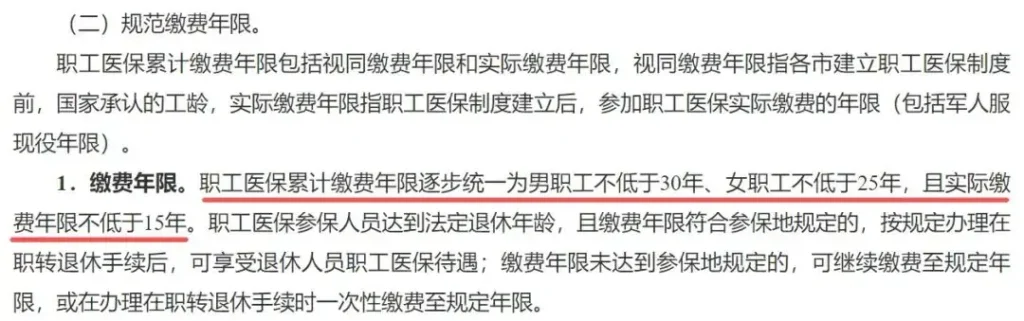
Someone who started working at 25, originally thought they could meet the standard by contributing until 50, but now finds they have to contribute until 55.
Hefei previously implemented 25 years for men and 20 years for women, but cities like Wuhu, Anqing, and Fuyang had already implemented the 30/25 standard. This unification means moving towards higher standards, with no room for negotiation.
Anhui is not the first to do this.
Shandong issued a document in 2021, and starting from January 1, 2026, the entire province will unify to 30 years for men and 25 years for women. Hunan officially implemented this this year. Liaoning, Jilin, Jiangxi, Henan, Hubei, Chongqing, Guizhou, the list continues to grow.
Guangdong is in a transition period, adding one year each year, and will fully implement it by 2030.
Only a few places like Beijing, Shanxi, Qinghai, and Tibet still adhere to the 25 years for men and 20 years for women standard.
Anyone with eyes can see that the 30/25 standard becoming a national standard is only a matter of time.
Why is everyone moving towards this number?
The superficial reason is provincial pooling.
The reason given in the policy document is that in the past, employee medical insurance was pooled at the city level, with each city setting its own rules, leading to a wide variety of contribution periods, rates, and reimbursement ratios.
Now that provincial pooling is being implemented, with one medical insurance card usable throughout the province, benefit standards must be unified, and contributions must also be leveled.
For example, Anhui has not only unified the contribution periods this time but also the benefit ceiling – an annual maximum payment of 400,000 yuan, with hospitalization reimbursement of 85% to 95%, and critical illness insurance up to 80%.
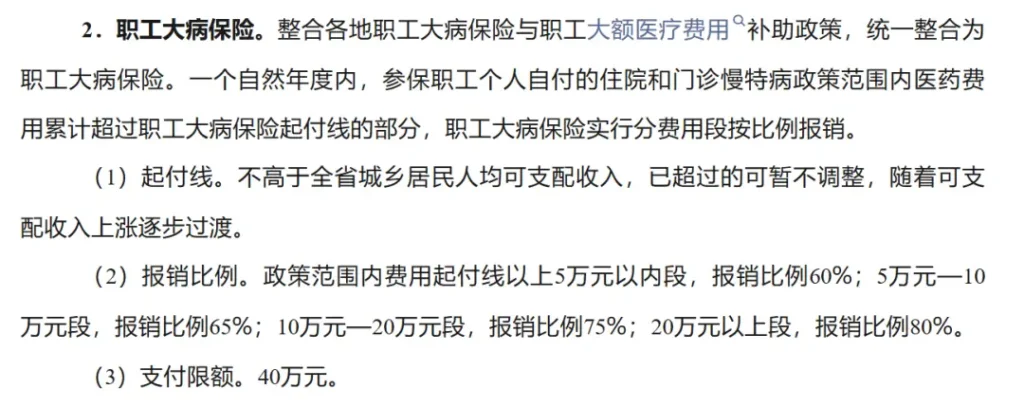
If the benefits are the same, the contribution threshold must also be the same, otherwise, it would be unfair to places with higher contributions.
This logic sounds reasonable.
But upon closer thought, ‘leveling’ always means leveling up, never leveling down.
The participants in cities with lower thresholds directly bear the full cost of the system merger.
Provincial pooling is the direct cause, but what truly forces each province onto this path is the population ledger.
According to data from the National Healthcare Security Administration, by the end of 2024, the number of participants in employee medical insurance nationwide was 379 million, with 275 million actively employed and 105 million retirees, resulting in a dependency ratio of approximately 2.63:1.
What does this mean?
According to industry retrospective calculations, this ratio was about 3:1 in 2012. In just over a decade, it has gone from 3 people supporting 1 to 2.5 people supporting 1.
And this is just the national average.
Some old industrial bases in the Northeast have fallen below 1.5:1, meaning about one and a half actively employed individuals are supporting one retiree.
The number of actively employed participants has been growing at an average annual rate of about 2% in recent years, while the number of retirees has been increasing at a rate of over 4% annually.
The number of people contributing is growing slower, while the number of people consuming medical insurance funds is growing faster.
The drug catalog continues to expand, and new drugs and technologies are continuously included in the coverage. Medical benefits are steadily optimized – overall, the growth rate of expenditures is much steeper than that of income.
If the current policy parameters remain unchanged for a long time, the long-term balance of income and expenditure for the fund will be unsustainable.
While the pooled funds for employee medical insurance still have surpluses, they are highly unevenly distributed.
Guangdong has a current surplus of nearly 40 billion yuan, while some provinces with severe aging populations have long since started depleting their reserves.
The national pooling pool has not yet been established, and funds cannot be transferred across provinces.
Each province can only find its own solutions, and increasing the contribution period is the most direct tool.
So why is the target standard set at 30 years for men and 25 years for women?
Most people start working around the age of 25. Men retire at 60 and women at 55, with a full career span of about 30-35 years.
The contribution target of 30 years for men and 25 years for women roughly requires participants to include most of their career span in the contribution period.
In the past, with lower life expectancy, the period of enjoying medical insurance after retirement was short, and a shorter contribution period was sufficient; now, the national average life expectancy is approaching 78 years, and women may enjoy medical insurance benefits for twenty to thirty years after retirement.
If contributions are only made for 20 years, the long-term pressure on the fund’s income and expenditure will continue to increase.
Extending the minimum contribution period is essentially relying on contributions over a longer working period to offset the increasingly long benefit-receiving period after retirement.
However, as mentioned before, while it is reasonable at the macro level, balancing the macro accounts does not mean that every participant’s individual burden is bearable. The most impacted group is flexible employment personnel.
Public data from the National Healthcare Security Administration shows that in 2025, 69.82 million people will participate in employee medical insurance as flexible employment or other self-employed individuals, an increase of over 20 million compared to the beginning of the ’14th Five-Year Plan’.
While the scale of participation is growing considerably, the overall participation rate among flexible employment groups remains low.
Manpower and social security departments estimate that the scale of flexible employment personnel in China has exceeded 200 million, and a large number of people have not yet participated in employee medical insurance.
Why are many flexible employment individuals reluctant to participate?
The core pressure comes from the continuous contribution costs.
Taking Anhui as an example, flexible employment individuals choose the employee medical insurance plan with a personal account, using 60% of the average wage as the contribution base. The monthly contribution is about 360 yuan, plus over 4,000 yuan for critical illness insurance annually.
This expense is manageable for individuals with stable incomes, but flexible employment generally involves highly fluctuating incomes. While it can be afforded during periods of high income, continuous contributions during periods of low income become a heavy fixed expenditure.
Many regions plan to gradually transition the minimum contribution period for employee medical insurance to 30 years for men and 25 years for women.
Compared to the currently common 20-year standard, many individuals will need to contribute for several more years throughout their careers, potentially increasing the total cost by tens of thousands of yuan.
Many flexible employment individuals who were already waiting and seeing may choose to discontinue their employee medical insurance and switch to urban and rural resident medical insurance.
The situation of those who discontinue their payments is also being overlooked.
Many regions’ employee medical insurance policies stipulate that if payments are interrupted for more than 3 months, a waiting period will be imposed upon re-enrollment, with variations in local regulations.
Frequent job changers and those with periods of unemployment will face a dilemma:
If the contribution period does not meet the standard by retirement, they can only continue to contribute until the standard is met, delaying the enjoyment of retirement medical benefits.
Continuous contributions constitute a long-term burden, and delaying benefit reception increases risk.
The barriers encountered by cross-provincial mobile workers are even more pronounced.
Since 2021, the state has clarified that the contribution period for medical insurance transfer and continuation will be calculated cumulatively. Many pooled areas have completed system interoperability, but local thresholds still exist for handling retirement medical insurance in various regions.
For example, Shandong requires that individuals transferred from other provinces who wish to handle retirement medical insurance locally must have at least 10 years of actual contributions within the province, in addition to meeting the total period requirement; Shenzhen also has a local actual contribution period threshold for handling local retirement medical insurance.
Against the backdrop of most regions increasing the minimum contribution period, the conflicts faced by cross-regional migrant workers continue to escalate:
Many people have contributed in multiple provinces and cities throughout their lives, and the contribution period in each place is not sufficient to meet the local retirement conditions independently.
After decades of continuous and timely contributions, they may find themselves unable to find a place of enrollment that can undertake lifelong employee medical insurance benefits as retirement approaches.
From a longer-term perspective, more provinces will implement the standard of 30 years for men and 25 years for women for the minimum contribution period of employee medical insurance in the coming years.
Unifying the contribution period within a province has clear benefits: provincial institutional barriers are gradually broken down, cross-provincial medical treatment within the province becomes smoother, and the rules for medical benefits in various regions become more transparent.
National pooling is the long-term direction of reform.
In the first half of this year, the National Healthcare Security Administration disclosed that 22 provinces have issued relevant plans for provincial pooling of employee medical insurance; in 2026, efforts are being accelerated to promote the implementation of cross-provincial family co-pooling of employee medical insurance individual accounts in various provinces. Currently, the direct settlement rate of inpatient expenses across provinces has reached 90%.
Technical barriers are continuously being removed.
However, moving towards national pooling cannot be achieved overnight.
Unifying the contribution period within a province is only one part of provincial pooling. Subsequent challenges include unifying contribution rates, balancing benefit policies, and centralized collection and expenditure of funds. Each adjustment will involve local finances and the vital interests of hundreds of millions of participants.
More noteworthy is: in the process of extending the minimum contribution period, can the most pressured groups – flexible employment individuals, low-income participants, cross-provincial migrant workers, and individuals with interrupted payment records – receive supporting institutional buffers.
Can flexible employment individuals have more flexible choices for contribution bases, contributing more when income is ample and reducing the burden during periods of low income?
For historical payment interruptions, can more humane transition plans be introduced?
Can the rules for calculating contribution periods and merging cross-provincial periods for cross-provincial employment individuals be further simplified?
The direction of a series of supporting policies will determine whether the reform of raising the minimum contribution period can find a balance between the long-term sustainability of medical insurance funds and the fairness of protection for different groups; otherwise, the pressure may simply shift from the medical insurance fund’s ledger to ordinary people with the weakest risk-bearing capacity.
Adjustments to the medical insurance system ultimately affect everyone.
Many young people currently feel that the 30-year minimum contribution period is very distant.
But when they reach their forties or fifties, burdened by family responsibilities, and calculate their medical insurance contribution period, they will find that they are still more than ten years away from the retirement standard. At that point, they will realize that this ongoing institutional adjustment has already quietly affected everyone’s future medical security.
End of full text, thank you for reading. If you found it good, please like, share, and comment.
-end-
Written at the end: I have created a ‘Planet’ community, which has been operating for 600 days. Friends with similar values are welcome to join.

Every day, I share some of my observations and thoughts in the community, and you can also ask me questions, and we can progress together at a steady pace and enjoy the beauty of uniform progress.
-end-
写在最后:建了一个星球社群,已经运营600天了,欢迎三观相合的朋友们加入。
每天都会在星球分享我的一些见闻和想法,也可以向我提问,一起日拱一卒,享受匀速进步的美~
Discover more from 自由档案馆
Subscribe to get the latest posts sent to your email.