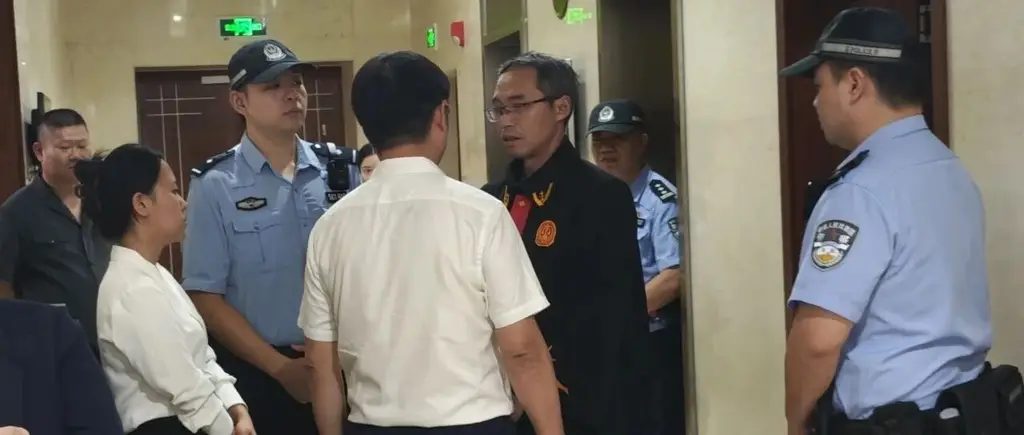
Judge Liu Haibing, despite knowing that this lawyer, as the defendant’s agent, had been waiting at the courthouse entrance for a long time, proceeded with the trial in the defendant’s absence. This severely infringed upon the litigation rights of the parties and their agent lawyer, and should be immediately rectified by re-forming the collegial panel to hear the case.
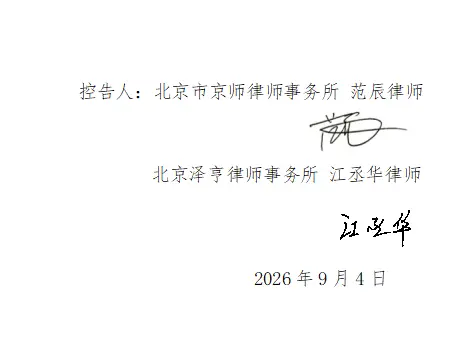
Just now, the main leaders and relevant departments of the Chongqing Municipal Commission for Discipline Inspection and Supervision, the Chongqing Municipal Political and Legal Affairs Commission, the Chongqing High People’s Court, the Chongqing People’s Procuratorate, the First Branch of the Chongqing People’s Procuratorate, the Chongqing First Intermediate People’s Court, and the Liangjiang New Area Procuratorate have received the “Complaint Letter Regarding Judge Liu Haibing of the Chongqing Liangjiang New Area Court Arbitrarily Violating Legal Provisions, Infringing Upon Lawyers’ Professional Rights and Litigants’ Litigation Rights, Violating Discipline and Law, and Requiring Investigation” filed by Fan Chen, a lawyer from Beijing Jingshi Law Firm, and Jiang Chenghua, a lawyer from Beijing Zeheng Law Firm.
The full text of the complaint letter is as follows:
Judge Liu Haibing of the Chongqing Liangjiang New Area Court Arbitrarily Violates Legal Provisions,
Infringes Upon Lawyers’ Professional Rights and Litigants’ Litigation Rights, Violates Discipline and Law, and Requires Investigation
Complaint Letter
Complainant: Fan Chen, agent for the respondent, lawyer at Beijing Jingshi Law Firm, contact address: Jingshi Law Building, No. 37 East 4th Ring Middle Road, Chaoyang District, Beijing.
Complainant: Jiang Chenghua, agent for the respondent, lawyer at Beijing Zeheng Law Firm, contact address: No. 26 Xiaoyun Road, Chaoyang District, Beijing.
Accused: Liu Haibing, judge at the Chongqing Liangjiang New Area People’s Court, presiding judge in the two cases of “He XX v. Bin Yu – Reputation Rights Dispute” [Case Numbers: (2026) Yu 0157 Min Chu 26613, (2026) Yu 0157 Min Chu 26733].
Complaint Matters:
1. To lawfully file a case and investigate Judge Liu Haibing for serious violations of discipline and law, including prohibiting lawyers from bringing electronic devices such as computers and mobile phones into the courtroom, requiring lawyers to undergo security checks, and conducting ex parte trials, thereby infringing upon lawyers’ professional rights and litigants’ litigation rights, and to hold him accountable for party discipline and judicial responsibility;
2. To request and supervise the Chongqing Liangjiang New Area People’s Court to correct its errors, re-form the collegial panel to publicly hear the case, effectively protect the litigation rights of the parties, and guarantee lawyers’ right to bring electronic devices such as computers and mobile phones into the courtroom, as well as lawyers’ right to be exempt from security checks with valid identification.
Facts and Reasons:
The two cases of “He XX v. Bin Yu – Reputation Rights Dispute” [Case Numbers: (2026) Yu 0157 Min Chu 26613, (2026) Yu 0157 Min Chu 26733] are being heard by the Chongqing Liangjiang New Area People’s Court, with Judge Liu Haibing as the presiding judge.
The summons for the aforementioned two cases notified the court sessions to be held at 2:30 PM and 3:30 PM on September 3, 2026, respectively. Lawyers Fan Chen and Jiang Chenghua (hereinafter referred to as “this lawyer”) arrived at the court at 2:00 PM that afternoon, ready for the trial.
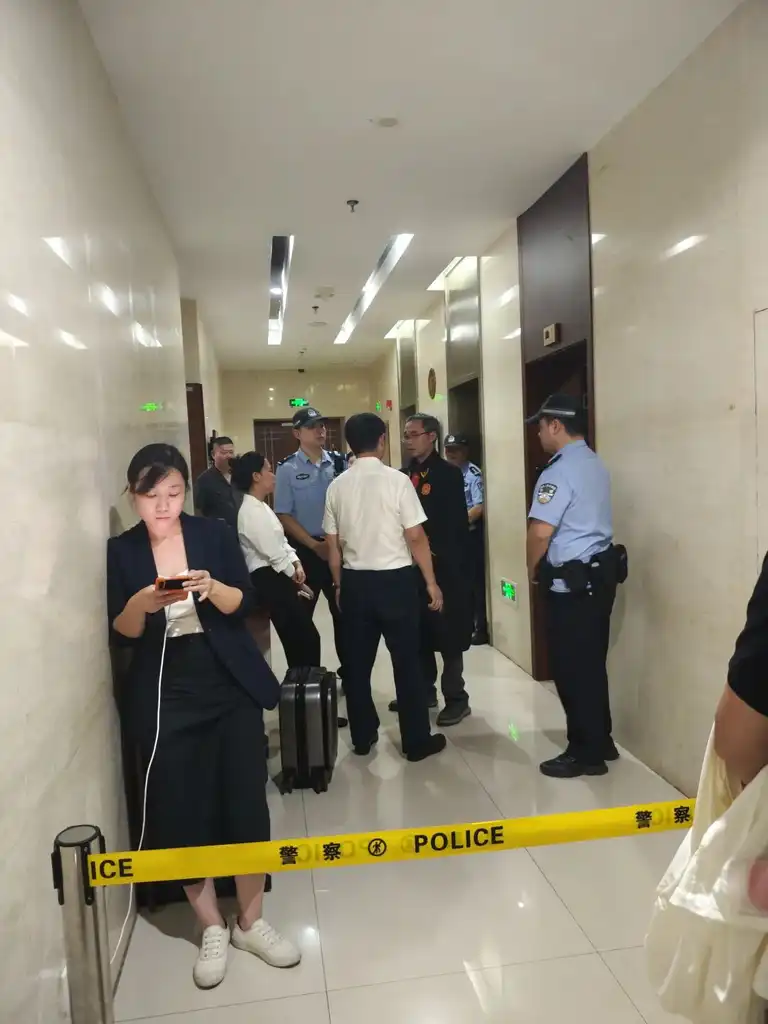
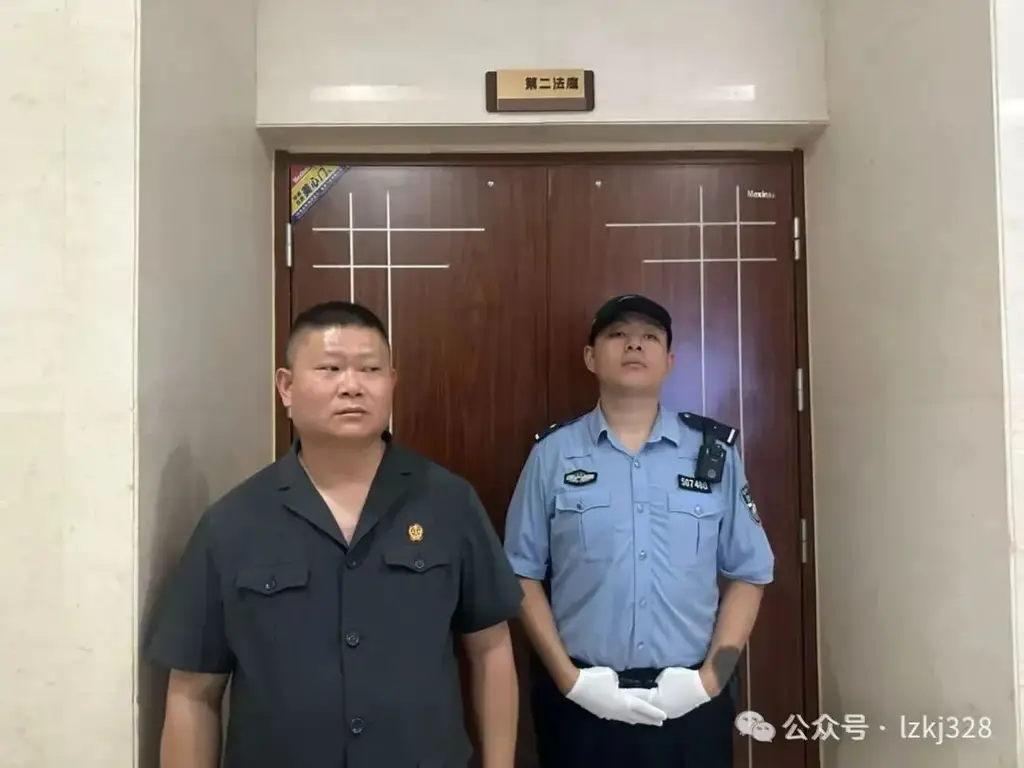
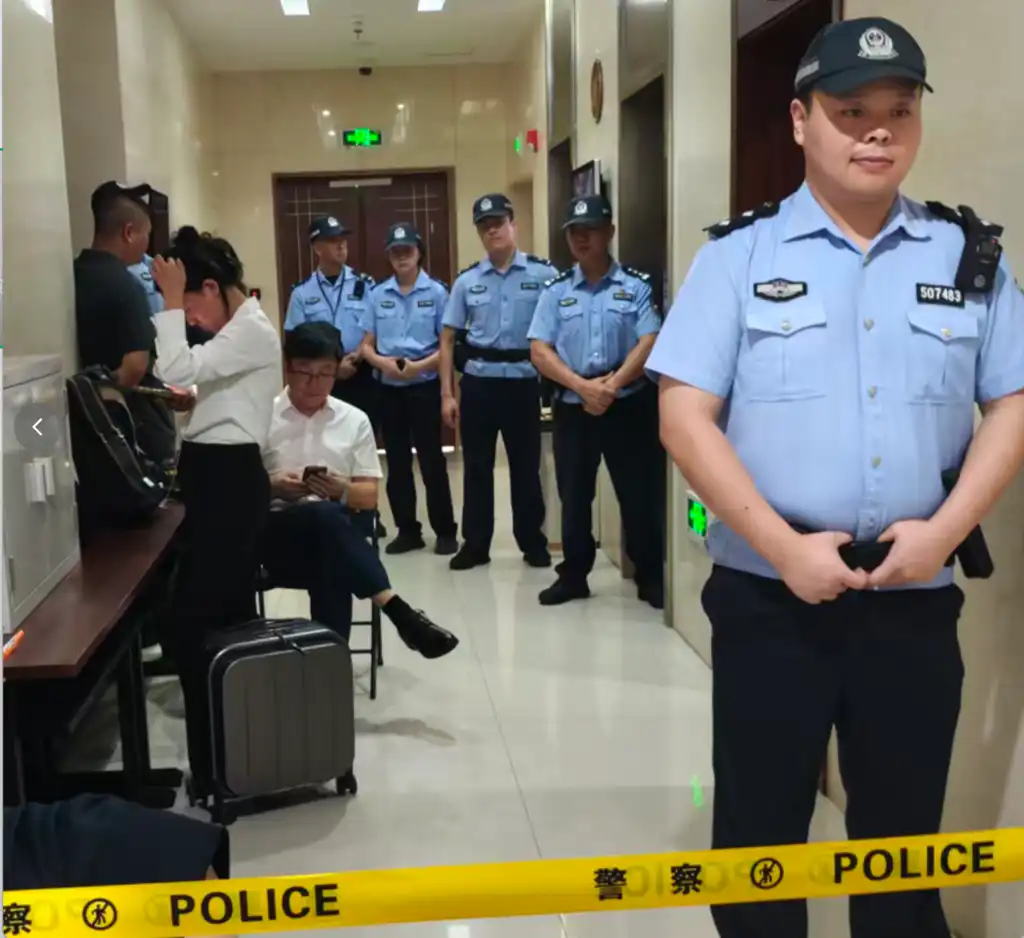
Unexpectedly, upon exiting the elevator, a cordon was set up at the entrance of Courtroom No. 2, with at least seven or eight fully armed court police officers guarding the entrance. A man claiming to be the judge’s assistant stated that the case would not be heard in public and required lawyers to undergo security checks and store their computers and mobile phones in lockers. Despite this lawyer presenting their lawyer’s identification and the assistant verifying it, the security check was still insisted upon.
Due to non-cooperation with the court’s illegal actions, this lawyer was unable to enter the courtroom guarded by the judge’s assistant and court police, and could only wait at the entrance. During this period, a staff member in a court uniform threatened: “If you don’t go in, we will proceed with an ex parte trial.” This lawyer warned him, “It is not that we are not entering the courtroom, but that you are illegally preventing lawyers from entering; the responsibility lies with you.”
After waiting outside the courtroom for nearly an hour, Judge Liu, who had not yet appeared, slowly emerged from the courtroom and asked, as if unaware, why this lawyer had not entered. This lawyer informed him that his staff had illegally prevented the lawyer from entering the courtroom. Judge Liu stated, “The agent was informed that the trial would not be public, and the court does not permit the agent to bring their own electronic devices. According to regulations, lawyers must undergo security checks. If you do not agree, this is how it will be.” After saying this, Judge Liu entered the courtroom, and this lawyer remained blocked outside. Shortly thereafter, the sound of the clerk reading the court rules could be heard from inside the courtroom, and the ex parte trial began. Around 4:30 PM, the trial inside concluded.
This case was tried as an ex parte trial in the absence of the defendant’s agent lawyer, who was waiting at the courthouse entrance. Judge Liu Haibing disregards the law, the litigation rights of the parties, and the professional rights of the agents, and has seriously violated discipline and law, warranting investigation and accountability for party discipline and judicial responsibility.
I. The court’s prohibition of lawyers bringing electronic devices such as computers and mobile phones into the courtroom on the grounds of “not to be heard in public” is unlawful and severely infringes upon lawyers’ professional rights.
(I) Judge Liu Haibing failed to fulfill his duty to inform; this lawyer was not informed that the case would not be heard in public during prior communication with Judge Liu, nor was it indicated on the summons.
On July 29, 2026, this lawyer submitted agency documents to Judge Liu Haibing at the Airport Judicial District of the Liangjiang New Area Court and communicated the case details with Judge Liu in person. During the communication, Judge Liu did not inform this lawyer that the case would not be heard in public.
Additionally, on August 26, 2026, this lawyer received the summons for this case, which only specified the time and place of the hearing, without any indication that it would not be heard in public.
Article 37 of the “Provisions of the Supreme People’s Court, Supreme People’s Procuratorate, Ministry of Public Security, Ministry of State Security, and Ministry of Justice on Legally Protecting Lawyers’ Professional Rights” states, “For major procedural information in litigation and litigation documents served to parties, the handling authority shall notify the defense or agent lawyers.”
The non-public nature of a case is “major procedural information in litigation,” but Judge Liu Haibing failed to fulfill his duty to inform in advance, infringing upon this lawyer’s litigation rights.
(II) This case is not one that should be heard in private according to law. The prohibition of lawyers bringing electronic devices such as computers and mobile phones into the courtroom on the grounds of “not to be heard in public” is unlawful and severely infringes upon lawyers’ professional rights.
1. The evidence provided by He XX or Bin Yu are all public materials; there is no privacy involved in this case.
The core of privacy protection is “private information that one does not wish to be known by others.” According to Article 1032 of the Civil Code, “Privacy refers to the tranquility of a natural person’s private life and private spaces, private activities, and private information that one does not wish to be known by others.” In other words, whether a piece of information falls within the scope of privacy protection depends on whether it is objectively still in a state unknown to the public.
Judge Liu Haibing prohibited lawyers from bringing computers and mobile phones into the courtroom on the grounds that “the case involves personal privacy.” However, the facts involved in this case, the evidence provided by He XX, or the evidence provided by the respondent Bin Yu, contain no secrets or privacy. They have either been publicly heard and judged by the court or have garnered over 330,000 views on online platforms, becoming a widely known and discussed public event by an unspecified number of people. In this situation, the relevant information has moved beyond the state of being “private” and should naturally no longer be protected as privacy.
2. He XX’s extramarital affair violates multiple legal provisions. The information involved does not constitute legally protected privacy and should not be protected. Non-public hearings are incorrect.
In an article posted online by He XX’s ex-wife, Li XX, it is mentioned that He XX “has a dissolute lifestyle, has long-term extramarital affairs, and harasses and even rapes women.” (“Li XX: He XX, I hope you still have the chance to speak like a human.”)
He XX’s extramarital affairs with others violate the marital fidelity obligations stipulated in the Marriage Law and the Civil Code and undermine the military marriage. It violates the provisions of the National Defense Law and the Law on the Status and Rights and Interests of Military Personnel, which provide special protection for military marriages. The extramarital affair with teacher He violates the responsibility of “being a role model” stipulated in the Teacher Law. During his marriage, He XX had an extramarital affair with another person, prosecutor Wang XX, and had a child, violating laws and regulations such as the Law on Disciplinary Sanctions for Public Officials, the Procurator Law, and the Basic Norms of Procuratorial Ethics.
He XX is also a member of the Third Chongqing Municipal Committee of the Chinese People’s Political Consultative Conference, and his extramarital affair violates the relevant provisions of the “Charter of the Chinese People’s Political Consultative Conference” regarding the appointment of members. At the same time, their behavior violates public order and good morals and does not conform to the core socialist values.
The protection of personal privacy primarily requires an examination of its legality. The legality of personal privacy refers to whether the personal information involved pertains to the lawful conduct of the parties concerned. The legality requirement is an embodiment of the principle of non-abuse of rights and a necessary limitation on personal privacy. Accordingly, personal privacy can be divided into two categories: privacy protected by law; and privacy not protected by law. Only personal privacy that is protected by law is the object of legal protection. Privacy not protected by law cannot be used as a reason for non-public trials.
In this case, whether it is He XX’s extramarital affair or his assault of his ex-wife and her family, these are illegal acts. Although related to the parties’ reputation, they do not constitute personal privacy protected by law, and therefore cannot be a legal reason for non-public hearings.
Therefore, this case is not one that should be heard in private according to law. The prohibition of lawyers bringing electronic devices such as computers and mobile phones into the courtroom on the grounds of “not to be heard in public” is unlawful and severely infringes upon this lawyer’s professional rights.
(III) Judge Liu Haibing’s prohibition of lawyers bringing electronic devices into the courtroom on the grounds that “the case involves personal privacy” is a case of “throwing the baby out with the bathwater,” a misinterpretation and abuse of the “non-public hearing” system, and it severely infringes upon the litigation rights of the agent lawyer and the parties.
Although the “Notice of the Supreme People’s Court on Further Standardizing Court Order and Protecting Litigation Rights” stipulates that electronic devices are prohibited from being brought into the courtroom for cases that are not to be heard in public according to law, it also stipulates that “if there is a genuine need for use, it must be approved by the People’s Court.” This means that if there is a genuine need, it can be approved by the court to bring electronic devices into the courtroom.
With the development of information technology, case files and prepared legal documents are mostly stored in electronic devices. Temporarily prohibiting lawyers from bringing electronic devices on the grounds of non-public hearings effectively restricts and deprives lawyers of their professional rights, making the trial a mere formality and severely infringing upon the litigation rights of the parties.
Furthermore, the purpose of non-public hearings is to prevent the diffusion of parties’ privacy to the public. Lawyers, as litigation agents, are legally obligated to keep parties’ privacy and secrets confidential according to the Lawyers Law, so there is no risk of leaking parties’ privacy due to carrying electronic devices. Judge Liu Haibing’s prohibition of lawyers bringing electronic devices on the grounds that “the case involves personal privacy” is a case of “throwing the baby out with the bathwater,” a misinterpretation and abuse of the “non-public hearing” system.
It is thus evident that public hearings are the principle, and non-public hearings are the exception; lawyers bringing electronic devices are the principle, and not bringing them is the exception. A collegial panel cannot prohibit lawyers from bringing computers and mobile phones into the courtroom without sufficient and valid reasons.
(IV) Regarding the situation of non-public hearings, unlike the situation where this lawyer was notified at the last minute, the plaintiff’s lawyer seemed to have known in advance and prepared paper materials. It is doubtful whether Judge Liu Haibing can impartially hear this case.
This lawyer noted that, unlike the situation where this lawyer was notified of the non-public hearing at the last minute, He XX’s agent lawyer did not seem surprised. When asked to refrain from bringing electronic devices into the courtroom, they did not copy files from their portable computer but directly entered the courtroom with paper materials, as if they had known about the non-public nature of the case in advance.
This lawyer inquired with the staff outside the courtroom whether the non-public hearing was at the plaintiff’s request or decided by the court itself, but the staff did not give a definitive answer. If the court decided not to hear the case in public at the plaintiff’s request, it should have notified this lawyer, as the defendant’s agent, in advance to allow for preparation. However, Judge Liu Haibing did not inform this lawyer of this situation in advance, thus losing impartiality. If the court decided on its own not to hear the case in public, the reaction of He XX’s agent lawyer, who was not surprised upon hearing this situation at the courtroom entrance, clearly indicates they already knew about it. This implies that Judge Liu Haibing had already informed He XX’s lawyer, completely undermining the impartiality of his handling of this case.
II. Insisting on security checks even after this lawyer presented identification severely infringes upon lawyers’ professional rights.
Article 6 of the “Rules of the People’s Republic of China for Courtrooms” states, “Personnel entering the courtroom shall present valid identification documents and undergo security checks of their person and belongings. Prosecutors and lawyers holding valid work identification and appearing in court with a summons to perform their duties may enter the courtroom through a special channel. If security checks are required, the People’s Court shall treat prosecutors and lawyers equally.”
Therefore, lawyers holding identification can enter the courtroom through a special channel. It is understood that although the Liangjiang New Area Court has not set up a special channel for lawyers, when hearing criminal cases, prosecutors performing their duties can use the special channel for prosecutors without undergoing security checks. In accordance with the above rules, lawyers entering the Liangjiang New Area Court for hearings should also enjoy the right to be exempt from security checks after their work identification has been verified. Moreover, this lawyer has never been required to undergo security checks in other basic courts or even the Supreme People’s Court.
Upon arriving at the courtroom entrance, this lawyer handed their lawyer’s identification to the judge’s assistant on duty for verification. Judge Liu Haibing’s insistence on security checks, despite knowing that this lawyer had presented identification, lacks any legal basis and constitutes a severe infringement of lawyers’ professional rights.
III. Judge Liu Haibing, knowing that this lawyer, as the defendant’s agent, had been waiting at the courthouse entrance for a long time, proceeded with the trial in the defendant’s absence, severely infringing upon the litigation rights of the parties and their agent lawyer, which should be immediately rectified by re-forming the collegial panel to hear the case.
Article 147 of the “Civil Procedure Law” stipulates, “If a defendant, after being summoned by a summons, refuses to appear in court without a valid reason, or leaves the court midway without the court’s permission, a judgment may be rendered in absentia.”
In this case, the defendant had legally appointed this lawyer as their agent to appear in court. This lawyer arrived at the court on time but was unable to enter the courtroom due to non-compliance with the court’s illegal actions. Therefore, there was no situation of “refusing to appear in court without a valid reason.” Proceeding with an ex parte trial on this basis constitutes a serious procedural violation and should be immediately rectified by re-forming the collegial panel to hear the case.
IV. Judge Liu Haibing acted contrary to the latest national regulations protecting lawyers’ professional rights, seriously violated laws and judicial professional norms, severely infringed upon lawyers’ professional rights, and should be investigated, and held accountable for party discipline and judicial responsibility.
On August 28, 2026, the Standing Committee of the National People’s Congress passed an amendment to the Lawyers Law, changing Article 3, Paragraph 4 to Article 5: “Lawyers’ lawful practice is protected by law, and no organization or individual shall infringe upon the legitimate rights and interests of lawyers.” “People’s courts, people’s procuratorates, public security organs, state security organs, judicial administrative departments, and relevant entities shall establish and improve systems for protecting lawyers’ professional rights and shall, within their respective functions and powers, protect lawyers’ professional rights in accordance with the law.”
Article 39 stipulates, “Where a lawyer acts as a litigation agent or defense lawyer, their right to debate or defend shall be protected by law.”
Article 10 of the “Judges Law” stipulates that “Judges shall fulfill the following obligations: (I) Strictly abide by the Constitution and laws; (II) Handle cases impartially and not pervert the law for personal gain; (III) Legally protect the litigation rights of parties and other participants in litigation; (IV) Uphold national interests, public interests, and the legitimate rights and interests of individuals and organizations…”
Article 10 of the “Basic Norms of Judicial Ethics” stipulates: “Firmly establish procedural awareness, adhere to the equal importance of substantive and procedural justice, strictly enforce laws and handle cases according to legal procedures, fully protect the litigation rights of parties and other participants in litigation, and avoid arbitrary actions in law enforcement and case handling.”
As a judge of the People’s Court, Liu Haibing should have been an impartial arbiter and fully protected the litigation rights of the parties and their agent lawyers. However, he has acted contrary to the latest national regulations protecting lawyers’ professional rights, illegally prohibiting lawyers from bringing electronic devices into the courtroom with the unfounded reason of “the case involves personal privacy,” and enforcing security checks. This is a blatant violation of discipline and law, a serious breach of legal and judicial professional norms, and a severe infringement of lawyers’ professional rights, warranting investigation and accountability for party discipline and judicial responsibility.

Discover more from 自由档案馆
Subscribe to get the latest posts sent to your email.