Guangdong Shantou, a man named Zhao discovered that some manhole covers were sinking. He spent his own money to buy white paint and drew white circles on over 70 manhole covers to alert passing pedestrians and vehicles.
The next day, he was approached by the local urban management. They warned him and initially intended to call the police. However, considering his good intentions, they told him that if he erased all the white circles one by one, the matter would be dropped.
Poor Zhao started the cleanup work that afternoon. However, drawing circles was easy, but cleaning them was difficult. By yesterday afternoon, he had only managed to clean half of the over 70 manhole covers.
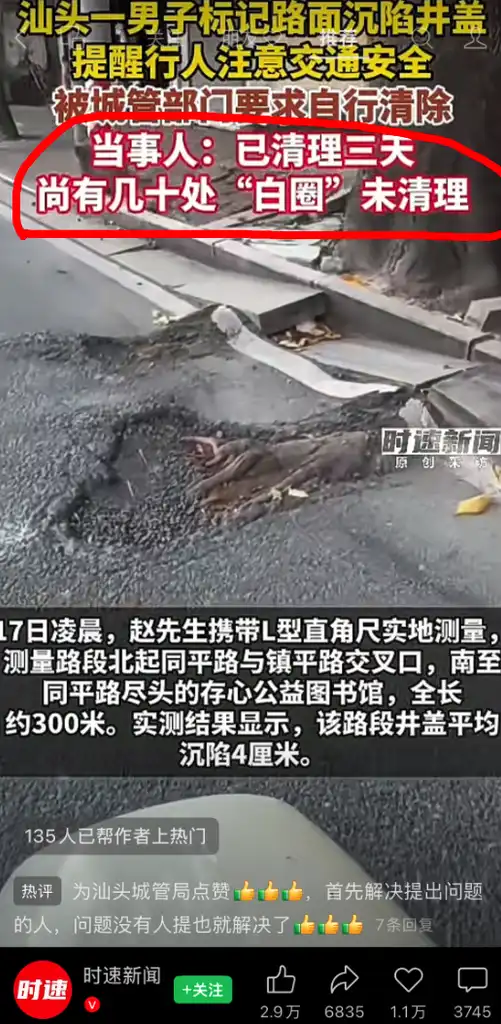
Indeed, compared to solving problems, ‘dealing with the person who points out the problem’ is much simpler. The manhole covers marked by Zhao had an average subsidence of 4 centimeters. According to the local ‘Manhole Cover Safety Management Guidelines,’ a subsidence exceeding 1.5 centimeters constitutes a Level 2 safety hazard risk.
Since those manhole covers had long met the standard for rectification, what was wrong with the problem Zhao raised?
His mistake was that dealing with him, a troublemaker, was far easier than dealing with the sinking of over 70 manhole covers. His mistake was marking a ‘ledger’ that had never been marked before.
This ledger was there every day, making some people naturally uneasy.
Originally, a sinking manhole cover, as long as no one marked it, was just an ‘undiscovered’ ordinary road facility and did not need to enter the repair process. Now, it has been marked by Zhao, making it an ‘exposed’ management defect that must be ‘handled’.
Unless, the marks are erased, and others are deterred from marking them again.
This is also a ‘collateral benefit’ of dealing with troublemakers like Zhao, which is to ‘kill the chicken to scare the monkeys.’ Next time such public safety hazards occur locally, citizens will not dare to speak out and will only silently choose to mind their own business. It’s a win-win situation, so why not do it?
Therefore, what Zhao drew were circles, but what the urban management saw were his ‘criminal evidence’; Zhao wanted people to see the danger, while the urban management wanted people to see ‘who was causing trouble.’ One used white paint to mark the ground’s pit, the other used power to mark disobedient people.
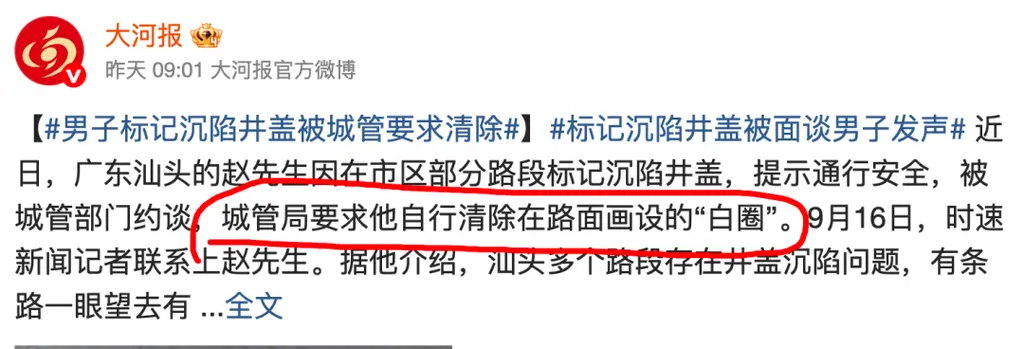
Of course, on the surface, the urban management bureau gave a different reason: Zhao had defaced public property without authorization, affecting the city’s appearance.
This is an extremely ironic reason, especially when contrasted with Zhao’s original intention.
In Zhao’s eyes, like most of us ordinary people, a white circle is a public warning expressing ‘danger.’ Its significance, big or small, is entirely dependent on the physical state of the manhole cover itself.
But in the eyes of the urban management, what they could see, care about, and focus on was merely who drew it? Where was it drawn? And was there any approval.
There’s a subtle feeling that what they truly wanted to eliminate was an ordinary person’s ‘right to interpret’ danger, not the circle Zhao drew. This implies that in public spaces, only officially authorized meanings are allowed to exist. The ‘meanings’ that ordinary people spontaneously produce, judge, and understand are meaningless, even though they point to real risks that need to be addressed.
Therefore, making Zhao erase the white circles he drew is also necessary. It is a declaration of power, manifested through Zhao’s performance of obedience.
Letting others see, ‘Your meddling looks very ugly.‘
Mr. Zhao, without any shouting or fuss, holding his tools, enduring the sun, painstakingly erasing the white circles on the manhole covers, is a suffocating scene. If you had any humanity, you would have just fined him two hundred yuan and given him a quick end. His continuous erasing of circles on the street, every minute, is an ordeal.
At the same time, every minute, it serves as a warning refresh to passersby. Because everyone who sees Mr. Zhao squatting on the ground erasing circles as they pass will feel sadness in their hearts and give up on ‘meddling’ next time.
In other words, by making Zhao squat by the roadside and erase the white paint, he is not just erasing the white paint; he is also erasing the last bit of courage that he and other citizens, as ordinary people, have to ‘meddle’ in this city.
Suddenly, I recall Orwell’s words in ‘1984’: In an age of universal deceit, telling the truth is… well, I’ll put it in my own words: When a person is punished for pointing out a problem, the most absurd scene has already occurred in advance: the problem itself is pardoned.
Discover more from 自由档案馆
Subscribe to get the latest posts sent to your email.