

There was news yesterday that many provinces are requiring the implementation of the paid annual leave system, encouraging employees to take staggered vacations, to take all their leave, and for leading cadres to take the lead in vacationing.
Currently, Henan, Tianjin, Shanxi, Anhui, Guizhou, Zhejiang, and Yunnan have issued notices.
Henan’s actions are the most specific.
On August 5th, the Provincial Party Committee Organization Department, Provincial Department of Human Resources and Social Security, Provincial Department of Commerce, Provincial Department of Culture and Tourism, Provincial Government State-owned Assets Supervision and Administration Commission, and the Provincial Federation of Trade Unions jointly issued the “Notice on Further Promoting the Implementation of Paid Staggered Annual Leave for Employees.” It requires that the main person in charge of the unit be the primary responsible person, leading cadres take the lead in vacationing, and promote all employees to take their full leave.
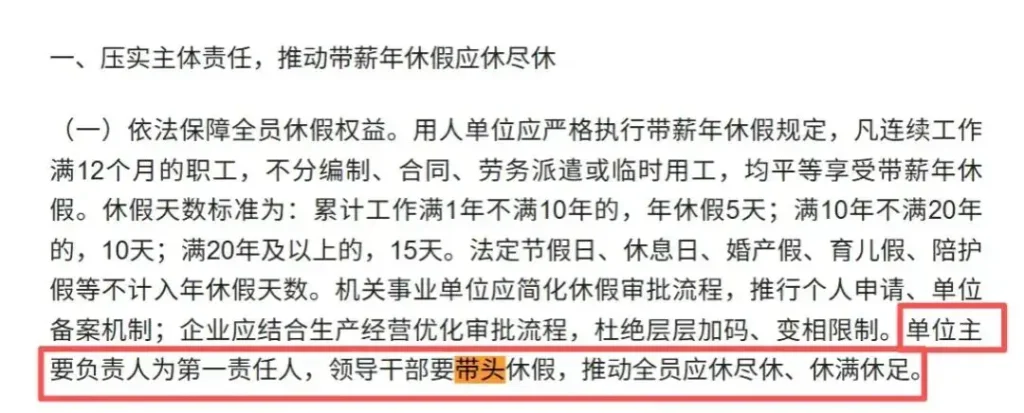
The document is quite comprehensive.
There are ledgers, supervision, and penalties. Failure to rectify will be recorded in the credit file and publicly exposed.
AB posts complement each other, staggered rotation, priority for pregnant and lactating women, and preferential treatment for migrant workers in different places.
At first glance, everything that should be considered has been considered.
But after reading the document, the first sentence that came to my mind was, what next?
Let’s talk about reality first.
Annual leave has always existed in law.
The “Regulations on Paid Annual Leave for Employees” are in black and white: five days after one year of service, ten days after ten years, and fifteen days after twenty years.
The regulations have been in effect since 2008, which is almost twenty years ago.
The law exists, so why is it necessary for six departments to issue a notice to urge it?

Because in reality, few people can take their full leave, and many are afraid to take it.
I asked a friend in the system, and paid annual leave can theoretically be taken at any time, and the leader will not stop you.
But most people choose not to take it, or take less.
First, there is too much work.
There are only a few people at the grassroots level, so who will do the work if you take leave?
When you come back from leave, the work piles up, making you more tired than not taking leave, so what’s the point?
Second, not taking leave results in triple pay. According to regulations, unused annual leave is compensated at 300% of the daily wage.
Ten days of annual leave for ten years of service can result in twenty extra working days’ wages if not taken.
For many families, this is a tangible income, more practical than taking leave.
So you will find that annual leave is not that it is not given to you, but that even if it is given, you dare not take it, or it is not cost-effective to take it.
Can the arrival of the document change this?
Within the system, it is highly likely to change.
Leaders take the lead in vacationing, all leave is taken, there are ledgers, supervision, and penalties. This set of measures will significantly increase the vacation time for government agencies and public institutions.
After all, performance reviews are hanging over their heads, and no one wants to be a negative example.
Large companies can also benefit.
The system already exists, and with the policy push, enforcement will be stricter. It is possible for most people to take about ten more days off each year.
But beyond that, it’s uncertain.
The document states, “encourage units with conditions.”
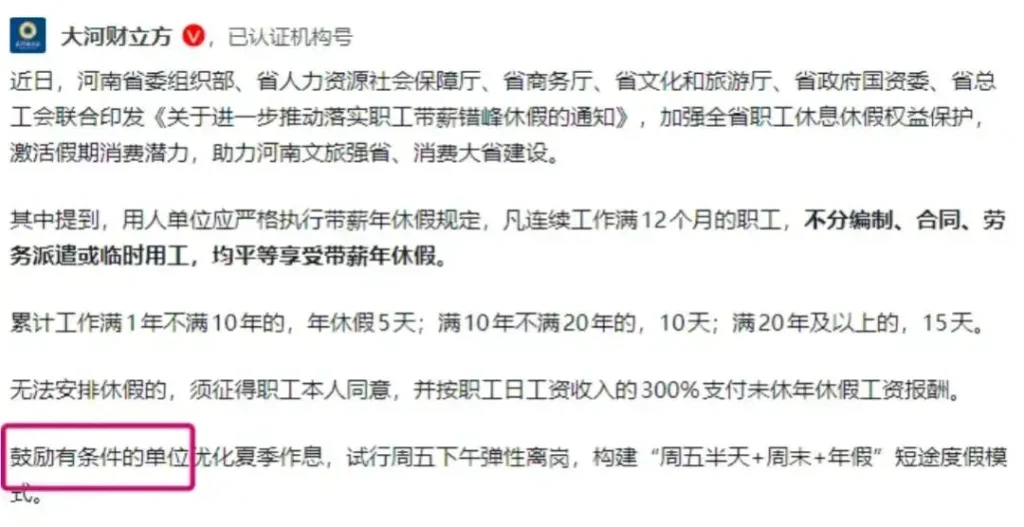
What are “conditions,” and who decides?
It’s still up to the boss.
If the boss wants to give it, there are always conditions; if the boss doesn’t want to give it, there are no conditions.
Private enterprises and small companies may not even guarantee a two-day weekend, and you want to talk to them about annual leave?
So the first answer to “what next” is stratification.
Those in the system will get their leave, large companies will get some, and small companies will remain the same.
The document can control the system, but not the market.
So why is this matter being pushed at this particular time?
A clear background is that the logic of economic growth has changed.
What drove growth before? Competition. Competition in working hours, in population, in who can endure more.
In 2023 and 2024, the average weekly working hours reached a historical high of 49 hours, the peak of involution.
But the path of competing in working hours has reached its end.
In 2025, weekly working hours will decrease to 48.6 hours and begin a slow decline.
Graduate school applications peaked in 2023, college entrance exam applications peaked in 2024, and even civil servant applications, after reaching new highs, are likely to turn around soon.
People don’t want to compete anymore, and they can’t compete anymore.
When people can’t compete, what about consumption?
If everyone doesn’t spend money, how can domestic demand be stimulated?
At this point, looking back, annual leave is a good thing.
Paid leave, on a small scale, is rest; on a larger scale, it creates time for service consumption.
Travel, watching movies, eating out, all require leisure time before spending money.
Henan’s document is very direct, encouraging “half a day on Friday + weekend + annual leave” to form 3 to 7 day long holidays, advocating for avoiding May Day and National Day and choosing to travel during March-April and September-October, with consumption vouchers also tilted towards the off-season.
This is about giving people time to go out and spend money.
This time, concern for your vacation is half concern for you, and half concern for your wallet.
This may not sound pleasant, but policies always involve calculations.
Then, there is a more distant answer, related to population.
Someone on Zhihu asked when the eight-hour workday could be realized.
Someone joked, “When the chicken pecks the rice clean and the dog licks the noodles dry.“
The words are a joke, but the meaning is true.
The eight-hour workday has never been pushed by documents; it has been forced by labor scarcity.
Look at neighboring Japan and South Korea for an understanding.
South Korea’s fertility rate dropped to as low as 0.72, rose to 0.8 last year, and reached 0.9 in some metrics this year.
Ours was 0.91 in some metrics last year, the largest country, with the lowest fertility rate globally.
If this trend continues, labor will eventually become a scarce resource.
At that time, it won’t be about whether the policy wants you to take leave, but that if you don’t take leave, there won’t be enough people.
When the current generation ages and retires, and labor becomes absolutely scarce, the eight-hour workday will be unstoppable.
Employers will either comply or buy it out at a high price, increase wages, or use robots.
So the document is just pushing along with the trend, and the trend is fundamental.
This is probably the most distant answer to “what next.” The policy is the fruit, and population is the cause.
Returning to the question in the title, leading cadres take the lead in vacationing, all leave is taken, what next?
In my opinion, within the system, leave will be taken. Large companies will benefit. Small companies will remain the same.
In the short term, policy implementation depends on supervision, penalties, and whether leaders will truly take the lead.
In the long term, it depends on the population structure, labor scarcity, and the trend moving forward on its own.
The direction is correct. Weekly working hours are decreasing, graduate school applications are peaking, and fertility rates are bottoming out. These variables are slowly converging, and more rest time is a long-term trend. The policy is just going with the flow.
People have legs, and they will move to where there are better lives.
People also have brains, and they know that staggered vacations mean cheaper airfare, fewer crowds at attractions, and a more pleasant experience.
As long as the conditions for taking leave are truly in place, workers will arrange it themselves.
The fear is that the conditions are created, but the boss doesn’t allow it to be used.
The policy on paper is the first step, and reaching every worker is the final step.
The document has a good sentence: abandon the wrong workplace culture of “not taking annual leave is dedication.”
It’s just that when every worker can hear this sentence is unknown.
What next, is probably what this means.

End of full text, thank you for reading. If you think it’s good, please like, forward, and comment.
-end-
Written at the end: I have created a planet community, which has been operating for 600 days. Friends with similar values are welcome to join.

Every day I share some of my observations and thoughts in the planet community, and you can also ask me questions, and we can progress together at a steady pace.
Discover more from 自由档案馆
Subscribe to get the latest posts sent to your email.