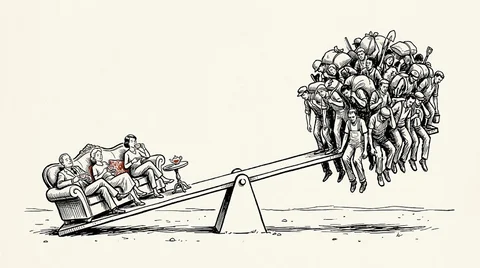


In the Chinese public opinion field, James Liang is a highly contradictory yet highly symbolic figure.
On the one hand, he is one of the earliest, most systematic, and most persistent intellectuals to repeatedly emphasize China's population red line;
On the other hand, Ctrip, which he founded and has long been at the helm of, is the most typical product of the golden age of the platform economy.
The whistleblower stands above the platform.
And in the end, it is this platform that is being investigated.
This is not a satire, perhaps a necessity.
1. Population Red Line: Not pessimism, but the analysis and prediction of Ctrip's platform data
James Liang's core judgment on population has long been misunderstood as "singing the blues for China".
But if we detach from emotions, his arguments are extremely restrained:
【1】Fertility rate is not a cultural variable, but an institutional and expectation variable
【2】Once it falls below the structural threshold, the cost of recovery rises exponentially
【3】The population problem does not "happen slowly", but is accelerated by policies and social expectations
The cruel part of the population system is:
When most people realize that the problem is "already very serious", it is actually too late.
2. His book: "Population Innovation"
James Liang is not "talking about population casually".
He wrote a systematic book for this purpose - "Population Innovation".
The core proposition of this book is quite shocking:
【1】Population size is not a burden, but the foundation of innovation and complex systems
【2】An aging society is not "slowing down", but a decline in innovation density
【3】Technology cannot automatically replace the systemic losses brought about by the collapse of the population structure
In other words, he does not believe in "technological omnipotence",
The significance of this book lies in:
It is not a policy text, but an attempt to pull the population issue back from the moral level to the data level.
3. His doctoral degree and Ctrip data:
In public discussions, there is often a saying:
James Liang "used Ctrip's platform data to obtain a doctoral degree from a foreign prestigious university".
The fact is:
James Liang obtained a Ph.D. in Economics from Stanford University, from a complete and formal academic training and thesis system
His research focuses on human capital, entrepreneurship and economic behavior, and enterprise practice and platform data are one of the research materials, not a "degree pass"
But this misinterpretation itself is not meaningless.
It precisely reflects a kind of realistic tension:
When a commercial platform accumulates unprecedented behavioral data, it will naturally spill over into the academic and public knowledge fields.
This entrepreneur is also a rare sample of the overlap of these three - "data-knowledge-policy".
4. Ctrip: The most vulnerable platform type in the era of population decline
If we look at the industrial structure, Ctrip's position is extremely clear:
Tourism, travel, accommodation
Highly dependent on population size, population mobility and middle-class density
Highly sensitive to young population, family consumption and cross-regional mobility
James Liang's anxiety about the population is, to some extent, not a humanitarian concern, but a clear prediction of the fate of his own industry.
But the problem is -
What Ctrip relies on is not the demographic dividend, but the platform monopoly dividend.
5. Algorithm "killing the familiar": Not a moral scandal, but a platform logic
Ctrip has repeatedly fallen into the so-called public opinion storm of "big data killing the familiar":
Old users pay more than new users / Apple mobile phone users pay more than Android mobile phone users
The prices of the same flight and hotel are different for different accounts
The price fluctuates significantly when refreshing the page
From a technical point of view, this belongs to dynamic pricing and user portrait algorithms;
From the user experience, this is directly perceived as differential treatment of loyal users.
The key is:
This is not a "moral failure" unique to Ctrip,
But a business model that is bound to appear in the mature stage of the platform economy
When the platform has enough data, it will definitely try to transform "user relationship" into "pricing power".
And this is exactly the part that regulators and the public cannot accept the most.
6. Is monopoly a fact? Why is it being investigated now?
Ctrip's real problem is not whether "killing the familiar" is established,
But in its market structure position.
Through a series of mergers and integrations, Ctrip has formed a high degree of concentration in the domestic OTA market:
Traffic entrance is highly concentrated
The bargaining power of hotels and airlines is tilted towards the platform
New competitors are difficult to shake its network effect
In the period of population and demand expansion, this is regarded as "efficiency";
But in the period of population decline, it immediately turns into a distribution obstacle.
Therefore, anti-monopoly is not an emotional rebound, but a system-level loss-cutting mechanism:
Compress platform commissions
Restrict algorithm power
Release the limited social surplus to the physical and family sectors
7. The real paradox: Can the enterprise of the cognitive leader be spared from structural adjustment?
Here comes a very tense realistic paradox:
James Liang is a leader in long-term cognition
But the enterprise he controls is deeply embedded in the profit structure of the old cycle
He calls for paying the cost for the future, while the platform logic is essentially maximizing the present
The result is:
Individual long-term rationality cannot change the organizational mode inertia.
This is not a failure, but a kind of ending of the toBtoC platform-based business model in the current era.
The intersection of James Liang and Ctrip does not constitute a satirical drama,
But a clear specimen of the times:
The population problem has changed from a "discussion topic" to a "fait accompli"
The platform economy naturally becomes the object of rectification in the contraction period
The whistleblower can remind the system, but cannot escape the system's own correction mechanism
When long-term variables truly begin to dominate the world,
The first to collapse is often the most successful part of the previous cycle.
The view "beyond cognition" is:
The real historical turning point often happens outside our cognitive framework. James Liang saw the population crisis, but may not have fully foreseen that the platform economic model he represents will be doubly liquidated with the population crisis in the same time and space.
We often ignore the road under our feet that is collapsing because we see the mountains in the distance. And in the end, what buries us is often not the distant mountains, but the soil under our feet that has long been hollow.
In this sense, the story of James Liang and Ctrip is a parable about the paradox of modernity:
Reason can illuminate the future, but cannot exempt the present.