

From January to November, the national general public budget revenue was 20.0516 trillion yuan, a year-on-year increase of 0.8%. Among them, national tax revenue was 16.4814 trillion yuan, a year-on-year increase of 1.8%; non-tax revenue was 3.5702 trillion yuan, a year-on-year decrease of 3.7%.
The main tax revenue items are as follows:
1. Domestic value-added tax 6.3629 trillion yuan, a year-on-year increase of 3.9%.
2. Domestic consumption tax 1.5639 trillion yuan, a year-on-year increase of 2.5%.
3. Corporate income tax 4.0234 trillion yuan, a year-on-year increase of 1.7%.
4. Personal income tax 1.4689 trillion yuan, a year-on-year increase of 11.5%.
5. Value-added tax and consumption tax on imported goods 1.6520 trillion yuan, a year-on-year decrease of 4.7%. Tariffs 214.9 billion yuan, a year-on-year decrease of 3.2%.
6. Export tax rebates 1.9038 trillion yuan, a year-on-year increase of 5.6%.
7. Urban maintenance and construction tax 475.3 billion yuan, a year-on-year increase of 3.4%.
8. Vehicle purchase tax 181.4 billion yuan, a year-on-year decrease of 17.4%.
9. Stamp duty 404.4 billion yuan, a year-on-year increase of 27%. Among them, securities transaction stamp duty 185.5 billion yuan, a year-on-year increase of 70.7%.
10. Resource tax 271.7 billion yuan, a year-on-year decrease of 0.5%.
11. Deed tax 396.8 billion yuan, a year-on-year decrease of 14.3%.
12. Property tax 471.4 billion yuan, a year-on-year increase of 10.8%.
13. Urban land use tax 234 billion yuan, a year-on-year increase of 5%.
14. Land appreciation tax 378.2 billion yuan, a year-on-year decrease of 17.3%.
15. Farmland occupation tax 130.8 billion yuan, a year-on-year increase of 5.7%.
16. Environmental protection tax 27.4 billion yuan, a year-on-year increase of 14%.
17. Vehicle and vessel tax, ship tonnage tax, tobacco leaf tax and other various tax revenues totaled 127.8 billion yuan, a year-on-year increase of 0.3%.
The above data comes from the statistics released by the State Treasury Department of the Ministry of Finance on December 17. These data are all real data, because they have to match the funds entering the state treasury, and the money has to go into the state treasury account.
The secrets of the empire are all in the numbers.
Let's first look at value-added tax, consumption tax, and corporate income tax. These three items together still account for the bulk, but the growth rate is not high. 3.9%, 2.5%, 1.7%, none of them can be called eye-catching. They all point to one thing, that is, the entire system has entered a state of low-speed operation.
The 17.4% decrease in vehicle purchase tax is almost the closest item to ordinary people's lives. Cars are never necessities of life; they represent a family's confidence in the next few years.
The growth of stamp duty seems lively, especially the 70.7% surge in securities transaction stamp duty. However, this type of income has always reflected the frequency of transactions, not the creation of value. It does not automatically mean a long-term improvement in the economy. For the treasury, this is a source of water that can be used, but in many cases, it is more like a gust of wind.
Real estate-related taxes are almost all declining. Deed tax and land appreciation tax have both decreased significantly. It is worth noting that property tax and land use tax are increasing. This is not contradictory. Houses are no longer expected to drive growth, but they are still there and can still collect taxes slowly.
Unable to interpret everything, I will mainly talk about one of them—personal income tax, which increased by 11.5% year-on-year.
Although this is only the data for the first 11 months, it will be almost the same in 2025. The question is, do you think your income will have a double-digit increase this year?
Like a fish drinking water, no answer is needed.
OK, where does this 11.5% come from?
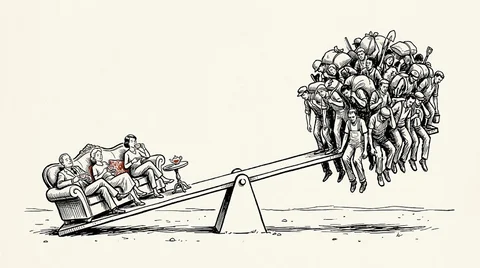
Did a certain group of people suddenly become rich? Or did the income of the whole people increase significantly? Probably not, but more taxes were collected from the middle class. Because the income of the middle class has always been the most stable and easiest to be counted, this item will be valued more when other tax sources are not doing well.
There is nothing to tax on the poor. Their income is already low, many are still below the threshold, and a large amount of income is informal, scattered, and difficult to count. Once the tax burden is slightly increased, their lives will immediately be in trouble, so this group of people cannot become the chickens that lay eggs.
Many people will think that the rich are the ones with money, why not collect more from them? In fact, it is most difficult to collect money from the rich.
Compared to regular, above-board income such as salaries and bonuses, the wealth of the rich exists more in things like equity, asset appreciation, long-term investments, and family structures. This wealth may not be realized immediately, nor may it appear in a personal name, and can be dispersed or postponed.
For the treasury, this type of wealth is difficult and costly to tax, and it is also very sensitive. Any slight change can trigger a chain reaction. Not only in China, but all over the world, the rich have the ability to plan their own wealth. It seems unfair, haha, this world has never been fair.
For example, according to Forbes data, from 2014 to 2018, Buffett's wealth increased by $24.3 billion. During these years, Buffett reported paying $23.7 million in taxes. This is equivalent to an actual tax rate of 0.1%, or less than $0.1 in taxes for every $100 increase in his wealth.
The rich in China are the same.
In the past many years, because the economy was in an upward phase, the treasury was not in a hurry to focus on individuals. Previously, when a piece of land was sold, the housing prices would rise for a period of time, and the treasury would have a lot of income. When the economy was good, ordinary people's feeling of taxes was also vague. They were deducted, but they didn't feel particularly painful.
Now it's different.
You see, from January to November, the land appreciation tax decreased by 17.3%, and the deed tax decreased by 14.3%, both of which are double-digit decreases, which shows that the land finance road is difficult to continue.
The enterprise side is similar. Corporate income tax only increased by 1.7%, which shows that enterprises still have a small profit, but they are struggling to survive.
In this context, the most stable tax source can only be people, the middle class.
People with fixed incomes, people with pay stubs, people with year-end bonuses, people with clear identities and tax records. These incomes are not easy to hide, so personal income tax has become the most certain and easiest to increase tax type.
Many middle-class people have actually sensed this change in their experience. For example, the year-end bonus is less in hand, labor income is combined and calculated, subsidies, bonuses, and various odds and ends are all taken seriously.
At the same time, another layer of buffer is disappearing.
In the past, houses would help you cover it. When housing prices rose, a lot of pressure would be covered up. Now the houses don't rise, and even begin to become a burden. Assets cannot provide a hedge, but taxes are cut down, which is particularly painful.
You have to endure the pain, because you have no choice but to pay taxes for the country.
This is the result of the era shifting gears.
The rapid expansion has ended, and the treasury has to go back to the existing stock to find certainty. And the middle class is the fattest part of the existing stock.
Will things get better in the future? Maybe, but in the short term, it is difficult to expect to return to the past state. Land finance will not suddenly revive, enterprise income will not collectively explode, and the importance of personal income tax will only continue to exist, and even become stronger and stronger.
Therefore, in the future, you must accept an unwelcome fact, that is, the middle class will mainly consider, not the issue of rising, but the issue of pressure resistance.
Of course, hard work is still very important, but the previous hard work was to rise to a higher position, and the future hard work should correspond to not falling from the current position.
Many middle-class people used to rely too much on a single source of income and assets. Once any of them has a problem, the whole family will fall into crisis. In the future, you should pay attention to diversifying assets and have multiple sources of income.
Don't fantasize about how the big environment will be in the future. From a structural point of view, as long as public costs do not fall significantly, the importance of personal income tax will not decrease.
Instead of complaining, it is better to make more realistic plans at the level of life, such as which incomes are truly stable, which expenditures can be flexibly adjusted, which decisions are difficult to reverse once made, and so on.
Also, try to retain the right to choose.
The right to choose here is not necessarily changing jobs, nor is it immigration, but more broadly, such as whether you have the ability to not completely rely on a single system? If you leave this unit and this system, can you survive, can you guarantee the livelihood of the whole family?
The last point, and also the most difficult one, is the psychological adjustment. It is easy to go from frugality to extravagance, and difficult to go from extravagance to frugality. We learned this sentence in middle school.
I have repeatedly written articles to mention and remind these things since three or four years ago. If you are an old reader, you should be able to understand my consistent views and attitudes. It is not because I am bearish on anything, but because many changes, before the data appears, have already been reflected in all aspects of life. As long as we have common sense and insight, we can understand the trend and make a pre-plan in advance. Only by being prepared can we avoid being caught off guard when things come, and being forced to accept the worst result.
Thank you for reading this far without being bothered. Above, let's just chat with old friends. Best wishes.