


The countdown to the National Day holiday is on, and it's almost Double Eleven. I see that many e-commerce platforms have already started various promotional activities in advance.
But what I didn't expect was that social security has also started limited-time, limited-quantity discount promotions.
According to a report in Southern Weekend a few days ago, a Southern Weekend reporter searched policy documents from 31 provinces (autonomous regions, municipalities directly under the central government) and found that,
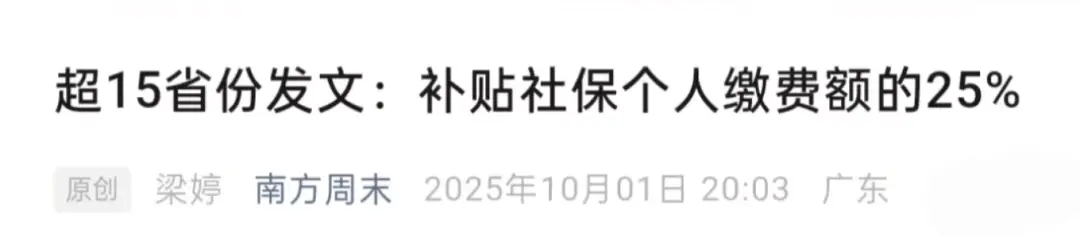
Since September, more than 15 provinces have issued documents (including: Guangdong, Jiangxi, Tianjin, Jiangsu, Chongqing, Guangxi, Yunnan, Shaanxi, Hubei, Hebei, Guizhou, Liaoning, Gansu, Anhui, Ningxia), offering a 25% subsidy on the individual social security contributions for key groups employed in relevant industries.
This is equivalent to a 75% discount on social security.
It sounds pretty good, but there are two key words here, "relevant industries" and "key groups".
This means that this "discount" is not for everyone.
From an industry perspective, it targets the manufacturing and service industries, which absorb the most employment;
From a demographic perspective, it focuses on graduates who are about to enter society, long-term unemployed people, and those monitored for returning to poverty.
The goodwill of the policy is obvious. Against the backdrop of economic pressure, it aims to stabilize employment and encourage job creation more vigorously by directly subsidizing individuals, rather than subsidizing enterprises as in the past.
This is undoubtedly a positive attempt to convey the warmth of the policy more directly to individuals.
However, the subtlety and complexity of any public policy often lie not in its original intention, but in the details of its implementation and the corners that are not covered.
When we peel back the attractive outer layer of "limited-time subsidies", we will find some details worth pondering.
First, this "subsidy rain" did not fall on the vast number of flexible workers.
Flexible workers are the most vulnerable and stressed group in the social security system, bearing thousands of yuan in expenses each month.
But the precise drip irrigation of the policy has bypassed this most arid land.
Secondly, the policy adopts a "pay first, then subsidize" approach, and some areas will first issue subsidies to enterprises, which will then be transferred to individuals.
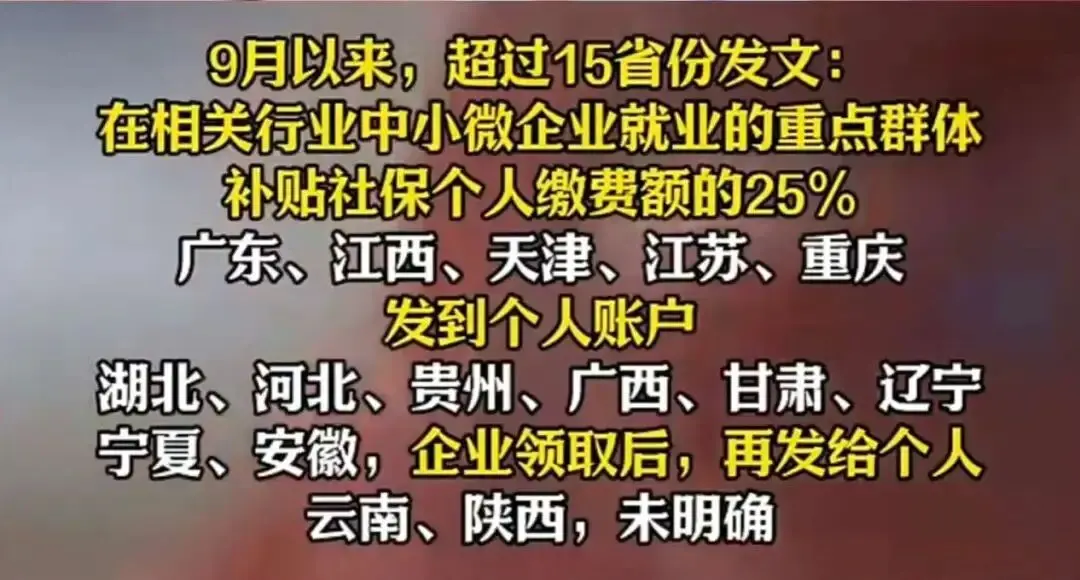
This seems to be just a procedural issue, but it is not friendly to ordinary people.
First, for the target group with low incomes, "paying in full first" itself is a high threshold.
Furthermore, having the subsidy "pass through" the enterprise adds a layer of communication costs and uncertainty.
I'm quite puzzled, since every insured person has a unique social security record and associated bank account, why can't it be directly issued point-to-point to show the greatest sincerity and efficiency?
Is there any insurmountable technical obstacle behind this? Maybe.
Another key question is, where does the money come from? How sustainable is the policy?
The article says that the subsidy funds are shared by the central and local governments at 50% each, with the local government's 50% portion being shared according to the classification and responsibility of the provincial and municipal/county financial powers and expenditure responsibilities.
But the local government is currently facing a large financial gap, and if the policy is only implemented for one year and cannot become a continuous incentive, people will be attracted this year, but may leave the next year.
This is obviously a waste of the already invested financial resources.
The Southern Weekend reporter inquired about the implementation measures in Jinan, Shandong, and was told: no supporting documents have been issued, and more specific audit conditions and application methods are still pending.
This reminds me of this matter:
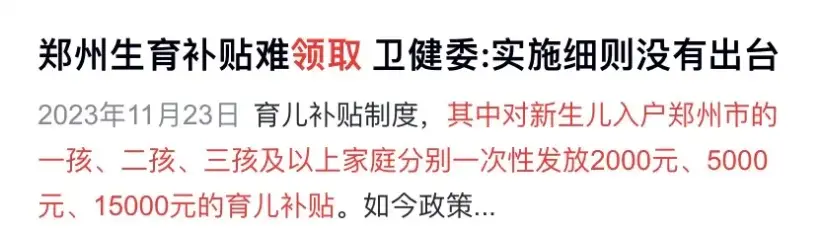
So how will it be implemented in practice? It's better to wait until the policy is truly implemented before we look back and summarize the actual results.
However, what is more worth pondering is that when looking at this "social security discount" policy, it cannot be viewed in isolation.
Its introduction actually forms a very interesting echo with a judicial interpretation issued by the Supreme People's Court in early August.
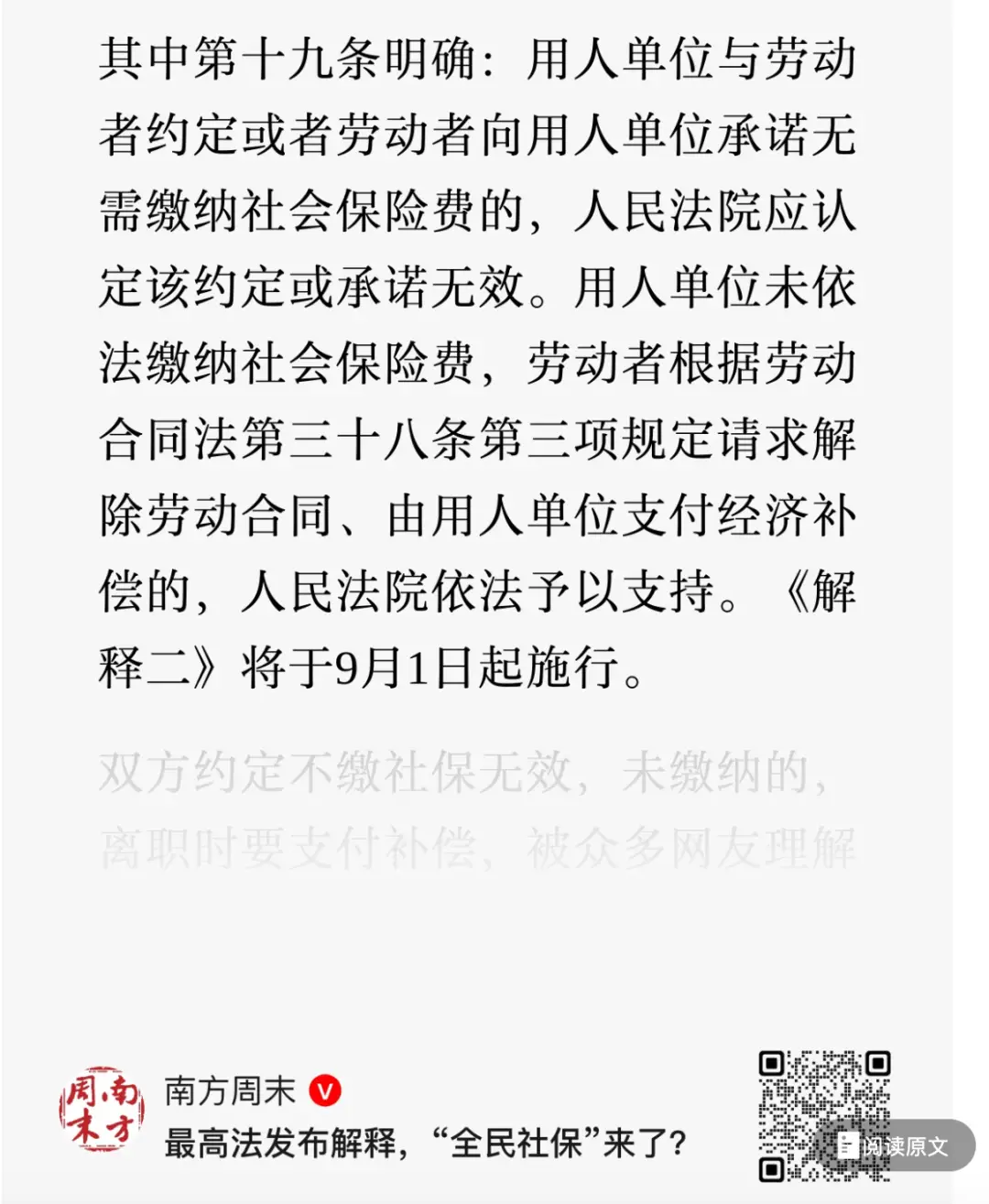
By the way, some people say "social security will be compulsorily paid from September 1st", which is actually incorrect - because social security has always been legally mandatory.
And this provision of the Supreme People's Court essentially gives workers a "unilateral, unconditional" right of recourse, which completely breaks the gray tacit understanding between enterprises and employees in the past, where "I don't help you pay social security, and your monthly take-home pay can be a little more".
For enterprises, evading social security may have been a kind of "negotiable unspoken rule" in the past, but now it has become a legal time bomb that could explode at any time.
Instead of facing high arrears and fines in the future, it is better to pay according to the rules now - so the pressure of compliance costs suddenly comes up.
But for those labor-intensive enterprises that are already making meager profits, the sudden increase in social security costs has only two destinations: either reduce the number of employees, or lower the take-home pay of employees.
And this is precisely the deep reason for the introduction of the "social security 75% discount" subsidy policy.
It's like a buffer, trying to reduce the direct impact on enterprises and employees in this wave of social security compliance driven by the judiciary.
It's telling those employees who may have their take-home pay reduced due to social security compliance: "Don't worry, the policy will help you share a part."
This subsidy may not be a large amount, but the psychological comfort it can provide may be more important than the money itself.
Seeing this, you can actually clearly feel that this is a set of quite ingenious policy combinations:
On the one hand, the judicial interpretation is used to strongly "plug loopholes" and expand the coverage of social security;
On the other hand, financial subsidies are used to gently "relieve pressure" and reduce the pain caused by compliance.
Its fundamental purpose is to strive to find a balance between maintaining the fund pool and a stable group of contributors against the backdrop of the peak of the demographic dividend and the increasing pressure on the social security fund.
But it is precisely the action of "discounting" itself that inadvertently reveals a signal, that is, the pressure of social security contributions may have become so great that the government needs to use finance to "promote sales" in order to implement it.
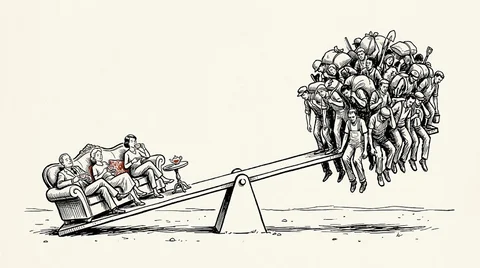
And because of this, the deeper contradictions behind social security - fairness and sustainability - are passively brought to the surface.
Although social security is called "social insurance", its actual meaning and experience are actually very different for people of different identities.
I guess there's no need to explain this, everyone knows it.
Therefore, this social security subsidy with a one-year limit is more like a clever trick to deal with the current troubles, an emergency tactic, and far from a long-term strategic adjustment.
It solves the problem of social security compliance for the time being, but the trust issue hidden behind it is exposed.
If the current policy is really promoted according to a reasonable logic, the order should be like this:
First, straighten out the market economic environment, then improve the enforcement of labor laws, stabilize the employment environment, and protect the basic rights and interests of workers - after all, even if retirement is delayed, everyone must be able to work with peace of mind until the age of 65.
After these foundations are laid, then optimize the rules of social security itself, and don't just invalidate the previous rights and interests because of a few days of interruption.

Finally, gradually promote the coverage of social security for all.
I always feel that there should be a reasonable order of precedence for policy promotion, right?
But the current situation is that no matter how difficult everyone's current situation is, they only keep saying "thinking about your future", which is illogical.
Doing this is actually eroding the credibility of the policy itself bit by bit.
And as mentioned before, when an institution has to rely on "discounts" to make everyone willing to accept it, what really needs to be rebuilt is not just the balance of the social security fund pool,
but also the people's fundamental trust in the fairness of this system and the certainty of their future security.
What do you think?