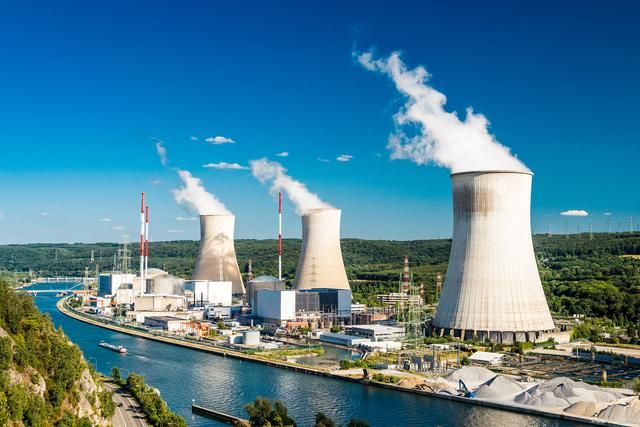
Japan announced that the Fukushima nuclear power plant will begin discharging treated nuclear wastewater on August 24. In recent years, the discharge of nuclear wastewater from Fukushima has attracted widespread attention in China. A recent study by the Shenzhen Graduate School of Tsinghua University said that the discharge of nuclear wastewater from Fukushima would cause radioactive substances to reach the coast of China in 240 days. Facing these various “dangers”, is it necessary for the public to panic? Will the nuclear wastewater that is about to enter the Pacific Ocean really pose a threat to us, and will the seafood in the Pacific Ocean really be contaminated by nuclear radiation?
1. Where does nuclear wastewater come from? Why is it discharged?
Before discussing whether the discharge of Fukushima nuclear wastewater is scientific and whether it will pose a threat to the surrounding environment, we need to take a step back and ask a basic question: Why does Fukushima need to discharge nuclear wastewater? Many rumors about nuclear wastewater start with this basic question, exaggerating the situation as if Japan wants to cause nuclear pollution for no reason. But does this make sense? Fukushima is located within Japan, and Japan is also a country that consumes a lot of seafood, especially fond of its own aquatic products. Would they intentionally cause pollution within their own borders?
In fact, the current discharge of Fukushima nuclear wastewater is part of the entire Fukushima nuclear power plant cleanup plan. In March 2011, due to the tsunami caused by the earthquake, a serious accident occurred at the Fukushima nuclear power plant, with cores melting in units 1-3 and unit 4 being damaged. After that, Japan entered the process of controlling and cleaning up the Fukushima nuclear power plant. Decommissioning a nuclear power plant involves cleaning up a large amount of nuclear fuel, which is a long process. For Fukushima, which has suffered a serious nuclear leak accident, it is even more complex because it needs to clean up the damaged nuclear reactors and the surrounding contaminated soil. It is currently estimated that it will take 30-40 years to complete the decommissioning of the entire Fukushima nuclear power plant.
During the process of cleaning up the Fukushima nuclear power plant, from the beginning of cooling the nuclear reactors after the accident to maintaining the cooling state of the nuclear reactors later, cooling water needs to be continuously injected into the reactors. This cooling water will be contaminated during this process and become nuclear wastewater with extremely high radioactivity. The cooling water also cannot be 100% recycled, meaning that the nuclear power plant cleanup personnel will continuously input new cooling water, while the old wastewater will continuously accumulate. The damage suffered by the Fukushima nuclear power plant during the nuclear accident also means that rainwater and groundwater seep into the nuclear reactors, forming wastewater other than cooling water.
This radioactive nuclear wastewater will continue to accumulate before the Fukushima nuclear power plant is completely decommissioned. Of course, the rate of accumulation will vary. For example, rainwater and groundwater infiltration existed in the early stages, and this has been resolved through measures such as cutting off groundwater. In the early stages after the nuclear accident, the amount of cooling water used was greater, and the proportion of recycling was lower. These factors combined have significantly reduced the current accumulation rate of Fukushima wastewater.
However, these contaminated waters must be dealt with somehow. The operating management company of the Fukushima nuclear power plant – Tokyo Electric Power Company, TEPCO, began to designate an area within the Fukushima nuclear power plant area shortly after the accident and continuously built water storage tanks to temporarily store the continuously accumulating wastewater.
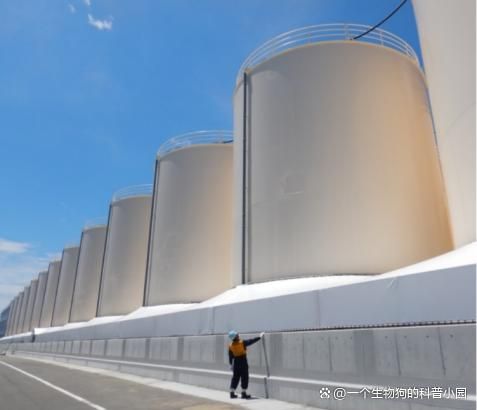
Fukushima’s water storage tanks
However, this storage is only temporary because the local space in Fukushima is limited, and the storage tanks that can be built are also limited. By the end of 2020, the storage tanks had reached their upper limit, with a total volume of 1.37 million cubic meters, but the volume already used had reached 1.23 million cubic meters. With an additional 50,000-60,000 cubic meters of wastewater added each year, a longer-term solution is needed.
And the current discharge into the sea is also based on this large background.
2. Nuclear wastewater, nuclear wastewater, ALPS treated water, which is more accurate?
Rainwater and groundwater contaminated by nuclear leaks, as well as contaminated water formed by cooling nuclear reactors, these generally highly radioactive wastewater are collected together, which becomes the nuclear wastewater that Fukushima needs to find a way to deal with.
The contradiction between the total amount of nuclear wastewater and storage space broke out shortly after the Fukushima nuclear accident. In April and May 2011, a large amount of wastewater was quickly generated by cooling the nuclear reactors that had just had an accident, and the storage space built by the Fukushima nuclear power plant at that time was limited, so TEPCO chose to discharge the relatively low-radioactive wastewater directly into the sea, discharging 115,000 tons in April and 300,000 tons in May. This caused a lot of controversy at the time, on the one hand because TEPCO did not communicate the accumulation of wastewater in advance and directly announced the discharge into the sea. On the other hand, although low-radioactive wastewater was chosen for discharge, the radioactivity of the discharged wastewater still exceeded the international emission standards for radioactive substances.
The discharge in 2011 is also the source of many media and self-media reports that emphasize nuclear wastewater rather than nuclear wastewater. Those waters contain radioactive substances such as cesium-137 and iodine-131, which are also used by many reports in the current discussion of nuclear wastewater discharge.
It’s just that these reports that emphasize that it must be called nuclear wastewater are misleading about the current discharge situation, and the claim that there are various dangerous radioactive substances such as cesium-137 and iodine-131 is even false information.
After direct contact with the nuclear reactor, whether the source is cooling water, rainwater, or groundwater, it does form water that has been contaminated, and it is reasonable to call it nuclear wastewater, which is also the type that TEPCO discharged into the sea in 2011. But now Fukushima is not directly discharging this type of nuclear wastewater, but treating the nuclear wastewater and discharging it after it meets international emission standards. This type of treated water that meets emission standards but still has a certain radioactivity should belong to nuclear wastewater, not nuclear wastewater.
To understand the difference between the current nuclear wastewater and the nuclear wastewater that was originally produced, the ALPS system must be mentioned. Since the cleanup of nuclear accidents inevitably produces a large amount of nuclear wastewater, how to safely dispose of this wastewater has long been considered by TEPCO and the Japanese government. In 2013, Toshiba specifically developed a multi-radioactive substance removal system, ALPS, for this purpose.
ALPS can be understood as a filtration system. In the actual operation process, the stored nuclear wastewater enters ALPS for treatment, and 62 kinds of radioactive elements are removed (reducing their content significantly) through adsorption and filtration, forming ALPS treated water.
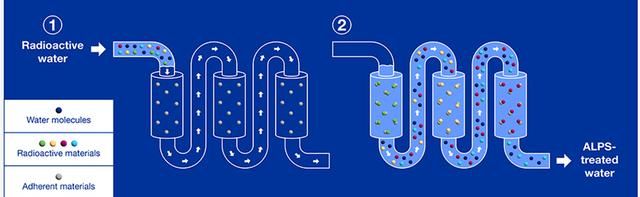
ALPS system working principle diagram
Since ALPS was launched in 2013, the Fukushima nuclear power plant has been using ALPS to treat the accumulated nuclear wastewater, and the treated ALPS water continues to exist in the storage tanks mentioned earlier. What is now to be discharged is actually ALPS treated water.
Some reports deliberately exaggerate that cesium-137 and iodine-131 are also radioactive elements that will be removed by ALPS. Therefore, emphasizing that these radioactive substances will be discharged can only be said to be false information.
3. Nuclear wastewater discharge standards
Compared to what system is used to remove radioactive elements from nuclear wastewater, the public is more concerned about how much radioactivity is left in the nuclear wastewater that will be discharged. Some news reports will say that the ALPS system treatment is not successful, and a lot of wastewater still has high radioactivity after treatment.
For these statements, we need to understand the standards for the discharge of Fukushima nuclear wastewater. The discharge of Fukushima nuclear wastewater is not just a matter of checking in at the ALPS system and then discharging it, but there are clear emission standards for radioactive substances, and the purpose of ALPS is to make the discharged wastewater meet this standard.
ALPS can remove 62 kinds of radioactive elements, but there are two that cannot be removed, namely carbon-14 and the hydrogen isotope tritium. The content of carbon-14 in nuclear wastewater itself is not high, about one-tenth of Japan’s emission standard. The one that ALPS cannot really handle and is more significant in terms of total radiation is tritium.
In this regard, the final emission standard is that, in addition to tritium, the total radiation of the remaining radioactive elements treated by ALPS is lower than the environmental emission standard for radioactive waste (the total value is 1, which is also the standard recognized by the International Commission on Radiological Protection, ICRP). By the end of 2020, 29% of the nuclear wastewater stored in Fukushima met this standard.
So what about the rest that didn’t meet the standard? Some media reports are very happy to emphasize that 70% of the nuclear wastewater does not meet the standard. But these non-compliant ones will not be discharged, but will be treated by ALPS again until they meet the standard before entering the discharge sequence.
Those non-representative wastewater includes those treated early, and those that encountered filtration system failures for a period of time, and those with much higher radioactive element content (10-100 and above 100 respectively). But they will all go through ALPS again, that is, remove radioactive substances again. According to TEPCO’s monitoring report, water with a radioactive element content of 2400 or more before, after reprocessing, is only 0.35. That is to say, this repeated treatment with ALPS to meet the standard is feasible.
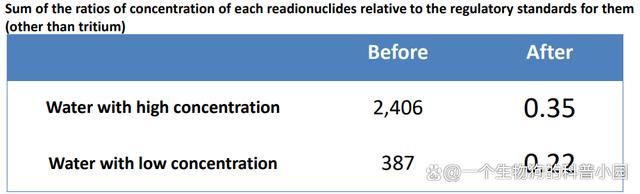
Repeated ALPS treatment can make the wastewater meet the standard
We mentioned earlier that the only thing that ALPS cannot handle is tritium, so what Fukushima is actually waiting to discharge is nuclear wastewater that has been treated by ALPS and meets the radioactive emission standards except for tritium.
So what remains here is how to deal with the problem of tritium, which is why the International Atomic Energy Agency (IAEA) and others often refer to the discharge of Fukushima nuclear wastewater as the tritium water treatment problem.
Tritium is an isotope of hydrogen, and the physical and chemical characteristics of tritium water are the same as ordinary water, making it difficult to separate tritium water, and the total amount of tritium water that Fukushima needs to treat is also particularly large, more than 1.3 million tons. With current scientific and technological capabilities, physical separation is impossible. For this reason, the dilution step is added to Fukushima’s discharge plan, and seawater is used for more than 100 times dilution during discharge, so that the final tritium content does not exceed one-fortieth of Japan’s national standard.
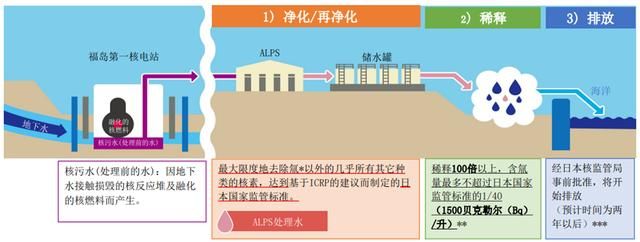
Nuclear wastewater discharge flow chart
That is to say, the discharge of Fukushima nuclear wastewater first requires that the total radioactivity of more than 60 kinds of radioactive elements (excluding only tritium) after ALPS treatment is reduced to the international emission standard for radioactive substances before entering the discharge sequence; secondly, it must also undergo more than 100 times dilution during discharge, which not only reduces the content of radioactive substances, but also ensures that the carbon-14 that ALPS cannot remove is one-thousandth of Japan’s regulatory standard, and tritium is below one-fortieth.
In the actual discharge, the tritium radioactivity in the wastewater after dilution is 1500 becquerels per liter (Bq/L), while the upper limit of tritium content in WHO’s drinking water standard is 10,000 Bq/L. This is why foreign governments and media will mention that the radioactivity of the discharged wastewater meets the drinking water standard. Of course, that only refers to the tritium emission, and because a large amount of seawater is used for dilution, this is not really drinking water, but it only means that in terms of radioactivity, it is already equivalent to drinking water
4. Is there any supervision of nuclear wastewater discharge?
Many people may also have doubts about the standards for nuclear wastewater discharge: are these standards reliable? Are these standards formulated unilaterally by the Japanese side? Is there even supervision of the entire discharge process? Are the so-called qualified data reliable?
The discharge of Fukushima nuclear wastewater is really not something that Japan came up with one day. After the ALPS system was launched in 2013, Japan began to discuss how to deal with ALPS treated water – the problem of tritium exceeding the standard that ALPS cannot remove. Therefore, Japan established a tritium water working group from 2013 to 2016 to specifically analyze how to deal with Fukushima’s tritium water.
The working group first verified and confirmed that it was not realistic to separate tritium from wastewater. Next, it compared and analyzed five potential tritium water treatment methods, including discharge into the sea, steam emission, geological injection, hydrogen emission, and underground burial. Nowadays, domestic media and self-media are very keen to say that discharge into the sea has the lowest cost, and other schemes such as geological injection are better. These statements are unfounded. The so-called geological injection and underground burial currently have no corresponding standards, and there is uncertainty about whether suitable geological formations can be found. Hydrogen emission has technical difficulties in expanding the treatment. Considering the feasibility of technology and management, only discharge into the sea and steam emission are realistic.
Some media also cited the statement of Greenpeace, believing that tritium water can be used to make concrete and directly used in the construction of the Fukushima nuclear power plant. This is also without any precedent and has technical uncertainties. On the basis of the tritium water working group, Japan established the ALPS Wastewater Treatment Committee in 2016. The committee chose the discharge into the sea, which is more convenient for implementation and monitoring and has more precedents, between the two feasible schemes (liquid discharge into the sea and steam emission into the atmosphere). It should be noted that the precedent for steam emission of tritium water appeared during past nuclear power plant accidents (there is also steam emission during the operation of nuclear power plants, but the total amount is small), and it is difficult to predict the situation of steam blending into the atmosphere and establish effective monitoring.
The above working groups and committees are composed of technical experts, so we can see that the current discharge plan is based on the research and demonstration of technical professionals, not the unilateral decision of TEPCO or the Japanese government.
The report of the ALPS Wastewater Treatment Committee was published in February 2020. After the report was released, the Japanese government held a large number of meetings, including discussions with local governments and people in the agricultural, forestry, and fishery industries. Combining the scientific report of the committee and the opinions of all parties, the Japanese government issued the basic treatment plan for Fukushima wastewater on April 13, 2021, and formally proposed the strategy of discharging the wastewater into the sea after treatment and meeting various standards.
The basic treatment plan also clarifies: the independent Nuclear Regulation Authority (NRA) will allow TEPCO to implement wastewater discharge only after reviewing and approving the detailed plan. It was estimated at the time that this process would take two years. Now it has been more than two years, and it is about to start discharging.
Although the above discharge plan was constructed within Japan, the discharge of nuclear wastewater is not only supervised within Japan. When announcing the basic treatment plan, the Japanese government also requested technical support from the International Atomic Energy Agency (IAEA). After receiving the request from the Japanese government, the IAEA immediately agreed to provide technical support through a series of audits and inspections.
In July 2021, the IAEA and the Japanese government formally signed an agreement on how to implement audits and inspections. The IAEA also established a working group specifically for the Fukushima wastewater discharge issue. In April 2022, the IAEA working group published its first audit report. In June and December 2022, and April and May 2023, the working group published the 2nd-5th audit reports respectively. In the 5th audit report released in May 2023, the IAEA working group confirmed that the NRA is independent, and the NRA will supervise TEPCO’s discharge plan and process. The IAEA confirmed that all threatening radioactive substances are within the detection plan approved by the NRA, and there are no omissions of radioactive substances that will have a significant impact on human health and the environment.
On July 4, 2023, the International Atomic Energy Agency (IAEA) published a comprehensive safety review report on Japan’s plan to discharge ALPS-treated nuclear wastewater from Fukushima, covering all key safety elements of the discharge plan, including three main parts: protection and safety assessment; regulatory activities and processes; and independent sampling, data verification, and analysis. The report concluded that Fukushima’s plan to discharge treated water into the sea complies with international safety standards, and the impact on humans and the environment can be negligible.
The IAEA’s comprehensive report mentions that the IAEA’s Fukushima nuclear power plant working group is composed of top experts from the IAEA Secretariat, and is also advised by internationally recognized external experts from around the world (including the areas around the wastewater discharge). We also see that China’s permanent representative to the IAEA is also on the working group list. This person is the chief expert of China National Nuclear Corporation and the former vice chairman of the China Institute of Atomic Energy, with more than 30 years of experience in nuclear safety.
The IAEA’s report also states: The IAEA’s conclusion, based on its comprehensive assessment, is that the plan and activities of Japan to discharge water treated by the Advanced Liquid Processing System comply with the relevant international safety standards. In addition, the IAEA noted that, according to TEPCO’s current plan and assessment, the controlled and gradual discharge of treated water into the sea has a negligible radioactive impact on humans and the environment.
It should be noted that the IAEA’s independent supervision does not end after the above report is issued, but will participate in supervision before, during, and after the discharge. That is to say, the Fukushima wastewater discharge plan is not just the words of Japan or TEPCO, but has independent NRA supervision in Japan, and IAEA audit supervision internationally.
5. Will the discharge of nuclear wastewater make seafood unsafe?
The IAEA’s international supervision confirms that the discharge of Fukushima nuclear wastewater complies with international safety standards and will not have a significant impact on humans and the environment. So what data is this “no impact” based on?
First of all, unlike some reports that exaggerate, the Fukushima nuclear power plant will not discharge all 1.3 million tons of wastewater at once. TEPCO’s discharge plan is that the daily wastewater discharge does not exceed 500 tons, and the annual discharge does not exceed 200,000 tons. The entire discharge is currently estimated to be 30 years, and will be accompanied by the entire decommissioning process of the nuclear power plant.
Secondly, the total radioactivity of tritium in the wastewater discharged in the plan is 22 TBq per year. Tritium is also produced and discharged during the normal operation of nuclear power plants, and the discharge methods include liquid and gaseous forms. Referring to the tritium discharged by nuclear power plants in many parts of the world each year, the 22 Tbq planned by Fukushima is nothing at all.
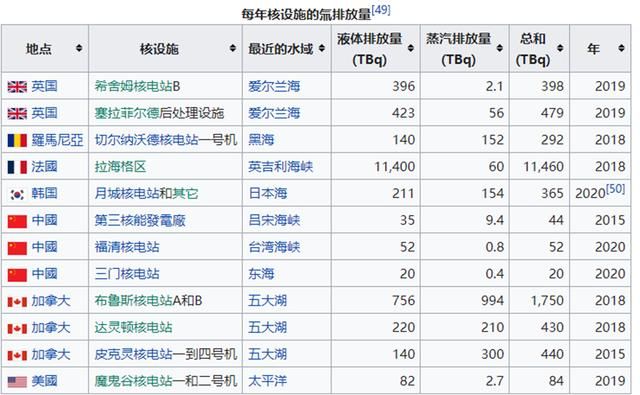
Annual tritium water discharge from some nuclear power plants worldwide
The two nuclear power plants in mainland China, Fuqing and Sanmen, discharged 52 and 20 TBq of liquid tritium into the Taiwan Strait and the East China Sea respectively in 2020. In 2020, the Pacific Ocean could accommodate the 72 tbq discharged by the two nuclear power plants in China and the 211 TBq discharged by South Korea into the Sea of Japan. I believe that the Pacific Ocean in 2023 should not shrink to the point of fearing the 22 TBq added by Fukushima each year.
How much impact can such a discharge have on the surrounding environment?
Japan, according to the method designed by the United Nations Scientific Committee on the Effects of Atomic Radiation, estimates that the nuclear wastewater discharged after treatment according to the current Fukushima plan will not affect each person in Japan by more than one ten-thousandth of the natural background radiation (Japan, which is closest to the discharge point, is the most affected area). In contrast, the radiation received from eating a banana is about one two-thousandth of the natural background radiation per year, which is five times the impact of Fukushima nuclear wastewater discharge on local residents in Japan. The IAEA believes that this impact can be ignored and is scientifically reasonable.
Let’s take a look at the problem of ocean pollution and seafood safety that many people are worried about. It should be noted that the discharged nuclear wastewater will first be diluted with seawater by 100 times, and then discharged into the sea after being lower than the WHO drinking water tritium content standard. The impact on the ocean is also actually within a negligible range. According to simulations, only the tritium content in the sea area within 2 kilometers around the Fukushima discharge point will exceed the seawater background of 1 Bq/L during the discharge of wastewater, and it will be in the range of 1-10 Bq/L, which is far lower than the WHO drinking water standard. Even if some countries adopt stricter standards, such as Norway, the drinking water standard is also 100 Bq/L.
Combining these information, the “nuclear wastewater” discharged by Fukushima has a very low “nuclear” content, and the overall impact on the environment will not increase significantly on the basis of existing nuclear power plants worldwide. Even in the waters around Fukushima, there will be no significant radioactive pollution due to the discharge of nuclear wastewater, and it is even more absurd to say that it will affect the safety of seafood.
However, many people will still be confused by some reports that can exaggerate the threat of nuclear wastewater, and feel that these impact assessments are all based on the impact of tritium. Some people will emphasize that this is nuclear wastewater, not nuclear wastewater, and there are many other radioactive substances in it.
In fact, as mentioned earlier, other radioactive substances have been removed by ALPS to a very small extent and will not have a significant impact. Finally, let’s take a look at the results of the comparison and detection of the radioactive substance content in ALPS-treated water by multiple laboratories around the world organized by the IAEA.
The results were published on May 30, 2023, and are also available on the IAEA website, confirming the reliability of TEPCO’s detection, showing that except for tritium exceeding the standard, the content of other radioactive elements in the ALPS-treated wastewater is very low: except for tritium (3H in the first row), the amount of other radioactive elements is very low, and is also far below the emission standard (Regulatory limit).
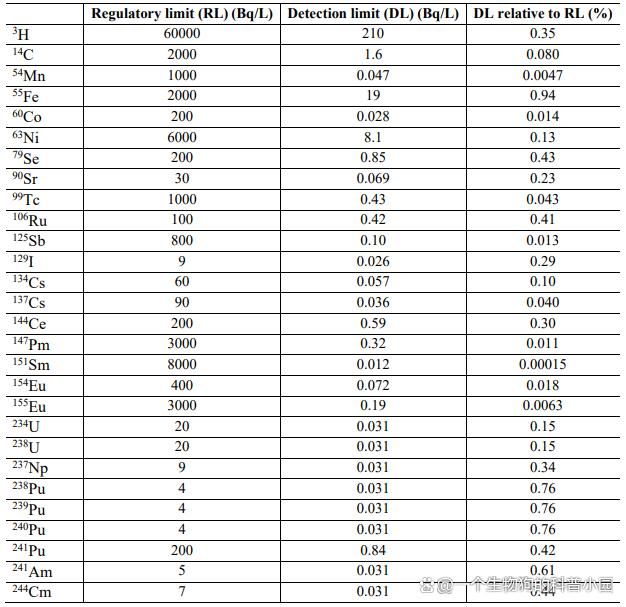
Content of various radioactive elements in ALPS-treated water
Therefore, not only is the tritium in the nuclear wastewater discharged by Fukushima not enough to have a significant impact on the environment, but other radioactive substances have also been treated to be far below the emission standard and cannot “wreak havoc”. On the contrary, those who promote nuclear wastewater instead of nuclear wastewater all day long are only seeking traffic dividends by inciting national emotions, and may not really care about the safety of the people.
In fact, according to the laws of ocean currents, the seawater near Fukushima will first flow through Canada and the United States, and then return to China via the Pacific Rim. Canada and the United States have already clearly stated their support for Japan’s nuclear wastewater discharge plan. Even South Korea, which has long been sensitive to relations with Japan, also admitted on July 7, 2023, after independently reviewing the materials, that the Fukushima discharge plan complies with international standards and respects the IAEA’s assessment conclusions.
Don’t these countries understand the harm of radioactive substances? Or do they not care about the health of their citizens?
As a maritime neighbor of Japan, China has the right to require Japan to be open and transparent in the discharge of nuclear wastewater and to respond to the concerns and doubts of all parties. Chinese media and self-media should also pay attention to the discharge of Fukushima wastewater, but they should pay attention to the impact on people and the surrounding environment, and provide the public with true and reliable information, rather than selling anxiety and gaining traffic through exaggerated or even false content.
Discover more from 自由档案馆
Subscribe to get the latest posts sent to your email.