Onion Daily Headline: Well-known media outlet Cailianshe to close down in July
Rumor has it: According to sources, the well-known domestic media outlet Cailianshe may be sued by an international beverage giant for false reporting and face a loss of billions of dollars, facing the risk of closure this July.
The actual situation: Due to fabricating and distorting Reuters’ news in its report on the topic of aspartame causing cancer, it triggered market panic about aspartame, a common ingredient in artificial sweeteners, causing huge property losses to international beverage giants Coca-Cola and Pepsi, which produce sugar-free cola. Relevant companies are convening legal and lawyers’ meetings to discuss countermeasures, and theoretically, they do not rule out the possibility of suing Cailianshe for compensation.
I wonder how you all feel about the above news. Do you believe that Cailianshe will close down in July? I think the editors of Cailianshe should feel very subtle about this news, because they themselves have just used the above logic to publish a report, causing a stir about aspartame causing cancer.
The real and complete situation is this:
Reuters recently released a news report, citing sources, that the International Agency for Research on Cancer (IARC) under the World Health Organization is evaluating whether aspartame, an artificial sweetener, causes cancer, and will release the evaluation results in July. At the same time, the Joint FAO/WHO Expert Committee on Food Additives (JECFA) will hold an expert meeting in July to evaluate whether aspartame poses a carcinogenic risk in actual use.
Currently, the evaluation results of the above two institutions on whether aspartame has a carcinogenic risk, and the level of evidence, have not been announced, and are still uncertain and unknown information.
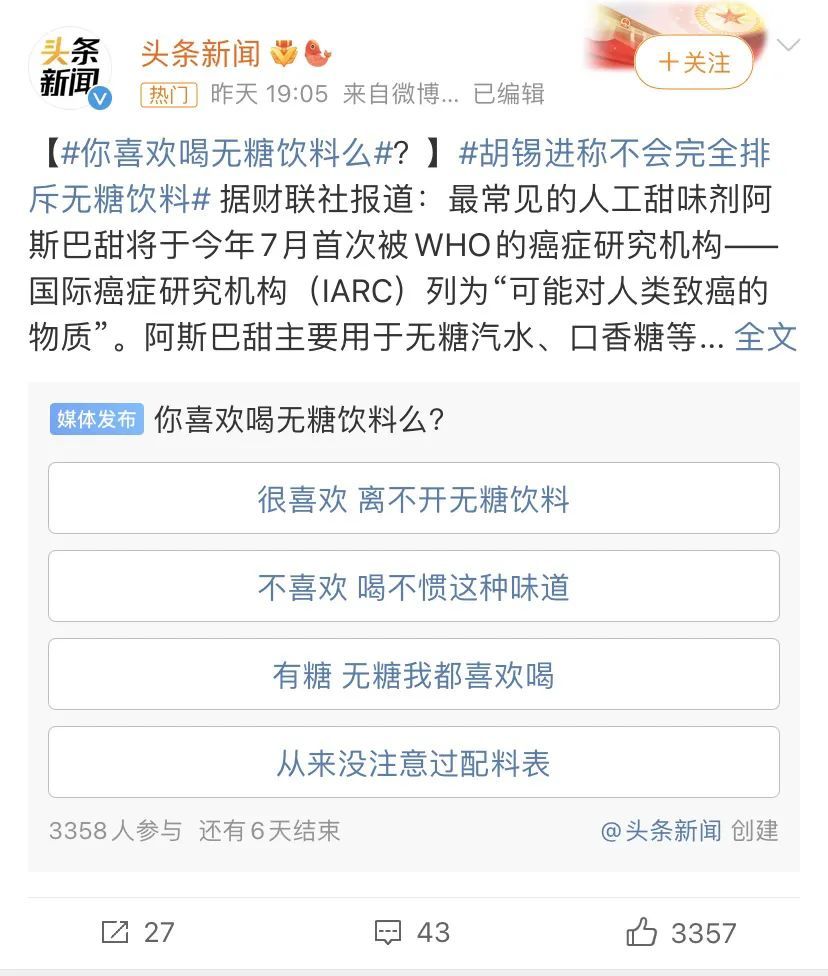
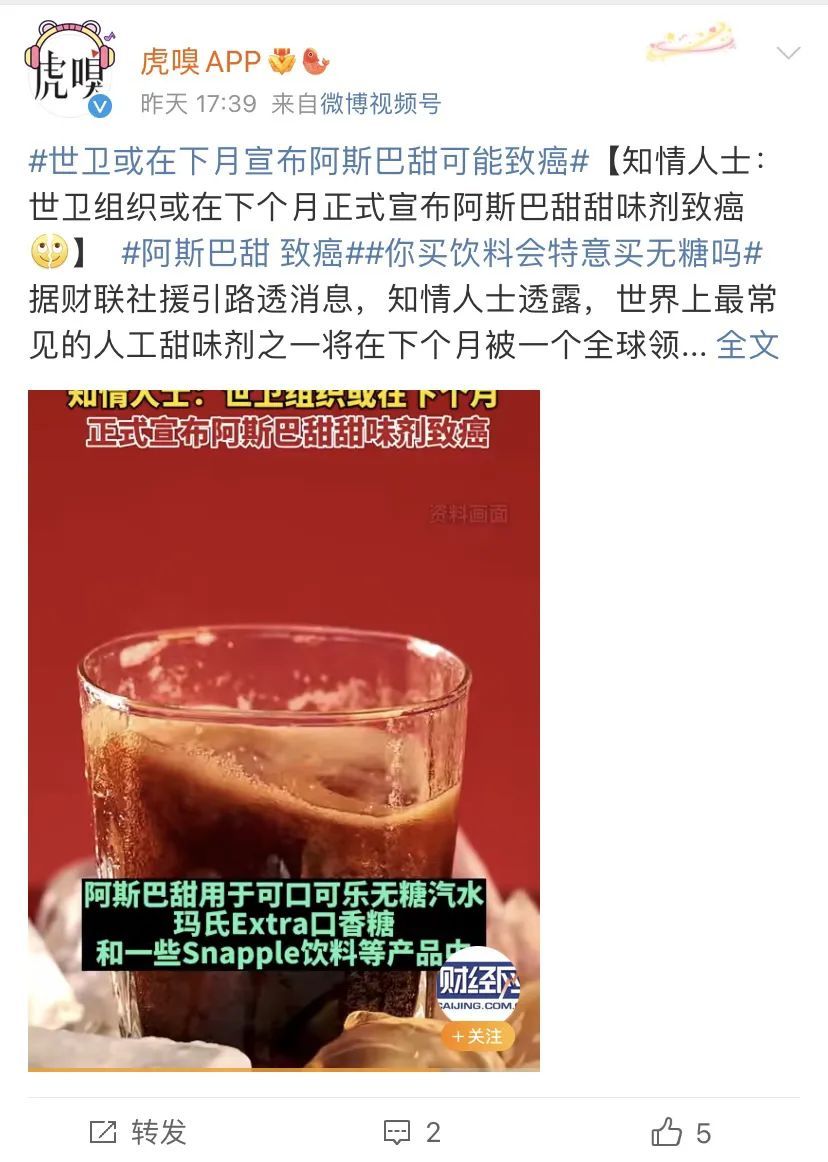
However, when Cailianshe compiled the relevant Reuters report, it directly ignored the expression of “possible”, ignored the expression of “unknown results”, and directly reported a predictive message as a definite message, directly reporting the unknown results as known conclusions.

Just looking at this news from Cailianshe, everyone will think that aspartame being listed as a carcinogen by the International Agency for Research on Cancer is a definite piece of information, so other media also cited this unreliable second-hand information, eventually triggering public discussion and topping the trending searches.

Why did so many media outlets directly cite this highly simplified and seriously distorted news from Cailianshe? Couldn’t such a large financial website find a reporter who understands English to take a look at the original Reuters report?
This involves another problem with Chinese characteristics… Domestic media actually rarely have the qualifications to compile news from foreign media. Even if they do, Reuters is usually not on the list of permitted sources.
Cailianshe took the risk and took the lead, citing Reuters’ news, but it didn’t dare to write the three words Reuters in the news. Other media outlets used Cailianshe as a shield. They cited Cailianshe’s news, and Cailianshe cited Reuters’ news, a chain of plagiarism, which is also a set of life-saving skills.
The only problem is that Cailianshe, which first cited the English information, did not do a good job, the information cited was incomplete, or it may have been deliberately cut, leading to all the media on the entire forwarding chain being hit.
A large number of false and untrue international news on the Chinese Internet are spread in this way.
Think about it, if my article is seen by English media, they translate the Chinese into English and then cut it, saying that the well-known Chinese financial media Cailianshe will close down in July, how would you feel?
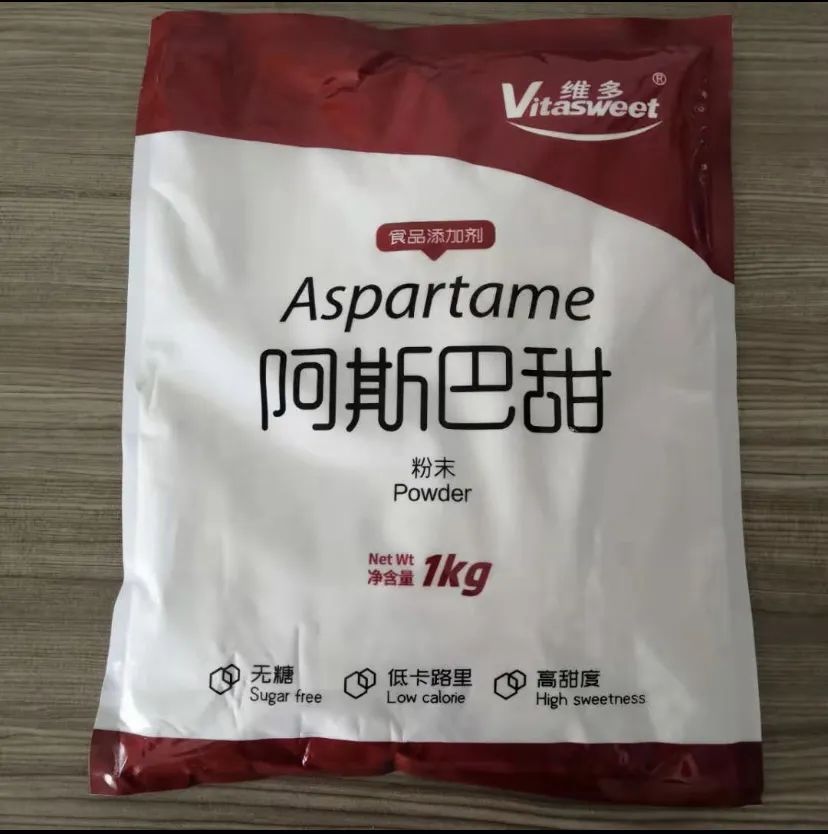
Going back to the aspartame issue, is it possible for IARC to list aspartame as a possible carcinogen? It is possible! But even if it really happens, it will be listed as a 2B carcinogen at most, which is the category of 【possibly carcinogenic, but with insufficient evidence, requiring more research】, which is one level lower than the carcinogenic evidence level of pork and beef (2A).
With the assessment of the carcinogenic level, the safety threshold of the intake dosage also needs to be considered. If it takes 800 grams per day to have a carcinogenic risk, it is completely different from having a carcinogenic risk with 800 milligrams per day.
You media outlets should still improve your own skills and don’t always want to make a big news!
Discover more from 自由档案馆
Subscribe to get the latest posts sent to your email.