

Is personal struggle useful? After distributing 2,500 questionnaires and interviewing 200 people, the survey ultimately showed that hard work cannot truly change their circumstances; social factors are the main determinants of their fate.
Lao Zhao, the sanitation worker in my neighborhood, has been working in Beijing for 23 years, but he couldn’t retire at the age of 60. His future pension is only a little over 100 yuan per month, so he plans to work until he is 70.
This generation of migrant workers, also known as China’s “first generation of migrant workers,” were born before the 1970s and came to the cities to work in the 1980s and 1990s, with many working for over 30 years. But for these more than 86 million people, their situation in old age is roughly the same as Lao Zhao’s.
Lao Zhao is from Zhumadian, Henan. He came to Beijing in 2000, when he was 32 years old. He worked as a gatekeeper and did landscaping. In 2007, he came to our neighborhood to work as a security guard. Another 10 years passed, and at 49, he still hadn’t saved enough money to get married. He lived alone in a 10-square-meter basement that had no heating in winter and was damp and moldy in summer.
I know this because I was an intern at a newspaper at the time and needed to write a report on migrant workers, and Lao Zhao was the closest migrant worker to me.
“I haven’t had a vacation in 7 years, working 10 hours a day, and earning 2700 a month. This isn’t just my situation; everyone is like this.” Before leaving, he urged, “You must not delete these words.”
Not only these few sentences, but the entire section about Lao Zhao was deleted, the reason being “negative energy.” Lao Zhao doesn’t fit our beautiful vision of the lives of migrant workers, but the actual situation of this group of people is even worse than we can imagine.
Associate Professor Qiu Fengxian from Anhui Normal University conducted a study. She distributed 2,500 questionnaires and interviewed 200 people to find out how the first generation of migrant workers would survive in their old age. I saw countless Lao Zhaos in the lines of the report—
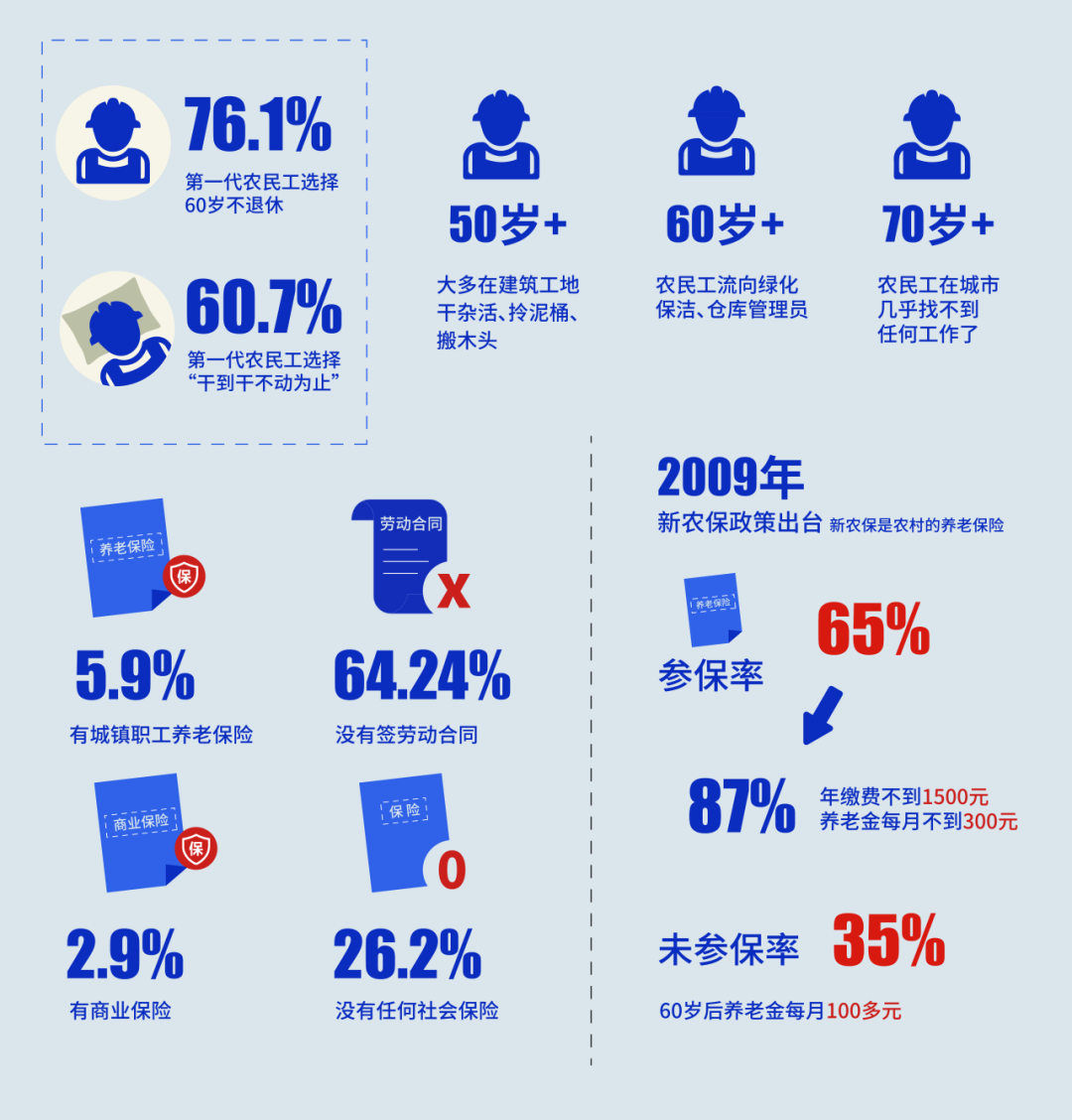
When we are discussing “delayed retirement” and worrying about not being able to rest at 60, 60.7% of them can only “work until they can’t work anymore”;
When elderly people in cities can receive an average monthly pension of 3,000 yuan, their pensions are only one or two hundred yuan;
They have all worked for more than 15 years, but in their old age, more than half of them have less than 50,000 yuan in savings;
They send the money they earn back home to support their children’s education, but as a result, the next generation’s class mobility is less than 20%.
One point we are more likely to overlook is that they are both workers and elderly people. They have to continue working hard at an age when they should have retired, but as a result, they neither get what old age promises them, such as family happiness and medical security, nor do they get the rewards and dignity that workers should have.
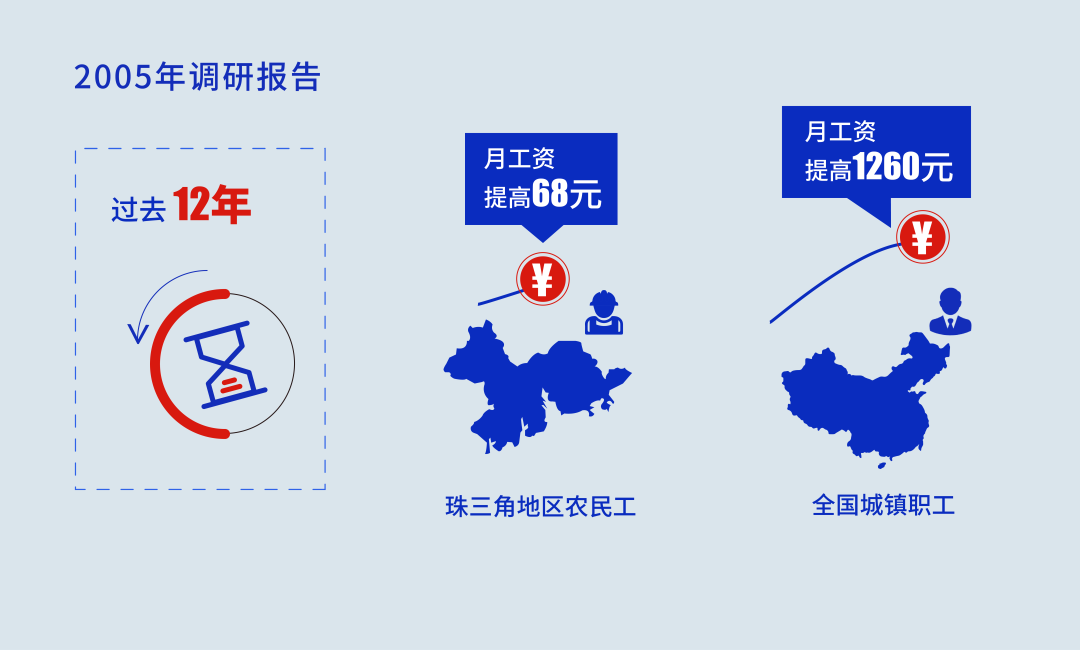
From 1993 to 2005, the monthly wages of urban employees nationwide increased by 1,260 yuan, while the increase for migrant workers was: 68 yuan.
They are not not working hard, but the survey ultimately showed that hard work cannot truly change their fate. Qiu Fengxian finally used “social vulnerability” to describe their situation, that is, this is a problem of the times, deeply affected by socially exclusionary policies, far beyond what individuals can decide.
Their predicament is surprisingly similar to the predicament many people face today, which may be a common fate for the weak in a society.
“Retirement” does not exist
The real Lao Zhao hasn’t received a single penny of wages for two full years. Four years later, the neighborhood canceled the security guard positions, so he switched to cleaning, but after another three months, the cleaning positions also stopped paying.
Lao Zhao still insists on cleaning the neighborhood. He comes at 6 a.m. every day to clean two trash cans, and he is “always the first to arrive” when the garbage station opens at 7 a.m., and then goes back to sweep six buildings. In order to earn money for food, he sorts the garbage himself to sell for scrap, earning more than 600 yuan per month.
“You can choose not to do it, but what if they don’t give you the money from before?” He said he would wait until he got his wages back.
He did consider labor arbitration, which was 21 months after he didn’t receive his wages, but he didn’t know that arbitration required a contract, and this 14-year job never had a labor contract.
Therefore, the state of this job is in a state of Schrödinger’s cat. If he can get his wages in the end, it is, and if he can’t, it isn’t. But in Lao Zhao’s eyes, this “job” is still “hard-earned” because he is already 55 years old. In the labor market, at this age, he can only do more unstable daily wage work. Due to the implementation of the “eviction order,” he will soon lose the right to even carry bricks on construction sites—the policy strictly prohibits migrant workers over 60 from entering construction sites.
Lao Zhao is not an isolated case. Standing at the threshold of 60 years old, many migrant workers have tried everything to get a job.
In order to find a job on a construction site in Shanghai, a 64-year-old migrant worker obtained a fake ID card, reducing his age by 7 years. As a result, he was caught during an inspection after only two days of work. He was fined 500 yuan and detained for 1 day.
Also in Shanghai, a 49-year-old cleaner wanted to change jobs, but was always rejected due to her age. She also spent 300 yuan to get a fake ID, reducing her age by 11 years, and was eventually administratively detained for 5 days.
Even if it’s hard to find a job, even if they take risks, most of the first generation of migrant workers do not plan to retire. Among the migrant workers surveyed, 76.1% decided to continue working in the city after the age of 60.
They do not have the conditions to enjoy retirement. Elderly people in cities have a pension guarantee, with an average of 3,000 yuan per month. In the first generation of migrant workers, this number is less than 300 yuan. Even so meager, only 65% of people can receive it.
Most of them couldn’t afford to consider their old age when they were young and could only spend their wages on the present. In 2009, the pension policy was introduced, and 35% of people did not believe or understand how this policy related to their future, so they did not participate in the insurance. After the age of 60, they can only receive a basic pension, only a little over 100 yuan per month.
People who participate in the insurance can also rarely understand that the pension is “more contributions, more benefits.” A 45-year-old worker has paid pension insurance for 11 years, but has actually been paying at a low rate. After the age of 60, he can only receive 195 yuan per month. After learning this number, he asked, what’s the use of this? The second sentence: I’ve paid for so many years, why do I only get this much money a month?
In order to receive a higher pension (600-700 yuan per month), a female worker needs to pay the insurance fees for the previous 15 years in one go at the age of 60, totaling 80,000 yuan. She can’t raise this money. She only earns a few thousand yuan per month. “They all want me to pay pension insurance, what will I eat?” She decided to give up and continue working as a sanitation worker.
These migrant workers also don’t have much savings. Among the people surveyed, nearly half (41.22%) have worked for more than 20 years, but more than half (55.2%) have less than 50,000 yuan in savings.
They can only continue working. But market and policy restrictions make them earn less and less money as they get older.
Migrant workers in their 50s can still find jobs with a daily wage of 300 yuan on construction sites. Although “you can’t sit all day,” someone shouts to carry mud buckets and move wood, and they have to go immediately to help. Many people will also voluntarily work overtime to earn more money. A 56-year-old worker from Shandong worked a maximum of 14 hours a day, sometimes working overtime all night, and could still continue working the next day.
When they are over 60 years old, they lose the right to earn this hard-earned money. In the past two years, various places have issued “eviction orders,” strictly prohibiting migrant workers over 60 from entering construction sites. They can only switch to landscaping, cleaning, and warehouse management, with salaries less than 1/3 of those on construction sites.
After the age of 70, they have almost no way to survive in the city. A 71-year-old migrant worker was forced to return to his hometown and helped build houses in the village, earning 100 yuan a day. At the age of 75, a labor agency went to the countryside to recruit sanitation workers, with a salary of 110 yuan a day. Although it was only 10 yuan more, he still went. His 69-year-old wife had just had gallbladder surgery 3 months ago, but fortunately, she could also work, and their combined income was more than 200 yuan.
From then on, he took his wife and went to the city at 6 a.m. every day, taking a 1-hour bus to dump garbage and sweep the floor at a construction site, and then took the bus back to the countryside at 4 p.m., working 7 days a week. He said: “Being able to move is a blessing; not being able to move is pitiful.”
Work and income are limited by the times; hard work also can’t save money
Most of the first generation of migrant workers started working in the cities in the mid-1980s and early 1990s. Their most profitable prime years happened to be the thirty years of the fastest urban development. But why didn’t the dividends of the times bring them benefits? Why, after working half their lives, did they still fail to save money?
Let’s take a look at what happened in these thirty to forty years:
In the 1980s after the reform and opening up, the first generation of migrant workers began to enter the cities, creating the first “migrant worker tide” in 1989. In the same year, various places began to evict migrant workers.
In 1990, Beijing required the eviction of 250,000 people, and all units and enterprises had to fill out forms every month to report progress. At that time, the “migrant worker tide” impacted urban management, and at the same time, the cities were facing a wave of layoffs, and urban residents also needed to find new jobs. Migrant workers became a “problem” for the cities.
Three or four years later, the market economic system was gradually established, and the cities needed a large number of cheap labor. They were allowed to enter the cities again. Two or three years later, they were evicted again because the cities were facing large-scale layoffs again.
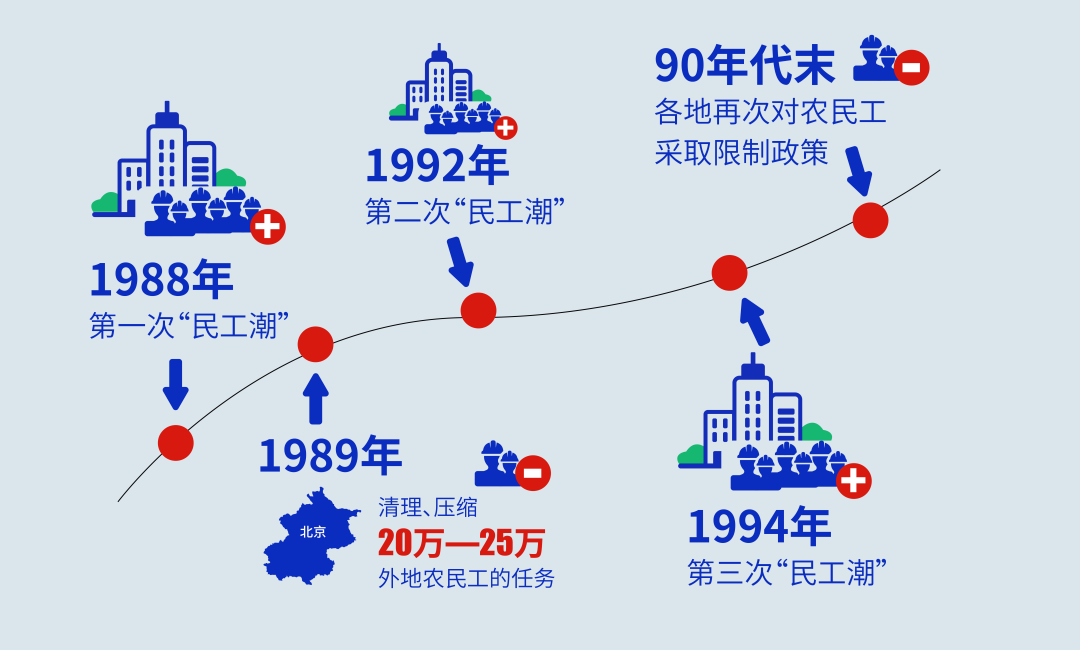
But they didn’t understand the policies and didn’t know that they had been “evicted.” They only knew that after being fired one day, it would be difficult to find work again. A migrant worker who started working outside in 1989 remembers that he couldn’t find work, so he lived under a bridge for a month, bringing his own quilt.
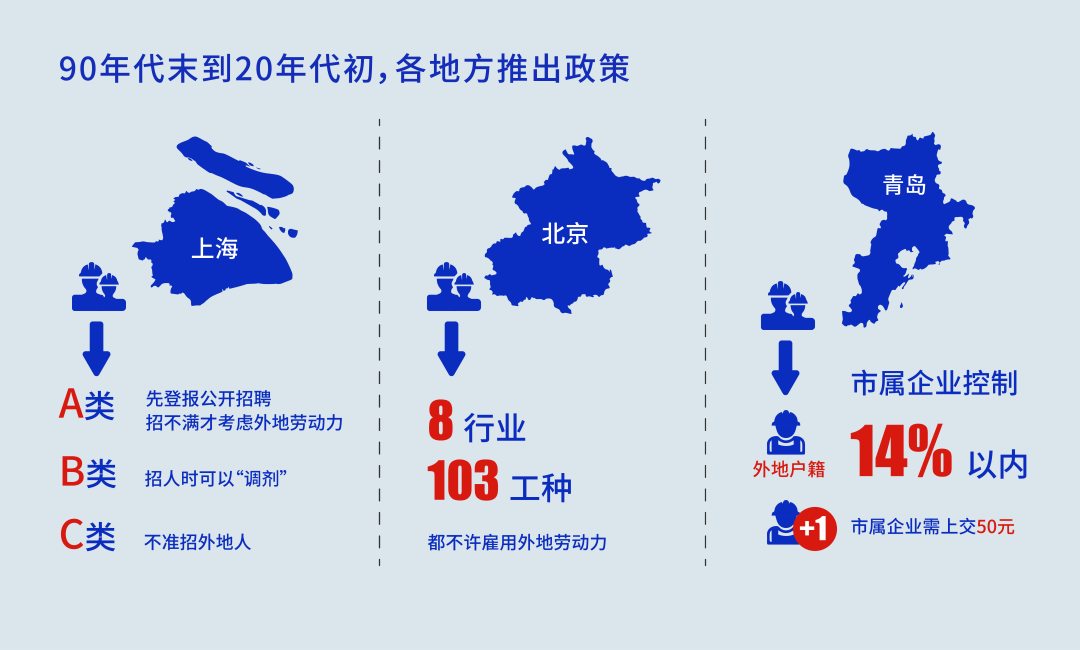
In the late 1990s and early 2000s, the types of jobs that migrant workers could participate in were also limited in the cities—
In Shanghai, among the three types of work in the city, only one type “allowed consideration” to use out-of-town labor, provided that local people were not fully recruited;
In Beijing, 8 industries and 103 types of work in the city did not allow the employment of out-of-town labor;
In Qingdao, a municipal enterprise also had to pay 50 yuan for each out-of-town person recruited;
They couldn’t even enter factories to work on assembly lines like later migrant workers (many factories were also limited to local household registration). What they could do were all the jobs that local people were unwilling to do, such as construction and manual loading and unloading. Many of these jobs were “black labor,” and 21% of them suffered wage arrears and other rights violations.
Wage increases were even more out of the question. In the 12 years of dividends brought by the reform, from 1993 to 2005, the monthly wages of migrant workers in the Pearl River Delta region only increased by 68 yuan (while the average for urban employees nationwide increased by 1,260 yuan). Considering inflation, it was equivalent to them being continuously paid less during their golden years.
The experiences of the first generation of migrant workers are closely related to urban development, but they are always in a passive position. When the cities need them, they absorb them; when they don’t need them, they evict them. During their prime years, they were always unable to work continuously and stably, and they were constantly swaying between urban and rural areas.
In the past 20 years, there have been more opportunities to make money, but they have also grown old and can’t compete with young workers; at the same time, they also have to bear the education, housing, and weddings of their children, and the little money they have left is also being drained.
The money all went to the children, and as a result, the next generation’s class mobility is less than 20%
It can’t be said that Lao Zhao has nothing. He worked in Beijing for 23 years and saved 200,000 yuan, which is higher than 90% of the people in the survey. But this is based on a special reason. Unlike most of the respondents, Lao Zhao has no children.
The order of expenses for the first generation of migrant workers, the first place is basically the marriage and education of their children.
In rural areas of the north, the expenses for a child’s marriage are between 300,000 and 500,000 yuan. In the year of his son’s marriage, a migrant worker’s annual income was 70,000 yuan, but his expenses were as high as 320,000 yuan. He had to borrow money.
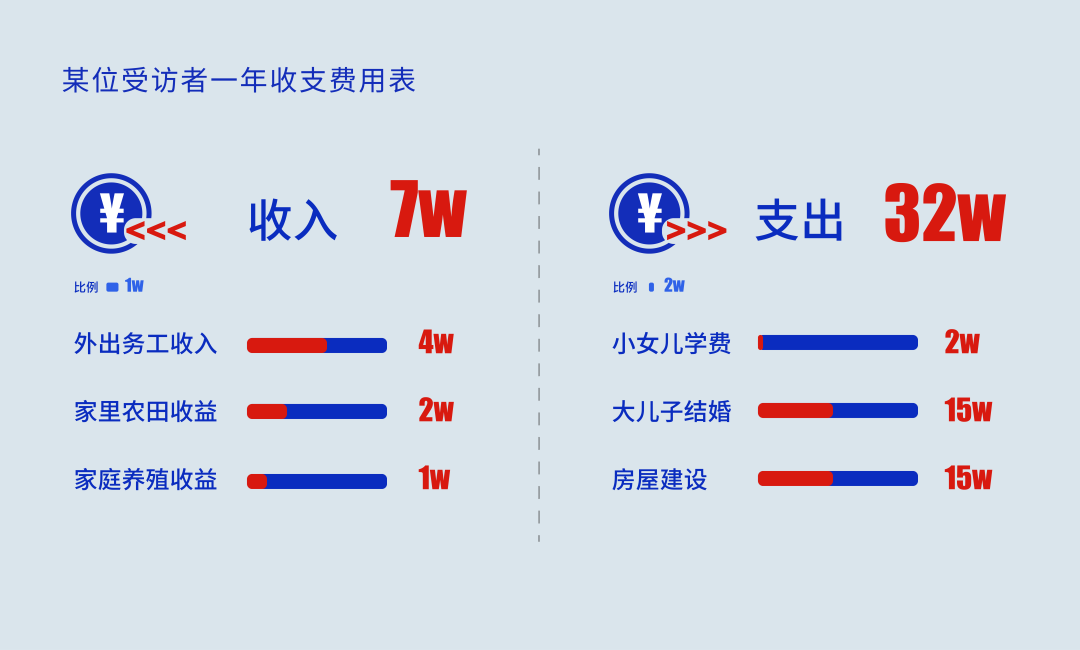
Afterwards, they repay all the debts. Because the woman usually requires “no debt after marriage.” A couple in Anhui had three sons. They had already exhausted their savings for the first two marriages and had no money to borrow, so they had to give their third daughter-in-law an IOU, promising to pay for the house. After that, the couple went out to pick up scraps together and didn’t go home for 10 years, only continuously sending money to their youngest son.
Their children will spend the money on themselves, and their grandchildren will strive to become city people, but the first generation of migrant workers are still insisting on providing blood for the family. A survey in 2009 showed that in Guangdong, 65%-70% of the income of the new generation of migrant workers is used for personal consumption, but 80%-90% of the first generation of migrant workers are still sending their wages home.
In order to be able to stably supply the family, the first generation of migrant workers will actively give up opportunities for personal development—for example, investing some money first, they might become a small contractor—because they dare not take risks, fearing that failure will ruin their family. They will also give up saving for themselves. They will start saving money for themselves only at the age of 60, after completing the task for their children.
They place their hopes on the next generation, hoping that they will not repeat the fate of working as migrant workers.
But as a result, most of their children dropped out of junior high school and high school, and less than 20% went to college or above. 63.5% of the children became the next generation of migrant workers. Only 5.1% entered government agencies and public institutions, and only 2.9% started their own businesses.
Corresponding to the first generation of migrant workers, their children may be called the first generation of left-behind children. Neither of these two generations has much choice. Their parents can only go out to work to make a living, and their children have to stay in the countryside. When talking about their children in interviews, the first generation of migrant workers mostly say that they have accepted their fate, “The children are not the material for studying.”
Research shows that due to the lack of guidance and emotional support from their parents, left-behind children are at a disadvantage in their studies. A survey based on 3,500 people shows that compared to their peers, left-behind children are more likely to have difficulty adapting to high-intensity alienated labor when they grow up. The “Three Great Gods” in Shenzhen, who “work one day and play three days,” live a “three-abandonment” life—abandoning family, abandoning society, and finally abandoning themselves—many of them are children of the first generation of migrant workers.
Like a cycle, their children, after giving birth to their own children, also enter the mode of their parents. Many people buy houses in the county town for their children to go to school, but they can only work in big cities, so the children become another generation of left-behind children.
A migrant worker A once tried to break this cycle. He went to Shanghai to work on a construction site in 1989, and his child was born in 1991. To avoid being left behind, he let his child go to school in Shanghai in the second grade of elementary school, with a borrowing fee of 5,000 yuan per year, “equivalent to three or four children in an ordinary family.” After paying, he couldn’t save any money. But in the second year of junior high school, he learned that foreign household registration could not participate in the high school and college entrance examinations in Shanghai, so he had to let his child return to his hometown alone.
At first, he felt that the six or seven years of life in Shanghai still made his child different from his peers in his hometown, but this difference didn’t last long, “He was not taken care of at home, and we didn’t know whether he was studying well or not.”
His child later graduated from college and went to work in Changzhou, and later had his own child. The third generation of this family was sent back to Anhui rural areas to be left behind.
Because he paid the borrowing fees in those years, A had no savings and didn’t buy a house. After the outbreak of the pandemic in 2020, he returned to his hometown. When he left, the last job still owed him 40,000 yuan and didn’t give it to him. He also didn’t understand that pension insurance should be “more contributions, more benefits,” and in the future, he can only receive a little over 200 yuan per month. At the time of the interview, he was 56 years old and opened a small storefront in Wuhu to collect garbage. He said that he had worked for more than 30 years, but in the end, it seemed that he was no different from those who had always been in the village.
Unable to see a doctor, injuries and illnesses can only accumulate with work
The youngest of the first generation of migrant workers are also in their 50s, and they face the common problem of seeing a doctor for all elderly people. Unlike elderly people in cities who go to the hospital to get medicine on a daily basis, they rarely see a doctor.
A cleaner in a Wuhu building lost her job because she went to see a doctor. She only took a day off, and when she went back to work, the company didn’t want her anymore, saying that someone had taken her place.
From then on, she didn’t dare to take sick leave. She is 64 years old, with inconvenient legs and feet, and she has to be responsible for mopping six floors twice a day, and also cleaning other areas. Her monthly salary is 1,800 yuan. During the interview, she was mopping the floor, and she had to stop and catch her breath every time she mopped a floor. But she said that there was no way, as long as it wasn’t a life-threatening illness at the time, she would wait until the end of the year to go home to see a doctor.
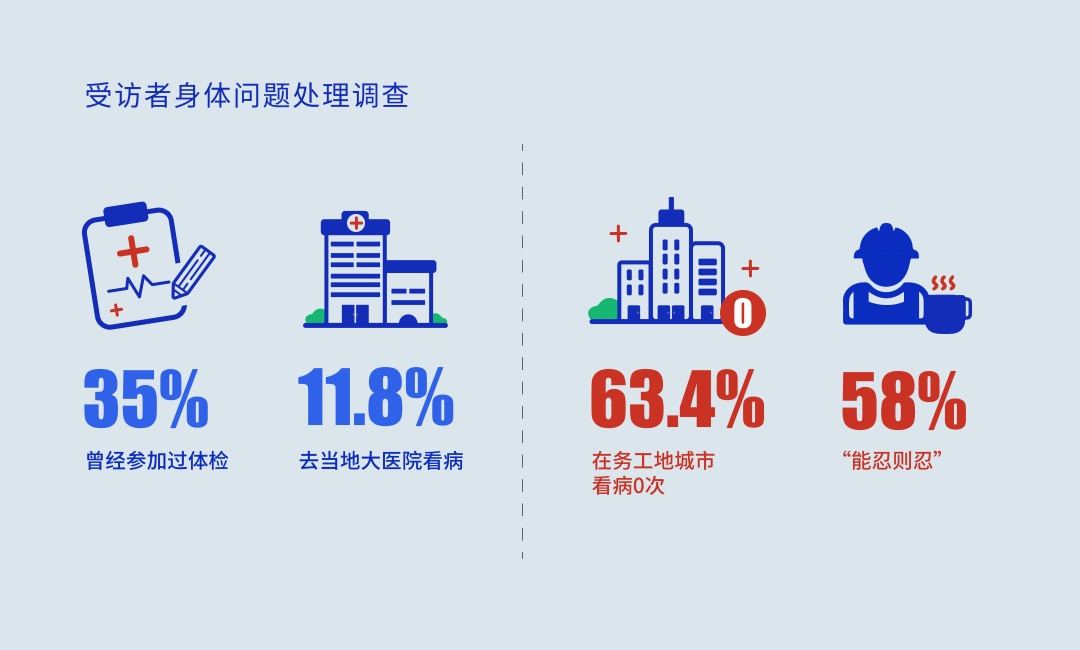
In the survey, for the most worrying problem, 61.4% of the first generation of migrant workers believe it is “physical health,” but—
Only 35% have participated in physical examinations;
63.4% have seen a doctor 0 times in the cities where they work;
58% of the people “can endure it,” and only 11.8% choose to go to local hospitals for treatment.
In the 1980s and 1990s when the first generation of migrant workers went out to work, there was no medical insurance in rural areas, and seeing a doctor was a “naked running” state. Most people were unwilling to use the hard-earned money for medical treatment.
In 2010, the New Rural Cooperative Medical Scheme basically covered the whole country, but it could not be carried across different places. When they get sick at work, they must first go to the hospital where their household registration is located, confirm that they cannot be treated, go through the transfer procedures, and then go back to the place where they work to see a doctor before they can be reimbursed, but they still have to pay for it themselves.
They either pay for their medical treatment themselves or go back to their hometown for reimbursement, but they have to bear the cost of travel, time, and the risk of unemployment.
But when asked about their attitude towards the New Rural Cooperative Medical Scheme, more than half of them chose “satisfied,” saying that it was very good, and they didn’t get reimbursed for seeing a doctor before. They only compare themselves to the past, but they won’t compare horizontally because they don’t know how high the medical reimbursement ratio is in the city.
Whether it’s pain or difficulty seeing a doctor, they choose to endure it. The occupational injuries they suffer, such as back pain, are far more serious than those of elderly people in cities, but they won’t do massage, physiotherapy, or acupuncture like elderly people in cities. They just endure it and apply tiger balm.
They think it’s useless to go to the hospital because they can’t follow the doctor’s advice. A female worker in her 50s, due to long-term work, developed a cyst on her wrist that couldn’t bend and was very painful. The doctor advised her to go home and rest, saying that it was caused by working too hard and she couldn’t work anymore. But she felt that if she didn’t work, she couldn’t live.
Problems accumulate over time. In their old age, they generally look more than ten years older than their actual age, with pain in various parts of their bodies. Some people also suffer from pneumoconiosis, lupus erythematosus, and other diseases caused by environmental pollution… Compared to people who have worked for more than 10 years, people who have worked for less than 5 years have a 44.7% higher probability of self-assessing “health,” that is, the longer they work, the worse their health may be.
A migrant worker used to do the work of carrying bags when he was young. A large bag weighed more than 100 kilograms, and he earned 10 yuan for carrying one. He had to carry more than a dozen a day, and he would occasionally strain his back, and the pain would make him sweat. During the interview, he was 54 years old and could no longer straighten his back, and his arms couldn’t be raised either. The hospital diagnosed him with muscle strain.
Another person did the work of shoveling cement for many years, taking orders day and night, and was constantly choked by cement and coughing. At 50, he began to feel short of breath from time to time, but he didn’t go to see a doctor or take leave, “I can work after resting myself.” A few years later, he became more and more short of breath, and was diagnosed with emphysema in the hospital.
During the interview, he was 57 years old, and he would pant heavily as soon as he walked, and he had to rest after taking a few steps. He returned to his hometown and couldn’t do anything. “I heard that this disease can’t be cured anywhere,” so he didn’t get treatment, only took anti-inflammatory drugs every day, which were still bought by his children on Taobao. “When I’m really suffocating, I’ll go to the hospital for two days of intravenous drip.”
Qiu Fengxian believes that for the first generation of migrant workers, the deepest mark left by the city on them may be health problems, “They carry a body full of injuries and return to the countryside, return to that original point, but that original point is no longer the original point.”
Is personal struggle useful?
Some words are often used to describe the first generation of migrant workers, such as “small peasant consciousness” and the thinking of the poor. It seems that they are limited by their own minds and cannot live a better life.
They may indeed lack courage and pioneering spirit, dare not invest, and cannot seize opportunities, but this is not the reason for their difficult lives, but the result. They have no savings, no insurance, and no family support, so they naturally don’t want to take risks. Qiu Fengxian believes that it is social exclusion that makes them lack the ability to resist risks, but they shift the responsibility to the farmers themselves.
Before the survey, Qiu Fengxian had predicted that the fate of these migrant workers was related to both social factors and personal factors. After the questionnaires and interviews, she found that the personal situations of these people were almost the same. The vast majority of them did not finish junior high school (83.85%), did not learn skills (67.4%), and their families were so poor that they had no money to support them to set up stalls in the city, and they had no connections.
They are not not working hard. Even after the retirement age of 60, they still seek opportunities to work. If they can’t get into the construction site, they will do daily wage work, waiting on the side of the road for the recruitment van at 4 a.m. But hard work seems to be useless.
Qiu Fengxian finally used “social vulnerability” in the report to describe the predicament they face, that is, their situation and future is a problem of the times, deeply affected by the exclusionary influence of social policies, and not something that individuals can decide.
A forgotten generation
It is difficult for people to truly understand the situation of the first generation of migrant workers. Qiu Fengxian once called for providing more good job opportunities for elderly people in rural areas in an article. An expert criticized her for “lacking humanistic feelings,” believing that the elderly should rest. Qiu Fengxian believes that this is actually not understanding the countryside. If they don’t work, who will bear their living expenses?
They have no awareness and ability to speak out for themselves and fight for their rights. They have no education, cannot use the media, and can only endure. In the interviews, they rarely complain about being tired, but only say “How can there be no work that is not tiring?”; when their bodies are bad, they also feel normal, “How can you have a good body after working all your life?” When asked about their future plans, they say “See how the world goes,” meaning to see how this era will develop. Finally, they silently return to their hometowns.
Qiu Fengxian was born in 1979. Her father, brother, and sister had all worked outside, “If I went out, I would be the first generation of migrant workers.” Later, she became the only person in the family to go to college. Her younger sister, who is a few years younger than her, went out to work at the age of 16 and earned money to pay her tuition fees. In 2003, Qiu Fengxian graduated from university and went to Shanghai to see her sister and brother-in-law on a construction site. There were no family rooms on the construction site. They lived with a dozen people in a large shed, and only a wooden board separated a separate room. After becoming a scholar, she instinctively wanted to pay attention to the first generation of migrant workers.
After starting the research, she found that they were eager to talk. As long as she asked one person, a group of people would immediately gather around, and everyone would talk at once. It was even difficult for her to interview one person alone. They talked about not being able to find work, not having money to go home, or adding family members getting sick, and the problems were almost the same.
They said that they couldn’t tell their families about these things, and the relatives who hadn’t come out didn’t understand; they couldn’t tell their co-workers either, because they always changed places to work, and it was actually difficult to have friends; they couldn’t tell the city people even more, although these people really have channels to speak out for them—a migrant worker who has been on the construction site for a long time, that is actually a closed space isolated from the city, he said that he has never been clear about what kind of life the people in the city are living, and he only saw it recently by swiping Douyin.
They are indeed gradually leaving our sight, gradually retreating from the construction sites that we are not familiar with but still have a concept of, to places that we will not see and think of. They may retreat to your neighborhood, mop the floors of the corridors, and wipe the elevators; they may also retreat to the side of the building where you work, level the grass in front of the building, and water the flowers and plants. But you won’t notice them as you go in and out every day.
他们也许会退到你的小区,拖楼道的地、擦电梯;也可能退到你工作的大厦旁,平整楼前的草地、浇花草。但你每天进进出出也不会留意到他们。
You won’t even be able to associate them with a common identity, like when you pass a construction site. After they grow old, they are like stones crushed into fragments, blown by the wind to every corner of the city, so you can no longer see the stones.
Qiu Fengxian once pessimistically thought, “What will happen to the aging migrant workers” may never enter the minds of city dwellers. It seems natural that a person is a rural person, and when they get old, they return to the countryside. Only by carefully examining their every contribution and cost will one realize that they work in the city for their entire lives like city dwellers, but end up with nothing, which is not normal.
References:
Qiu Fengxian. Research on Sustainable Livelihoods of the First Generation of Migrant Workers. 2023
Bao Xiaozhong. Lewis Model and “Labor Shortage of Migrant Workers”. Economists, 2005, 4: 55-60.[J]Jiang Lihua. On the Equal Competition Rights of Urban Migrant Workers. Journal of Central China Normal University: Humanities and Social Sciences Edition, 2002, 41(4): 10-13.
Wang Jianhua, Huang Binhuan. Left-behind Experience and the Work Mobility of New Workers – How the Production System of Migrant Workers Makes Themselves Face Difficulties. Social Magazine, 2014, 34(5): 88-104.[J]Author – Hong Weilin
hongweilin@mianduifuza.com[J]Editor – Zeng Ming Yu Meng Consultant – Wang Tianting
Cover Illustration – xiang Text Illustration – Zeng Xing
Header Illustration – Felipe Vargas
Visual – pandanap Layout – Rìyuè
Creative – Vicson Operation – Chuanfeng
Producer/Supervisor – Zeng Ming
We have opened a newsletter
Welcome to register! The address is:
https://zhengmian.substack.com
We are continuously recruiting the best
Authors, editors, and interns, please contact
▼
Extended Reading
作者、编辑、实习生,请联系
zhengmian@mianduifuza.com
延伸阅读

Discover more from 自由档案馆
Subscribe to get the latest posts sent to your email.