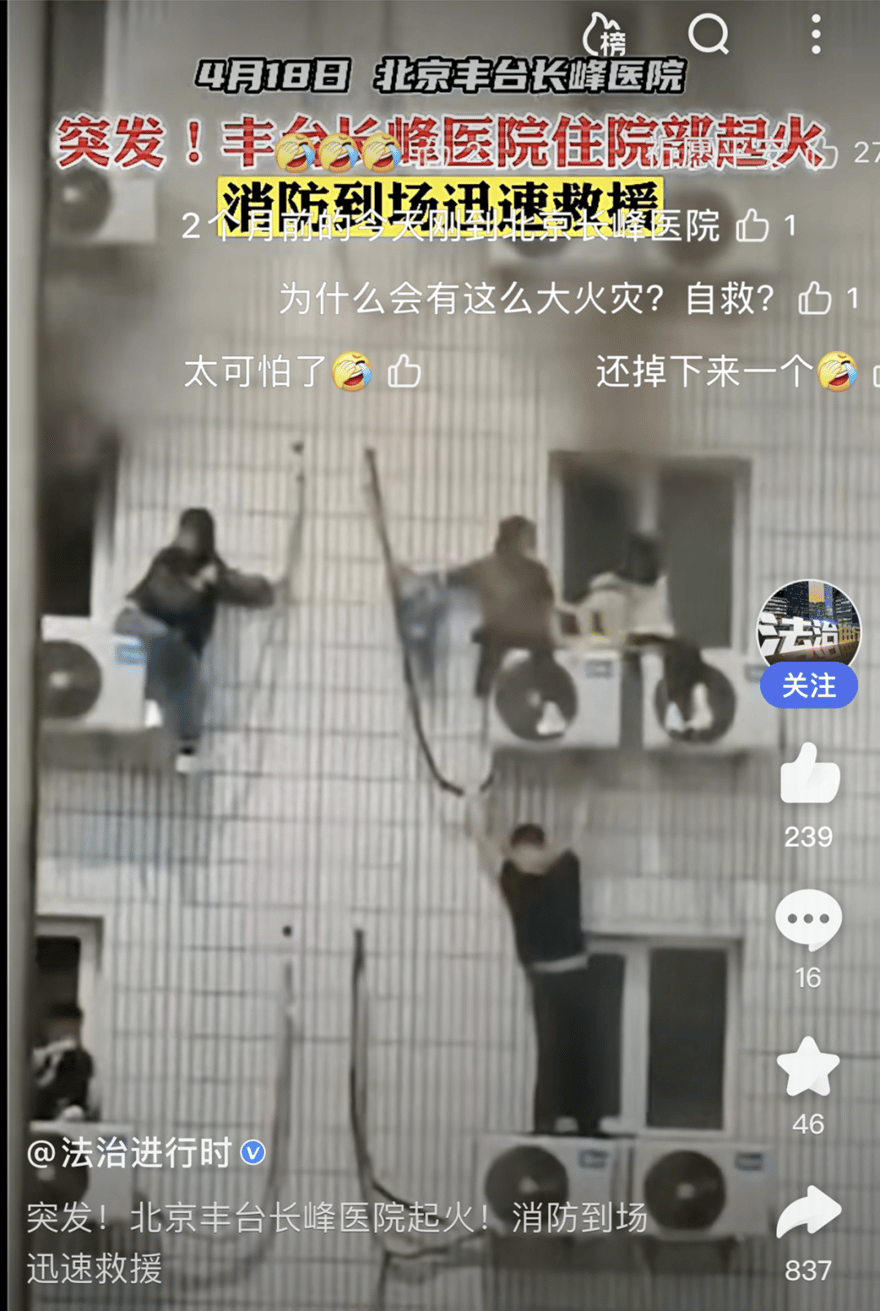
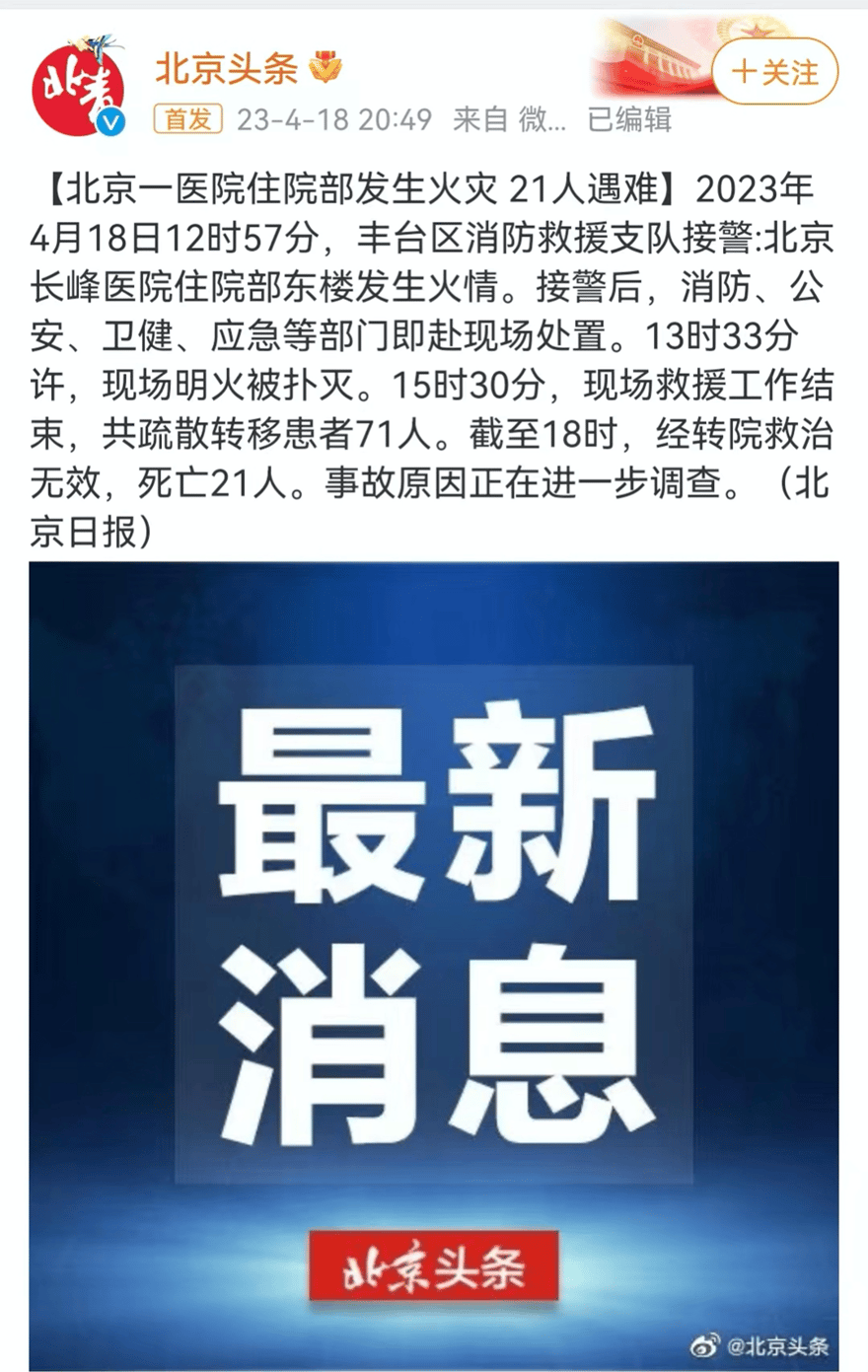
The fire occurred at 12:57 noon, but we didn’t see the report until 8:49 in the evening.
There was a blank space of nearly 8 hours in between.
This 8-hour blank space makes the “latest news” under the report seem ridiculous.
You know, this didn’t happen in a remote mountainous area, but in the best area of the capital.
Nor was there no casualties, but 21 people died, which is a “major fire”.
But in the 8 hours before the official announcement, there was almost no mention of this on the internet.
In an era where everyone has a smartphone and everyone is a social media expert, the fire at the capital hospital was silent on the internet, which is too strange.
Not to mention the public, according to media reports, even the families rushed over after seeing the news.
Don’t forget, the time when Beijing Toutiao released the news was 20:49.
And in the comment section of “Beijing Toutiao”, someone asked: Happened at 12:57, can it still be called news when it’s released at 20:49?
Someone immediately refuted: It takes time to count the number of casualties. For accidents like this, people in a room may be burned and stuck together, plus the transfer, rescue, and verification take time.
The refuter is emphasizing the accuracy of the news, and it does take time to verify the number of deaths and injuries.
But the problem is that accuracy is not comprehensiveness. Accuracy is that if Hospital A is on fire, you write that Hospital A is on fire, not Hospital B is on fire. You don’t have to wait until everything is clear before it’s called accurate.
After ensuring accuracy in this sense, what we should pursue is timeliness. You can first have a breaking news, noting “casualties are being counted”.
As for the number of casualties and the cause of the accident, it can be reflected in subsequent reports. News media is not a condom, it can only be used once.
Moreover, I remember watching TV before, when encountering major disasters, a group of TV stations would send reporters to the scene for live connections and live broadcasts. Maybe they would also do a series of real-time reports. Those who have experienced the Wenchuan earthquake should not find this operation difficult to understand.
Just last year, the Itaewon stampede in South Korea, our official media were all reporting in real time, and they were indignant and “questioned Seoul” ten times, demanding severe accountability.
So, this is not a matter of operation at all. It is not difficult to let the public know what happened in the first place.
But why do we have to wait for the official announcement now?
Some people worry: From then on, disasters may only exist in the announcement, and only one narrative is allowed to exist.
Some people will ask, what’s the use of knowing what happened? What can you help?
Firefighting is indeed a matter for professionals, and it’s hard for others to help.
But the problem is not whether we can help, but that the 8-hour blank space itself is not normal.
Knowing the truth may not save the fire, but it can offset this abnormality and prevent the whole society from falling into ignorant panic.
A disaster in which 21 lives have passed away is already enough to make people sad; but this disaster should not bring extra panic, which is another disaster that harms more people.
Our society should not play a game called “Guess Guess Guess” in ignorance after a disaster.
During the epidemic, people often quote a sentence from Camus’s “The Plague”: The only way to fight the plague is honesty.
But in fact, the field of honesty applies not only to the plague, but to any disaster.
Discover more from 自由档案馆
Subscribe to get the latest posts sent to your email.