In August last year, Belonging Space watched the UN’s periodic report review of the Convention on the Rights of Persons with Disabilities online and wrote a review article. (Unfortunately, it was deleted shortly after its release. Reply to the backstage private message “review” to get the original text.) At that time, three civil society organizations submitted reports to the UN Committee on the Rights of Persons with Disabilities, focusing on the “chained woman” incident and its representative significance. In addition to compiling a large number of data cases on the locking up of people with mental disorders, intellectual disabilities, and women with mental disorders in rural families who are prone to being trafficked and subjected to domestic violence, these reports also explored the gendered cultural soil behind the phenomenon and put forward many targeted legal and administrative suggestions.
From February 15th to 16th this year, the UN Committee on Economic, Social and Cultural Rights will once again review China’s implementation of the International Covenant on Economic, Social and Cultural Rights after nine years. In the recently released civil society reports submitted to the session, we have noticed that Chinese civil society has not given up its concern for the “Xiaohua Mei” and others, and continues to question issues including human trafficking and forced medical treatment for mental disorders. There are also many civil society reports that widely involve women, LGBTQ+, labor, disability, and related cross-cutting issues, such as the labor rights of domestic workers and workplace sexual harassment. (Reply to the backstage private message “report” to get the download link.)
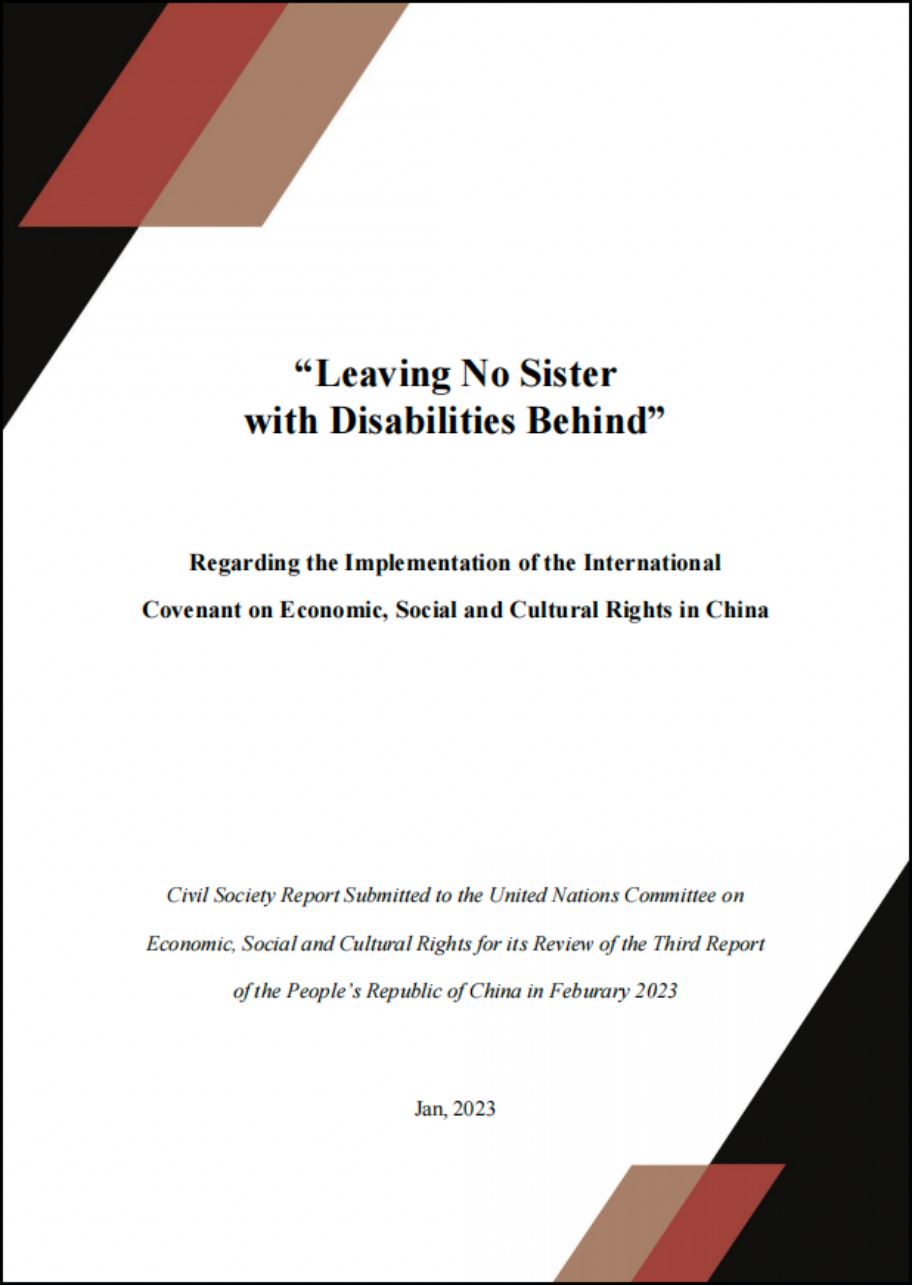
Today marks the one-year anniversary of the exposure of the “chained woman” incident. However, civil society figures are still forcibly denied entry into Feng County, and it is even more impossible to visit and learn about the recovery status of “Xiaohua Mei”. Here, we translate and organize the English report Leaving No Sister with Disabilities Behind written by the Fight For Her Group, to commemorate the awareness of women’s rights and the spirit of public participation awakened by the “chained woman” incident.
Due to the inability to contact the relevant authors, the following content is for exchange and learning purposes only. If there is any inappropriateness, please correct it via private message in the background.
Preface
The “eight-child mother” (also known as the “chained woman”) incident in Feng County, Xuzhou, Jiangsu [1] has once again brought the “ancient crime” of human trafficking to the public’s widespread attention. On the other hand, the incident also highlights the inadequacy of mental health services and social assistance in rural China. Women with intellectual or mental disabilities are more likely to become victims of human trafficking, forced marriage, and domestic violence.
Original note [1]: On January 27, 2022, a Douyin blogger from Xuzhou visited the home of Dong, a poor household in Feng County, and filmed a woman who was said to have given birth to eight children and was “mentally abnormal”, chained by the neck and locked in a dilapidated house. The video sparked nationwide public opinion. By early February, the administrative agencies of Feng County and Xuzhou City issued four notices, but they failed to quell public anger because of their contradictions. In mid-February, the Jiangsu Provincial Party Committee and Provincial Government formed an investigation team to intervene in the incident and issued a final investigation report, confirming the existence of human trafficking. On February 22, Dong was arrested on suspicion of abuse, and the woman was diagnosed with schizophrenia by the hospital.
There is a widespread preference for sons over daughters in rural China, and there is a deep-rooted thinking of reproduction. The family planning policy has exacerbated the imbalance in the sex ratio of the population, creating a large number of “rural bachelors”. The parents of women with intellectual or mental disabilities in rural areas transfer the heavy responsibility of raising their daughters by arranging marriages for them, and even condone trafficking crimes in the name of marriage introduction, while also depriving their daughters of the opportunity to receive education and employment development.
It is precisely because of the lack of social awareness [2] that women with intellectual or mental disabilities are often forced to marry and have children. These behaviors disregard and trample on their personal dignity and personal rights, causing immense physical and mental suffering. This is a discriminatory behavior based on gender and disability, abusing their vulnerable status for sexual exploitation.
Note [2]: At the end of 2021, the media exposed that a 76-year-old man in Pingjiang County, Yueyang, Hunan, “took in” a minor with a mental disability for more than ten years. The woman had repeatedly carved “I want to go home” on the wall, but was locked at home for a long time and gave birth to a child. Local people, including the village secretary, believed that this was “a very normal thing, helping the young girl”. Source: The Paper, https://www.thepaper.cn/newsDetail_forward_15868223
In view of this, we hope to stand from the perspective of women with intellectual or mental disabilities and other disabilities, and express our opinions and suggestions on China’s implementation of the UN International Covenant on Economic, Social and Cultural Rights over the past decade. The writing of this report has consulted the opinions of some Chinese women with mental disabilities and their families, and has absorbed their suggestions.
Editor’s Note: The International Covenant on Economic, Social and Cultural Rights has a total of 31 articles, of which Article 3 stipulates gender equality, that is, “The States Parties to the present Covenant undertake to ensure the equal right of men and women to the enjoyment of all economic, social and cultural rights.” The following report content is written for each article theme, although “Article 3” is not explicitly stated, it can be regarded as being under the leadership of this article.

Article 9 The right to social security (The right to social security)
A. Temporary assistance system
In 2014, China announced the establishment of a temporary assistance system, “full coverage” system. Those who meet the conditions for assistance for the homeless and beggars are provided with temporary accommodation, emergency medical treatment, and assistance in returning by the county-level people’s government in accordance with relevant regulations. In the relevant opinions issued in 2018, the government admitted that some areas still have problems such as insufficient timeliness of assistance, low levels of assistance, insufficient effectiveness of the system, and inadequate work guarantee.
At the end of 2014, a motorcycle taxi driver in Yilong County, Sichuan, encountered a homeless woman with intellectual disabilities on the road and sent her to the Civil Affairs Bureau and the police station, but the staff were unwilling to take care of her. In the end, the driver had to sell her to a local villager as a wife. She gave birth to a baby, but it died after only two months. This typical case highlights the inaction of the grassroots government in the responsibility of temporary assistance. [3]
Note [3]: See China Judgment Documents Network: (2016) Chuan 1324 Xingchu No. 166.
An analysis of 616 judicial case files involving the trafficking of women from 2017 to 2020 shows that 20% of the 1,252 women trafficked in China have disabilities, and most of them have intellectual or mental disabilities. More than 60% of these women were trafficked by strangers passing by on the roadside, at bus stations, or in the fields. Another study of 1,038 first-instance judgment documents involving the “crime of trafficking women and children” from January 2000 to July 2017 showed that 26.7% of the victims suffered from varying degrees of mental illness. Among the identifiable places of origin and inflow, rural areas accounted for 71.7% and 91.5% respectively, occupying a dominant position.
We studied 221 criminal judgments involving the trafficking of women with intellectual and mental disabilities from 2017 to 2021, involving 469 person-times of trafficking. Nearly 30% of the victims were trafficked multiple times, mainly because the sellers concealed the fact that the trafficked women had intellectual or mental disabilities, and the buyers asked for “returns and exchanges” after discovering it; a few victims were subjected to beatings, imprisonment, indecency, and rape, or died due to delays in treatment. [4] More than 10% of the victims gave birth to one or more children, and almost no buyer was prosecuted for the crime of rape. The average time for the victims to be rescued was five years, and the longest was 20 years.
Note [4]: In 2016, a woman with an unknown identity and dementia was trafficked at the Woyang long-distance bus station in Anhui. She was trafficked as many as five times in just two months, because the buyers took her to the hospital for examination and found that she had liver cancer, and then returned her and asked for a refund. A total of 15 people participated in the trafficking and buying process, and no one treated her. The hospital also failed to identify that she was trafficked. In the end, the woman died of illness. See the judgment of the China Judgment Documents Network: (2016) Wan 1622 Xingchu No. 433.
From the above judgments, it can be seen that there have long been gangs in mainland China that specialize in trafficking women with intellectual and mental disabilities [5]. There were 21 such cases tried in 2017 and 2018 alone. The women trafficked came mostly from Henan, Anhui, Yunnan, Guangxi, and Guangdong, and were mostly trafficked to Henan, Anhui, Hebei, Shandong, and Jiangxi. In the judgments, except for a few that specified entering a rescue station or mental hospital for treatment, or returning to their original families, the placement and rescue of the remaining nearly 70% of the female victims were unclear.
Note [5]: For example, in early 2018, the Zhengzhou Railway police arrested a criminal gang of five people who trafficked women with intellectual disabilities and rescued three women with intellectual disabilities who had been trafficked. They usually wandered around Guangzhou Railway Station and subway entrances, and after discovering women with intellectual disabilities, they lured them to rental houses under the pretext of introducing jobs and introducing partners, controlled their personal freedom by violent means, and then sold them after finding buyers.
https://fzsb.hinews.cn/html/2018-12/21/content_6_4.htm
To date, China’s Criminal Law does not have special legislation against human trafficking, only Article 240 of the crime of trafficking women and children, whose conviction standard is “referring to the act of abducting, kidnapping, buying, selling, receiving, transferring, or transporting women and children for the purpose of selling them”. This crime does not cover the evaluation of forced marriage and childbirth for women with intellectual and mental disabilities who are not for the purpose of selling, but only “taking in”. If it is treated as the crime of rape, many women with mental illness lack the help of close relatives and cannot provide evidence for this, and the difficulty of providing evidence for the crime of rape is recognized worldwide. In addition, there is a statute of limitations, and the female victims seriously lack procedural protection and judicial remedies. Especially in marriages where parents agree and involve money transactions, it is even more difficult for the law to define.
The reproductive health needs of homeless women with mental disorders need urgent attention. Empirical investigations in many mental hospitals show that the incidence of sexual assault among female homeless patients with mental illness is significantly higher than that of general patients with mental illness. The positive detection rate of infectious diseases such as hepatitis B, syphilis, AIDS, and tuberculosis, and the situation of pregnancy caused by sexual assault are more serious; their pregnancy history is unknown, and their sources are complex (different accents and cultures), and they often stay in the hospital and cannot be sent out.
In view of this, we suggest that the Chinese government:
- Investigate cases of abuse, abandonment, and trafficking of people with disabilities, prosecute the perpetrators, regularly monitor, statistically and announce relevant cases and the number of victims by gender;
- Provide shelters for victims of domestic violence (especially in rural areas), and list special data in the third item (1) of the annual “Statistical Bulletin on the Development of Civil Affairs” on social work providing accommodation;
- Ensure that every victim receives community rehabilitation and assistance, and that the government provides free physical, cognitive, and psychological rehabilitation support suitable for the corresponding gender and age; refer to the juvenile justice protection system, designate the procuratorial organs to perform legal supervision duties, and track the progress of relevant work.
- Strengthen the financial and human resource support for rescue management stations in various places, and help the homeless people with intellectual and mental disabilities find families or return to society; establish a permanent talent pool and a one-stop rescue system, and provide support for those who have been subjected to violence by physicians, social workers, lawyers, and psychological counselors.
B. Social security
The leakage of personal information of poor households in rural areas also affects people with mental disorders in rural areas. In 2018, the media exposed that many government websites disclosed a large amount of personal privacy information when publicizing poor households and poverty alleviation lists, including the degree of poverty and the causes of poverty (such as mental disorders). The government has no unified standards for the disclosure of relevant information, nor has it done a good job of digital desensitization of private information.
From January 1, 2020, China will fully implement the support system for children without actual care [6], and the support standard will refer to orphans, with a subsidy of 1,140 yuan per person per month. From a literal point of view, if one or both parties are severely disabled, they are equated with death or disappearance in the policy discourse, which has caused dissatisfaction in the disability community.
Note [6]: Children without actual care refer to children whose both parents meet one of the following conditions: severe disability, serious illness, imprisonment, compulsory isolation and drug rehabilitation, being subjected to other measures restricting personal freedom, or being out of contact; or children whose one parent has died or disappeared, and the other parent meets one of the following conditions: severe disability, serious illness, imprisonment, compulsory isolation and drug rehabilitation, being subjected to other measures restricting personal freedom, or being out of contact.
In view of this, we suggest that the Chinese government:
- Improve and standardize the system for collecting, registering, correcting, and summarizing information on people with mental disorders, standardize the system for information sharing and the protection of patients’ privacy, refine it by formulating relevant laws and regulations, and add provisions on the circumstances of deleting patient information;
- Cancel the term “children without actual care” and uniformly call them children in difficult circumstances.
Article 10 Protection of the family (Protection of the family)
A. Infringement of marriage and family
We have collected 78 news reports from 2012-2022 involving rural women with mental disorders being subjected to violence, including:
1. Imprisonment: Some are traffickers and buyers, who strictly monitor them to prevent them from escaping or calling the police for help, and prevent them from contacting the outside world; some are their family members or husbands, who restrict their personal freedom to restrain their violent or self-harming behavior;
2. Physical/mental violence: mainly from domestic violence by husbands or other relatives, including verbal abuse, beatings, rape, or failure to provide medical assistance, and some women are also very likely to be subjected to violence from strangers.
The right to life of women with intellectual and mental disabilities has not been better protected because they have entered marriage and family. On the contrary, there is systemic judicial injustice in dealing with domestic violence.
In the second half of 2018, because it was discovered that Fang Yangyang, the daughter-in-law, was infertile, a family of three in Yucheng, Shandong, abused her (imprisonment, beatings, freezing, starvation) for half a year, causing her death. In the first instance of the case, the highest sentence among the three defendants was three years in prison. Later, due to high public attention, the second instance was changed to intentional injury and sentenced to eleven years in prison.
In the Chinese legal community, the sentencing for abuse is lighter than that for intentional injury, which often causes public controversy in domestic violence cases. China’s Criminal Law stipulates that those who abuse family members and cause serious injury or death to the victims shall be sentenced to imprisonment of not less than two years and not more than seven years; if they abuse disabled persons as guardians or caregivers, constituting the crime of abuse of guardians and caregivers, and causing consequences of minor injuries or more serious, they shall be punished according to the crime of intentional injury. Those who intentionally injure others and cause death shall be sentenced to imprisonment of not less than ten years, life imprisonment, or death.
Many people with disabilities have not undergone medical diagnosis or judicial appraisal. The Fang Yangyang case is only a few individual cases that have received a just ruling through public opinion supervision. In mid-2020, a man in Sichuan, because his wife had a mental disorder, tied his wife to a tree with an iron chain in a forest 2 kilometers north of a village committee in a town in Wushen Banner, restricting her freedom for five months, which eventually led to his wife’s starvation. In April 2021, the case was prosecuted (the trial result was not disclosed), and the crime charged by the prosecution was still abuse.
The “Law on the Protection of the Rights and Interests of Persons with Disabilities” and the “Mental Health Law” only make declarative provisions for protecting the right to life of persons with disabilities and people with mental disorders, such as “prohibiting domestic violence against persons with disabilities, prohibiting the abuse and abandonment of persons with disabilities”, and “prohibiting domestic violence against patients with mental disorders, prohibiting the abandonment of patients with mental disorders”, but there are no supporting measures and no clear legal consequences.
In view of this, we suggest that the Chinese government:
- Issue judicial interpretations to clarify that those who abuse family members and cause serious injury or death shall be punished as intentional injury; those who constitute the crime of abuse of guardians shall be deprived of their guardianship of the victims and their children;
- Refer to the “Anti-Domestic Violence Law” and the “Draft Revision of the Law on the Protection of Women’s Rights and Interests”, revise the “Law on the Protection of the Rights and Interests of Persons with Disabilities” and the “Mental Health Law”, and add a mandatory reporting system for the abuse, abandonment, and trafficking of persons with disabilities.
Some media have searched for 90 divorce case judgments related to people with intellectual disabilities in the China Judgment Documents Network. The vast majority were filed by the intellectual disability party, and the common reasons were “being beaten” and “being ignored”. According to the trial inertia of marriage and family cases in China, the first-instance court almost never grants a divorce. This phenomenon also appears in the cases of buying and selling marriages and forced marriages, and women with mental illness cannot independently revoke their marriages. [7]
Note [7]: The plaintiff’s legal agent, the mother of the woman, stated in court that her daughter went missing in 2007 and was deceived by the man to live together in a scrap yard, and concealed the registration of marriage from the plaintiff’s parents. In January 2015, the People’s Court of Yuhu District, Xiangtan City, Hunan Province, made a judgment, “Considering that the plaintiff and the defendant have been married for a long time, they should strengthen communication in the future and work together to build a good family, and there is still a possibility of reconciliation between the husband and wife”, and did not allow them to divorce. Source: Sohu News Jiuzhou Studio, “The Marriage and Love Dilemma of Rural Women with Intellectual Disabilities”: https://mp.weixin.qq.-com/s/5JiLqdeYVq2k_GiWLHxAYg
In the Fang Yangyang case, the local police had mediated, but regarded it as “a matter between legal couples”, and failed to intervene in law enforcement in a timely manner. Afterwards, the public security department and relevant staff were not publicly punished. After Fang Yangyang died of abuse, the village committee and the Women’s Federation both claimed that they did not know and did not receive any help.
A study of 205 personal safety protection order rulings in the Shanghai area over the five years of the implementation of the “Anti-Domestic Violence Law” showed that two wives claimed to have suffered long-term domestic violence from their husbands, but the other party used their history of mental illness to excuse their violence, and both protection order applications were rejected, and no functional institution applied for a protection order on their behalf; in addition, a patient with schizophrenia opposed her sister’s forced treatment in a mental hospital, and the court also rejected it.
In view of this, we suggest that the Chinese government:
- The civil affairs department should strengthen the review of marriage registration, and on the basis of respecting the freedom of marriage of people with disabilities, identify trafficking crime clues in a timely and accurate manner, and perform the obligation of mandatory reporting;
- Allow civil society organizations to apply to the court to initiate the review of the revocation of marriage; amend Article 1052 of the Civil Code on the provisions of revoking forced marriage, and for women who have been trafficked to request the court to revoke the marriage, the “date of termination of the coercion” should be clearly defined as “the date of leaving the control of the infringer and restoring personal freedom”;
- Automatically provide legal aid to victims of domestic violence with intellectual and mental disabilities; allow civil society organizations to act as the agent litigation subject for women with intellectual and mental disabilities to protect their rights, or provide legal services;
- Strengthen the publicity of the rule of law against domestic violence in rural areas, link it to the performance appraisal of local departments, and force the staff of local relevant departments (such as police officers, grassroots judges, etc.) to learn relevant knowledge, complete a certain number of hours each year, and link it to professional qualifications and promotion;
- Legally stipulate that if state organs and their staff do not stop the infringement of the rights and interests of women with disabilities in a timely manner, regardless of the seriousness of the consequences, they should be given disciplinary action.
B. Freedom of reproduction and parental rights
The “China Action Plan to Combat Trafficking in Persons (2013-2020)” once proposed to “strengthen family planning services and pregnancy management in key areas of trafficking in persons, reduce unintended pregnancies and extra-policy births, and promptly report relevant information.” In the “China Action Plan to Combat Trafficking in Persons (2021-2030)”, due to the national policy adjustment of comprehensively liberalizing births, there is no content related to family planning, but this also means that the behavior of forcing women with intellectual and mental disabilities to continue to give birth to multiple children has lost policy constraints and regulatory penalties. [8]
Note [8]: In March 2022, Guangxi announced the investigation results of the “Liang Er couple in Rong County giving birth to 15 children” incident. There was no trafficking of women or forced marriage, but the government still imposed party discipline and administrative sanctions on 11 people responsible for the town on the grounds of “failure to implement family planning work responsibilities”.
From 2008 to 2016, a man (with mild intellectual disability) in Dezhou, Shandong, cohabited with a “picked up” woman with intellectual disability (with severe intellectual disability), gave birth to five children, and sold them all, earning 72,200 yuan. The man was sentenced to eight years in prison for the crime of trafficking children. [9]
Note [9]: See the China Judgment Documents Network: (2016) Lu 1403 Xingchu No. 136.
The judgment did not mention the subsequent disposal of the five children, and whether they maintained a relationship with their mother. In the “eight-child mother” incident in Feng County, the seven underage children were assigned guardians by the government (the specific situation was not announced to the public), and it is not clear whether this action respected the wishes of the children and their mother.
Generally speaking, people with disabilities are prone to discriminatory treatment in divorce lawsuits, and lose the custody and custody of their children. Children whose parents are both disabled may be referred to child welfare institutions and separated from their parents. The situation of people with intellectual and mental disabilities is even more dire. The court’s ruling that their guardians implement “surrogate care” is an extremely rare exception. In divorce lawsuits and cases of infringement of their own rights and interests, the protection of parental rights involving intellectual and mental disabilities is still very weak.
In view of this, we suggest that the Chinese government:
- The grassroots health and civil affairs departments should regularly investigate the fertility of women with intellectual and mental disabilities, strengthen daily visits and follow-up of mothers and children, and on the premise of respecting women’s reproductive autonomy, take educational and administrative measures to stop husbands from forcing multiple births, and ensure that children receive appropriate care and education;
- Formulate policies to further protect the reproductive rights of women with disabilities, such as ensuring that they receive medical services that meet their reproductive needs, considering the special needs of post-partum rehabilitation for women with disabilities, and including them in medical insurance;
- Respect and protect the parental rights of people with disabilities, including those with intellectual and mental disabilities. When they have the ability to express their willingness to raise their children, the national policy should shift to focus on supporting the development of their family guardianship and their own ability to raise children, instead of a single “aid for the disabled” model of subsidy payment.
Article 11 The right to an adequate standard of living (The right to an adequate standard of living)
A. Rehabilitation services
In 2020, the proportion of poverty among people with disabilities with agricultural household registration, excluding those who have been registered and filed, reached more than 28%. The poverty-stricken people with disabilities showed the characteristics of aging and severe disability, and gradually concentrated on disability types such as mental disability, intellectual disability, and multiple disabilities.
In 2021, 8.508 million people with disabilities received basic rehabilitation services, accounting for only about one-tenth of the total population, a decrease of 21.05% compared to the previous year, and the reason is unknown; it is estimated that at most 12% of the registered people with intellectual disabilities and 25% of the registered people with mental disabilities receive basic rehabilitation services. The Chinese government plans to widely carry out community rehabilitation services for mental disorders in more than 80% of the counties (cities, districts) by 2025, but the latest progress has not been found.
Studies have shown that the problem of insufficient development of community services for the disabled is still relatively obvious, and the regional gap is also widening. According to statistics, in 2020, the proportion of rehabilitation stations built in communities was less than 1/5, and less than 1/7 in special areas and villages; the proportion of rehabilitation service stations built in each village (community) in economically developed areas was higher, while the proportion of rehabilitation service stations built in the central and western regions was lower.
A sampling survey in 2013 showed that the proportion of rural women with disabilities who rated their health as poor or very poor was as high as 60.7%, and the proportion of seeking medical treatment in a timely manner was far lower than the overall level of women. Compared with disabled men, the proportion of disabled women who have received rehabilitation treatment is slightly higher, but the treatment cycle is long and the cost is low, and the level of rehabilitation services they receive is lower. And in the face of limited rehabilitation resources, under the influence of the traditional social division of labor of “men outside and women inside”, disabled women often lose the opportunity for rehabilitation.
In 2019, the Chinese government provided rehabilitation services to 4.412 million women with disabilities, accounting for less than 30% of the number of women with disabilities registered that year, but the China Disabled Persons’ Federation claimed that the coverage rate of rehabilitation services for women with disabilities in need reached 93%. The “Outline of China’s Women’s Development (2021-2030)” proposes to expand the supply of public services suitable for the special needs of women with disabilities, and focus on providing rights protection, life assistance, and spiritual comfort for women groups with difficulties in life, disabilities, and serious illnesses, but no specific implementation measures and financial budget have been announced.
In view of this, we suggest that the Chinese government:
- Assess and collect information on the status and obstacles faced by women and girls with disabilities (including women with intellectual and mental disabilities) in exercising the rights stipulated in the “Convention”;
- Increase the public service budget for women and girls with disabilities (especially women with intellectual and mental disabilities), and separately list relevant public service data in the annual “Statistical Bulletin on the Development of Civil Affairs”;
- Increase special financial support, gather social forces to participate, and the per capita proportion of rural community rehabilitation centers within the municipal area shall not be lower than that of cities, and announce the progress of project construction once a year.
B. Housing
A survey on the current situation of housing and care needs of people with mental disorders conducted in Shenzhen in 2022 showed that 5.68% of people with mental disorders were homeless, 47% of families said that the living environment was negatively affected by the mental disorders of family members, and 75% of families said that they had never received housing security services.
In view of this, we suggest that the Chinese government:
- Provide supportive housing for people with mental disorders; promote the construction of a community integration environment and improve the acceptance of community life for people with mental disorders;
- Include diversified care services such as community families in government procurement services; expand the applicable scope of subsidies for institutional centralized care services; and increase the subsidy standards for home care services and expand the applicable scope.
Article 12 The right to physical and mental health (The right to physical and mental health)
A. Mental health
China’s mental health service supply has a trend of expanding institutionalization. As of 2020, the number of psychiatric hospitals in rural and urban areas was 1,014 and 787 respectively, an increase of about 2.6 times and 1.1 times respectively compared to 2010. In 2019, the ratio of visitors to community mental health outpatient clinics was about 1/38 of the visitors to hospital outpatient clinics.
China’s financial funds are still more invested in the construction of mental health institutions, rather than at the primary health care level. From 2011 to 2020, the financial subsidies and special expenditures of mental health institutions in China generally showed an increasing trend. Among them, the special financial expenditures of psychiatric specialist hospitals increased by one time in ten years, and the special financial expenditures of psychiatric prevention and treatment institutes (stations, centers) increased by more than 5 times in ten years.
In view of this, we suggest that the Chinese government:
- Cultivate and support social groups participated in and led by people with disabilities; tilt resources to rural areas, allocate funds to purchase mental health social worker services, popularize mental recovery and care knowledge in rural areas; announce the financial ratio and procurement situation invested in rural disabled people in the government work report;
- Monitor and evaluate the effectiveness of community rehabilitation and family support for mental disorders in rural areas, and regularly announce it to the public, and openly accept the supervision of social groups.
B. Compulsory hospitalization
In the “686 Project” (a project of central subsidies to local health funds for the management and treatment of severe mental illnesses) launched in 2004, a major task was to “unlock and treat patients who are locked up”. According to statistics, from 2011 to 2015 alone, 25,499 people were released from being locked up through the project. However, after the project ended, the phenomenon of locking up people with mental illness in rural families still exists. [10]
Note [10]: From 2016 to 2020, the independent photographer Gong Yi visited more than 100 families who bought or picked up women with mental disorders as wives, and published the photography collection “Blind”, which also included photos of women who were locked up. https://dig.chouti.cc/link/34053669
Taking Hebei Province as an example, in a follow-up survey of patients with schizophrenia in rural areas of the province who were unlocked in 2014, 20 of the 82 follow-up objects (24.4%) were locked up again. The Center for Disease Prevention and Control of Guigang City, Guangxi, studied 849 patients with severe mental disorders who died between 2014 and 2017, and the locking rate of the deceased patients was 0.71%.
The “chained woman” incident in Feng County is another striking example of the infringement of the right to personal freedom of people with mental disorders. The image of her husband putting a chain on her neck aroused strong indignation from the public. After the media exposure, the government came forward to send the woman to a mental hospital for compulsory treatment, and strictly refused outside visits for the sake of maintaining stability, which was close to de facto “imprisonment”.
The incident highlights the procedural difficulties in the admission and treatment of people with mental disorders and how to restore their freedom. The “Mental Health Law” revised in 2018 established an admission and treatment method with the decision-making of close relatives as the core, and the phenomenon of “being mentally ill” has emerged one after another.
China’s current “Civil Procedure Law” (amended in 2021) stipulates that the guardians of people with mental disabilities are their close relatives, who exercise litigation rights on their behalf; the “Mental Health Law” (amended in 2018) stipulates that, except for vagrants, the close relatives of suspected patients with mental disorders can send them to medical institutions for diagnosis of mental disorders; the “Civil Code” stipulates that spouses are the first guardians of adults with limited civil capacity (ranking higher than parents and children), resulting in a “vicious cycle” where it is difficult for victims to file a case when they are harmed by their guardians.
Article 36 of the “Civil Code” stipulates that when a guardian infringes upon the rights of a person under guardianship, relevant individuals and organizations can apply to the court to revoke the guardian’s qualification, including: other persons with guardianship qualifications in accordance with the law, residents’ committees, villagers’ committees, schools, medical institutions, women’s federations, disability federations, organizations for the protection of minors, elderly organizations established in accordance with the law, and civil affairs departments, etc.
However, these organizations with official backgrounds rarely take the initiative to assist people with disabilities in safeguarding their rights, and they lack independence in the environment of local systemic corruption, making it impossible to provide judicial remedies.
In view of this, we recommend that the Chinese government:
- Legislate to allow non-governmental social organizations to act as agents for people with mental disorders to file applications for revocation of guardianship, subject to court review; establish and improve a social guardianship system to promote the autonomous decision-making of people with mental disorders.

Articles 13 and 14 The Right to Education (The right to education)
According to the education statistics released by the Ministry of Education in 2020, among students in special education schools, there were 556,500 boys and 324,200 girls, with boys being 1.71 times the number of girls. There is no data showing the enrollment rate of disabled girls.
In terms of policy dissemination on sexual health, China’s sex education policies focus on the underage population and emphasize reproductive health over the prevention of sexual assault. The “Outline for the Development of Chinese Children (2021-2030)” has included sex education in the basic education system and quality monitoring system, but sex education for people with disabilities is still in a long-term blank stage, and for rural disabled women, sex education is even more difficult to reach.
In 2016, the government issued special education curriculum standards for three types of schools: blind schools, deaf schools, and schools for intellectual development. It only pointed out the need to cultivate self-protection awareness in special children, including sports self-protection and online self-protection, without mentioning the importance of sex education in self-protection; the “14th Five-Year Plan for the Development and Improvement of Special Education” (2021-2025) also does not involve content related to sexual health education, indicating the absence of sex education policies for people with disabilities in China.
Due to the lack of policy guidance, special schools also rarely practice sex education. Many teachers in special education schools believe that sex education should be undertaken by parents, and students with disabilities are considered not easy to get married, so sex education is dispensable. In addition, there is almost no training for sex education teachers that combines the sexual physiological characteristics of students with intellectual disabilities, sex education teaching methods and techniques. The only authoritative and systematic textbook is “Sex Education for Adolescents with Intellectual Disabilities” published in 2006, written by Wang Yan and Liu Yanhong.
The non-governmental organizations dedicated to sex education for people with disabilities are also few and far between: the Ai Chengchang Comprehensive Education Classroom specifically conducts sex education for people with intellectual disabilities, and Ni Wo Ban develops sex education courses for disabled adolescents. Limited by the lack of publicity and consensus on the sexual autonomy of people with intellectual disabilities, these sex education courses are more focused on popularizing reproductive health knowledge during puberty and enhancing the ability to prevent sexual assault, and are still some distance away from supporting the autonomous marriage and love of people with intellectual disabilities.
In view of this, we recommend that the Chinese government:
- Formulate sexual and reproductive health policies that reflect disability integration; encourage the government and schools to purchase sex education courses customized and developed by non-governmental social organizations, and strengthen the sexual awareness and ability to prevent sexual assault of people with intellectual and mental disabilities;
- Promote the concept of sexual autonomy for people with disabilities throughout society and put an end to forced sterilization.
Article 15 The right to participate in cultural life and enjoy the benefits of science (The right to cultural life and the benefits of science)
A. Stigma and Privacy
The “Mental Health Law” stipulates a reporting system for the onset of severe mental disorders. Once patient information is illegally disclosed, illegally provided to others, or overused, it is easy to infringe upon the patient’s right to privacy.
The “686 Project” established the assessment of dangerousness and follow-up management for patients with severe mental disorders, making the public security and social comprehensive management departments long regard these patients as control objects, included in the monitoring system, and even their travel and social activities will be restricted, adding “invisible chains” to them at the social psychological level.
The latest “Management and Treatment Standards for Severe Mental Disorders” formulated in 2018 still regards the standardized management of patients with severe mental disorders as an indicator of local peace and stability construction. On June 10 this year, the Tangshan “barbecue restaurant beating incident” shocked the whole country. Subsequently, Tangshan City launched a special action of “Thunderstorm” for the summer social security rectification, proposing “to continuously strengthen the service and management of… special groups such as patients with severe mental disorders, improve the hierarchical and classified management, and strictly prevent the occurrence of vicious incidents and personal violent crimes”, and continue to strengthen the stigmatization of people with mental disorders.
Since 2020, the National Health Commission and the Ministry of Education have successively issued documents requiring all high schools and colleges to include depression screening in students’ health checkups, establish student mental health files, assess students’ mental health status, and give special attention to students with abnormal assessment results. This may involve infringing on students’ privacy and have a negative impact on their study, life and interpersonal communication.
In view of this, we recommend that the Chinese government:
- Improve and standardize the system for collecting, registering, correcting, and summarizing information on people with mental disorders, standardize the system for information sharing and protection of patient privacy, and formulate corresponding laws and regulations to refine it, and add provisions on the circumstances for deleting patient information;
- Stop the practice of screening for depression and establishing files in schools, strengthen the protection of minors’ privacy, mental health publicity and peer support;
- Strengthen the training of judicial departments and medical institutions, shift from the social management model of medical centers to the decision-making support model of disability rights centers, and pay attention to the design and implementation of mental disorder anti-stigma projects.
B. Freedom of Speech and the Press
“China does not have a system of press censorship; what the news media reports and how it reports are decided by the head of the media.” China’s third periodic report (E/C.12/CHN/3, p31) states. This is certainly not true.
Like many hot events, the online comments of Chinese netizens calling for “freeing the chained woman” were also censored and deleted.
In early February 2022, feminists “Wuyi” and “Quanmei” went to Feng County, Xuzhou to support the “chained woman”. On the evening of February 11, when they reported the case at the Sunlou Police Station, they were illegally detained and abused. From February 18, after being released, Wuyi disclosed her interrogation experience on Weibo, which attracted widespread attention, and then lost contact in early March. (Her Weibo account was blocked on July 14.)
It was not until mid-March that the outside world learned that she had been arrested by the Pei County police in Xuzhou and was placed under residential surveillance on charges of “picking quarrels and provoking trouble”. The police did not allow her to hire a lawyer, but instead appointed an official legal aid lawyer for her. Nearly a year has passed, and we still do not know the follow-up results of the case.
In view of this, we recommend that the Chinese government:
- Abolish the “picking quarrels and provoking trouble” catch-all crime;
- Immediately release all those arrested for defending human rights through their words and deeds, including all citizens arrested since the end of November 2022 for the “White Paper Protest”.
References:
- “The Abducted: 1252 Lives Priced”, RUC News Workshop of Renmin University of China: https://mp.weixin.qq.com/s/A2FCLvMlaecqIJhVVnO2Hg
- Huang Zhongliang, Weng Wenguo, Zhai Binxu. Characteristics and Governance Strategies of Trafficking in Women Crimes in China – Based on the Analysis of 1038 Judgments”,. Journal of the Chinese People’s Public Security University (Social Science Edition), 2019, 33(05):19-27.[J]Lu Zhenyun, Guan Wenhua, Qiao Jinrong. Research on the Nursing Difficulties and Nursing Responses of Female Patients with Mental Illness”,. China Minkan Medical…… (Backup finished)
- 芦振云,关文华,乔金荣.女性救助精神病患者护理难点及护理应对的研究[J].中国民康医……(备份结束)
Discover more from 自由档案馆
Subscribe to get the latest posts sent to your email.