The matter of the Nanjing Museum finally has some truth. The investigation team of the Jiangsu Provincial Party Committee and Provincial Government announced that in 1959, Pang Zenghe donated 137 paintings, including the “Jiangnan Spring” scroll, to the Nanbo Museum for collection.
The matter of the paintings donated to the Nanjing Museum appearing in the auction house finally has the latest “explanation.” I can only call it an “explanation” and dare not call it the “truth.”
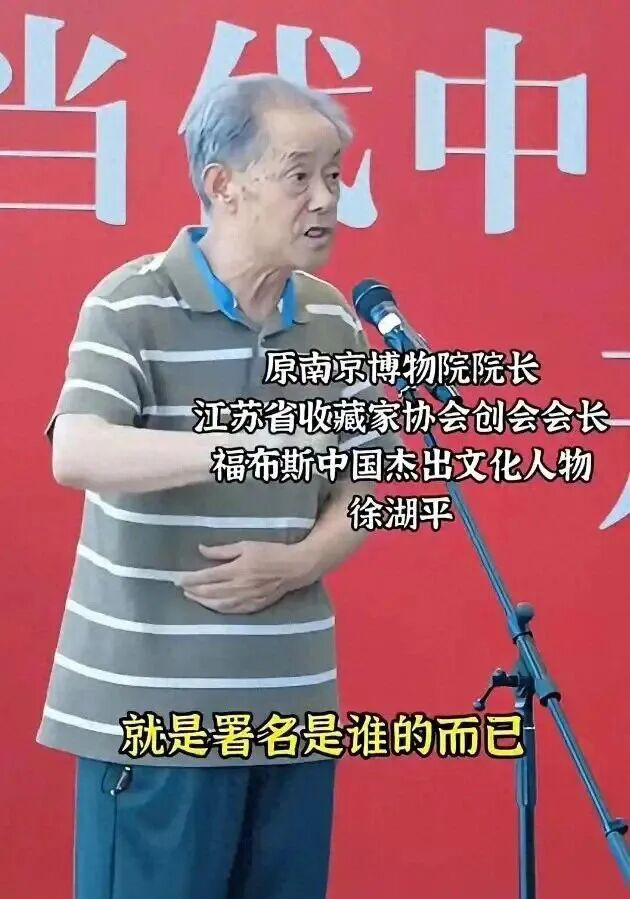
The investigation team of the Jiangsu Provincial Party Committee and Provincial Government announced that in 1959, Pang Zenghe donated 137 paintings, including the “Jiangnan Spring” scroll, to the Nanbo Museum for collection. In the 1990s, with the illegal approval of Xu Huping, then Executive Vice President, the original Provincial Department of Culture did not strictly review and approved the application, and the Nanbo Museum illegally transferred the “Jiangnan Spring” scroll and other calligraphy and paintings to the original Provincial Cultural Relics General Store (hereinafter referred to as the General Store) for sale.
The announcement also detailed the experience of the painting’s fall into the auction house:
In early July 1997, Zhang, a warehouse keeper and salesperson at the General Store’s calligraphy and painting warehouse, saw the “Jiangnan Spring” scroll, which was illegally transferred to the General Store, priced at 25,000 yuan. He thought it was profitable, so he conspired with his boyfriend Wang to buy it and resell it at a higher price. He also took advantage of his work to secretly change the price tag to 2,500 yuan. To avoid the regulation that the staff of the General Store could not buy the goods in the store, and also fearing that Wang would be recognized by his colleagues in the store, he arranged for Wang’s colleague Chen to come forward to buy it. On July 8 of the same year, Chen went to the General Store and bought the “Jiangnan Spring” scroll for 2,250 yuan after Zhang gave a 10% discount. To prevent the price change from being discovered, Zhang deliberately left the invoice’s item number blank, did not specify the buyer’s name, and wrote “Qiu Ying Landscape” in the product name column instead of the “Jiangnan Spring” scroll.
Later, Zhang told Wang to falsely claim that the “Jiangnan Spring” scroll was a family heirloom and sold it to calligrapher and painter Lu (the original legal representative of Nanjing Yilan Zhai Art Co., Ltd., who died in 2025). After discussion, the “Jiangnan Spring” scroll and two other calligraphy and paintings were sold to Lu for 120,000 yuan. From 2016, Lu pledged the “Jiangnan Spring” scroll to Nanjing Shuzhuzhai Art Investment Co., Ltd. (hereinafter referred to as Shuzhuzhai Company) three times.
In September 2019, Lu was unable to redeem the painting as agreed due to financial difficulties, and the “Jiangnan Spring” scroll was retained by Shuzhuzhai Company. In November 2021, calligrapher and painter Zhu purchased the “Jiangnan Spring” scroll from Shuzhuzhai Company. In April 2025, the Jiade Auction Company was commissioned by Zhu to auction the “Jiangnan Spring” scroll. In May, the “Jiangnan Spring” scroll was previewed at the Jiade Auction Company and was withdrawn after Pang Shuling, a descendant of Pang Zenghe, reported it to the State Administration of Cultural Heritage. On December 28, 2025, the painting was stored in the Nanbo Museum’s calligraphy and painting special warehouse.
The above is part of the announcement. Everyone can search for the complete announcement, and institutional media have complete reprints.
After reading the announcement, I am really impressed. These people are really bad. They are stealing and selling, and all kinds of seemingly strict rules and regulations, all kinds of so-called sound supervision measures, are all ineffective in front of these bad people, and are just for show.
In addition to these feelings, there are also many doubts: The announcement did not say that “Jiangnan Spring” is a fake, does that mean the painting is genuine? But, I remember very clearly that the Nanjing Museum just announced not long ago that the painting was identified as a fake by experts.
On December 17, 2025, the Nanjing Museum issued a “Statement of Circumstances”: In January 1959, the Nanjing Museum officially received 137 paintings donated by Mr. Pang Zenghe (Ms. Pang Shuling’s father). The five controversial paintings mentioned in the media reports were identified as “fake” by an expert group composed of Zhang Heng, Han Shenxian, and Xie Zhiliu in 1961; in 1964, they were again identified as “fake” by an expert group composed of Wang Dunhua, Xu Yunqiu, and Xu Shennong. In the 1990s, the Nanjing Museum disposed of the five paintings in accordance with the “Management Measures for Museum Collections.”
Two appraisals, involving six experts, I will check these six experts online.
Zhang Heng was born in 1914. His grandfather Zhang Junheng and uncle Zhang Naixiong were both famous book collectors. From 1934 to 1946, he was twice appointed as an appraisal committee member of the Palace Museum. In 1950, he served as a consultant to the Shanghai Municipal Cultural Relics Management Committee. In the same year, he was recommended by Zheng Zhenduo and transferred to the Deputy Director of the Cultural Relics Department of the Ministry of Culture. He died in 1963.
Han Shenxian was born in 1897. After 1950, he served as a researcher at the Tianjin Municipal Bureau of Culture and the Deputy Curator of the Tianjin Art Museum. He died in 1962.
Xie Zhiliu was born in 1910. In 1950, he was a compiler at the Shanghai Cultural Relics Management Committee. In 1956, he was appointed as a painter at the Shanghai Chinese Painting Academy. He died in 1997,
Wang Dunhua was born in 1901. He worked at the Nanjing Museum and was engaged in cultural relics appraisal and research. He was the first generation of cultural relics appraisal researchers after the liberation. He was most famous for his “porcelain, copper, bamboo, and stone” in cultural relics appraisal. He was good at appreciation and rich in collection. He claimed to have “three unique skills” and died in 1991.
Xu Yunqiu, the date of birth is unknown, staff of the Nanjing Museum, participated in the cultural relics appraisal with Wang Dunhua in 1964. It can be inferred that his age should not be much different from Wang’s. If he is still alive, he should be a centenarian, and he has probably passed away.
Xu Shennong, a famous collector in Yangzhou, served as a cultural relics appraiser at the Nanjing Museum. His family has been collecting for generations and has been influenced by family collections since childhood. The date of birth is also unknown, but public information reveals that he was appointed as a cultural relics appraiser at the Nanjing Museum in the 1950s, and he is probably also deceased.
The six appraisal experts of the Nanjing Museum who announced that the “Jiangnan Spring” was a fake painting, have basically passed away for many years. This easily makes people doubt whether the so-called two expert appraisals really existed – anyway, those experts are no longer alive, let them take the blame, and there is no way to verify the truth.
If this is the case, then these people are really beyond imagination.
The results of this investigation did not respond to the museum’s statement at all. The above six experts twice identified it as “fake,” what exactly happened, whether the two appraisals really existed, what the appraisal results were, and what the basis for the appraisal results was? It has been a long time, and the people who participated in the appraisal are no longer here, and they can no longer speak. However, now that this painting has caused such a big storm, whether it is true or false should be clarified, and important details related to the truth cannot be completely avoided.
In addition, the Nanjing Museum said on December 17, 2025, that the disposal of the five paintings, including “Jiangnan Spring,” was in accordance with the “Management Measures for Museum Collections.” The investigation results of Jiangsu Province said that Xu Huping did not perform the appraisal and review procedures as required, and illegally approved the application to transfer the “Jiangnan Spring” scroll and other calligraphy and paintings to the General Store, and illegally decided to transfer the calligraphy and paintings for sale.
The provincial investigation obviously denied the Nanjing Museum’s “Statement of Circumstances” on December 17, and the “Statement of Circumstances” on December 17 is suspected of harboring those who stole and concealed the truth. How was this “Statement of Circumstances” issued? This matter involves history and the present, and it should also be investigated and announced to the public.
February 11, 2026
Discover more from 自由档案馆
Subscribe to get the latest posts sent to your email.