

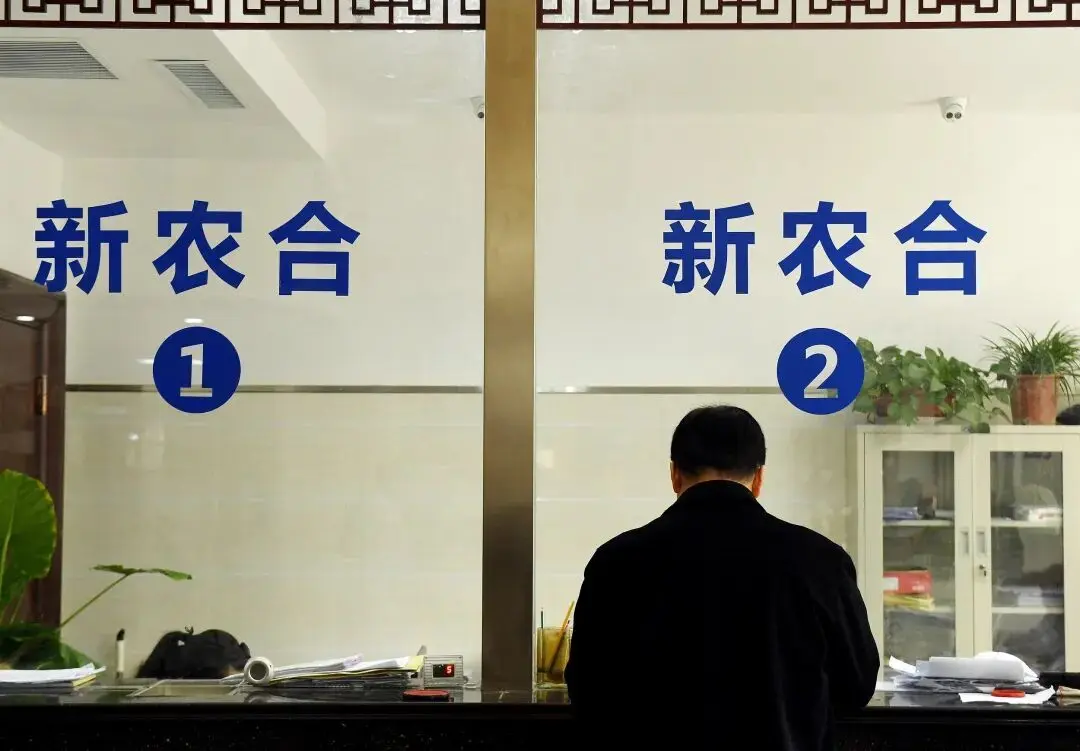
Why is the 400 yuan New Rural Cooperative Medical Scheme repeatedly urged? Why are farmers unwilling to pay?
At the end of each year, the grassroots cadres in thousands of rural areas begin to get busy. The annual work of collecting and paying for the urban and rural residents' medical insurance has entered a difficult final stage.
According to reports, in some areas, in order to meet the hard targets, village cadres have to pay out of their own pockets to "advance" the payment. A universal policy that should have guaranteed people's livelihood has turned into a tug-of-war of urging payments. Where does the problem lie?
01
In 2025, the individual payment standard for urban and rural residents' medical insurance is 400 yuan, and the financial subsidy is 640 yuan. In 2026, the financial subsidy standard will be raised to 700 yuan, and the individual payment standard will remain at 400 yuan - this is the first time in recent years that the increase has been stopped.
The relatively wealthy urban middle class may not understand that it only costs 400 yuan a year to cover the basic needs, which may only be the cost of a few cups of coffee, or a barbecue or hot pot meal. Why are many farmers unwilling to pay?
If we compare the consumption standards of the city with the survival reality of the vast rural families, we will undoubtedly fall into the cognitive misunderstanding of "why not eat meat soup".
Let's turn the clock back to 2003. In order to solve the problem of farmers becoming impoverished and returning to poverty due to illness, the new rural cooperative medical system officially started a pilot program. At that time, in order to reduce the burden on farmers and promote the rapid coverage of the New Rural Cooperative Medical Scheme, the participation threshold was very low - the individual payment standard was only 10 yuan.
Over the past 20 years, the individual payment standard has risen all the way, from 10 yuan to 400 yuan, a full 40-fold increase. This number's absolute value may be within the payment capacity of many people, but the growth curve is extremely steep.
We can calculate a simple economic account - in the past few years, has the per-mu yield of farmers planting rice and wheat increased by 40 times? Has the daily wage of migrant workers increased by 40 times? Obviously not.
For a typical three-generation family, the insurance premiums for four or five people add up to about 2,000 yuan, which may mean that the annual profit of several acres of land almost has to be handed over, or even have to pay extra.
When the medical insurance expenditure is seriously out of sync with the income growth, the pain caused by this "scissors difference" will naturally weaken the willingness to participate in the insurance.
The "Statistical Bulletin on the Development of National Medical Security Undertakings" released by the National Healthcare Security Administration shows that the number of participants in urban and rural residents' medical insurance has gradually decreased since 2019, decreasing by 0.3%, 0.8%, 0.8%, 2.5% and 2.1% year-on-year respectively from 2019 to 2023.
An official previously stated that the decline in the number of participants was due to some people flowing to the employee medical insurance, but also admitted that "in recent years, some rural residents have stopped paying urban and rural residents' medical insurance". The "disconnection tide" is not groundless, and a considerable number of people have chosen to "run naked" without medical insurance coverage.
02
Farmers are unwilling to participate in the insurance, far more than the cost itself, and the deeper reason lies in the imbalance between input and output.
In the early days of the New Rural Cooperative Medical Scheme, there were personal accounts, and farmers could directly deduct the cost of buying medicine for colds and fevers, "the money is still their own", and they felt a strong sense of gain.
With the advancement of the reform of outpatient overall planning, personal accounts were cancelled. Although the original intention of the reform was to improve the overall planning level and enhance the ability to help each other, for those who do not go to the hospital all year round, especially farmers who work all year round and are accustomed to "carrying minor illnesses", the annual investment of 400 yuan seems to have been in vain.
They are prone to form a simple understanding: the money they pay is used to cover others.
Moreover, in reality, some medicines have two sets of prices inside and outside the medical insurance - one price without swiping the card, and the price is more expensive when swiping the card.
A small number of medical institutions, in order to extract medical insurance funds, over-treat insured patients, treat minor illnesses as major ones, over-examine, and prescribe high-priced drugs. Even the self-paid portion after medical insurance reimbursement is more expensive than the completely self-paid, which is a bizarre phenomenon.
When the medical insurance fund becomes "Tang Monk's meat", when patients find that they have paid the insurance premium, but have to pay more money, the crisis of trust will quietly spread.
Previously, scholars found through investigation that the balance of urban and rural residents' medical insurance funds presents a paradox, "the richer, the more loss, the poorer, the more saving".
In layman's terms, in underdeveloped areas, due to the thin financial foundation and weak risk resistance, local medical insurance management departments often adopt defensive cost control strategies, by raising the deductible, strictly controlling the scope of reimbursement, and other means to artificially reduce expenditures, thus generating a large surplus of medical insurance funds.
And it is precisely these low-income areas that the people are most eager for medical relief.
On the one hand, the medical insurance funds are lying on the account "sleeping", and on the other hand, the people's burden of seeing a doctor is still heavy. This "having money but not daring to spend" idle funds is undoubtedly an implicit debt to the insured.
Of course, there are also systemic reasons for the floating population behind this.
A large number of people in underdeveloped areas have flowed out. They work in big cities, but their medical insurance payments are still in their registered residence. Due to the fact that the national unified settlement has not yet been realized, and is restricted by the cumbersome reimbursement of medical treatment in different places, many migrant workers who get sick outside may not be able to use medical insurance.
The insurance premiums paid have not been converted into effective protection, which objectively reduces the fund expenditure and causes the "passive surplus" of the medical insurance fund in their hometowns. This money is saved, but it has not been truly used to protect the health of the floating population.
Against the backdrop of the continuous rise in individual payment standards, all these factors are eroding the residents' willingness to participate in the insurance.
03
In order to enhance the willingness to participate in the insurance, various regions have set up a "waiting period for treatment". Simply put, if you pay the insurance premium within the specified window period, you can normally enjoy the treatment, but if you delay the payment, you need to wait for a period of time before you can normally enjoy the medical insurance treatment.
This is essentially a punishment mechanism, which has a certain deterrent effect, but it cannot fundamentally solve the problem of low willingness to participate in the insurance. The real way out is to improve the cost-effectiveness and sense of gain of the medical insurance system.
First of all, the state should assume a greater responsibility for covering the bottom line and increase subsidies.
We cannot forget that today's farmers, especially the older generation of farmers, have made huge historical sacrifices for the country's industrialization and urbanization. However, in the field of social security, they have long been in a marginalized position that has been ignored.
Taking old-age insurance as an example, for a long time, there has been a huge dual-track system gap between the urban and rural residents' pension and the urban employees' pension. The monthly pension of many rural elderly people is only one or two hundred yuan, which is vastly different from the treatment of urban retirees who receive thousands or even tens of thousands of yuan.
In the context of weak old-age security, medical insurance is their last line of defense against returning to poverty due to illness. Therefore, in terms of medical insurance financing, more inclination should be given to the farmer group, the financial subsidy standard should be raised, and the burden of individual payment should be effectively reduced.
Of course, what should not be ignored is to squeeze out the water from the medical system.
If the root of the high cost of seeing a doctor is not removed, no matter how high the reimbursement ratio is, it will be swallowed up by the inflated drug prices. In this regard, we must severely crack down on the price fraud and over-diagnosis behavior of medical institutions to ensure that the reform dividends truly benefit ordinary farmers.
In view of the characteristics of "minor illnesses are delayed, major illnesses are carried" in rural areas, the threshold for outpatient reimbursement should be further lowered, the process of reimbursement in different places should be simplified, so that farmers can enjoy the real reimbursement convenience in village clinics and town health centers, rather than actively giving up their rights because of the complicated procedures.
400 yuan, for the huge medical insurance fund, may be just a drop in the ocean, but for a farmer's family facing the loess and facing the sky, it is related to their confidence in the future and also related to their trust in the medical insurance system.
The root of solving the problem of the New Rural Cooperative Medical Scheme's disconnection lies not in how tough the village cadres' urging methods are, but in whether the system design is humane enough and whether it truly responds to the survival anxiety of vulnerable groups.
Only by facing the historical contribution of the vast number of farmers, by investing real money, and effectively reducing their burden, can this nationwide health protection network play a greater role in covering the bottom line.