Five years after buying a house, and three years after it became a stalled project, Qiu Yun finally received the final judgment in his favor.
On August 21, 2025, the court ruled in the second instance that Qiu Yun’s “Sales Contract for Commercial Housing (Pre-sale)” signed with the developer on October 23, 2020, was terminated, and the “Personal Mortgage Loan Contract” signed with the bank on December 23, 2020, was terminated, and the developer was required to return the down payment, principal of the loan, interest, and other fees.
Since starting to buy the house in 2020, Qiu Yun has paid a down payment of 196,781 yuan and has repaid more than 80,000 yuan in loan principal and interest. In June 2021, the project was completely suspended, and the developer “disappeared.” In March 2023, Qiu Yun decided to sue the developer and the bank, and in this process, he experienced a “reversal and then reversal” of the judgment results.
On July 7, 2025, the Supreme People’s Court Case Library released the “Lu Mou, Zhang Mouqian v. Yancheng Rong Mou Real Estate Co., Ltd., and a branch of a bank, Yancheng Branch, Housing Sales Contract Dispute Case.” The main points of the judgment in this case clearly pointed out that if the seller of commercial housing fails to deliver the house on time, and the construction of the commercial housing involved has been suspended and there is no possibility of delivery in the short term, the buyer’s contract objectives of purchasing commercial housing and obtaining a loan for purchasing the house cannot be achieved. In order to comprehensively resolve the dispute and ensure the uniformity of the judgment, if the buyer claims to terminate the commercial housing sales contract and the commercial housing guarantee loan contract in the same case, the people’s court should support it.
However, winning the case does not mean that Qiu Yun can get the money back to buy the house; he said he felt like he had received an “IOU in the air.”
According to an interview with Deep Dive, owners of stalled buildings from Guangdong, Henan, Shandong, Hubei, Xinjiang, and other places, in the lawsuits with developers and banks before and after the release of the Supreme Court’s case library, some have recovered all their losses after winning the case or mediation, and some have faced new problems such as “priority of compensation,” difficulty in execution, and the bank’s uncooperative “washing” of credit records after the contract was terminated.
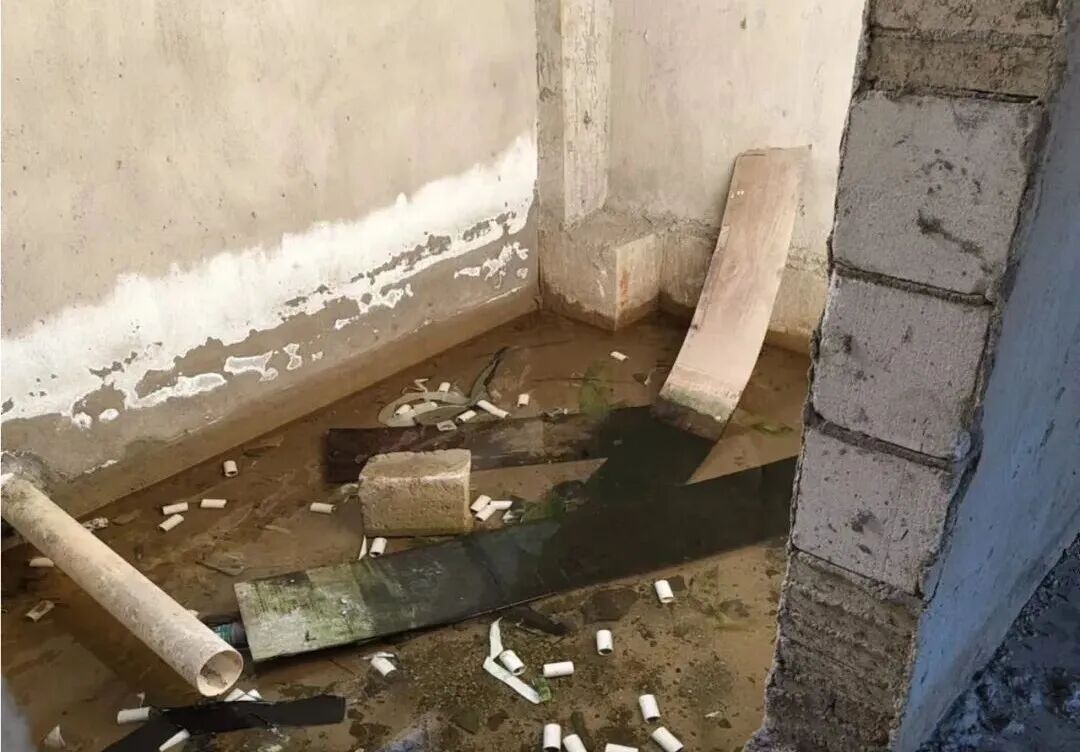
After the developer “rushed to complete” the project, the house purchased by Qiu Yun had serious water leakage problems. Photo | Provided by the interviewee
Returning the house, stopping the loan
Qiu Yun is from a county town in Qingyuan, Guangdong, and works in the city. On October 23, 2020, Qiu Yun spent nearly 200,000 yuan as a down payment and took out a loan of 589,000 yuan to purchase a house in Qingyuan.
The contract originally stipulated that the developer would deliver the fully-decorated house on June 30, 2022. However, when Qiu Yun came to the building complex again in June 2021, he found that after the completion of the first phase, the construction of the second phase he purchased was completely suspended. By June 2022, all the scaffolding outside the suspended building had been removed, and there were no signs of construction on the construction site.
After realizing that “something was wrong,” Qiu Yun began a long road of rights protection in 2021.
The owners first went to the local Housing and Urban-Rural Development Bureau. After investigation by the Housing and Urban-Rural Development Bureau, the developer withdrew project construction funds, leading to a broken capital chain of the building complex. Through mediation, on June 1, 2022, the developer promised the owners in writing: to deliver the house on November 30, 2022, and unlike the initially agreed fully-decorated house, it would only be a bare-bones house that had passed the completion acceptance. But the developer broke its promise again.
The Housing and Urban-Rural Development Bureau told the owners of the stalled buildings, including Qiu Yun, to either wait or sue.
In March 2023, Qiu Yun decided to sue the developer and the bank, and at the same time, he stopped repaying the loan. Before that, he had already paid more than 80,000 yuan in loan principal and interest. On June 18, the case was formally filed as a dispute over a sales contract.
On January 15, 2024, Qiu Yun won the first instance of the case, terminating his “Sales Contract for Commercial Housing” with the developer and his “Personal Mortgage Loan Contract” with the bank.
But the bank continued to appeal. The bank believed that even if the “Sales Contract for Commercial Housing” was terminated, according to the principle of contractual relativity, the bank, as a third party to the contract, could not bear the obligation, and Qiu Yun should continue to bear the obligation to repay the loan.
Article 20 of the “Interpretation of Several Issues Concerning the Application of Law in the Trial of Disputes over Sales Contracts for Commercial Housing” (hereinafter referred to as the “Interpretation”) promulgated in 2003 stipulates: If the purpose of the commercial housing guarantee loan contract cannot be achieved due to the invalidation, revocation, or termination of the commercial housing sales contract, and the parties request the termination of the commercial housing guarantee loan contract, it should be supported.
A new “episode” was encountered in the second instance of the case—the case was sent back for retrial on October 31, 2024. Qiu Yun received the retrial judgment on April 28, 2025. The court determined that the house “met the conditions for bare-bones delivery, the basic purpose of the contract had been achieved, and considering the need to ensure transaction security, balance the interests of all parties, and maintain social stability,” Qiu Yun’s “Sales Contract for Commercial Housing” and “Personal Mortgage Loan Contract” should not be terminated.
In fact, Qiu Yun and other owners found that the house was not much different from the initial stage of the stalled project. Only doors and windows were installed, and water was connected, and there were serious water leakage problems. Many owners dared not renovate and refused to accept the house.
Gu Fei, a lawyer from Shanghai Jintiancheng (Xi’an) Law Firm, pointed out that in actual practice, it is not uncommon for banks and developers to avoid bad debts and realize their claims by continuing to appeal, waiting for special teams to move in, and the allocation of relief funds and other ways to revitalize the project. This is called a “delaying tactic” during the litigation process.
In reality, some developers will also “rush to complete” the project. A judgment from the China Judgments Online shows that on September 28, 2025, a case of a stalled building in Foshan, Guangdong, was deemed by the court to have “met the conditions for delivery” because of the “rushed completion” before the trial, and the contract involved had the basis for continued performance, “so it is not appropriate to handle it as a termination.” The appeal of the owners of the stalled building was rejected in the second instance.
The retrial judgment of Qiu Yun’s case determined that the house “met the conditions for bare-bones delivery, the basic purpose of the contract had been achieved, and considering the need to ensure transaction security, balance the interests of all parties, and maintain social stability,” Qiu Yun’s “Sales Contract for Commercial Housing” and “Personal Mortgage Loan Contract” should not be terminated.
Qiu Yun continued to appeal.
On August 21, 2025, the Qingyuan Intermediate People’s Court of Guangdong Province ruled in the second instance that although the bare-bones house had passed the acceptance, it still did not meet the fully-decorated delivery conditions originally agreed in the contract, and the developer constituted a fundamental breach of contract. Qiu Yun’s contractual relationship with the developer and the bank were both terminated, and the developer was required to return the down payment, loan principal, and other fees.
Just before Qiu Yun received the second-instance judgment, on July 7, the Supreme People’s Court Case Library released a case of a housing sales dispute that occurred in Yancheng, Jiangsu. The second-instance judgment terminated the contracts between the homebuyer and the developer and the bank. Based on the provisions of the “Interpretation,” in the main points of the judgment in this case, the Supreme People’s Court clearly pointed out that the close connection between the commercial housing sales contract and the guarantee loan contract under the circumstances of a loan purchase should be fully considered. After the commercial housing sales contract is confirmed to be invalid or revoked or terminated, the commercial housing guarantee loan contract is also terminated, and the seller of the commercial housing shall bear the responsibility for returning the received housing loan, the principal of the housing payment, and interest.
Discover more from 自由档案馆
Subscribe to get the latest posts sent to your email.