


This year, we may have to face another question: is old age a get-out-of-jail-free card, and should we reduce the level of protection for elderly offenders?
Recently, the case of a 93-year-old man in Shaoyang, Hunan, who was sentenced to 15 years in prison for sexually assaulting a minor, but was refused admission to the detention center due to his inability to care for himself and was proposed for execution outside of prison, has sparked controversy. The heavy sentence but inability to execute it, the board raised high but then “lightly put down,” greatly impacts people's simple sense of justice, making it difficult for the public to accept.
From the perspective of the crime, sexually assaulting a minor and being sentenced to 15 years falls under the circumstances of aggravated and serious consequences in the crime of rape. In addition, according to the provisions of China's Criminal Law, those over seventy-five years old who intentionally commit a crime can be given a lighter or reduced punishment. Against this backdrop, the defendant in this case was still sentenced to 15 years, which shows how despicable his criminal acts were.
The physical and psychological trauma caused by sexual assault on minors is almost devastating and may affect their entire lives. In such cases, the public expects to see the perpetrators severely punished, to comfort the injured hearts and demonstrate the authority of the law. However, now, the perpetrator is exempt from imprisonment due to his inability to care for himself; in the eyes of many, this is a failure of justice.
However, judicial organs also have legal basis to consider execution outside of prison. According to Article 265 of the Criminal Procedure Law, there are three types of people who should be imprisoned but can be temporarily released for execution outside of prison:
- The first category is those with serious illnesses who need medical parole;
- The second category is women who are pregnant or breastfeeding their own infants;
- The third category is those who are unable to care for themselves, and execution outside of prison will not endanger society.
This includes humanitarianism and also considers the reasonable allocation of prison resources, avoiding the prison taking on excessive medical care, nursing, and other responsibilities beyond its functional scope. Of course, execution outside of prison is only temporary. If the above special circumstances disappear but the sentence has not been served, the person should be promptly re-imprisoned.
Many people ask: what is “unable to care for oneself”? Is there a vague space for individual differences or subjective discretion?
According to the “Opinions on Further Standardizing the Work of Temporary Execution Outside of Prison” jointly issued by the Supreme People's Court, the Supreme People's Procuratorate, the Ministry of Public Security, and the National Health Commission in 2023: in the five daily life behaviors of eating, turning over, defecating, dressing and washing, and independent movement, if three of them require the assistance of others to complete, and after more than six months of treatment, nursing, and observation, the ability to care for oneself cannot be restored, it can be determined as unable to care for oneself. For offenders over sixty-five years old, if one of the above five daily life behaviors requires the assistance of others to complete, it can be considered as unable to care for oneself.
Therefore, the defendant in this case is 93 years old, and there is more than one item in the five daily life behaviors that requires the assistance of others, which is in line with common sense and can also respond to the doubts of some netizens - “able to rape but unable to care for oneself,” which is possible.
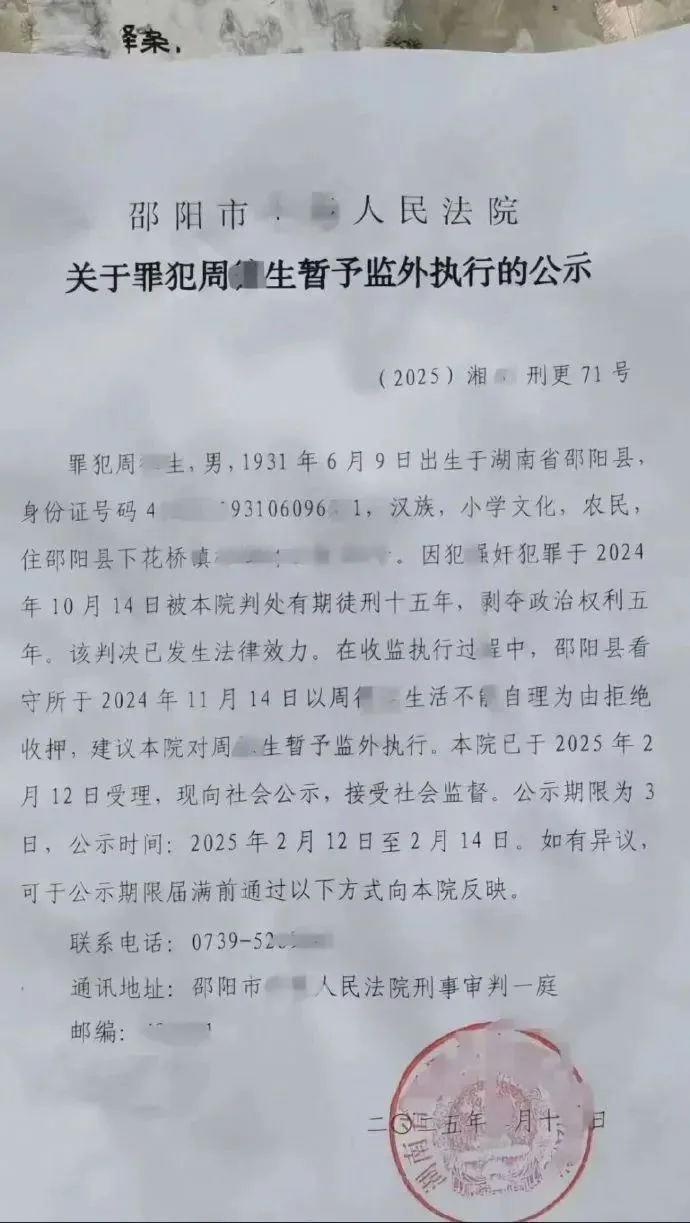
Therefore, as long as it is determined that the defendant will not continue to endanger society, the decision of execution outside of prison complies with the law.
This time, the Shaoyang Intermediate People's Court publicly announced the decision of “temporary execution outside of prison” for the elderly defendant, the background of which is that in recent years, China's judicial organs have strictly standardized the procedures for sentence reduction, parole, and temporary execution outside of prison. The public announcement is a manifestation of promoting judicial transparency and is commendable.
However, why would this series of legal operations cause dissatisfaction?
First, this is a conflict between legal provisions and a simple sense of justice. This conflict is not uncommon and reflects the tension between the rationality of the law and public sentiment. For example, when encountering vicious crimes committed by underage minors, the public will call for severe punishment, while the law will consider how the “Law on the Protection of Minors,” the “Law on the Prevention of Juvenile Delinquency,” and the “Criminal Law” construct a graded correction of the wrongdoings of minors, and the criminal law is the last tool to be used.
The law pursues a universal and abstract justice, which needs to consider various complex factors. The public's simple sense of justice is more derived from intuition and emotion, which is a direct judgment of good and evil in specific events. When the two conflict, we should conduct reflective balance.
In this case, the judicial organs' interpretation and reasoning may not be sufficient. If the judicial organs publicly disclosed the detailed medical assessment report of the perpetrator's inability to care for himself, and at the same time combined with his criminal circumstances, the risk of re-offending, and other factors, and made a comprehensive judgment that he would indeed no longer endanger society, it could eliminate some of the public's doubts.
Furthermore, if the final decision is to execute outside of prison, the supervision of the defendant must also be strictly enforced. Since it is a repeat offender, the punishment cannot be a mere formality, and the perpetrator must be made to truly feel the intensity of the punishment. For example, electronic monitoring can be strengthened, and their range of activities can be restricted. If the reasoning is sufficient, the public will not have so many worries and dissatisfaction.
Secondly, we also found that some legal operations, which appear to accurately apply the law, may not necessarily play a role in punishing and deterring. Similar to the aforementioned case, there have recently been several incidents of “those who have committed indecent assault on women being exempt from administrative detention due to old age,” and the offenders are all elderly people over 70 years old. According to the provisions of China's “Public Security Administration Punishment Law,” for people over 70 years old, even if administrative detention is imposed, the punishment does not need to be executed. This result is difficult for the victims to accept.
Last year, when the middle school students in Handan killed and buried their classmates, we discussed the issue of criminal responsibility of underage minors in the “Wind Sound” column. Legislation has conditionally lowered the age of criminal responsibility for minors to 12 years old, and the procuratorial organs have also made it clear that “prevention is protection, and punishment is also rescue,” and have increased the crackdown on violent crimes committed by young minors.
This year, we may have to face another question: is old age a get-out-of-jail-free card, and should we reduce the level of protection for elderly offenders?
As we all know, China has gradually entered an aging society. With the improvement of living standards and medical technology, the health status and cognitive abilities of the elderly over 70 years old around us have generally increased, and the crime rate of the elderly has correspondingly increased. If we still follow the previous thinking, defining 70 or 75 years old as the boundary for leniency, mitigation, or non-execution of legal responsibility, it may no longer be very suitable for the national conditions, and legislation should consider responding to this.
Taking the “Public Security Administration Punishment Law” as an example, this law is being revised. According to the existing provisions, administrative detention punishment may not be executed for minors under the age of 16. However, in the recent draft revision, such restrictive provisions have been removed and linked to the “Law on the Prevention of Juvenile Delinquency”; those who are not punished or do not execute detention are also required to undergo correctional education.
In fact, for elderly offenders over 70 years old, the revision of the “Public Security Administration Punishment Law” can also be adjusted simultaneously. It is not appropriate to use 70 years old for a “one-size-fits-all” approach. The public security organs can decide whether to execute detention based on their physical condition; even if not executed, alternative disciplinary measures such as community correction should be introduced. At the same time, the victim can also pursue legal liability through civil means. The penalty decision notice issued by the public security organs is an important evidence of the infringement.
The life of the law lies in its implementation, and the effect of implementation lies in the recognition and acceptance of the public. If we allow doubts like “able to rape but unable to care for oneself” to spread on the Internet without explanation, this is the dereliction of duty of legal professionals.
The social problems exposed in this case also need to be responded to by legislation and the judiciary. If it is only treated as a hot news topic, it will lose the opportunity to dialogue with public opinion and also consume valuable justice and conscience.