

Recently, I wrote several articles calling for an increase in the basic pension for farmers. Looking at the comments, some people are still saying "farmers didn't pay social security."
I have already discussed this in my article "8 Reasons to Raise the Basic Pension for Farmers to 800 Yuan". I know that some people don't know, some people don't understand, and some people are pretending to be confused. But in any case, for the convenience of everyone, I will elaborate and write another article—if anyone still brings up the issue of "farmers not paying social security" in the future, please just throw this article in their face.
I. Farmers were the first group to pay social security
In the second reason of "8 Reasons", it has already been said, "Farmers were the first group to pay social security for the whole society. Here, we are talking about public grain, including 'three withdrawals and five contributions', etc."
Agricultural tax is a typical unfair tax. You pay personal income tax now, and there is a threshold. Agricultural tax does not have one. Regardless of the yield, whether for self-use or for sale, it must be fully levied. Moreover, "the first tax is light, the second tax is heavy, and the third tax is a bottomless pit". The "first tax" is agricultural tax, the "second tax" is "three withdrawals and five contributions", that is, three items of village retention: public accumulation fund, public welfare fund, and management fee; five items of township coordination: education fee, preferential treatment fee, transportation fee, militia training fee, and family planning fee. The "third tax" is various fund-raising and apportionment, such as education, transportation, public security, family planning, power grid, new houses, old houses, etc., which is actually random charges.
Why do I write these things tirelessly? Because many people don't know, just like many city people still don't know that "farmers only have a little over a hundred yuan a month in pension" even today.
Overall, the tax burden is between 20% and 30%. What is the scale of this? People used to say that landlords exploited farmers, but according to the calculations of historian Gao Wangling, the agricultural "surplus" occupied by landlords was about 10%-12% (because a considerable part was self-cultivating farmers). In other words, in terms of the ability to extract surplus from farmers, no dynasty can compare with these past few decades.
It's not over yet, there are also various invisible ways, such as performing corvée, building bridges, building roads, building reservoirs, and dredging rivers, etc., and they have to bear 15-30 days of compulsory labor every year. What's more powerful is the "scissors gap" (lowering the purchase price of agricultural products and raising the price of industrial products). Research data shows that just the "scissors gap" alone, farmers have to send 25 yuan to the city for every 100 yuan of wealth they create.
My parents said that at that time, "pay enough to the state, and leave enough for the collective". The remaining grain could only be eaten during the New Year. After the spring, there was no food. They ate sweet potatoes when they came out, and broad beans when they came out. When I was a child, I occasionally mixed some sweet potato granules in the rice. My father resolutely refused to eat them because they were too filling.
This video is a Sichuan farmer recalling the past of paying public grain. This is just a small slice of the difficult situation of farmers at that time.
In summary, the farmers of that era handed over all the remaining surplus except for maintaining the minimum production and living, and the tax and labor burden they bore, except that the name was not social security, was much more than those who paid social security later—saying "farmers didn't pay social security" is just a shameless trick of playing with words.
II. What about "deemed contribution years"?
I know that some people will still say: no matter what, farmers didn't pay, they just didn't pay. Okay, what about "deemed contribution years"?
Before 1998, most enterprise employees did not pay social security, but their years of service were directly regarded as deemed contribution years. Before 2014, staff members of government agencies and public institutions also did not pay social security, and their years of service were also regarded as deemed contribution years. May I ask: why can't farmers be treated equally?
Okay, I'll take a step back. If you say that only jobs in factories and government agencies in the city count as years of service, then tell me: educated youths who went to the countryside can all count as years of service, why can't farmers?
Okay, I know that some people will still have opinions: after all, after 1998 and 2014, enterprise employees and staff members of government agencies and public institutions paid, while farmers did not. Okay, then let's start counting from 1998. Assuming that farmers started working on the land at the age of 18, farmers who are 60 years old this year have 16 years of service, and farmers who are 70 years old have 26 years of service. If we consider deemed contribution years, how much pension should they receive each month? Is 800 yuan enough?
Such a simple fact and logic, there is no need for me to continue to elaborate, right?
III. Farmers' children have paid social security
Even if farmers haven't paid social security, their children have, whether they are working in the city or have become city people.
Don't say "farmers belong to farmers, children belong to children". Get one fact straight: China's pension system is "pay-as-you-go". The pension you receive now is not what you saved up (what you saved has long been received by those who retired earlier than you), but is based on the pension insurance paid by young people who are currently working (the part paid by the enterprise is also essentially the employee's, which is part of the labor cost). Then the question arises: why can't the pension insurance paid by farmers' children be used for their parents? Can't they use what their children pay?
Don't think that this is a strange argument, nonsense. This is a basic fact. If you are a farmer's child, this is what you need to know; if you are a retiree and can't figure it out... then think again.
On the website of the Ministry of Health, Labour and Welfare of Japan's public pension, the propaganda of "paying for the parents and grandparents in their hometown" is still retained. In the 1980s, Japan also had a large number of young rural laborers coming to the city, and the farmers' pension accounts were insufficient. Therefore, Japan's public pension reform was pay-as-you-go, and different groups helped each other. Thus, there was the previous slogan.
As long as it is pay-as-you-go, there will inevitably be this problem: because the people who pay now do not know how much they will get in the future, especially in an aging society. In fact, the number of people who have stopped paying employee pension insurance is increasing, from 29.56 million in 2011 to 63.25 million in 2022. The compliance rate has dropped from 85.2% to 80.8%. Why? Lack of confidence, not enough encouragement.
I also said similar things in the article "8 Reasons": "If the basic pension for farmers can be raised to 800 yuan/month, for the children of farmers, paying social security is like opening an 800 yuan/month "family account" for their parents, which can still provide some comfort, right?"
I am the child of a farmer who is supporting the elderly in the city. I pay nearly 3,000 yuan in pension insurance in Shanghai every month, while my parents in a certain rural area in the north have almost no pension. Because they have no pension, they will always maintain a certain sense of crisis, and they still have to work hard to earn money even though they are over 60. My father is 64 this year, and he just had a stent surgery last year, and then he went to the construction site to work and move bricks. My mother is 62, and she is still farming to earn money. I feel sorry for them. I will occasionally send them money. But the sense of crisis deep in their hearts cannot be changed. What is retirement life like? Rural elders will never know.
This is a reader's message under that article. This sentence expresses the pain in the hearts of so many children who came out of the countryside.
IV. What about fiscal subsidies?
After talking for a long time, I know that some people will still insist that you only get it if you pay, and you don't get it if you don't pay. Okay, then tell me: what about fiscal subsidies?
The pension you receive has a part that is a fiscal subsidy, which is the taxpayers' money. Generally speaking, based on the basic concept of fairness, those with low incomes should receive high subsidies, and those with high incomes should receive low subsidies or no subsidies, but what is the actual situation?
See the picture below:
This picture was made by Nie Ming in the article "The Construction of the Basic Old-age Service System Must Face the Basic Problems". If you can't see it clearly, please be sure to click on it to see the large picture and feel the power of numbers.
The average monthly pension for government agencies and public institutions is the highest, reaching 6,483.8 yuan in 2021, with a fiscal subsidy of 2,211.3 yuan; the average monthly pension for enterprise employees is 3,047 yuan, with a fiscal subsidy of 482.8 yuan; the average monthly pension for urban and rural residents (including farmers) is 190.9 yuan, with a fiscal subsidy of 163.9 yuan.
There is no need for me to explain this data, is there? It's tragic enough.
Why did I say in the article "8 Reasons" that "the pension standard for employees of government agencies and public institutions can be lowered. Assuming it is lowered to 4,000 yuan/month, an employee of a government agency or public institution can save two and a half farmers". This is not just a casual remark, but it just removes the fiscal subsidy part.
The pensions of retired personnel in government agencies and public institutions have already reached an appalling level, with a replacement rate (the level of salary that can be received after retirement) of more than 80%. Some people even receive a higher pension than their salary when they were working. What level is this? Except for those high-welfare countries, many developed countries are only 50%-60%, such as the United States, Japan, Germany, and France. South Korea also needs to pay for 40 years to reach 50%.
People in government agencies and public institutions should never say that this is because you pay more, because every penny you pay is given by taxpayers. Paying more is equivalent to giving yourself a disguised pay raise. In fact, you do pay more. The basic old-age insurance unit is 16% + individual 8%, and the occupational annuity unit is 8% + individual 4%, totaling 36%. This is also an absurdly high number, and developed countries generally do not exceed 20%.
Last September, members of the "Social Insurance Law Implementation Evaluation" research group of the China Social Security Society released a research report. The authors were the president, secretary-general, and deputy secretary-general of the society, and it mentioned that the contribution rates of basic old-age insurance and occupational annuity for government agencies and public institutions should be lowered, and the replacement rate should be adjusted to around 50%.
“This phenomenon is not only contrary to the goal of common prosperity pursued by Chinese-style modernization, but also inconsistent with the institutional practice of public pension systems in capitalist countries in pursuing fairness and the objective laws formed thereby. The collapse of the former Soviet Union and the full privatization of public pensions in Chile are both related to the abnormally high pensions of public officials, which led to dissatisfaction among the vast number of workers.” - This is the original text of the report. Readers who want to put a hat on me should go to the most authoritative people in the Chinese system.
There are always people who say that I am "inciting social contradictions". They take advantage of the situation and still hope that others will remain silent. Don't think so beautifully about such a beautiful thing. Some people also take my IP to make a fuss. Since you sincerely ask, I will be merciful and tell you—because I have a conscience and do not forget my roots.
By the way, retired enterprise employees should not stand up and oppose the increase in the basic pension for farmers. You are not considered high either. The current plans do not say that your retirement pay will be lowered. In 2014, you were not much different from those in the system. Now you are only half as much. I used to work in a third-line factory. I respect and love my master and master's father-in-law have been laid off. I know the pain. Since I have had similar experiences, please have more empathy and do not build a sense of superiority on the farmers.
5. What is a basic pension?
The last reason is also the common sense of modern countries: it is not only if you pay, but also if you don't. This part is called the basic pension, or relief fund.
Countries like Canada, Australia, and New Zealand all have them. Some are universal, and some have conditions and thresholds. For example, Canada requires a residence of 40 years, a full amount of more than 700 Canadian dollars per month, and a return if the annual income exceeds 93,000 Canadian dollars, and cancellation if it exceeds 142,000 Canadian dollars. This is the basic pension, and there are also relief funds. For example, the United States, which emphasizes "work ethic", also has relief funds for the elderly in poverty, with a maximum of nearly 1,000 US dollars per month.
Therefore, according to China's actual living standards, a basic pension of 800 yuan is not a high amount. Income thresholds can also be set. Those with a monthly income of less than 3,000 yuan can make up 3,000 yuan, and can receive a maximum of 800 yuan, and those who exceed 3,000 yuan will be cancelled. In this way, from the system design, there is no need to consider the problem of "farmers not paying social security", and it can also cover all low-income elderly people in urban and rural areas. The fiscal subsidy amount mentioned in the fourth part is sufficient to cover it, and no additional expenditure is required.
There are always people who say "how complicated this matter is", "where does the money come from", etc. In fact, is this matter difficult? Not difficult at all.
Let's stop here. I think I have discussed it enough, and there is no need to say more.
In fact, I know that for some people, there is another reason, that is, they feel that farmers are lowly people in their bones. I suggest that this reason should not be mentioned. Those people dare not say it even if they can do it. After all, it is 2025.
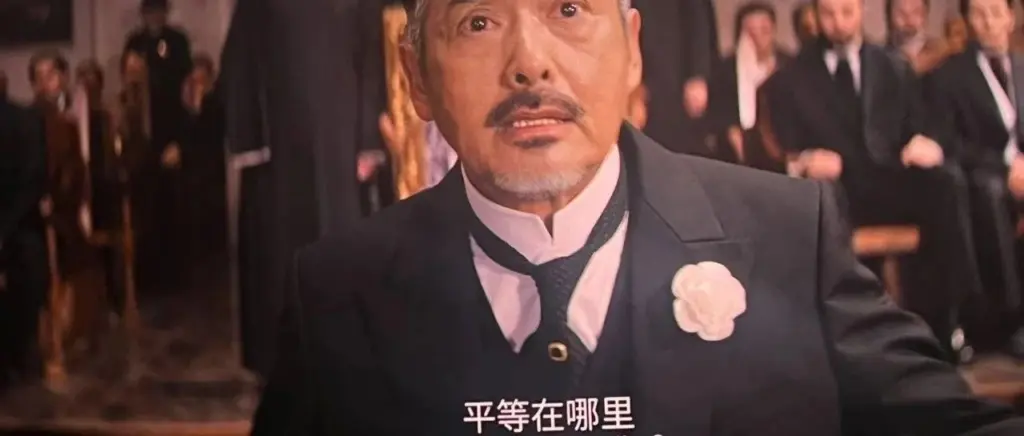
Last night, I watched "Detective Chinatown 1900". At the end, Chow Yun-fat made a passionate speech in court, saying that your clothes were washed by Chinese workers, the fresh vegetables in your home were sent by Chinese workers, and the houses under your feet were built by Chinese workers... At that time, what I thought of was not anything else, but a generation of Chinese farmers.
This generation of rural elders, the country owes them the most. They encountered the great famine when they were born, and they were lucky enough to grow up. They also encountered family planning. In order to support their families, they went out to work and encountered various system discriminations. Now they are old, and their children are not by their side (they went to the city to serve you, gentlemen), and they still have to work on the land with their sick bodies. I still remember that a few years ago, when I went back to my hometown with my parents, I saw an old man on the side of the road, deeply hunched over, his head almost buried in his thighs. I walked past him, and then turned back and gave him a hundred yuan. My mother said: No one gives him money, you don't know how happy he is.
Do we have to wait until they all die before we don't owe them?