

In order to evade debts and prevent being offset, both parties agreed that the property should belong solely to FAN 2.
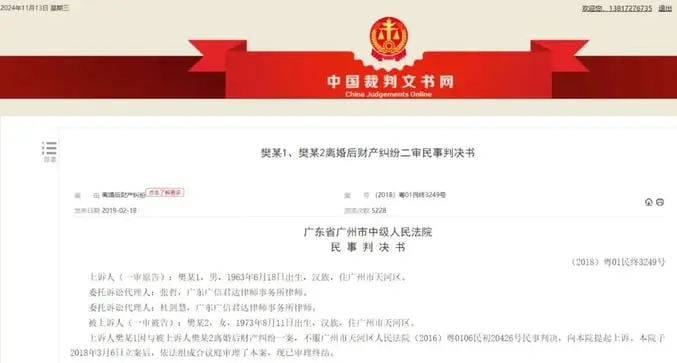
Guangzhou Intermediate People's Court of Guangdong Province
Civil Judgment
(2018) Yue 01 Min Zhong 3249
Appellant (Plaintiff in the first instance): FAN 1, male, born on June 18, 1963, Han nationality, residing in Tianhe District, Guangzhou City.
Entrusted Litigation Agent: ***.
Entrusted Litigation Agent: ***.
Appellee (Defendant in the first instance): FAN 2, female, born on August 11, 1973, Han nationality, residing in Tianhe District, Guangzhou City.
Appellant FAN 1, due to a property dispute after divorce with Appellee FAN 2, dissatisfied with the civil judgment No. 20426 of the Tianhe District People's Court of Guangzhou City (2016) Yue 0106 Min Chu, appealed to this court. After the case was filed on March 6, 2018, this court formed a collegial panel to hear the case according to law, and the hearing has now concluded.
Appellant FAN 1's appeal request:
1. Revoke the civil judgment No. 20426 of (2016) Yue 0106 Min Chu;
2. Order the legal division of the right to occupy and use a piece of land in XX, Tianhe District, Guangzhou, and the buildings on it (including a 2-story villa and a 6-story building), and the rental income of the buildings from the date of divorce registration, May 19, 2010, to the date of actual division, with both parties each holding 50%.
3. Order the legal division of the right to occupy and use the land in No. XX1, Tianhe District, Guangzhou, and the self-built 5.5-story (with a construction area of 500 square meters) building on it, and the rental income of the buildings on the ground from the date of divorce registration, May 19, 2010, to the date of actual division, with both parties each holding 50%.
4. Order the legal division of bank accounts, stocks, etc. under the name of FAN 2, with both parties each holding 50%.
5. Order that the litigation fees of this case shall be borne by FAN 2.
Facts and reasons:
The facts found by the court of first instance are unclear, and the law is misapplied, which should be revoked. I. The parties did not divide the jointly owned property involved in the case at the time of divorce. 1. The "Divorce Agreement" submitted by FAN 1 only stipulated that the jointly owned property in XX2, Tianhe District, belonged solely to FAN 2. Room 1405 is a registered commercial house. In order to evade debts and prevent being offset, both parties agreed that the property should belong solely to FAN 2. 2. The second agreement submitted by FAN 2 was not registered and filed at the time of the divorce agreement, and the property division agreement should also be deemed as not taking effect, and should be divided according to the actual situation, Article 14 of the "Interpretation of the Marriage Law (III)", and Article 77 of the "Several Provisions of the Supreme People's Court on Evidence in Civil Litigation". FAN 1 submitted a screenshot of a text message in the first instance to prove that the two parties were still negotiating the division of the property involved in the case in 2016, and FAN 2 confirmed the authenticity of the evidence. It proves that the two parties did not divide the jointly owned property involved in the case at the time of the divorce. II. The content of Agreement II is contrary to the principle of fairness and reasonableness and should not be adopted. The 2-story villa and 6-story building in Long XX3, Tianhe District, Guangzhou, and the 5.5-story house in XX4, Tianhe District, are both purchased by both parties during the marriage relationship, and the right to occupy, use and rental income should be shared by both parties at 50%, but according to Agreement II, almost all property rights and interests belong solely to FAN 2, and all debts are borne solely by FAN 1, which is obviously an agreement made to evade debts and transfer property. III. The judgment of the first instance omitted the litigation request of FAN 1 and did not make a trial and judgment. In addition to requesting the division of the right to use the 2-story villa and 6-story building in Long XX3, Tianhe District, Guangzhou, and the 5.5-story building in XX4, Tianhe District, and the rental income of the buildings on the ground, FAN 1 also had a third litigation request, which was to legally divide the bank accounts, stocks, etc. under the name of FAN 2 that belonged to the joint property of both parties and the income thereof. The court of first instance did not conduct a trial and judgment on this.
Appellee FAN 2 argued that she did not agree with FAN 1's appeal request.
FAN 1 filed a lawsuit in the court of first instance requesting: 1. Legally divide a piece of land in XX, Tianhe District, Guangzhou, and the buildings on it (including a 2-story villa and a 6-story building), with the right to occupy and use, the value of the real estate is provisionally estimated at 1.17 million yuan, with both parties each holding a 50% share, and requesting the division of the monthly rental income of 26,700 yuan/month (area 890 square meters) from the date of divorce registration, May 19, 2010, to the date of actual division, provisionally estimated to be 2,189,400 yuan as of the end of March 2017; 2. Legally divide the right to use the land in No. XX1, Tianhe District, Guangzhou, and the self-built 5.5-story (with a construction area of 500 square meters) building on it, and the rental income of the buildings on the ground (from the date of divorce registration, May 19, 2010, to the date of actual division, provisionally estimated to be 1.26 million yuan as of the end of March 2017), the value of the real estate is provisionally estimated at 320,000 yuan, with both parties each holding 50%; 3. Bank deposits, stocks, etc. under the name of FAN 2, the specific amount cannot be provided temporarily.
The court of first instance found the facts: FAN 1 and FAN 2 were originally husband and wife, and the two parties signed a "Divorce Agreement" (hereinafter referred to as Agreement I) and registered for divorce on May 19, 2010. The "Divorce Agreement" stipulates: I. Party A (FAN 1) and Party B (FAN 2) voluntarily divorce. II. The jointly owned property in XX2, Tianhe District, belongs solely to Party B... IV. Because Party A was addicted to gambling for a long time before the divorce, Party A borrowed money from Party B's relatives to repay gambling debts. After the divorce, Party A must independently repay the borrowed money to Party B's relatives, and the borrowing has nothing to do with Party B. V. During the existence of the marital relationship between the two parties, Party A's gambling debts and Party A's borrowings shall be repaid independently by Party A, and have nothing to do with Party B. There are no joint debts and debts between Party A and Party B during the marital relationship...
FAN 2 claimed that the two parties also signed another "Divorce Agreement" at the time of the divorce, and submitted a copy of the "Divorce Agreement" (with the original, hereinafter referred to as Agreement II) to prove it. Agreement II states: I. Party A (FAN 1) and Party B (FAN 2) voluntarily divorce. II. The houses in Lane 2, Longdong Juxian Community, Tianhe District, registered under the name of Party B, the houses in Lane 1, Dongyuan 4th Lane, Shahe Town, Tianhe District, registered under the name of Party A (Village and Town Homestead Use Certificate No.: Sui Tian Sha Zi No. 3230, Long Bian 96018), the jointly owned property in XX2, Tianhe District, and the house No. 16, Longdong Villa, Shahe Town, jointly purchased by both parties from Tan Guangtian (Village and Town Homestead Use Certificate No.: Sui Tian Sha Zi No. 8920) all belong solely to Party B. Party A should assist Party B in handling the property rights transfer registration procedures of the above-mentioned houses within five days after completing the divorce procedures... III. The house No. 9, Furen Lane, Dongjie, Longdong Shangshe, Tianhe District, Guangzhou, belongs to Party A. IV. Both parties have a very clear understanding of the ownership status and current status of all the houses stipulated in the second and third articles above, but both parties are still willing to reach the above agreement... XI. If this agreement is inconsistent with the content of the relevant documents signed by both parties during the divorce procedures regarding the distribution of property, the provisions of this agreement shall prevail... The signature and fingerprint of "FAN 1" are at the end of the first page of the agreement, the signature and fingerprint of "FAN 1" are at the end of Party A, and the signature and fingerprint of "FAN 2" are at the end of Party B.
FAN 1 did not confirm the authenticity of Agreement II and applied to the court for handwriting identification; FAN 2 also applied for the identification of the fingerprints on Agreement II. The court entrusted Guangdong Huasheng Judicial Appraisal Center to conduct the appraisal according to law. The center issued the judicial appraisal opinion No. 311 [2017] Wen Jian Zi on the signature on August 23, 2017, and the opinion was: The signature of "FAN 1" at Party A on page 2 of Agreement II is the same as the signature of "FAN 1" at Party A on page 2 of Agreement I. The center issued the judicial appraisal opinion No. 101 [2017] Hen Jian Zi of Yue Huasheng Si Jian Center on the fingerprint on August 31, 2017, and the opinion was that the red fingerprint at the signature of "FAN 1" on page 1 of Agreement II was formed by FAN 1's own left index finger pressing. FAN 1 paid 9,310 yuan for the appraisal fee, and FAN 2 paid 7,350 yuan for the appraisal fee.
FAN 1 submitted a screenshot of a text message to prove that the two parties were still negotiating the division of the property involved in the case in 2016, and at that time, FAN 2 agreed to let FAN 1 use and rent out the villa built on XX, Tianhe District, Guangzhou. FAN 2 confirmed the authenticity of the evidence, but claimed that it was a text message sent by FAN 1 in the Spring Festival of 2016, holding a hammer, knife, and lock to harass and intimidate FAN 2 and the children, and it cannot be used as a basis for the judgment.
FAN 2 submitted several civil judgments, "Execution Ruling", IOUs, loan contracts, and transfer vouchers to prove that FAN 1 had the bad habit of gambling and was therefore heavily in debt. To repay his personal debts, FAN 1 used the jointly owned property of the two parties—the house in No. 1, Dongyuan 4th Lane, Longdong Village, Shahe Town, Tianhe District, Guangzhou—to offset the debt. FAN 2 also submitted a will and a building construction contract to prove that the house No. 9, Furen Lane, Dongjie, Longdong Shangshe, Tianhe District, Guangzhou, was actually used and benefited by FAN 1, and FAN 1 was not penniless. FAN 1 had no objection to the authenticity of the above evidence, but believed that it was irrelevant to this case.
The court of first instance held: The focus of the dispute in this case is: I. Whether FAN 1's request to divide the jointly owned property exceeds the statute of limitations; II. The authenticity and validity of Agreement II.
Regarding focus one. The request for division of jointly owned property belongs to the right to request division of jointly owned property, which is based on the joint ownership of the property and is not subject to the restriction of the statute of limitations. Therefore, according to the provisions of Article 18 of the "Interpretation of the Supreme People's Court on Several Issues Concerning the Application of the Marriage Law of the People's Republic of China (III)", FAN 1's litigation request should not be subject to the provisions of the statute of limitations, and the court will not accept FAN 2's defense on the statute of limitations.
Regarding focus two. First, the signatures and fingerprints on Agreement II were identified as signed and pressed by FAN 1 according to law, so the court confirmed its authenticity. Second, FAN 1 claimed that Agreement II was signed by FAN 2 deceiving him, but did not provide evidence for this, so the court did not accept his claim and determined that the content of Agreement II was the true expression of will of both FAN 1 and FAN 2. Third, the marriage registration authority only confirms the marriage relationship and does not confirm the legal validity of other contents of the divorce agreement, so whether Agreement II is filed with the marriage registration authority does not affect its legal binding force. In summary, Agreement II is the true expression of will of FAN 1 and FAN 2, and there is no evidence to show that it violates the mandatory provisions of laws and regulations or public order and good customs, so according to the provisions of Article 143 of the "General Principles of the Civil Law of the People's Republic of China", Agreement II is legally binding on both parties. Agreement II made stipulations on the uncertified houses claimed by FAN 1, so his further lawsuit to claim the property rights and interests involved in the case from FAN 2 lacks a basis, and the court will not support it.
In summary, the court of first instance, in accordance with the provisions of Article 143 of the "General Principles of the Civil Law of the People's Republic of China", Article 17 and Article 39, paragraph 1 of the "Marriage Law of the People's Republic of China", Article 18 of the "Interpretation of the Supreme People's Court on Several Issues Concerning the Application of the Marriage Law of the People's Republic of China (III)", and Article 64, paragraph 1 of the "Civil Procedure Law of the People's Republic of China", ruled as follows: Reject FAN 1's litigation request. The court's acceptance fee for the first instance is 26,560 yuan, which shall be borne by FAN 1; the appraisal fee is 16,660 yuan (of which FAN 1 has paid 9,310 yuan, and FAN 2 has paid 7,350 yuan), which shall be borne by FAN 1.
During the second instance of this court, FAN 1 submitted the following evidence in accordance with the law around the appeal request: 1. Historical details list of the debit card account, intended to prove that FAN 2 still transferred 3,500 yuan to FAN 1 every month after FAN 1 and FAN 1 dissolved the marriage relationship. 2. Historical details list of the debit card account, intended to prove that FAN 1 has been collecting his personal share of the villagers' shares. 3. Homestead certificate No. Sui Tian Sha Zi 16083, intended to prove that the property involved in the case is under the name of FAN Jinchang, and is the jointly owned property of FAN Jinchang and Li Shaojuan, and does not belong to the jointly owned property of FAN 1 and FAN 2.
FAN 2 stated that she did not agree to be used as new evidence. In the first instance, FAN 2 had already submitted a will and a building construction contract to prove that the house was written under the name of FAN 1's father, but in fact it belonged to FAN 1 and FAN 2, so the rent could be collected.
The facts ascertained by this court in the second instance are consistent with the facts ascertained by the first instance, and this court confirms them.
This court holds that, according to the provisions of Article 168 of the "Civil Procedure Law of the People's Republic of China", the people's court of second instance shall review the relevant facts and the application of laws of the appeal request.
Divorce is a serious legal act. When both parties have completed the divorce registration procedures in the marriage registration department, the husband-wife relationship is dissolved, and this act is binding on both parties. FAN 1 claimed that the two parties had a fake divorce at that time to evade debts, which was not the true expression of will, and denied the legal effect of the divorce agreement. This claim has no legal basis, and this court will not support it. FAN 1 claimed that the property rights and interests involved in the two pieces of land in Lane 2, Longdong Juxian Community, Tianhe District, and No. 16, Longdong Villa, Shahe Town, and the buildings on them were not divided and handled at the time of the divorce, and requested the division of the above-mentioned rights and interests. After review, the parties have mentioned the above-mentioned property rights and interests and made a decision in the divorce agreement (II), so FAN 1's claim has no factual and legal basis. As for the issue that FAN 1 believes that the divorce agreement (II) is not his true expression of will, FAN 1 has full civil capacity and should know and bear the legal responsibility of signing the agreement. He stated that he did not understand the content of the agreement and was deceived to sign it, but did not submit sufficient evidence to prove it, so this court does not accept it. FAN 1 claimed to divide the bank deposits and stocks under the name of FAN 2, because he stated that he could not provide the specific account number and amount, so this court will not handle it.
The original court made a determination of the facts of this case based on the pleadings and evidence submitted by both parties, and made the original judgment on this basis according to law, which is legal and reasonable, and the reasons are fully explained, and this court confirms it. During the trial of this court, FAN 1 still insisted on his claims with the reasons he held in the original trial. The evidence submitted by him in the second instance was overdue evidence, and could not prove his claims. Therefore, FAN 1's appeal request has no new reasons and factual basis, and this court will not support it. In summary, the facts found by the original trial are clear, and the judgment is not improper, and this court will uphold it. In accordance with the provisions of Article 170, paragraph 1, item (1) of the "Civil Procedure Law of the People's Republic of China", the judgment is as follows:
Dismiss the appeal and uphold the original judgment.
The second instance acceptance fee is 26,560 yuan, which shall be borne by the appellant FAN 1.
This judgment is the final judgment.