

In recent years, we have constantly heard voices like: "Factories are struggling" and "Factories are about to go under." As consumers, we can feel the fierce price competition among e-commerce platforms, but what situation are the factories on the front lines of production facing now?
In August and September of this year, we visited dozens of source factories in Zhuji, Zhejiang, and Yishui, Shandong. These two places, one in the south and one in the north, have both been selected as China's top 100 counties. Their most famous local industries are two of the most representative light industries: traditional textiles and food processing.
There are many differences between the north and the south. For example, factories in the Yangtze River Delta region are usually affected by e-commerce earlier, and they simply want to do e-commerce first and then open a factory; while those in Shandong are later in entering e-commerce, and entering e-commerce is a kind of last resort for them. The common point is that, whether in Zhuji or Yishui, they have been affected by the era of low prices, and they are a microcosm of the survival of Chinese factories.
The factory is the boss's life. In a food factory in Yishui, a boss said this: "To run a business is to invest your whole life, which is equivalent to putting your life into it, like you are swimming in the water, when the water accumulates, you also use your life to gamble, once you fail, you lose everything, and no one will back you up."
Now, the lifeline is not broken, but the lifeline is like a thread.
The factory can't turn on the air conditioner.
Cars drive through the streets of Zhuji, Zhejiang. At noon in the scorching heat of August, the rolling shutters of the shops were tightly closed, and there was no one on the street. Under the control of the subtropical high-pressure zone, the outdoor body temperature has approached 40 degrees Celsius. But the moment the factory door was pushed open, the stuffy hot air still rushed towards you.
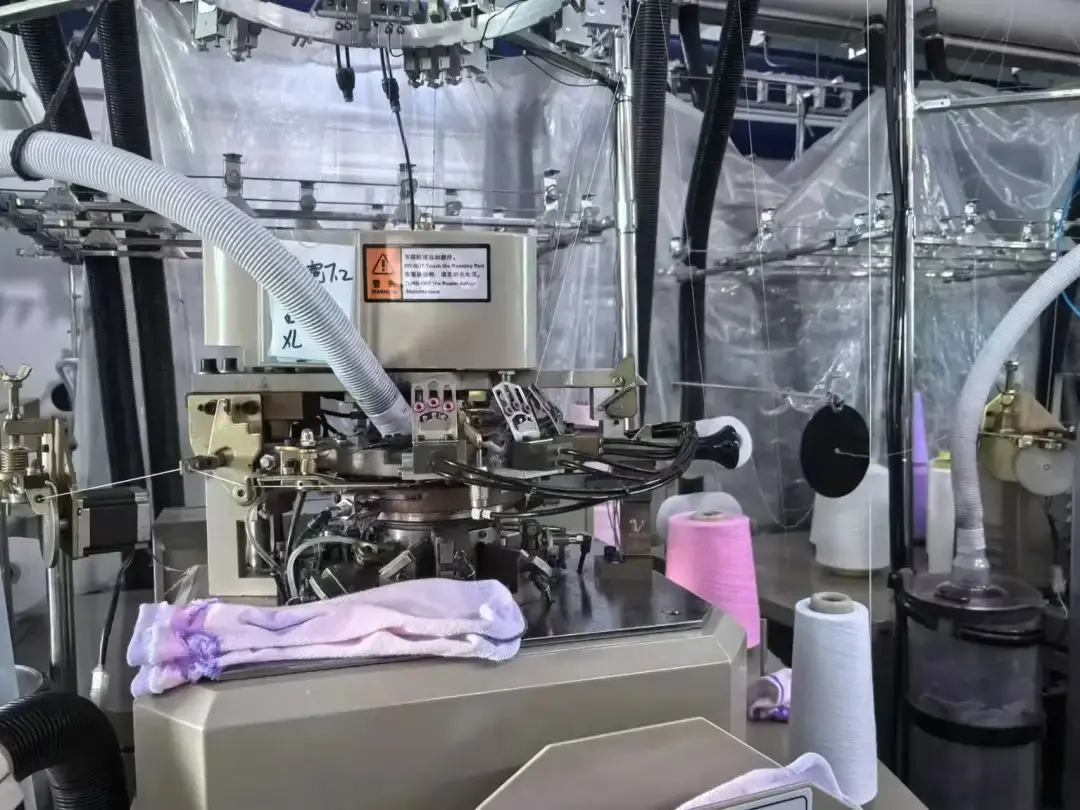
This sock factory is in a building, and one building is an independent factory. Going up the external stairs, the simple triangular steel welded stairs creaked all the way up, and every step felt like the stairs were about to fall apart. Entering a small door with a stoop, the space of more than 500 square meters on the third floor is filled with layers of spinning machines - 14 machines in a group, a total of 5 groups of 70 machines, and the warehouse and the boss's office are also squeezed in.
Five groups of spinning machines should have 5 people guarding them, but now there is only one worker left - most of the spinning machines have stopped running. He was bare-chested, sweating profusely, with a pair of earphones hanging around his neck, and nothing was played in the earphones, isolating the rumbling sound of the spinning machine.
The sock factory here does not turn on the air conditioner, it cannot be turned on, and it cannot afford to turn it on. It cannot be turned on because the low temperature affects the shaping of the socks, and the economic account that the sock factory owner Huang Xiong cannot afford is calculated like this: "I turn on a machine, I can earn 30 yuan a day at most, and 15 yuan at least. If I turn on 30 machines, it's less than 500 yuan. If I turn on the air conditioner, a space of several hundred square meters, the electricity bill for a day will be more than 300 yuan, so I dare not turn it on."
Huang Xiong told us that generally after August 15th, the demand for autumn socks should rise. But this year it hasn't, and the semi-stoppage has lasted for nearly a month and a half.
Zhuji is a county-level city under the jurisdiction of Shaoxing, Zhejiang, and the sock industry is developed, "you are making socks even if you go the wrong door". In Zhuji, 25 billion pairs of socks will be produced every year, accounting for 70% of the national sales, and 1/3 of the world's socks also come from here.
But this year, almost every household is clearing inventory, and no boss dares to hoard goods. There are many factories with tens of thousands of pairs of socks and millions of pairs of socks. In previous years, they could sell one or two thousand orders a day, but in the past two years, the best time was less than a thousand. New models are becoming more and more difficult to sell, "If you launch 10 models before, five or six can be successful, but now if you launch 10 models, only one or two can be successful, and the others can't be sold."
Profits are getting thinner and thinner. According to the "Sock War: The Growth History of Datang Sock Industry" published in 2008, at that time, the gross profit of a pair of socks was about 1.2 yuan. But now, "it's a huge profit to earn 5 cents". As for high-end socks, the profit used to be about 10%, but now "some still earn 10%, some earn 2%, 3%, and some even less than 1%."
Huang Xiong is not an isolated sample. We have heard similar stories on the industrial belts we visited in Zhejiang and Shandong, "This year is a cliff-like decline." A boss of a food factory in Yishui, Shandong, said. In Yishui, a food factory used to operate for 27-28 days a month, interspersed with a few night shifts. Now, sometimes it can only operate for 7-8 days.
The only way out seems to be, "You can only cut costs from all aspects," said a boss lady. Labor, water and electricity, raw materials, and operating costs can all be reduced.
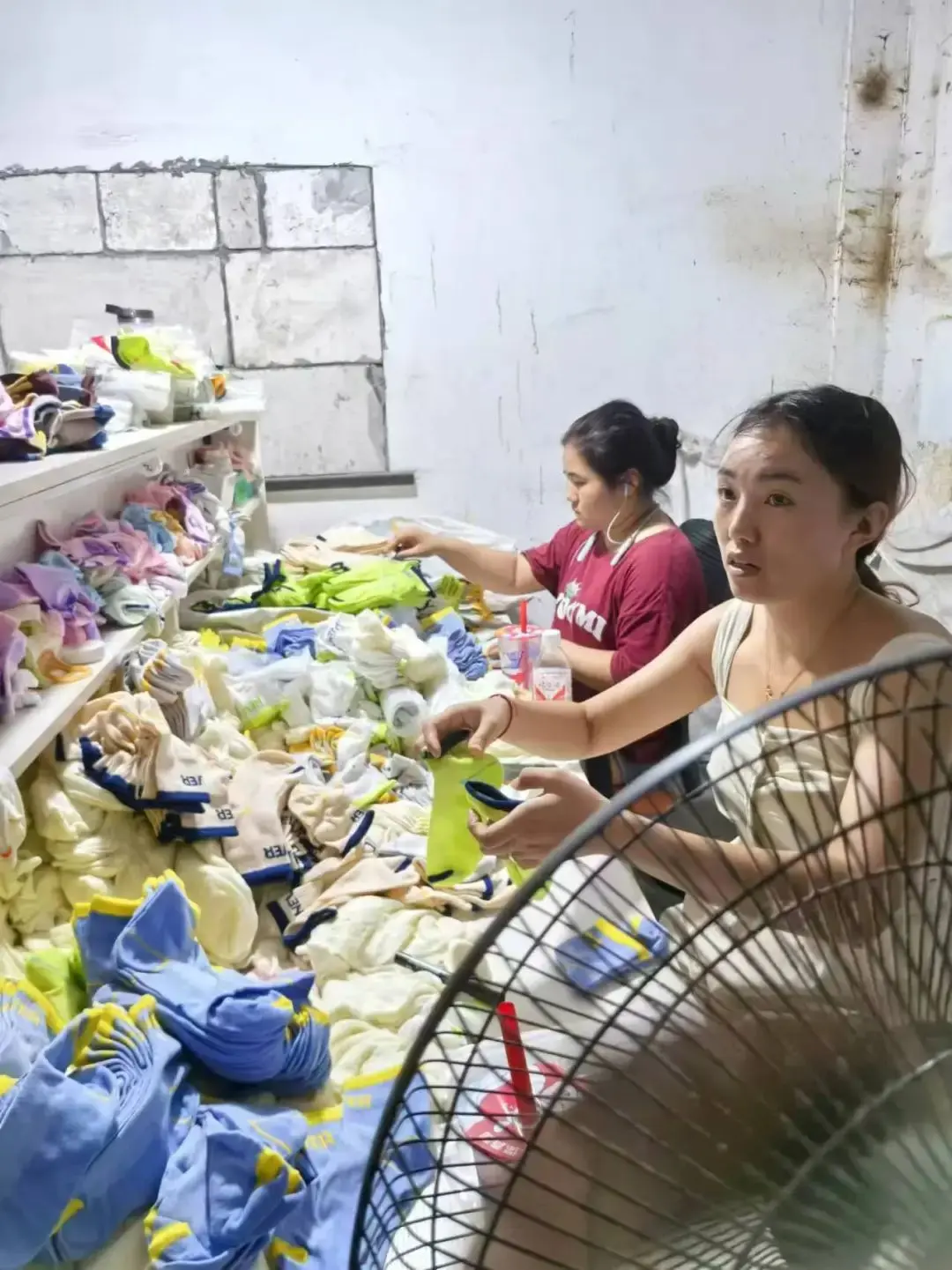
Business is going backwards
Local merchants and factory owners in Zhuji have found that some of the game rules of e-commerce platforms have completely turned into a low-price "battle royale".
The logic of the factory has now become very simple: they reduce costs and profits to the lowest level, and supply socks to customers at almost the lowest price. How low is the profit? "Earn one cent in one link." Wang Kai is the boss lady of a typical "low-end volume factory", she told me that the sock turning link earns one cent, and the sewing head link earns another cent, and a pair of socks earns 5 cents. However, if the volume is large enough, such as selling 30 million pairs of socks a year, that is an annual income of 1.5 million. For local small bosses, this value is not small.
Pure cotton socks absorb sweat, are breathable, soft and do not smell feet. In the 2010s, when consumption was developing rapidly, pure cotton socks had become the absolute mainstream. Cotton is also divided into many grades, such as high-end cotton, combed cotton, anti-pilling cotton, and the cotton content of each pair of cotton socks is also different, with 60% and 80%.
However, as long as there is cotton in the socks, the cost of a pair of socks must be more than 1 yuan.
If the cost is to be reduced to less than 1 yuan, polyester will be used. Polyester socks are cheaper, but the material is hard, easy to pilling, easy to smell, and not antibacterial. However, it seems that most consumers cannot distinguish the subtle differences in materials, and this retro material is regaining the market. In the local area, the factory's polyester sock shipments have been several times that of pure cotton socks.
Zhou Xin is Huang Xiong's neighbor and owns another children's sock factory. He has always hated polyester socks, which he calls "garbage socks". He hasn't made any money in the past few years, and he thinks it's because "polyester is messing around". When polyester socks occupy the market at a low price, the traffic of his cotton socks has declined, and he believes that this is the process of "bad money driving out good money" and "disrupting the market". "Some consumers are not even worthy of wearing cotton!" he is very angry.
Zhou Xin also found that many of his peers stole the product pictures from his shop and made them at a lower unit price, and the pictures also marked "pure cotton".
After buying the socks with the same pictures home, he knew by touching them that they were polyester. Consumers cannot directly distinguish them with the naked eye and touch, he emphasized that "you can burn them with fire". If it is cotton, it will smell like paper when burned, and polyester socks will emit the smell of burning plastic after being ignited.
Once, he specifically bought the best-selling polyester socks on a certain platform and recorded a video "burning it for customers to see", but how could consumers across the internet smell what it was? Zhou Xin specially asked a friend to use a voiceover to tell the audience: "It's burning, it's burning very badly. Are these socks made of pure cotton? Made of plastic bottles, it smells so bad! The smoke is black!"
At the same time, the trend of copying models and stealing pictures prevailed for a while. Sometimes, a model finally gained some momentum, and before it was sold hot, the imitation model came out, "It's like a wolf, where the smell of blood is smelled, (everyone) will go together."
"Anyway, socks don't have copyright." The locals emphasized. "Except for Disney's strict copyright management", most other IPs can be drawn directly, such as the recently popular Kuromi in pink and purple. When imitations appear, they have nowhere to complain.
Everyone prefers to make the models that have already "sold out" on the platform - open an app on a certain platform, search for "socks", and the models with the most traffic on the homepage are what all the factories are competing to produce. However, although the models are the same and the pictures are exactly the same, the quality may be very different.
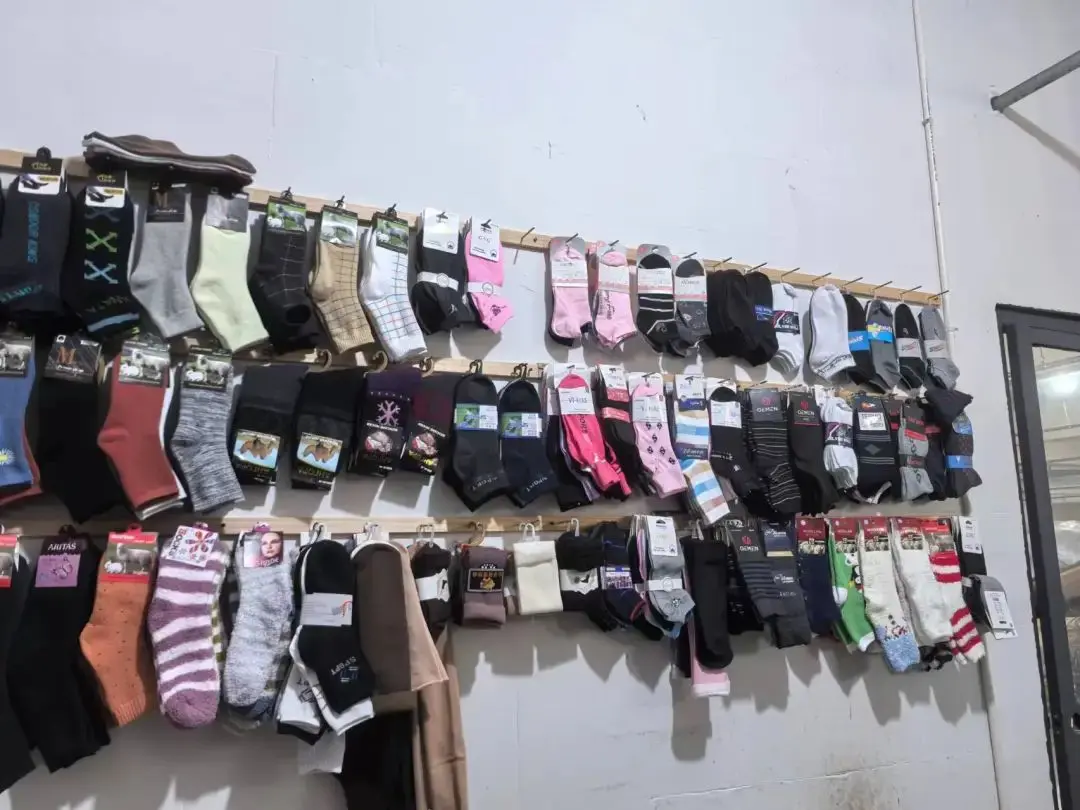
Zhao Zhendong, the boss of another supplier factory, told me, "A product must be made in two to four different qualities", covering all the grades for different customers to choose from. "If it sells well, there are four qualities and four prices", "When customers come, I will directly ask: Do you want quality or not?"
He showed us his samples. "They are all polyester," he said. "Polyester is for running volume, and you can stock up some appropriately. I don't stock cotton, I only make it when customers order." Not stocking cotton socks is another strategy of his.
Zhao Zhendong admitted that these are all some stable practices. And using such a strategy is only a matter of the last three or five years.
But Zhou Xin still insists that he will never make polyester socks. In addition to the ostentatious moral standards, he believes that the more important thing is that "involution has no end", "you are never the lowest and the cheapest. There will always be someone cheaper than you". In addition to raw materials, the weight, number of strands, number of needles, and labor costs of socks can all be reduced. "If there are 20-gram socks, there will be 15-gram ones. If there are 15-gram socks, there will be 14-gram ones."
Industrial upgrading is stuck
Bosses like Zhou Xin originally hoped to improve product quality in "industrial upgrading", so that the products would be more competitive. In fact, this upgrade was almost successful.
After 2010, Datang Sock Industry began to develop towards differentiation and quality winning. Different tracks such as "fashion trend style", "business style", and "sports style" also began to be gradually distinguished. The machines were upgraded and replaced, and the "computer machines" could make hundreds of patterns, "just press it and it's done".
Abandoning the small factories that focus on low-end volume was also an important step in the industrial structure upgrade at that time. In 2014, the government closed down the "three-in-one" small factories (factories that integrate production workshops, warehousing, and employee dormitories, which are prone to fire hazards) and eliminated coal-fired boilers, which is a major event in everyone's impression.
"When doing this, there was a lot of social criticism," a government official told me. "It will definitely touch the interests of a group of people. (They) will feel that you seem to be blocking their way, or that it will have a great impact on the industry. But once you have an accident, how many people will be injured or die." He believes that this is a transformation and change that must be done.
But now, everything seems to have returned to the starting point. The factories are in a precarious situation and have long lacked sufficient funds to upgrade, and they don't have the energy to think about transformation.
A most direct piece of evidence is that factories are unwilling to replace new machines. In the past, almost every machine replacement met the needs of the times and brought a significant improvement in production efficiency. A factory director said that replacing machines at that time was a "must, you must replace" thing, and if you didn't replace them, you would be eliminated by customers. But now, most of the factories we interviewed have not yet replaced the latest generation of "weaving and sewing integrated machines".
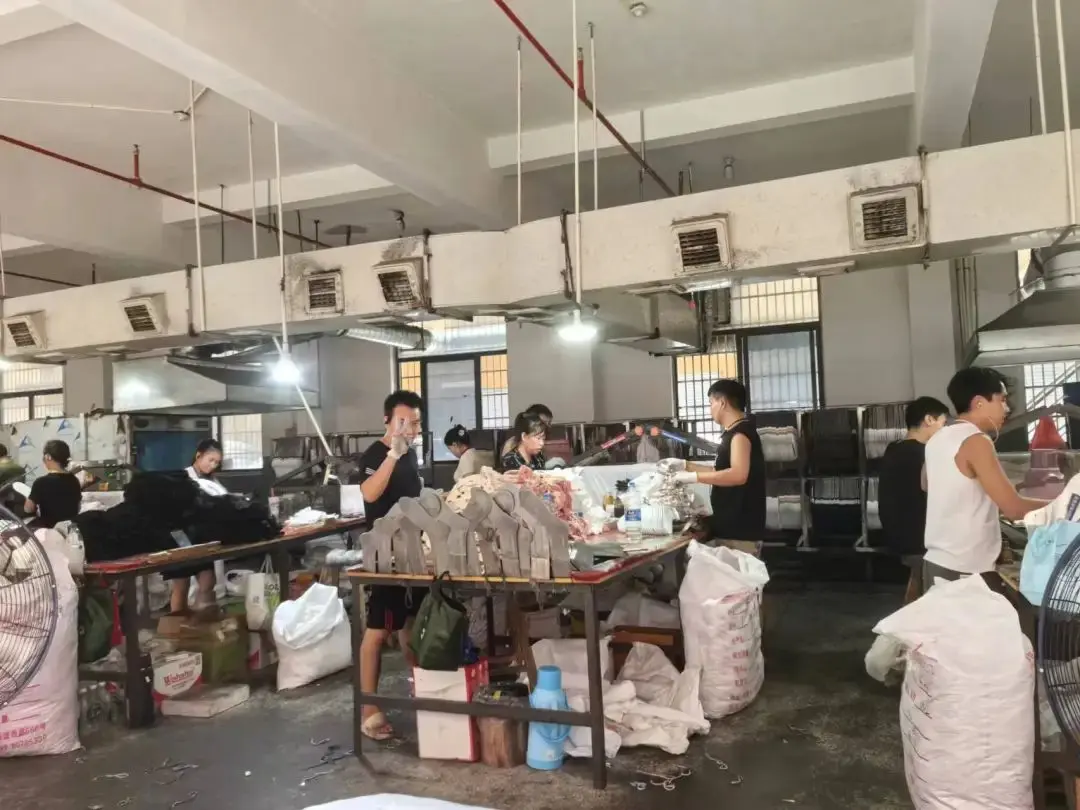
The government once subsidized the integrated machines by as much as 40%. The problem is that the integrated machines produce high-end socks. But now, high-end socks are the most difficult to make, so they naturally don't need to spend a lot of money to replace the machines that make high-end socks. This year, the subsidy for integrated machines has been reduced to 10%.
A food factory located in southwestern Shandong also originally "had a passion" to develop towards the mid-to-high end, take the offline supermarket channel, and build its own brand. But the factory director soon found that it was difficult to make progress in the high-end without any resource advantages.
Brands need marketing, advertising, and media influence, all of which require money. The factory director invested several million, and found that it was "a bottomless pit", and finally "couldn't hold on". Two years ago, a manager who often had new ideas and thought of some new product development plans also left the factory because of this. The boss re-formulated a low-end volume production strategy, abandoned the offline supermarkets, and recruited a dedicated e-commerce person.
Now, in the warehouse of this factory, there is a pile of packaging materials worth 2 million yuan for making new products, and a thick layer of dust has fallen on the packaging materials, just like the "brand dream" that the factories have given up.
In September, I attended the 18th Datang Sock Industry Expo in Zhuji. The Sock Industry Expo started in 1999, and it was held every two years in the early years, and it has been held every year in recent years. For many years, the exhibition has been the mainstream channel for brand merchants to get large orders.
At the exhibition site, some companies are promoting their new technology that has developed new technology that doesn't strangle the ankles, and some companies are promoting new Chinese-style gift box packaging - more comfortable technology and more marketing packaging, which is already the largest industrial upgrade space for daily necessities such as socks.
What's strange is that someone always recommends silk quilts to me, and the rhetoric is the same: we are about to close the stall, and we will sell these quilts cheaply and leave. Later, I finally figured out what was going on. A salesperson told me: these quilts were originally gifts given for free after a large customer signed a large order. But this year, there are few customers at the exhibition, and those who come and go are all peers, and there was basically no one in the morning. Because there are no customers who have signed large orders, merchants can only try to sell the gifts to passers-by, so as to recover the cost.
I stayed from 1 p.m. to 4 p.m., and their quilts were not sold. The next day, these quilts were taken to the sock market again, and they were still being sold.

The predicament of white-label factories
In such an environment, a large number of low- and mid-end small factories that have not completed industrial transformation are accumulated here, and they are called "white-label". The so-called "white-label" means that it only has production functions and no brand functions.
The mainstream channels of white-label factories are "OEM" and "supply". "OEM" means to produce according to the needs of brand merchants, and let brand merchants sell under their own brand, becoming an external organ of a large factory. "Supply" is to provide products to retailers and wholesalers. The profits of both are very meager. A white-label factory that makes socks only earns a few cents per pair of socks, and it needs to rely on "volume" to make money.
In the era of e-commerce, "white-label" once became synonymous with "high cost-effectiveness". It is more flexible than large factories. Thanks to the M2C model (Manufacturers to Consumer) provided by e-commerce platforms, the products of these source factories can directly reach consumers, "without middlemen earning the difference". Consumers can enjoy lower prices, and white-label factories can also earn higher profits.
For factories, the M2C model is also worry-free and labor-saving. The biggest advantage is that they no longer have to deal with human relationships - they no longer have to accompany customers and distributors to socialize and drink, they only need to manage production - it seems that this "external organ" is independent.
But when the environment changes, people find that white-label factories are fragile.
As an external organ of a large factory, it lacks sufficient risk resistance. With the changes in the international situation, the production capacity that can be digested by foreign trade has also been reduced compared to the past, and domestic demand is not strong. However, large factories can use innovation in R&D, market, and operations to gain new profit growth points for themselves, while white-label factories have no way to do anything.
At the same time, because of insufficient qualifications, white-label factories often find it difficult to receive large orders from offline entities. Even if they want to do it, because the low-end production line has been in production for a long time, and they have long reduced their offline channels, even if they want to transform temporarily, it is too late. White-label factories can no longer match the needs of most offline mid-to-high-end allocations.
Even the last way out - live streaming - they can't do it. Yizhiyu, a leading e-commerce company in Zhuji sock industry, invests hundreds of millions of yuan in live streaming every year and hires Wang Baoqiang as a spokesperson. For most small factories, it is impossible to spend so much money. In addition, live streaming "cannot control how much to sell". If a certain product sold out the day before, selling 1,000 orders, the factory accelerates production, and there is no volume the next day, but the production line that is already running cannot stop.
In the end, the only way left for many white-label factories is that they must participate in a low-price war: join the e-commerce platforms that are rolling low prices in the market, or redouble their efforts to continue to do OEM and supply with the logic of low-end volume. No matter which way, it is to exchange more profits for a kind of certainty.
Many factory owners know one thing very well: if the machine doesn't make a sound, you know you are losing money; if the machine makes a sound, you know you are also losing money.
This matter is understood like this: if the production line cannot be started, the fixed costs of the factory, machines, and labor will steadily drain, "as soon as the sky is bright, it's a day". Time is converted into money, and it flows at a specific speed. The most concrete discomfort of the factory owner is "watching the workers not working".
It's not that there are no orders, it's that the orders are unstable. If the factory stops and starts again, and sometimes needs to lay off workers, and sometimes needs to re-recruit people, temporary workers are more expensive than long-term workers, and the production cost will still increase. Only when the machines are fully turned on and the production line reaches saturation, the average cost can be minimized by adding variable costs and fixed costs.
Production is not good, and not producing is not good either. The factory must sell products at a very low price to ensure that the machines are running. In other words, as long as the machines are running, they must offer a very low price to ensure that the products can be sold. "Hanging you in a state where you can't die or live," a factory owner described.
If the equilibrium point continues to fall, the factory has to sell the products in a way that is lower than the cost, then it will lose money, "If you do it, you lose 2,000, if you don't do it, you lose 4,000, will you do it or not?"
The prices of some categories have already fallen to the point of breaking the cost. Some mooncake factory owners can't figure out, no matter how they calculate the cost of a mooncake, it is impossible to be lower than 3.5 yuan, why can it be sold for one yuan? "We bought it back and ate it, it is indeed a mooncake," a boss was puzzled.
That factory may be clearing inventory. Jian Zhe, the boss of an e-commerce agency company, answered this question briefly.
When the situation is good, some bosses can't figure out how much they actually earn in a year, they only know that they are making money. Because "no one will specifically hire an accountant to sit at home and do the accounts", they usually outsource the financial function at a low price, and the main function of outsourcing the financial function is to clear the taxes. They will not find someone to inventory the inventory in time, but "as long as there is still inventory, the money is not yours yet".
These bosses will never tell you how much their best year's turnover was. They only tell you how many orders they can sell in a day at the best time, such as "40,000 to 50,000 orders a day" before, and now "only 1,000 to 2,000 orders a day".
At first, because the order volume was large enough, even if the profit was low, they still made money. Even if some production lines lost money, as long as the production line reached a saturated state, there were always a few products that could be sold for money. "In order to support the workers, we have to turn on the machines and make them cheap," Huang Xiong explained the logic of the factory.
In addition to cutting costs and clearing inventory at a loss, the reason why many extremely outrageous low prices can be sold is actually because the boss "can't figure out the accounts". They "do it when they see it's almost the same, but in fact they are losing money".
The rules of some e-commerce platforms are too complicated for factories, and they don't have the energy to study them. For some bosses who have entered the game halfway, these rules are like a book from heaven. There are also some platforms that are more assertive and more demanding of factories, and factories will face tremendous mental pressure.
After joining the e-commerce platform, the factory may receive a document, which includes many major penalty categories, but no one will give an interpretation. In practice, the right of interpretation is in the hands of others, so only by jumping into the pit yourself can you know which are the pits and where you may be fined.
At this time, a "butterfly effect" of cost accumulation will be generated.
The merchant's goods are pulled to the door, and the transportation cost has been paid; the goods are rejected because of the quality, and the quality problem penalty must be paid; the rectification on the spot requires bearing the price gouging of the labor company; the rectification is completed and the goods are late in the warehouse, and the late penalty must be paid; the goods cannot enter the logistics on time, which will lead to the link showing that the inventory is insufficient, and the merchant continues to pay the out-of-stock penalty...
If the price is too low, it will also lead to a burst of orders. A rice factory in Shandong decided to clear the goods on the platform. He only had 200 orders to clear. The shop assistant told him that he had to lower the price to clear the goods. The boss lowered the price from 15 yuan per bag to 11 yuan per bag, and finally to 5 yuan per bag. The next day, he woke up and found that at the low price of 5 yuan, the rice sold 2,000 orders, but he only had 200 orders in stock. If he couldn't ship the goods, he had to bear the penalty. 8 yuan per order, a total of 1,800 orders were out of stock. In the end, the boss bore a penalty of nearly 15,000 yuan.
And the workers are the last link in this transmission chain. The workers do not have social security, and they earn 5,000-8,000 yuan per month (only in coastal cities such as Zhejiang, the monthly salary may reach 8,000). They rarely complain, they prefer to say "it's just a habit". However, even the simplest work, the soreness of the legs and feet is the basis. A worker said that he used to wear casual shoes, then cloth shoes, and then slippers. No matter how he changed, he was still tired after standing for a day.
The most important thing is that the wages have not increased in the past two years. In Zhejiang, the monthly wages of workers used to increase by 200-300 yuan almost every year - but this increase has been frozen in the past two years.
Some workers are worried that their income will become unstable. In Yishui, Shandong, the production line has shrunk even more severely. In the past, if a month's work was saturated, it would take at least 27 or 8 days, interspersed with a few night shifts. Now, some workers can only work 7 or 8 days a month. In order to subsidize their families, they have to drive online car-hailing as a side job.
Escape involution
The situation is stronger than people, and once the trend of low prices is formed, no force can easily stop it, and Zhou Xin knows this very well.
In the first half of this year, Zhou Xin came into contact with a new model called "semi-managed", and finally felt a little sense of security.
The so-called semi-managed is relative to the "full-managed" model, where the platform has full control over the goods. The platform takes over the needs of merchants, matches some factories that are not good at, or are not cost-effective to do themselves, only the order, logistics, and marketing links. The factory has more decision-making power in management, especially the pricing power that determines life and death. This model incubates new products quickly, and the cycle for a product to explode is within 7-15 days, and the long-term sales of the product are also relatively stable, and the model of small profits but quick turnover of factory sellers can continue to run.
The main platform that has run through this model is Taobao's Taobao Factory. Zhou Xin didn't understand at first, how the platform could compete with other platforms for low prices after ceding part of the pricing power. But the obvious reduction in the number of refunds made him understand that the root is with the users: Taobao has mostly mature users, and their tolerance for inferior products is obviously lower, which leaves a certain amount of space for the price.
The value that the platform can provide under the semi-managed model lies in the market insight that the factory does not have. Due to the limitations of funds, technology, and capabilities, in the interviews, many factories mentioned that they "cannot do market research, and don't have the conditions". The platform can use its mastery of data resources, its judgment of the market, and its insight into consumers to help factories truly produce products that meet the needs of consumers.
Take a simple example, 5 pairs of socks in a pack, sometimes you only need to adjust the color of one of them - this small adjustment can make the merchant's orders soar, and it doesn't need to blindly roll low prices.
Similarly, bananas are a normal fruit category, but Taobao Factory has redefined it as the need for "workers to give gifts to each other", added packaging for it, and added a small card of "prohibit green", which quickly made the hydroponic bananas in Zhangzhou, Fujian, sell well across the entire network, with a single link selling 100,000+.
"Everyone says that China has overcapacity, but we think that China has a mismatch of capacity." A factory owner relayed an exchange with a Taobao Factory account manager: in China's huge market, there are still a large number of needs that have not been perceived, while many products that do not match the needs of consumers are being produced in large quantities.
The toy factory that this account manager was connected to had previously been afraid to invest funds in R&D and model development. Toys look like standard products, but in fact they are non-standard products, and there are many types. If you develop 10 models, 3 to 5 can explode, which is a very big confidence for him. After having a very clear explosive link and saving operating costs, the merchant's certainty is very strong, and he is willing to take the initiative to develop models.
When the situation is good, a typical reason for the factory's closure is "poor inventory control". At that time, the factories were more optimistic about the future and were more aggressive in their strategies. But if too much goods are hoarded and cannot be sold in the coming year, the factory will bear huge losses.
In the current environment, "certainty" is crucial to the factory. Factories participating in the semi-managed model can customize production according to sales. In this way, there is no longer the dilemma of too much inventory or too little inventory.
Interestingly, on the several industrial belts that have been visited, there are factories that are "secretly" doing Taobao Factory. The factory owners are very careful, and they find that this channel is good, so they are afraid of being discovered by their peers, and they don't even let their brothers know. Afraid that they know, they all squeeze in to do it, and start rolling again.
They are really afraid of involution.