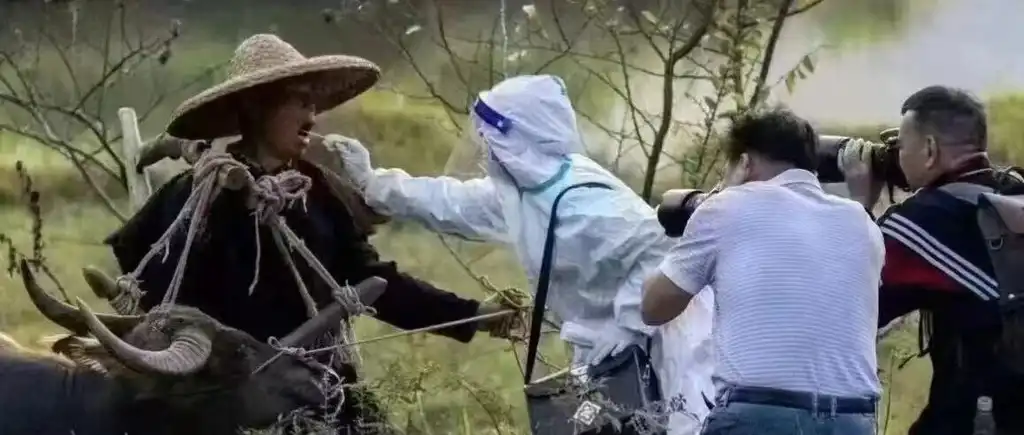
The high temperatures in the Sichuan-Chongqing area in summer did not subside until mid-September. The persistent heat and drought tormented the elderly farmers working in the fields. On August 27, Gong Tao, a rural resident of Suining, Sichuan, passed away while working in the fields. She had just celebrated her 80th birthday. For her and the elderly in the village, the land was their last reliable means of livelihood and the only carrier of their personal value. Facing the risks associated with the scorching heat, they could only rely on their declining physical strength and simple experience.
Intern Reporter | Tong Chang
Editor | Wang Shan
The elderly who passed away in the fields
In the short video that went viral online, Chen Hua immediately recognized the village where she grew up: white-walled, gray-bricked houses lined both sides of the main cement road, and the vegetable patch in front of a house was overgrown with vegetation. The sky was bright, and several elderly people carrying hoes were passing by on the road. In the video, a villager said, “An old woman was sun-dried to death while picking up corn.”
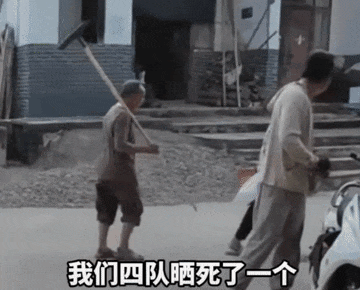
In the video circulating online, local villagers expressed their grief over the old woman’s death
Chen Hua was saddened. She knew that the “old woman” in the video was her aunt Gong Tao. The day before, at noon, she received a phone call from her father in Chengdu, saying that Chen Hua’s aunt Gong Tao had passed away while moving corn, probably due to heatstroke. Gong Tao was the wife of Chen Hua’s father’s cousin and lived with Chen Hua’s parents in Sujiahe Village, under the jurisdiction of Anju District, Suining City. Gong Tao had two sons and two daughters. The eldest daughter was doing business in other places, and her sons were working outside. Not long ago, Gong Tao had just celebrated her 80th birthday. Chen Hua thought that her aunt should have been enjoying her old age, but she passed away like this.
Huang Ming is a villager of Sujiahe Village. He heard from the villagers that on August 27, Gong Tao went to the fields in the afternoon under the scorching sun. The weather forecast for that day showed that the minimum temperature in Anju District, Suining, Sichuan was 27 degrees Celsius, and the maximum temperature reached 40 degrees Celsius, with clear skies and no wind. At that time, Gong Tao, who was working outside, also fell on the field ridge and sat on the ground. A woman from the same village met her and asked if she needed help. Gong Tao said she would be fine after resting for a while. Huang Ming said that Gong Tao went to pick up corn. Recently, it was the corn harvest season. After the machines harvested, the owners did not want the corn left in the fields, and Gong Tao and other elderly people would go to pick up the corn to feed the chickens.
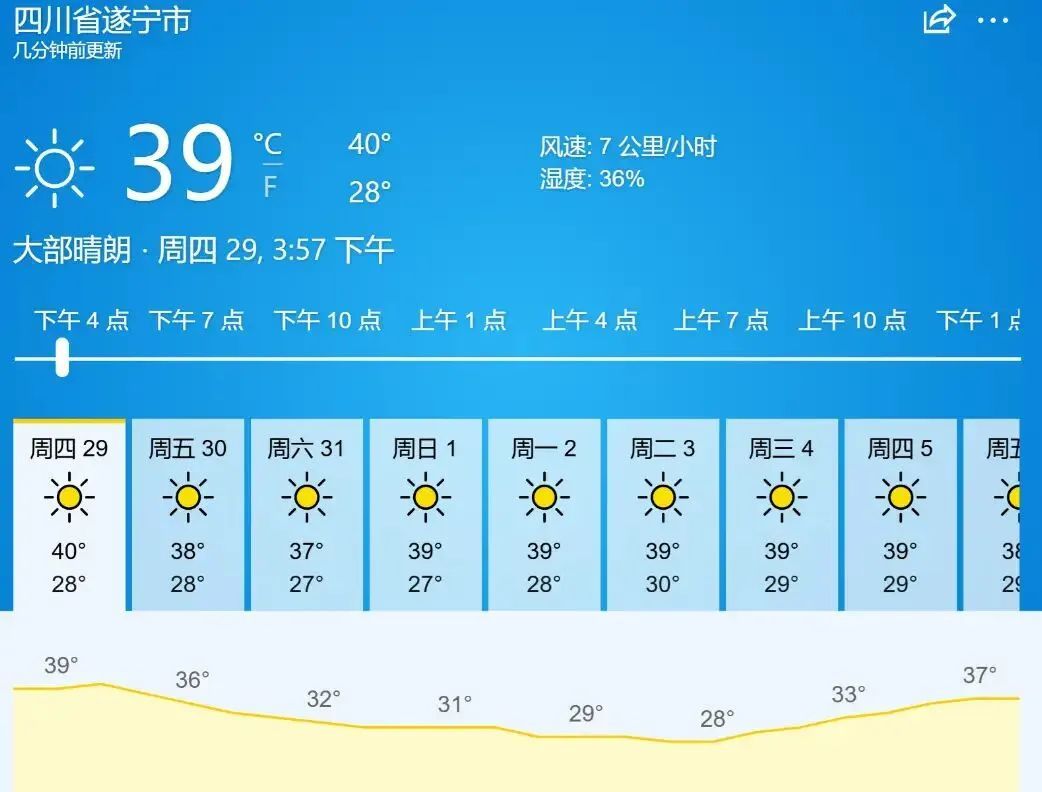
High temperatures persist in Suining City, Sichuan Province
Throughout the summer, the Sichuan-Chongqing area has been experiencing persistent high temperatures. Chen Hua, Gong Tao’s niece, works as an elevator operator at a construction site in Chengdu, and she feels anxious every day because of the heat. Almost everyone on the construction site has to drink two bottles of Huo Xiang Zheng Qi Shui every day. She often sees her colleagues unable to bear the heat and vomiting at the construction site. In the past month or so, the Suining Meteorological Observatory has issued 11 high-temperature orange warnings. Chen Hua said that her mother, who lives in the village, often tells her this year that she feels unwell due to the heat, and she gets heatstroke, sneezes, has a stuffy nose, and gets goosebumps. Chen Hua stopped her parents from farming seven or eight years ago, but the two elderly people still grow some vegetables for their own consumption in front of and behind their house. Chen Hua is worried about her parents’ health and repeatedly urges them not to work in the heat. But Gong Tao was diligent, and villager Gong Guoqiang often saw her going to the fields after lunch.
On the afternoon of August 28, Gong Guoqiang received a phone call from the villagers and was asked to find Gong Tao. It had been more than 20 hours since Gong Tao went out. Gong Guoqiang told this magazine that Gong Tao’s husband had a disease and usually had difficulty moving. For more than ten years, Gong Tao had been farming the land alone. Gong Tao’s son’s house was only a few dozen meters away from Gong Tao’s house. The son worked outside all year round. Gong Tao felt that that house was closer to the vegetable field, so she usually lived there alone. Therefore, her husband did not find out that she did not come home that day. In the fields, Gong Guoqiang saw Gong Tao’s stiff body had turned blue, and he could smell the stench through the mask. In the basket on the side, besides corn, there were also two pumpkins. The next morning, the village hastily buried Gong Tao. Gong Guoqiang remembered that when he went out to the market to buy groceries in the morning, he saw the funeral procession returning from the mountain.
On August 27, staff from relevant departments in Anju District, Suining, mentioned in an interview with the media that Gong Tao had underlying diseases and had recently had symptoms of a cold. The statement that she was “sun-dried to death” was inaccurate, and her death was caused by multiple factors. However, Dr. Lu Hui, who works at a 120 emergency center in Guangdong and has treated many heatstroke emergency cases, told this magazine that the elderly, especially those with underlying diseases such as hypertension and diabetes, are more susceptible to heatstroke, and heatstroke can also trigger or worsen some underlying diseases. Lu Hui said that in the increasingly extreme climate nowadays, the weather is also very stuffy at night, and this “hot night” is especially difficult for the elderly: the compensatory functions of the elderly’s various organs are not as good as those of young people, and the organs cannot get good rest during the hot night; and the elderly’s sleep quality deteriorates at night, which can also lead to fluctuations in blood pressure and blood sugar.
Compared to the dangers of “hot nights”, heatstroke is a more serious type of heatstroke. Lu Hui said that in recent years, many people know that outdoor workers who are exposed to high-temperature environments for a long time, such as construction workers, deliverymen, and tour guides, are prone to heatstroke. The patient’s core temperature rises rapidly, exceeding 40 degrees Celsius, accompanied by skin burning, impaired consciousness, and multiple organ dysfunction. But there is another type of heatstroke, which is non-exertional heatstroke. Many elderly people who are originally weak will suffer from this disease in their stuffy homes. In July 2022, Lu Hui encountered an elderly patient. The patient’s village houses were densely arranged, with walls close to each other, and the surroundings were impermeable concrete floors, with no plants. The elderly person’s room only had a ceiling fan, which was extremely stuffy and humid. The elderly person was drenched in sweat and fainted at home, and their body temperature reached 40 degrees Celsius. The elderly person later passed away. Lu Hui said that most elderly people with heatstroke are difficult to be rescued. On the afternoon of August 27, when Gong Tao went to the fields to pick up corn, she may not have realized the danger of the high temperature. For this 80-year-old woman, her elderly body has always followed a labor inertia that is unaffected by wind or rain. This is her way of survival and cannot be changed because of the temperature.
Labor under high temperatures
Sujiahe Village, where Gong Tao lived before her death, is located in the northeast of Anju District, Suining, adjacent to the Xingwang community, which is in the urban-rural fringe. The village has a population of nearly 2,000 people, with a cultivated area of 1,766.6 mu, with half of the land being dry land and half being paddy fields. In 2014, Sujiahe Village was identified as a provincial-level poverty-stricken village. In 2016, in order to get rid of poverty and become rich, the village introduced lotus root and fragrant osmanthus industries, and a large area of land in the village was contracted out. Gong Guoqiang told this magazine that there are almost no young people in the village now, only the elderly are at home, and most of them will grow some food and vegetables on their remaining or abandoned land to eat themselves.
Huang Ming’s wife was very sorry for Gong Tao’s death, and she thought she was “so honest and so silly, going out in such hot weather.” In her impression, Gong Tao was small in stature, but she had always been very capable and never said where she was in pain. She often saw Gong Tao working in the fields when she went to the market. She told this magazine that Gong Tao’s family’s economic conditions in the village were average. A few years ago, Gong Tao and her husband still lived in a dilapidated, blue-tiled house. Later, the village helped her family rebuild an “affordable housing” with white-painted exterior walls and red bricks on the sloping roof. Gong Guoqiang lives very close to Gong Tao’s family, and he can feel the pressure of Gong Tao’s family’s life more closely. Gong Guoqiang remembers that this summer, Gong Tao always went out to work soon after lunch. Gong Guoqiang speculated that Gong Tao had to work alone, so she had to extend her working hours. Sometimes he would advise Gong Tao, “You are so old, don’t do so much,” and Gong Tao would reply, “I have to live.” On the day Gong Tao had the accident in the cornfield, Gong Guoqiang saw her go out to pick peanuts in the morning.
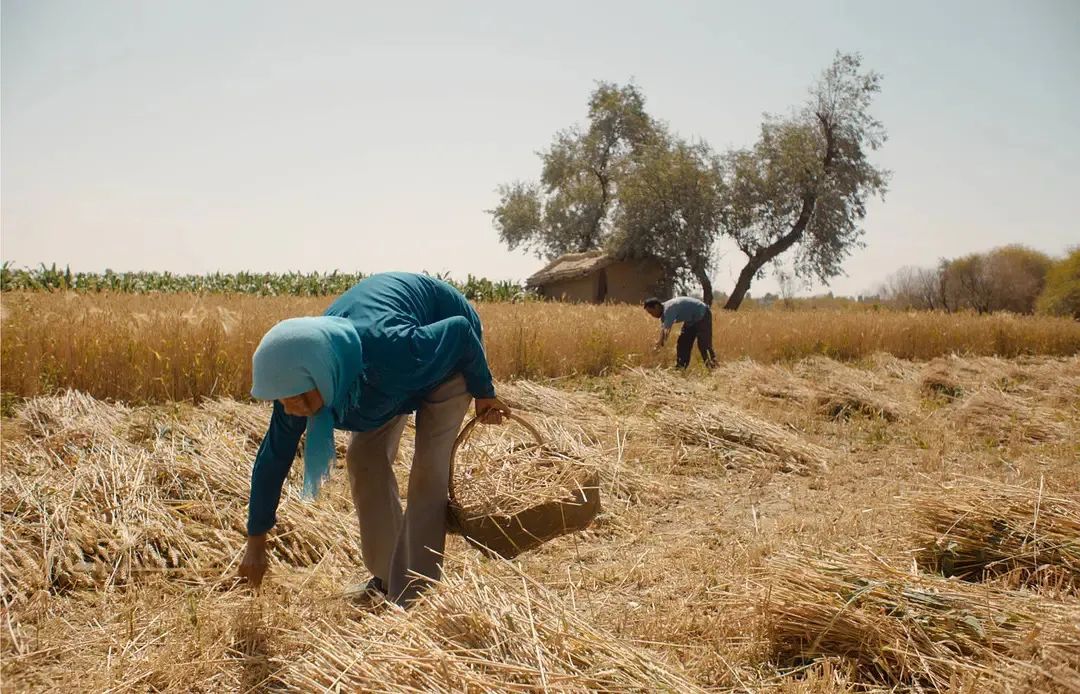
Stills from “Return to Dust”
Gong Guoqiang said that there are many elderly people in the village like Gong Tao, who are in their seventies or eighties and are still farming. Everyone wants to earn more money and not burden their children. Four or five years ago, Gong Guoqiang, who was nearly 70 years old, also went to plant lotus roots for the contractor’s lotus root fields. He started at seven o’clock in the morning and worked in the paddy fields for eight or nine hours. He could earn a hundred or eighty yuan a day, and he could earn 110 yuan when things were good. But this kind of job is not for everyone. The boss only hires a dozen lotus root planters and will also assess the efficiency of each person’s work. Gong Tao had expressed envy for Gong Guoqiang’s job, but the contractor almost never hired women or elderly people who were too old. The year before last, probably because of poor efficiency, the lotus root contractor withdrew. Gong Guoqiang could only guard some of the remaining land and grow some vegetables and fruits, “I earned some money before planting lotus roots, and I didn’t have to ask my children for it. Now that the work is gone, my physical strength is not good either.”
Fang Donghua, 75, is also a villager in the rural area below Suining. He clearly felt his physical strength decline after he turned 70, and he could no longer carry the burden. In recent summers, when he harvested corn, he had to first collect the corn into a basket, then transport it to the dumper parked on the side of the road, and slowly push it back after filling a car. And the scorching weather is also increasing their burden of farming. In the villagers’ impression, since 2022, the summer has been very hot. Weather data also shows that in the summer of 2022, the average number of high-temperature days in Sichuan Province was 30.1 days, and the average temperature reached the highest level in the same period in history since 1961, with the highest temperature at a single weather station reaching 44°C. This year, the summer heat has intensified again, and the average temperature and average number of high-temperature days in Sichuan Province have reached the third highest in the same period in history, and the highest single-station temperature in the province is 43.3°C.
In Fang Donghua’s impression, it hasn’t rained much in the local area for more than two months since July. A little rain fell on an evening in early September, which was not enough to soak the land. Summer is the season for harvesting corn and planting radishes and Chinese cabbage. To avoid the high temperature, he goes out at more than four o’clock in the morning, just as it is getting light, and works in the fields until eight or nine o’clock, when the sun comes up, and then he prepares to go home. Sometimes he feels anxious in the fields, so he stops and sits under a tree to rest for half an hour and drinks a bottle of Huo Xiang Zheng Qi Shui. Because of the heat, the working hours in the fields are very short every day, and the work in the fields is delayed from today to tomorrow, and from tomorrow to the day after tomorrow. Fang Donghua feels anxious, afraid that he will not have time to plant rapeseed, and afraid that the harvest will be low. After the summer, he always calls his wife, who is helping his son take care of the children in the county town, and asks her to come back to help him plant and harvest the crops.
The road home under the scorching sun is the hottest. The journey, which originally took more than 20 minutes, sometimes requires him to stop the cart loaded with corn and rest for ten minutes. Every day when he goes home, his clothes are soaked with sweat. Afraid of being sunburned, he usually doesn’t take off his shirt. It’s not cool when he gets home either. The cement floor in the house is hot to the feet, and the electric fan is always on, but when he sleeps at night, his sweat will still wet the bed. Fang Donghua said that a few people in the village have air conditioners. His house is a sloping-roofed blue-tiled house built in the 1970s, with a large area, high eaves, and some wind leakage on the top. He feels that his house is too “cramped” and too empty, and it cannot gather cold air, so it is not suitable for installing air conditioning, “Which rural area is not afraid of wasting electricity”.
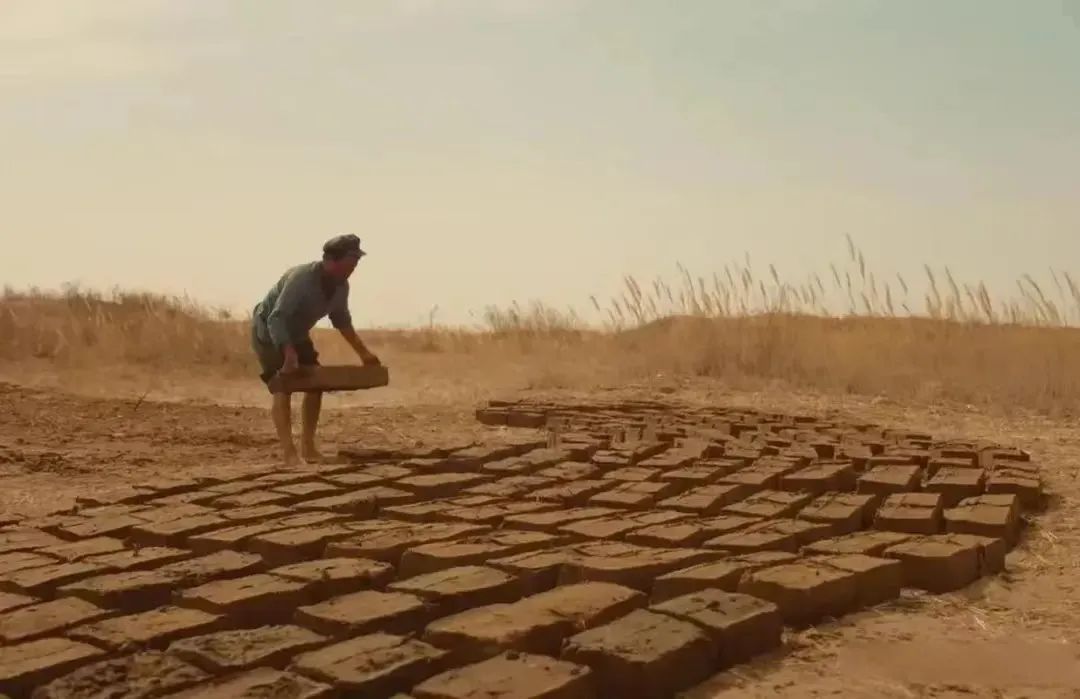
Huang Dequan, an elderly man in the same village who is familiar with Fang Donghua, is a large-scale farmer. He and his wife, who are over 80 years old, still farm more than ten acres of paddy fields and more than ten acres of dry land. Because they have a lot of land, their working hours in the scorching heat are longer than those of most elderly people in the same village. They almost have to work until eleven or twelve o’clock at noon, and then go out to work in the evening, and they don’t eat dinner until after 10 o’clock at night. When going out to work, Huang Dequan’s basket is equipped with a clean set of clothes and frozen ice water. When he feels upset in the fields, he feels comfortable when he drinks ice water. He will also bring water soaked with mint and perilla to the fields. He passes on these experiences to other elderly people, wanting to prove that it is okay to work in the hot weather, but others “don’t believe it”. “One water and soil nourishes one people. We people in our seventies and eighties have to withstand the sun.” Part of his land is on the slope, and the highest point has three platforms of soil – more than ten meters high. During the days of harvesting corn, after returning home at more than ten o’clock, his wife cooks, and he drinks two taels of “Lao Bai Gan” at home, and blows the fan, and feels cool and energetic, and then goes out to pick another one or two trips, and the meal is just cooked, and he can drink another one or two drinks with the meal.
The value of aging
Lu Hui’s hospital is in a district under the jurisdiction of Zhaoqing City, and the hospital’s emergency center serves more than 10 towns and townships around, some of which are mountainous towns and townships. Many of the patients he comes into contact with are elderly rural people. After realizing the impact of hot weather on the elderly, Lu Hui often goes to the villages to chat with the elderly. He found that the elderly’s awareness of heatstroke prevention is very lacking. Many rural elderly people told him that they rarely drink water, especially at night, and they are afraid of getting up at night. Such habits will lead to dehydration and cause heatstroke. Some rural elderly people regard Huo Xiang Zheng Qi Shui as a panacea for preventing heatstroke, and they drink a bottle when they are hot. In fact, Huo Xiang Zheng Qi Shui is used to treat summer-damp cold caused by the body being exposed to a low-temperature environment suddenly from a high-temperature environment, and it is not suitable to be taken as a preventive medicine under the scorching sun. The lack of coping experience will also make simple heatstroke problems serious. Lu Hui has had many experiences of going to see elderly people who have suffered heatstroke in the fields after receiving a 120 call. He said that some elderly people fainted under the sun, and the people next to them did not dare to move the elderly’s bodies rashly, and the elderly who fainted were continuously roasted by the sun, and their condition worsened as a result. For this reason, Lu Hui and his colleagues have compiled some accumulated experience information into a manual for the prevention of heatstroke for the elderly in rural areas and sent it to rural areas.
But persuading the elderly to change their farming habits is still a difficult thing. Professor Yao Huasong of the Department of Sociology at Guangzhou University grew up in the countryside of Xishui County, Huanggang City, Hubei Province, and his parents are still farming in the village. Every summer, he will be anxious when he sees his parents working in the scorching sun. Last summer, he heard his mother mention that an old woman fainted in the fields in the middle of the day, and the vegetation on the hillside was lush, and there were few people around, and people found the old woman’s body in the fields a few days later. Yao Huasong used this as an example to remind his parents to pay attention, but it didn’t work.
Yao Huasong found that the elderly of his father’s generation do not decide the working time and intensity based on the temperature, but everything is based on their own experience. Sometimes Yao Huasong doesn’t understand what’s the point of peanuts growing in the fields for a few more days. But in the experience of the old farmers, pulling peanuts when the sun is strongest, the water dries quickly, and it will be easier to carry them back in the afternoon. Sometimes his parents rush out to harvest the grain at noon, also because they are afraid that the basket will become wet and heavy after the rain in the afternoon. And if the harvest is not good in the end due to the weather, Yao Huasong’s father will not think it is a change in objective conditions, but will attribute the problem to his own lack of effort – since it is hot and dry, he should water it more times. Yao Huasong said that his father, who is in his seventies, still carries the same weight of burdens as many years ago. “We modern people think this is a very cruel thing, but for them, it seems that this is how they have lived their whole lives.”
In addition to the long-term labor habits and experience, the elderly’s unwillingness to change is also mixed with the worry of losing their self-existence value. In Yao Huasong’s view, many elderly rural people link the value and meaning of life with the welfare of their children, and if they cannot “get something for their children”, they will feel useless. Therefore, every time Yao Huasong and his younger brother return to the village, their parents will start preparing to bring the crops back to the city for them a few days before they leave, from rice and oil to vegetables, and everything is included. They have to bring five or six pumpkins weighing more than ten kilograms, and they want to fill the trunk and seats of the car. If Yao Huasong refuses, his mother will scold him, “Don’t want this, don’t want that, go buy it everywhere, waste money”. Yao Huasong feels that in the past, children relied on their parents, and when the parents grew old, they found that they had to rely on their children to take care of them, and the gap in their hearts was very large.
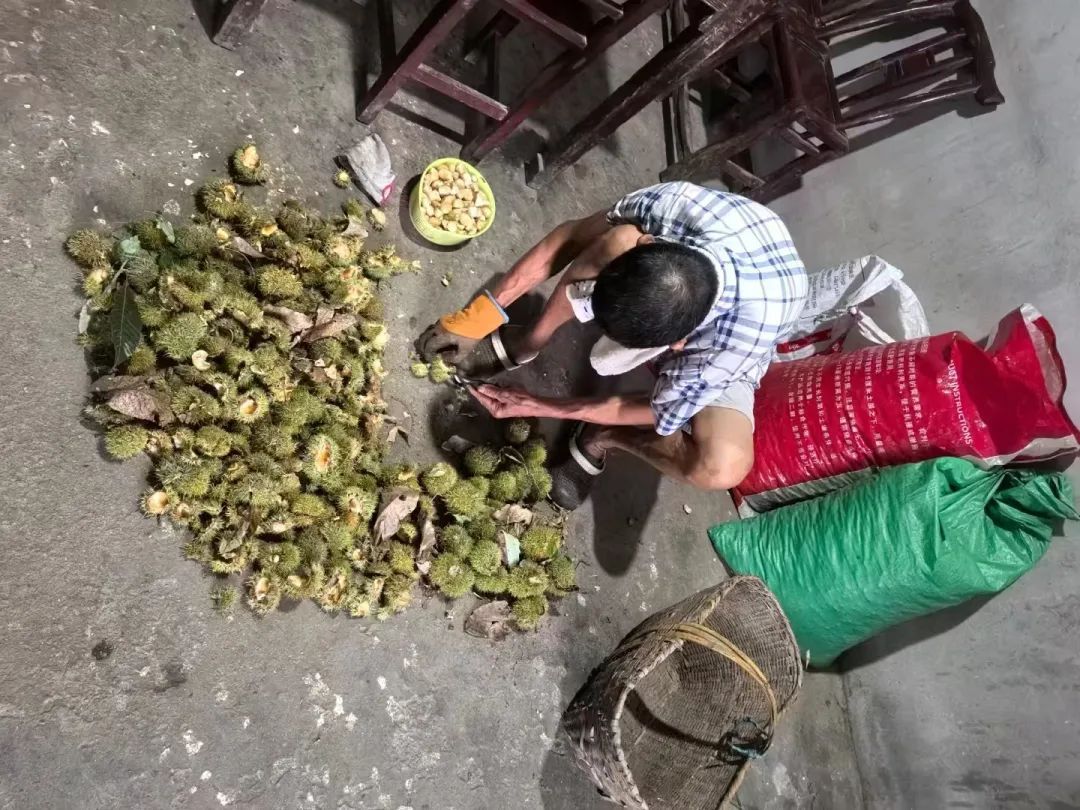
Chestnuts that Yao Huasong’s father prepared for him to take back to Guangzhou (provided by the interviewee)
Before the age of 60, Fang Donghua had worked in Guangdong, Xinjiang, and Northeast China to support his children, and the land on the hillside at home was abandoned. At the age of sixty, he couldn’t find a job outside, so he returned to his hometown. The children didn’t want him to farm anymore, but he didn’t listen. He had a fear of losing his labor force, and he felt that the current life of “living on his old capital” was unreliable, and he wanted to do more while he could still work. So, he picked up the land that his neighbors didn’t want, east and west, and planted sweet potatoes, corn, soybeans, and rapeseed on it. The selling price of sweet potatoes and corn this year was too low, and he didn’t sell them after harvesting, but kept them to feed the chickens. In addition, he harvested more than 1,000 catties of soybeans this year, which can be sold for about 2.4 yuan per catty, and more than 1,100 catties of rapeseed, which is about 2.7 yuan per catty. The income from farming this year is more than 5,000 yuan. Fang Donghua said that after deducting the money for fertilizer, seeds, and pesticides, he can only earn two or three thousand yuan a year. In addition, the only income he can get is a monthly pension of 135 yuan.
Fang Donghua understands his son very well, who has to support his children to study, and also has to pay him the electricity bill, phone bill, and the money for human relationships every month, which adds up to about two hundred yuan. In addition, his son also buys him medical insurance that increases year by year. For this reason, he tries to keep his living expenses to a minimum. He lives alone on weekdays, and he is too lazy to cook and cook well. He eats porridge, noodles, duck eggs, and homemade sausages for three meals. A few years ago, he got sick and was also diagnosed with high blood pressure. His son Fang Wenbin took him to the hospital to see a doctor, and the doctor said that he had symptoms of anemia due to malnutrition, which also affected his blood pressure. His son also asked Fang Donghua to live with him. His son and daughter-in-law are both teachers in the county, and they also opened a small shop in front of the house in the county town. Usually, Fang Donghua’s wife helps to look after the shop, cook, and take care of the children. In comparison, Fang Donghua felt that his arrival did not help his son’s family, and he returned to the village.
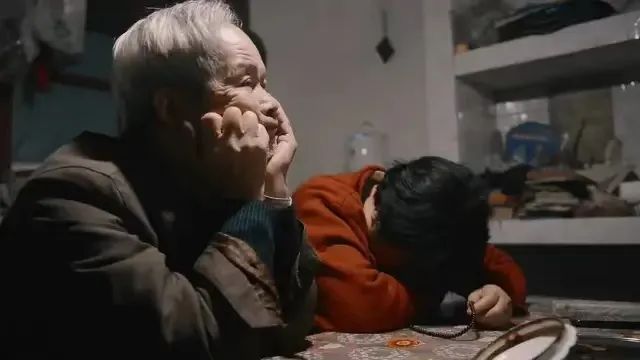
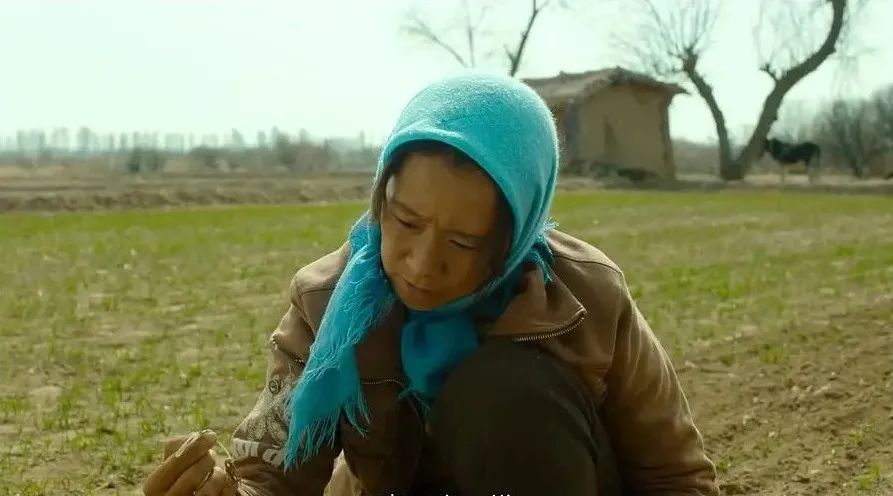
Stills from “Four Springs”
After Gong Tao passed away, Huang Ming heard that her children also proposed to take their father to live in the city, but the old man insisted on staying in the village. In the past, Gong Tao cooked at home with firewood. There was no way. The children bought an electric rice cooker for their father.
(At the request of the interviewees, except for Yao Huasong and Lu Hui, all are pseudonyms)
“Like” and “Watching”, let more people see
Typesetting: Taotao / Review: Mihua
Recruitment | Interns, Writers
This article is original content and the copyright belongs to “Sanlian Life Weekly”. Welcome to share, like, and watch the three consecutive times at the end of the article! Without permission, it is strictly forbidden to copy, reprint, tamper with, or re-publish.
Discover more from 自由档案馆
Subscribe to get the latest posts sent to your email.