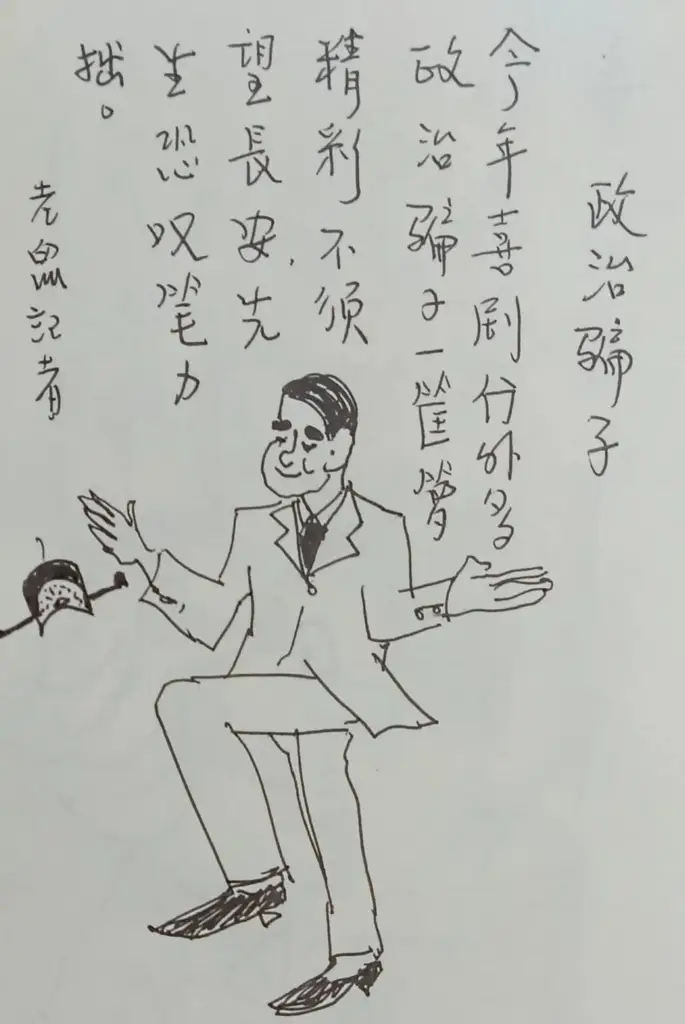
Jiang Zemin passed away, and today we’ll talk about the topic of this “elder.” My overall impression of Jiang Zemin is quite good. He once accepted an interview with Wallace. Among the leaders of the Chinese Communist Party and the country, only Deng Xiaoping and Jiang Zemin accepted interviews with Wallace. Later, Hu Jintao and Xi Jinping completely dared not accept interviews with Western media. In the era of Xi Jinping, let alone Western media, I think even Chinese media are afraid to interview him. Therefore, Jiang Zemin dared to accept Wallace’s interview back then, which was definitely quite courageous.
You must know that when Deng Xiaoping accepted Wallace’s interview, first, the relationship between China and the United States was still relatively in a honeymoon period; second, Wallace’s interview with Deng Xiaoping was relatively short, and frankly speaking, Wallace was intimidated by Deng Xiaoping’s powerful aura and did not raise particularly sharp questions, basically only raised the issue of the lifelong tenure of leading cadres. When Jiang Zemin accepted Wallace’s interview, it was after the “June 4th” incident, and Sino-US relations were very tense. Moreover, Jiang Zemin himself knew that Wallace would definitely ask very sharp questions, but he still accepted the interview. In the interview, Wallace pointed at him and said, “Some people say you are a dictator,” and Jiang Zemin could still talk and laugh. Among the leaders of communist countries, to be able to do this, I personally feel that if not unique, it is also very rare.
Jiang Zemin is gone, and today I will talk about what Jiang Zemin’s greatest contribution to Chinese society was during his more than a decade in power. I think the first very important point is the construction of the “Three Represents” theory. The core of the Communist Party’s original Marxism-Leninism and Mao Zedong Thought was “class struggle.” The so-called “class struggle” is to regard the Communist Party as a revolutionary party, and the revolutionary party regards the working class as the vanguard, and the peasants, the bourgeoisie, and intellectuals are either allies or class enemies, and need to be struggled against. Under this theory, society was divided into different classes, and political movements were carried out desperately, and even internal political movements were carried out every day. The final result was that social elites were excluded from the ruling system.
In any society, intellectuals are the most precious wealth of society. However, in the early theories of the Communist Party, intellectuals were “stinky intellectuals” and were the objects of reform. This identity regulation made it impossible for people with knowledge and culture in society to play a role, but instead, illiterates and proletarians were in leadership. And those with knowledge and culture all became the objects of criticism and reform, and this society would naturally move towards anti-intellectualism.
Mao’s set of theories, that is, the theoretical system of Marxism-Leninism and Mao Zedong Thought, is, on the whole, a revolutionary theory. But after the reform and opening up, Deng Xiaoping actually overturned Mao’s set. However, Deng Xiaoping did not construct a complete set of ideology. His theories were often relatively scattered, like the Analects, every sentence makes sense, such as “respect knowledge and respect talents,” “it doesn’t matter whether it’s a white cat or a black cat, it’s a good cat if it catches mice,” “not discussing the issue of socialism or capitalism, focusing on economic construction,” and so on. These words are relatively scattered and do not have a unified ideological system.
Although Deng Xiaoping broke the theoretical system of Mao, he did not establish a complete process of “establishment.” After Jiang Zemin came to power, with the help of Wang Huning, he reconstructed a set of theoretical systems, which is the “Three Represents” theory. The so-called “Three Represents” is actually to transform the Communist Party from a revolutionary party into a ruling party. Its core idea is that the Communist Party is no longer the so-called “vanguard of the working class,” but represents the most advanced culture, the most advanced thought, and the most advanced productive forces. All social classes, including intellectuals, farmers, workers, and even capitalists, are all part of the Communist Party’s representation.
This theoretical system is completely different from Mao’s system. According to Deng’s transformation method, the Communist Party is no longer the original Communist Party. It is gradually becoming similar to the social democratic parties in Europe, the only difference being that it is still a one-party dictatorship. If it implements party rotation, it no longer talks about achieving “communism” ideologically, nor does it talk about class struggle. The core theory of Marxism-Leninism has been abandoned. However, the time to truly and completely abandon these theories was after the completion of Jiang’s “Three Represents” theory, which formed a new theoretical system.
This theoretical system is very important because it constructs the transformation of the Communist Party from a revolutionary party to a ruling party. It allows ordinary people to examine the Communist Party from the perspective of a ruling party and can evaluate the legitimacy of the ruling party through public opinion supervision and criticism from outside the party. A revolutionary party does not allow criticism, but a ruling party must consider the economic development and the correctness of its governance methods, otherwise, the people have the right to criticize and even demand correction.
During the more than a decade of Jiang Zemin’s rule, China’s reform entered a “deep water zone.” Reform is the process of transforming from a planned economy to a market economy, which has no successful precedent in the entire communist country. Russia adopted the method of “brittle disintegration,” carrying out privatization reform through “shock therapy.” Although it achieved certain results, it also brought huge inflation and the loss of social wealth. In contrast, China’s reform is more complex, especially the issue of state-owned enterprises. Jiang Zemin’s government broke the “iron rice bowl” and implemented the layoff system, making uncompetitive state-owned enterprises either go bankrupt or be reborn.
During the reform process, Jiang Zemin and Zhu Rongji jointly solved the problem of the dual-track price system. Although this problem brought the pain of inflation and the devaluation of the RMB, it ultimately created the conditions for China’s economic take-off. Ultimately, China, by joining the WTO, officially integrated into the global economic system and achieved rapid economic development.
Jiang Zemin’s most commendable contribution is that he “stepped down at the appointed time,” achieving the first power transfer according to the term system in a communist country. In 2002, Jiang Zemin handed over power to Hu Jintao, an act that was unique in communist countries. Although he retained the position of Chairman of the Central Military Commission for more than a year, he did not interfere much with Hu Jintao’s administration overall. Jiang Zemin’s actions set a precedent for leaders to step down after 10 years and not interfere with the policies of their successors.
In the Jiang Zemin era, although the political system reform was basically interrupted, the process of marketization and the rule of law did not stop. That was a golden age of economic development and social progress. The media also flourished in that era, with the successive birth of print media and television programs such as Southern Weekend, Focus Interview, and Oriental Time and Space, becoming symbols of that era.
Jiang Zemin’s open attitude towards public opinion supervision is also worth mentioning. In those years, Focus Interview once made a program about a town mayor in Yunnan Province forcing a restaurant owner in the town to death. After Jiang Zemin watched it, he immediately instructed the Secretary of the Yunnan Provincial Party Committee to go to Zhongnanhai the next day to accept criticism. This detail shows Jiang Zemin’s emphasis on and open attitude towards public opinion supervision.
Jiang Zemin also had a certain recognition of the freedom of speech and media supervision in Western society. When he gave a speech at Harvard University, facing protesters, he said that he would raise his voice to ensure that the audience could hear his voice. This open and inclusive attitude is missed.
Compared to the current era, the era of Jiang Zemin seems particularly missed. People from all social classes felt the hope of life and the future, while we today feel endless despair. Comparing the current era with the era of Jiang Zemin does make people feel a lot of emotion.
Discover more from 自由档案馆
Subscribe to get the latest posts sent to your email.