

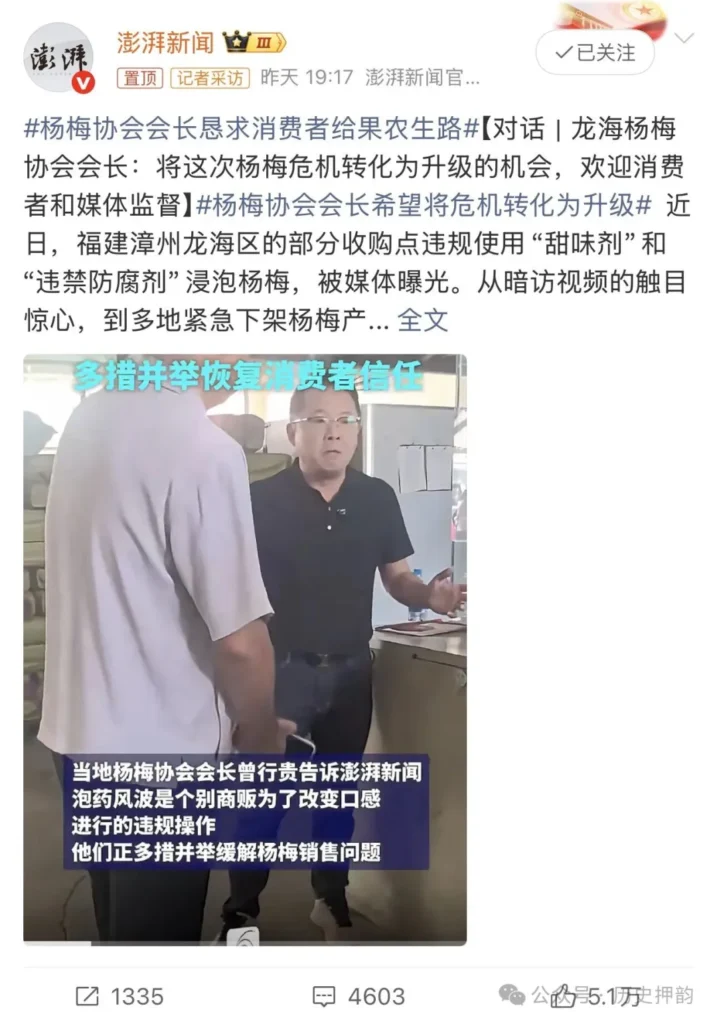
Recently, the exposure of the use of sweeteners and illegal preservatives to soak bayberries in Zhangzhou, Fujian by the media has attracted a lot of attention, which has directly led to the fact that many places now have bayberries rotting on the trees and no one is collecting them, and the losses of the fruit farmers are very serious.
Speaking of bayberries, I actually rarely eat them. Because this thing has a very short shelf life, and unlike apples and oranges, it doesn't have a thick peel to protect it. The bayberry flesh is directly exposed, and it is easily targeted by fruit flies. Many people have seen that bayberries that haven't been soaked in medicine, after being soaked in salt water at home, will have small white worms slowly crawling out. In fact, that's not some kind of "poisonous worm", mostly just fruit fly larvae, strictly speaking, they are still high in protein. But the principle is the principle, seeing this scene, most people will still lose their appetite instantly.
So the problem becomes very embarrassing.
If not soaked in medicine, the shelf life is short and prone to insects, and consumers are afraid;
If soaked in medicine, they are worried about illegal additives and excessive preservatives, which are harmful to the body.
And what's even more frustrating is that when supervision is not in place, whether to soak, what to soak, and how much to soak, in many cases, it can only rely on the conscience of the merchants. But the reality is that in the face of interests, consumer health is often not something that some people prioritize.
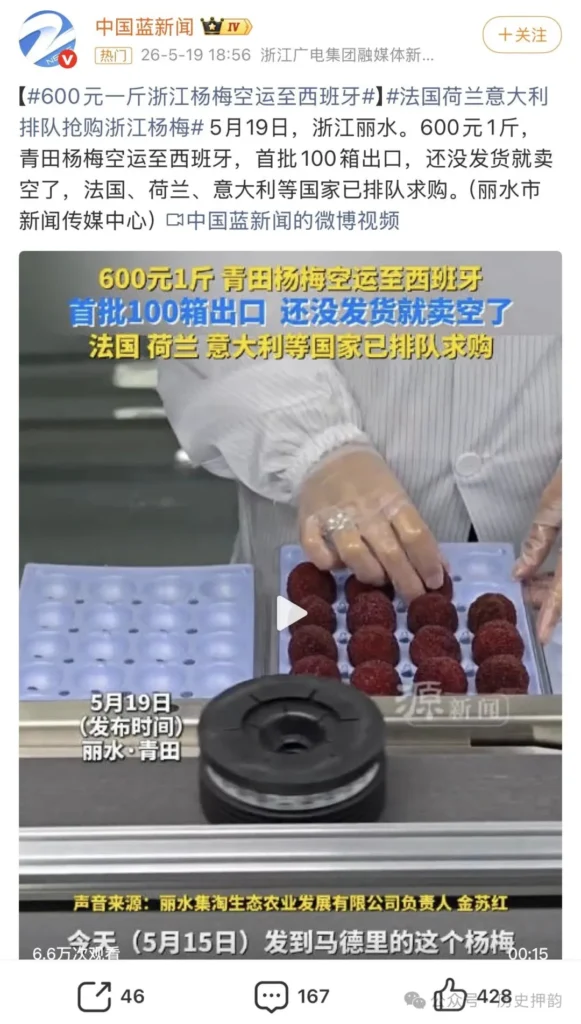
At the same time, I saw another piece of news: Zhejiang bayberries were airlifted to Europe, and a pound could be sold for 600 yuan, and there was even a queue to buy them. In fact, it's not just Zhejiang, Fujian's bayberries are also exported to Europe.
Why don't European consumers worry about buying bayberries soaked in medicine like we do?
Don't they fear insects? Don't they fear pesticide residues?
The reason is actually very simple.
Because they believe in the testing system.
In many European countries, food safety is a full-chain supervision, from planting, transportation to sales, each step has spot checks and traceability. Once a problem is found, fines, recalls, business suspension, and even imprisonment, the cost of violation is so high that no one dares to take risks easily. Although consumers will also worry, they believe that the system can protect them.
And here, once a problem is exposed, a familiar scene often appears:
It's not about accurately dealing with problem products, but the entire industry is "buried" together.
Last year was "Yunnan poisonous sweet potatoes", and this year it became "Fujian poisonous bayberries".
Every time we encounter this kind of thing, we would rather kill a thousand by mistake than let one go.
In addition, the spread of the Internet makes it easy for a rat dropping to spoil the whole pot of porridge.
In the end, those ordinary fruit farmers who honestly grow fruits are often the ones who suffer the most.
I recently traveled to New Zealand, and I don't have to worry about the problem of vegetables and fruits. Apples can be eaten directly without peeling, strawberries don't need to be soaked in salt water to remove pesticide residues, and even tap water can be drunk directly.
The fundamental reason is that there is a trustworthy inspection system, as well as laws and regulations that have zero tolerance for food safety.
In fact, China does not lack good fruits, nor does it lack people who work hard. What is lacking is a trust system that can truly reassure consumers.
At present, everyone's trust system has become: insects have become the quality inspectors of fruits and vegetables.
I've written a lot about food safety issues. Those who sell bayberries don't eat bayberries, those who sell milk don't drink milk, and those who make chicken feet don't eat chicken feet... The whole society is eating excrement.
The food I produce, I know there are problems, I don't eat it. I go to eat other people's food, but in fact, other people's food may also have other problems.
It's just hurting each other like this.
So when there is only mutual suspicion left between people, what is hurt is not just an industry, but the trust cost of the entire society.
So, what do we need to do to rebuild this trust?
The quality inspection department cannot only take action on March 15th every year. Food safety cannot always rely on media exposure to make amends after the fact.
Truly effective supervision should be routine, transparent, and normalized.
The cost of violation must also be so high that people "dare not touch" it.
And before the environment improves, what should we individuals do?
Try not to eat processed foods, try to cook your own meals, and try to choose things that you can see the raw materials of.
The end of the article
Please pay attention, like, comment, and forward