How to Rebuild Institutional Trust
By Li Yiming
Edited by Xueli Wang
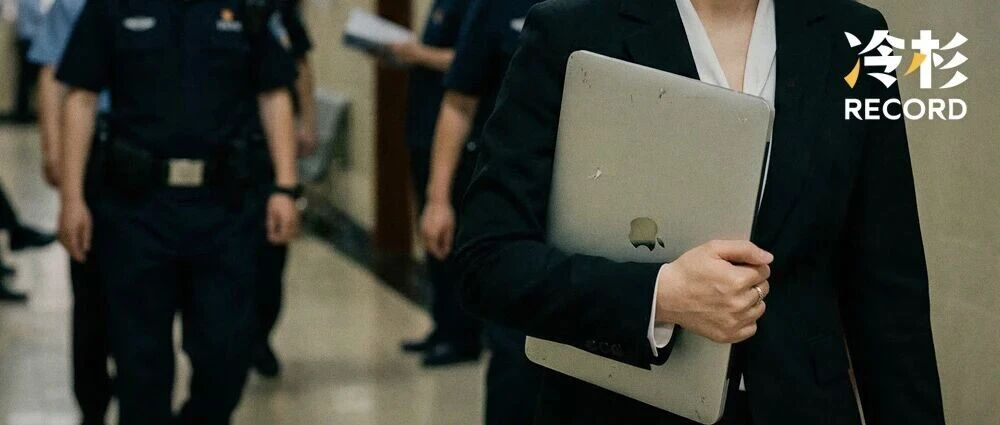
Lawyer Li Renhuo’s computer was not allowed to be brought into the court.
On the morning of March 16, at the trial site of the People’s Court of Echeng District, Ezhou City, Hubei Province, he and four other lawyers were deadlocked with court staff at the security check-in because they insisted on bringing their personal laptops to court. More than two months before this, Li Renhuo had raised several objections to the court about whether this computer could enter the court, but he was not allowed.
Bringing a laptop to court has been the default working method for lawyers for many years. After all, the computer contains almost all the materials needed for handling cases: evidence catalog, legal search, hundreds of volumes of files, tens of thousands of words of defense opinions and defense outlines. Today, when legal search software and even artificial intelligence (AI) auxiliary tools have been widely used, this digital office method is nothing unusual and is becoming increasingly important.
However, in the past two years, some lawyers have found in their practice that this long-standing default practice has been suddenly interrupted in some courts.
The personal computers are usually blocked by a document issued to them by the local court—the “Notice on Further Regulating Court Trial Order and Guaranteeing Litigation Rights” (hereinafter referred to as the “Notice on Regulating Court Trial Order”) issued by the Supreme People’s Court in 2020. Article 7 of which reads, “For major sensitive cases and cases tried in camera in accordance with the law, the People’s Court shall prohibit the carrying of electronic devices into the court, take necessary technical measures such as shielding network signals to prevent the improper dissemination of information on trial activities, and if it is necessary to use them, it shall be approved by the People’s Court”.
The contradiction arises from this.
In the court’s management logic, restricting the carrying of electronic devices into the court is a safe means to prevent illegal audio and video recording and ensure that case information is not leaked; while in the eyes of lawyers, in today’s world where case materials are often millions of words and technical means have deeply assisted in handling cases, not being able to carry personal computers does bring difficulties to their work. The divergence on “tools” is evolving into a new conflict between defense and trial.
When technology has been deeply embedded in the legal profession, how should its restrictions and use be kept moderate? In view of this controversy, a reporter from Phoenix Weekly interviewed many lawyers who have had similar experiences, relevant scholars, and court workers, trying to clarify the logic behind this phenomenon, and also to further explore how to adapt and rebuild trust between court order and professional rights in the context of technological changes?
Conflict
Li Renhuo, a lawyer at Beijing Zhongdun Law Firm, had his computer stopped by a notice.
On January 9, 2026, he received an electronic notice of appearance from the People’s Court of Echeng District, Ezhou City, Hubei Province. The text at the bottom of the page was particularly eye-catching: “This case is a major sensitive case. According to relevant regulations, the carrying of personal laptops, mobile phones and other electronic devices into the court is prohibited. If it is necessary to use a computer, this court will provide a dedicated computer and a U disk.””
The day before receiving the notice, at the adjournment of the pre-trial conference on January 8, the presiding judge showed the defense counsel a paper document. After the lawyers searched, the document was the “Notice on Regulating Court Trial Order” issued by the Supreme People’s Court.
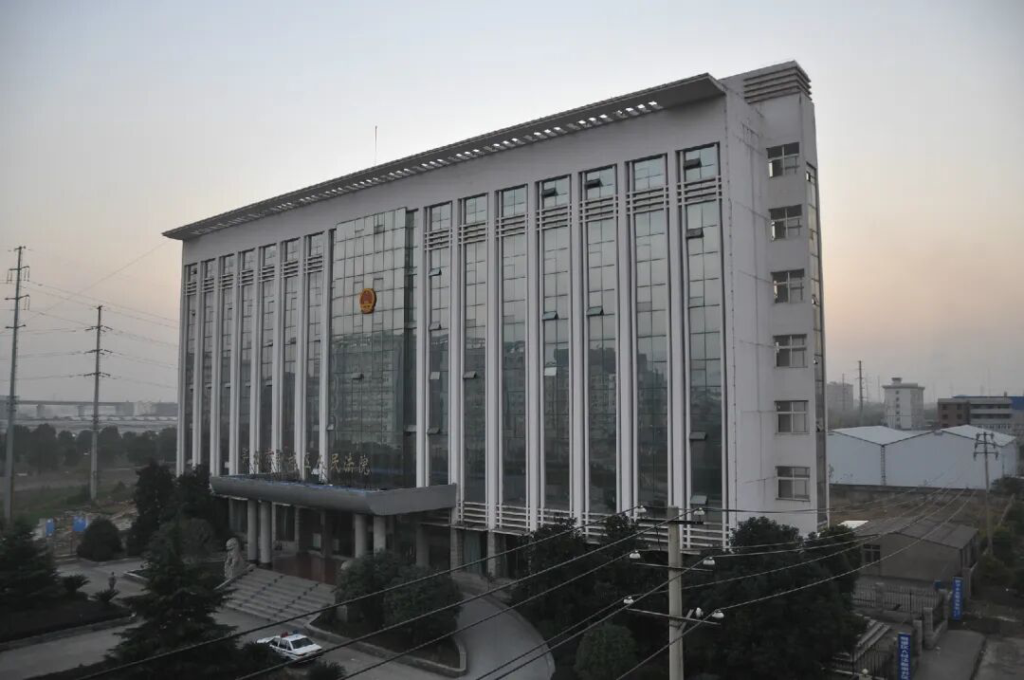
The building of the Echeng District Court. The case was originally scheduled to open on March 16.
Li Renhuo remembered that at the time, the presiding judge clearly pointed out that Article 7 of the regulation was the basis for not allowing lawyers to use personal computers during the trial.
As mentioned earlier, in addition to the principle that “electronic devices such as mobile phones and computers are generally allowed to be carried into the court”, the article draws a red line for “major sensitive cases”. The focus of the dispute then appeared. It is understood that the case does not fall within the scope of “trial in camera in accordance with the law”, so does it belong to a “major sensitive case”?
According to the guiding opinions issued by the Supreme Court in 2023, “major sensitivity” usually covers situations involving national interests, having the effect of the first case, or involving national security and religion. In the notice issued by the Echeng District Court, the case was clearly marked as a “major sensitive case”. The notice of appearance issued by the People’s Court of Echeng District to the lawyers in the case clearly stated that the case was a major sensitive case.
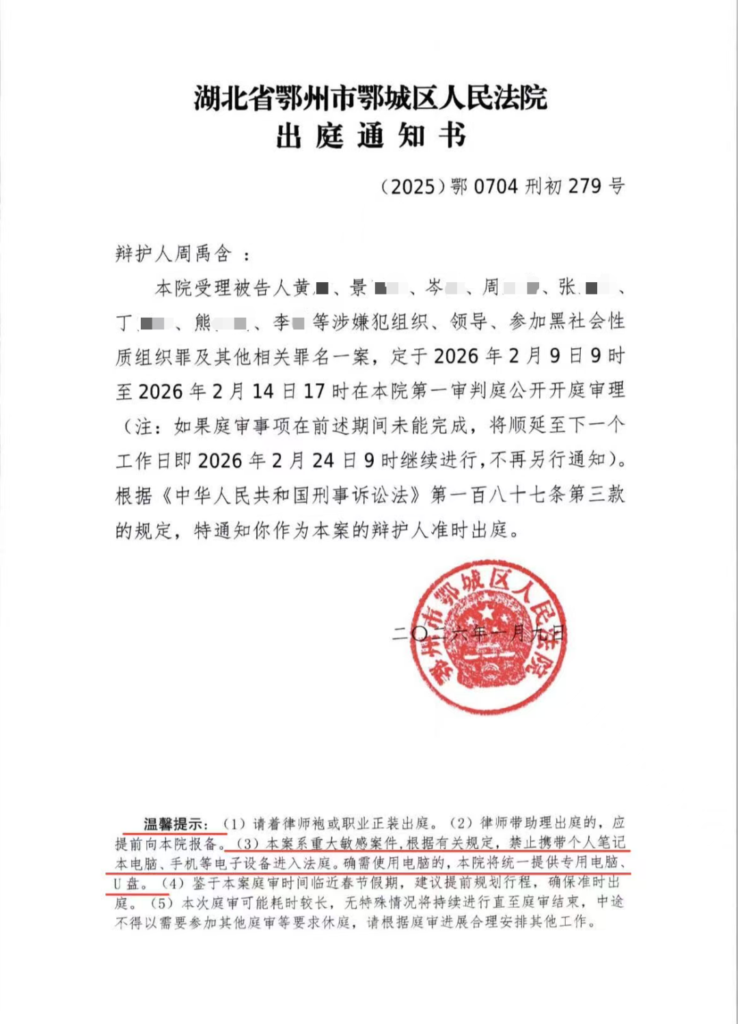
The court’s notice of appearance.
Zuo Deqi, a professor and doctoral supervisor at the School of Law of Shenzhen University and a standing director of the China Criminal Procedure Law Research Association, paid attention to the incident. In his view, Article 7 gives the court the discretionary power to control electronic devices. He published a comment in the Shanghai Legal Daily, saying that if the dissemination of trial information lacks norms, it is easy to be misinterpreted out of context and may even trigger false public opinion, interfering with the normal trial of the case. Therefore, the court’s strengthening of the control of information outlets has its reasonable starting point.
However, Zuo Deqi also pointed out that in judicial practice, there have been deviations in the application of the regulation. Due to the ambiguity of the regulations on the management of electronic devices in major sensitive cases tried in open court, it is easy to raise public doubts—”Since the trial is open, why is the use of electronic devices prohibited?”
Zhu Kai had worked in the criminal trial court of a court in Zhejiang Province for 10 years, served as a judge in the criminal trial court, and also participated in the trial of a large number of criminal cases. In his view, the “Rules of the People’s Court of the People’s Republic of China” clearly stipulates that it is forbidden to privately record audio and video or take photos during the trial, and it is also not allowed to privately disseminate trial activities through the Internet. The objects of prohibition naturally include lawyers. This is a consensus and there is no dispute. The above-mentioned prohibitive provisions must have their rationality, such as protecting the privacy of the parties, state secrets, and avoiding negative impacts, etc.
As for Article 7 of the “Notice on Regulating Court Trial Order”, the purpose is also to prevent someone from privately recording audio, video, taking photos, and disseminating trial activities. The reason behind this is that there are currently many types of electronic devices and diverse functions, and it is difficult for court staff to individually confirm whether each electronic device has secretly turned on the recording or network live broadcast function.
Therefore, for major sensitive cases or cases that are not tried in open court, the court has adopted a method of blocking risks from the source.
Dilemma
However, in the eyes of lawyers, restricting the carrying of personal computers into the court does bring real difficulties to them.
Lawyer Jin Hongwei of Beijing Huayi Law Firm said that before the “Notice on Regulating Court Trial Order” was issued, he had encountered similar situations in many places such as Hunan, Hubei, and Guangxi. At that time, the court relied on Article 15 of the “Several Provisions of the Supreme People’s Court on Audio and Video Recording of Court Trials”: Without the permission of the People’s Court, no one may record audio and video of court trial activities, and may not take photos, copy, delete, and migrate audio and video recordings of court trials. If the actor implements the acts of the preceding paragraph, the corresponding responsibility shall be pursued in accordance with the provisions.
“In order to prohibit audio and video recording, these devices were directly blocked outside the court,” he said.
In Jin Hongwei’s view, this practice is an infringement of the lawyers’ full exercise of their right to defense. Regarding the situation encountered by Li Renhuo and other lawyers recently, he believes that this is an expanded understanding of the relevant documents. “First of all, the ‘Notice on Regulating Court Trial Order’ only points out that for major sensitive cases, lawyers are in principle prohibited from carrying personal computers, while the Echeng District People’s Court has ‘cut across the board’ and completely prohibited them. Secondly, the so-called ‘major sensitivity’ is not a serious ‘legal language’ and does not provide a clear boundary.”
“If the local court prohibits lawyers from using personal computers in court trials for any event that may trigger public opinion under the pretext of ‘major sensitive cases’, then this may trigger a certain trend,” Jin Hongwei told Phoenix Weekly, which is also what he is most worried about.
Zhu Kai also believes that the relevant provisions in the “Notice on Regulating Court Trial Order” are “excessive”. “The use of computers and other electronic devices by lawyers during court trials is often necessary for their work,” he pointed out, especially in complex cases such as those involving organized crime, the files may be thousands or tens of thousands of pages long, and some electronic data need to be displayed in court, and it is obviously inconvenient or even impossible to use paper materials.
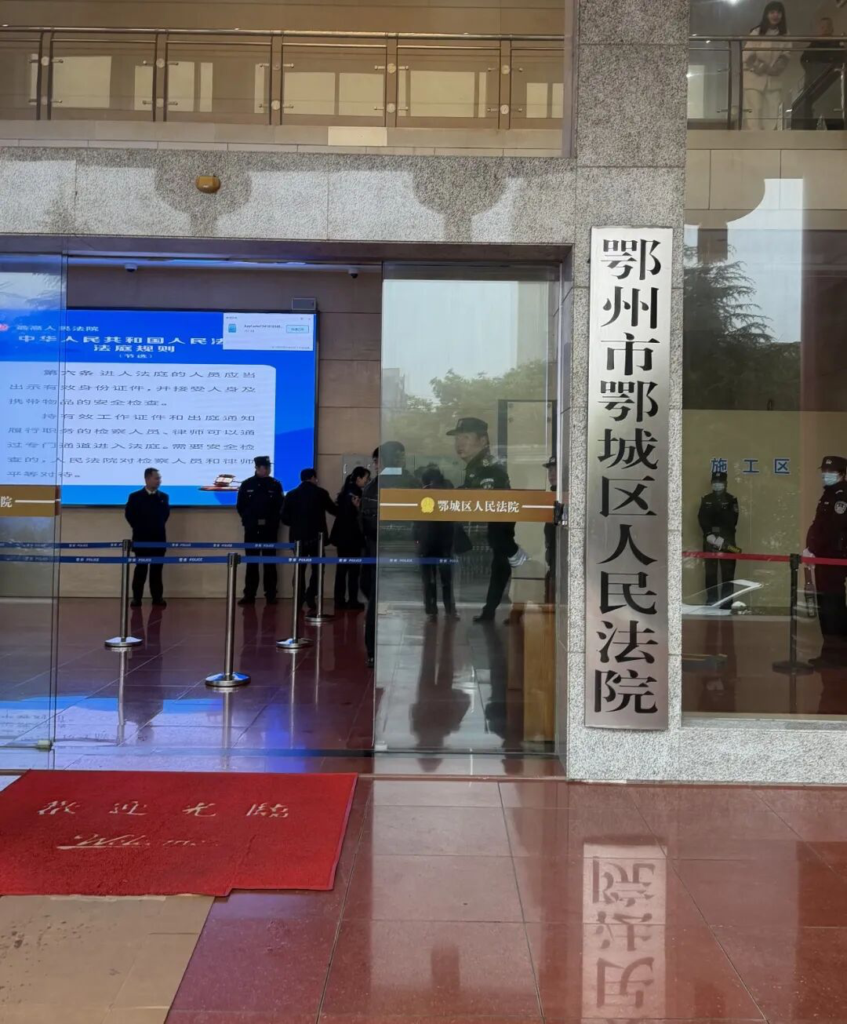
The entrance of the Echeng District Court.
In the view of Peng Fu, a former lecturer at the School of Law of Hubei Economic College and a partner at Tianda Hezhong Law Firm, the “Notice on Regulating Court Trial Order” does have a binding effect within the court system. However, the document deprives citizens of their right to defense—Article 14 of the “Criminal Procedure Law of the People’s Republic of China” stipulates that “the People’s Court, the People’s Procuratorate, and the public security organs shall guarantee the right to defense and other litigation rights enjoyed by criminal suspects, defendants, and other participants in litigation in accordance with the law”.
“The exercise of the right to defense does not mean that it is called defense just by speaking or reading from paper,” Peng Fu said. “The right to defense needs to be effectively exercised. And if it is to be effectively exercised, the use of computers should be a basic guarantee. Now is the information age, and I cannot imagine what work in today’s society can completely get rid of the Internet and computers, which is impossible. If that is the case, wouldn’t it be back to the age of slash-and-burn agriculture?”
He also pointed out that the “Notice on Ensuring the Litigation Rights of Lawyers” issued by the Supreme People’s Court in 2020 emphasized that “lawyers shall not be restricted from carrying computers and other necessary equipment for handling cases to participate in court trials”. “In this way, the two ‘notices’ present a ‘contradictory’ state.”
“Of course, in the process of case trial, there are indeed situations where lawyers publicly disclose court trial records. This situation usually causes public opinion and puts pressure on the court,” Peng Fu analyzed to Phoenix Weekly, and the concern about triggering public opinion is one of the main motivations for the court to prohibit lawyers from carrying personal computers into the court. However, it cannot be prohibited for this reason, which is a presumption of guilt and also “throwing the baby out with the bathwater”.
From the perspective of legal economics, Peng Fu believes that the cost and benefit of the court’s move are also disproportionate. “The purpose of the court is to hope that the prosecution and defense can fully express their opinions and then make a judgment in the middle. If the carrying of personal computers is prohibited, so that the prosecution and defense cannot fully express their opinions, then it will go against the court’s original intention of clarifying the facts of the case and making a fair judgment.”
According to this logic, the court sacrifices the original intention of the court in order to prevent lawyers from secretly recording the case trial process, which is “uneconomical”.
On this issue, Phoenix Weekly interviewed Professor Yi Yanyou, Director of the Evidence Law Research Center of the School of Law of Tsinghua University. In his view, the “Notice on Regulating Court Trial Order” is not a judicial interpretation and can only regulate the work of the court, and cannot restrict the rights of defense lawyers. “If it is to involve the rights of lawyers, it needs to be at least a judicial interpretation at the level of effectiveness.”
He further emphasized that the court’s move is a deprivation or restriction of the lawyers’ right to defense. “This is artificially creating a conflict between defense and trial, which is ‘meaningless’. Since there are strict regulations on court discipline, it is not allowed to record audio and video in violation of regulations. Then, if a lawyer violates court discipline, he can be held accountable afterwards in accordance with court discipline. It is not possible to deprive everyone of the right to work normally in advance because of the concern that someone may violate the regulations.”
Consensus
Faced with the lawyers’ doubts, the court gave an alternative solution, that is, to allow lawyers to use the computers provided by the court to open the court. However, in the eyes of the lawyers, this measure is not “quenching thirst”.
In August 2025, Cao Zongwen, a lawyer at Beijing Cailiang Law Firm, had a similar experience when he participated in the trial of a case of embezzlement and abuse of power. The case was tried in the Intermediate People’s Court of Huanggang City, Hubei Province. At that time, a notice board was set up at the entrance of the court, which printed the relevant content of Article 7 of the “Notice on Regulating Court Trial Order”.
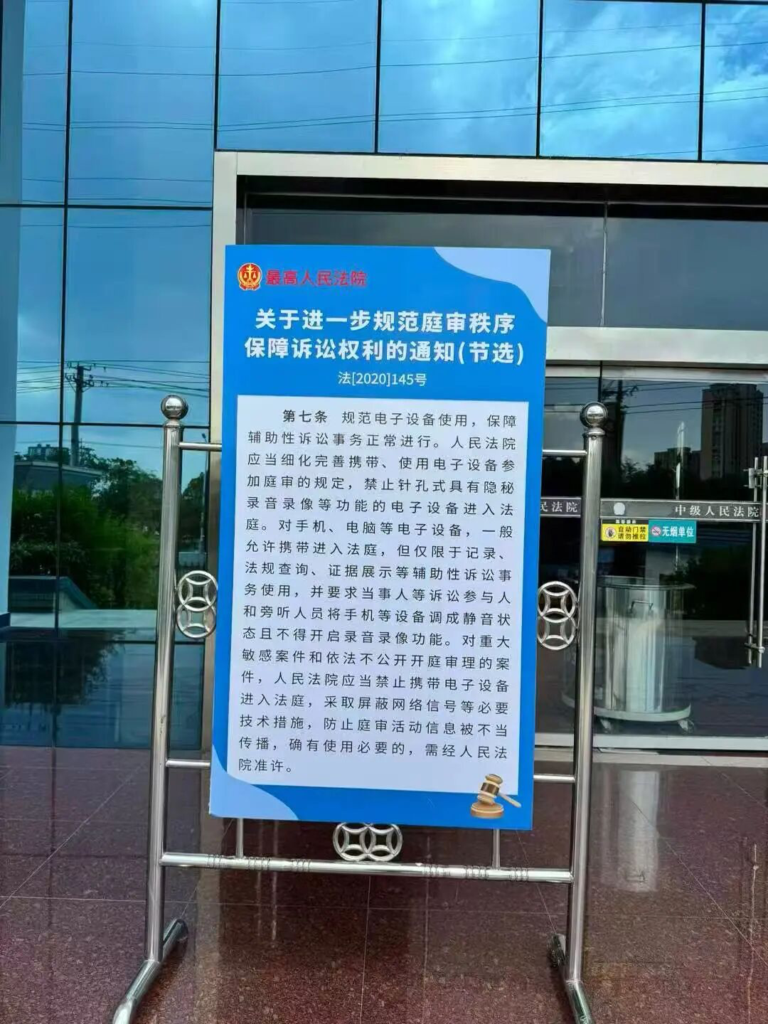
A notice board standing at the entrance of a court.
As an alternative, the court provided a Windows-based laptop. Cao Zongwen had to copy the work files in his personal computer to the U disk provided by the court, and then connect to this dedicated device to use it in the trial. The court will seal the computer every day after the court is over.
During the six days of the trial, Cao Zongwen has been adapting to this computer.
“The operating system is completely different from what I am used to. The system is very slow, and there is no other built-in software except Word and WPS,” Cao Zongwen said, which greatly reduced his work efficiency.
Peng Fu likened this alternative to a table tennis match: it is like requiring a table tennis player to give up his racket that he has been adapting to for many years on the court, and instead use a substitute with inconsistent specifications uniformly distributed by the organizing committee. “The system and interface used by the computer, as well as the different locations of file storage, will affect the use effect”.
Peng Fu said that during the trial, he often opened many windows—such as paid professional reading software, law databases, and case databases, and its efficiency is far higher than the software in the computer provided by the court. In addition, there are shortcut instructions, mind maps, etc. that he is familiar with on the computer. Many other lawyers also said that once they are stripped of these familiar tools, the efficiency of handling cases will be greatly reduced.
From the court’s point of view, this action may be a helpless move for “insurance”.
A judge assistant of an intermediate people’s court in a municipality directly under the Central Government confided to Phoenix Weekly that this kind of measure is to a certain extent to “avoid risks”. Although the court rules strictly prohibit audio and video recording, it is difficult to completely eliminate it due to the extreme concealment of modern recording methods. Prohibiting all personal electronic devices from entering the court, although it seems to be “cutting across the board”, but for the court, this method is indeed more stable and safer.
He further mentioned that every formal trial has audio and video recordings of the trial, and the parties can consult and copy the audio and video after applying. In this case, recording audio and video by oneself is not only disrupting the court order, but also unnecessary.
Zhu Kai observed that the “Notice on Regulating Court Trial Order” actually left a “loopholes”, “if it is necessary to use it, it needs to be approved by the People’s Court”. In practice, the court should, according to the actual situation, approve the necessary needs for using computers and other equipment for handling cases; and as lawyers, they should also consider the court and try to use electronic devices that do not have audio and video recording functions and network dissemination functions, so as to eliminate the court’s worries.
“This actually involves the issue of judicial openness,” Zhu Kai said. “The People’s Court once emphasized judicial openness and vigorously promoted the online publication of judgment documents and trial live broadcast activities, and also achieved relatively good results.” In his view, judicial openness is the general trend, and the court should follow the trend.
The above-mentioned judge assistant also talked about his observations. In his view, lawyers and the staff of the procuratorate and the court are mostly taught in the same legal system and have the same professional background. “However, after entering various positions, they are often limited by their respective job responsibilities and are prone to fall into the inherent positions brought by their professions, thus lacking mutual understanding.” He believes that the legal community still needs to communicate more internally. “Listening to all sides can lead to clarity, which can promote understanding and avoid the occurrence of ‘defense and trial conflicts’ like this.”
This game against computers ultimately reflects the subtle state of the defense and trial relationship. Gao Guijun, a former member of the Trial Committee of the Supreme People’s Court and the head of the Fifth Criminal Trial Division, once said that “defense and trial conflicts” should not have happened. In the trial of criminal cases, the judge, the prosecutor, and the defense lawyer are in an equilateral triangle relationship. The judge is in the middle to make a judgment, and the opposing parties are the prosecution and the defense (i.e., the prosecutor and the defense lawyer). The judge should be a mediator and a neutral party. But now, the judge and the lawyer have become a pair of “resentful couples” and have disputes.
“This is a very abnormal phenomenon,” Gao Guijun said.
He believes that “both sides have certain responsibilities, but the main responsibility should still be on the judge, because after all, the judge is in a dominant position among the defense and trial parties, and the lawyer is in a weak position. In this case, the judge is more tolerant and inclusive, which may solve the problem in a timely manner.”
Specifically to the experience of Li Renhuo and other lawyers, Zuo Deqi believes that it is necessary to clarify the statutory identification standards for “major sensitive cases”, distinguish the management rules for open and in-camera trial cases, improve technical and institutional management measures, and establish a pre-notification, objection, and review mechanism for the management of electronic devices in court trials. At the same time, abandon the simple thinking mode of “cutting across the board”, replace “rough prohibition” with “refined regulation”, and while using technical means and institutional design to dispel the court’s reasonable concerns, effectively safeguard the lawyers’ professional rights. “The progress of justice requires continuous optimization of institutional design in the balanced coordination of multiple interests and rights.”
This game about computers eventually ended with the postponement of the trial.
In the last communication before the trial on March 16, the court assistant called and said that the court had prepared a dedicated computer. On the day of the trial, after the security check-in person in charge, the judge assistant, and even the presiding judge communicated in turn without results, the presiding judge announced that the trial of the case in which Li Renhuo and other lawyers served as defense lawyers would be postponed to the next day. On March 17, due to the continued lack of communication, the court announced another postponement, and the time of the trial will be notified separately.
The lawyers did not stop. On the afternoon of the 16th, they went to the Ezhou Procuratorate and the Ezhou Intermediate Court for relevant materials, and formally applied for legal supervision and correction of the relevant acts of the Echeng District Court. On March 17, Phoenix Weekly called the presiding judge of the People’s Court of Echeng District, and the other party refused to respond to the matter.
Li Renhuo judged that the court might want to postpone the trial time to make them finally accept not bringing personal computers into the court. In fact, this strategy is working—on March 17, one of the five lawyers who originally insisted on their position accepted this outcome and agreed to enter the court without carrying a personal computer.
Operation / Huang Xinyue Proofreading / Li Xiangling Art Design / Uncle Mary
Discover more from 自由档案馆
Subscribe to get the latest posts sent to your email.