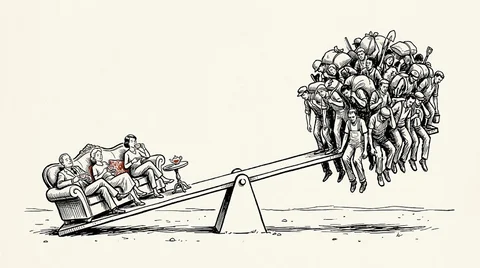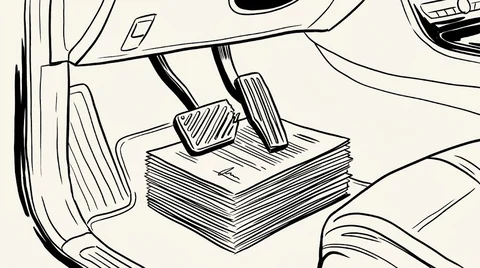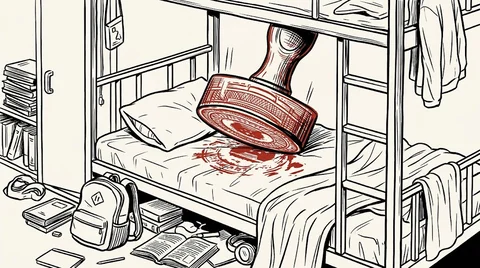



Hopefully, technology doesn't become a kind of "art."
Today, February 11th, the Shanghai First Intermediate People's Court made a public pronouncement:
Bao Bingzhang (former Secretary of the Xuhui District Committee of Shanghai) illegally accepted property worth over 54.01 million yuan, committing the crime of bribery, and was sentenced to thirteen years in prison; he abused his power in the process of land acquisition and compensation, causing significant losses of state-owned assets, committing the crime of abuse of power, and was sentenced to three years and six months in prison; multiple crimes were punished concurrently, and it was decided to serve a combined sentence of fourteen years in prison, and a fine of 5 million yuan.
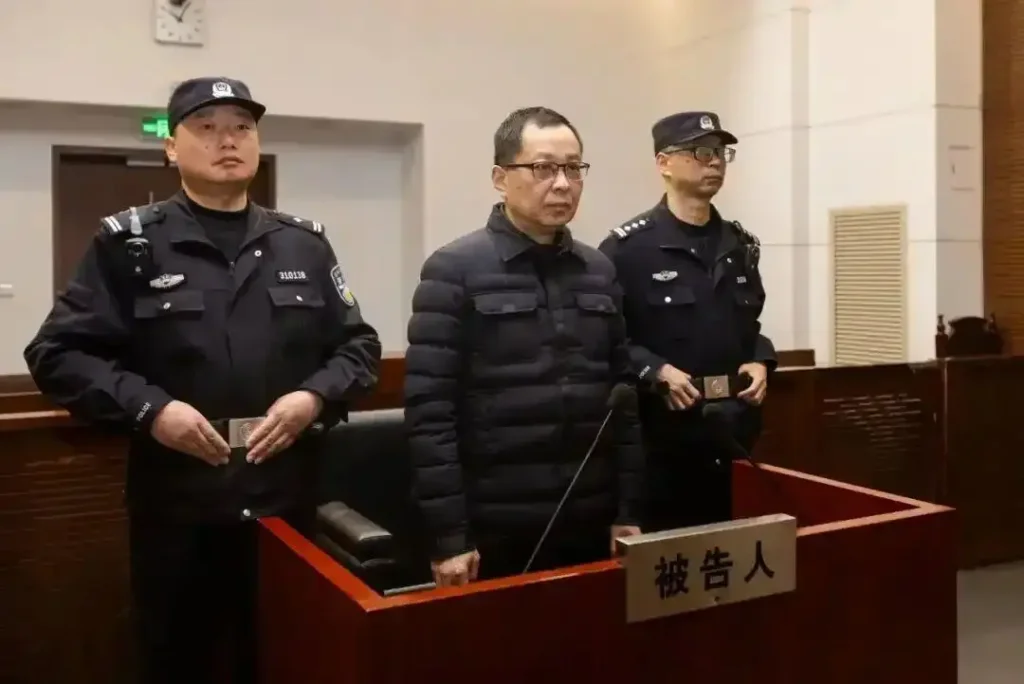
I am mainly concerned about the sentence of this corrupt official (bribery and corruption are not the same crime; "corrupt official" is not a legal term, but a colloquial term). The court said that this was the result of a lenient sentence.
Also today, I saw another "Criminal Ruling" on my WeChat Moments: (2025) Yu 12 Xing Geng 313.
This ruling states that "since the convict Wang Moujia entered prison, he has conscientiously observed the prison regulations, accepted education and reform, and has indeed shown repentance," and his sentence was reduced by 5 months.
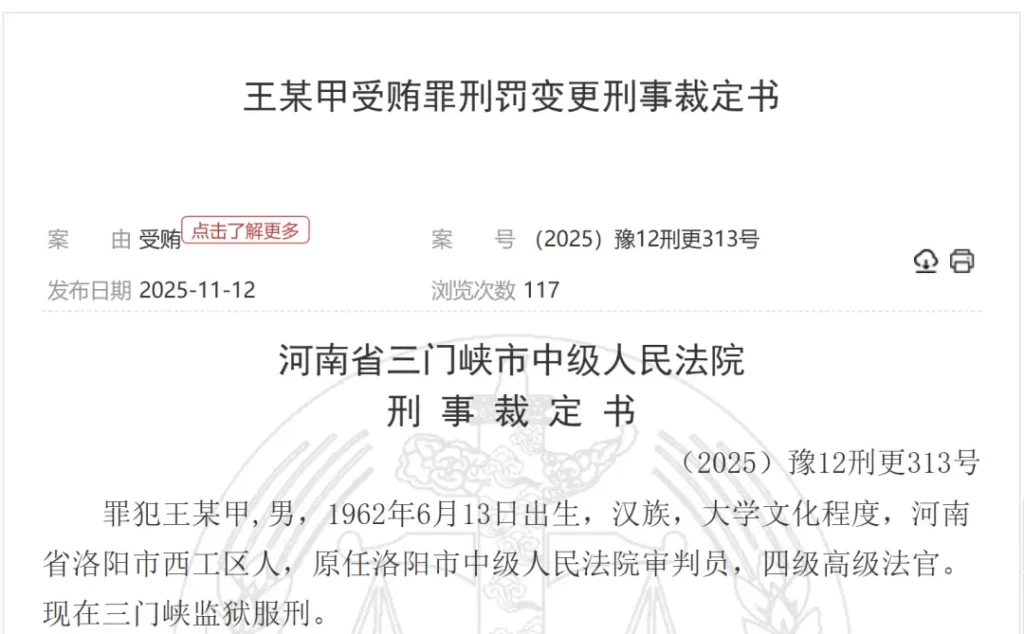
Why was Wang Moujia imprisoned? The ruling has a few brief sentences: The Yanshi District People's Court of Luoyang City, Henan Province, made a criminal judgment (2020) Yu 0381 Xing Chu 385 on December 19, 2020, sentencing Wang Moujia to six years in prison for the crime of bribery, and a fine of 500,000 yuan.
"After trial, it was found that: the original judgment determined that Wang Moujia committed the crime of bribery: from 2006 to 2017, Wang Moujia, taking advantage of his position as the chief judge of the administrative trial court of the Luoyang Intermediate People's Court, the president of the Songxian People's Court, the president of the Luoyang City Chanhe Hui Nationality District People's Court, and the deputy county-level judge of the Luoyang Intermediate People's Court, as well as the convenience formed by his authority or status, through the actions of other state staff, in matters such as case handling, job transfers, and project approvals, he sought benefits for the petitioners, repeatedly illegally accepted property from others totaling 3.687 million yuan and 300 grams of gold, and his actions constituted the crime of bribery."
Bribery of 3.687 million yuan + 300 grams of gold, sentenced to 6 years in 2020, and another 5 months reduction in 2025. Now, he should have been released from prison and regained his freedom.
Bao Bingzhang was sentenced to 13 years for accepting 54.01 million yuan in bribes, while Wang Moujia was sentenced to 6 years for accepting over three million yuan in bribes. The latter's bribe amount is less than the former's, but the sentence is half of the former.
Criminal judgment is a very professional legal technique, but in essence, it is "punishing evil." Therefore, every ordinary person will have a simple perception of this, and it is precisely here that, from the perspective of an ordinary citizen, it is puzzling.
So, is Wang Moujia's sentence really too long?
No, on the contrary, my first feeling is that it is too short. After a closer look, this Wang Moujia, whose real full name is Wang Hongwei, not only served as the president of two courts, but also served as the chief judge of the intermediate court. Such a corrupt official who holds judicial power, his corruption is particularly egregious. The illegal acts of others only pollute the water flow, but the corruption of a judge, especially the president of a court, pollutes the source of the river of society. Under his millions of yuan in bribes, how many unjust judgments are there? How much injustice? How many tears of families? How much cheering and rejoicing of evildoers?
Such a person, only sentenced to 6 years?
How should the crime of bribery be sentenced?
Article 386 of the Criminal Law states that those who commit the crime of bribery shall be punished in accordance with the provisions of Article 383, based on the amount of the bribe received and the circumstances. Those who solicit bribes shall be punished more severely.
So we need to look at Article 383 of the Criminal Law:
Those who commit the crime of corruption shall be punished separately according to the following provisions, depending on the seriousness of the circumstances:
(1) Those who have a relatively large amount of corruption or other relatively serious circumstances shall be sentenced to imprisonment or criminal detention for not more than three years, and shall also be fined.
(2) Those who have a huge amount of corruption or other serious circumstances shall be sentenced to imprisonment for not less than three years but not more than ten years, and shall also be fined or have their property confiscated.
(3) Those who have a particularly huge amount of corruption or other particularly serious circumstances shall be sentenced to imprisonment for not less than ten years or life imprisonment, and shall also be fined or have their property confiscated; those who have a particularly huge amount and have caused particularly serious losses to the state and the people's interests shall be sentenced to life imprisonment or death, and shall also have their property confiscated.
Those who have committed multiple acts of corruption that have not been dealt with shall be punished according to the accumulated amount of corruption.
If a person who commits the crime in the first paragraph truthfully confesses his crime, sincerely repents, and actively returns the stolen goods before the public prosecution is initiated, and avoids or reduces the occurrence of damage results, and if there are circumstances as stipulated in the first item, he may be given a lighter or reduced punishment or be exempted from punishment; if there are circumstances as stipulated in the second and third items, he may be given a lighter punishment.
If a person who commits the crime in the first paragraph is sentenced to a suspended death sentence with a two-year reprieve, the people's court may, according to the circumstances of the crime, decide to impose life imprisonment after the two-year reprieve expires, and the sentence shall not be commuted or paroled.
So, what is meant by "relatively large amount", "huge amount", and "particularly huge amount"? What are the standards?
The Supreme People's Court and the Supreme People's Procuratorate's "Interpretation on Several Issues Concerning the Application of Law in Handling Criminal Cases of Corruption and Bribery" (Fa Shi [2016] No. 9) provides a specific explanation, which is, in simple terms:
- If the amount of corruption or bribery is between 30,000 yuan and 200,000 yuan, it is considered a "relatively large amount", and the sentence is imprisonment or criminal detention for not more than 3 years, and a fine.
- Between 200,000 yuan and 3 million yuan, it is considered a "huge amount", and the sentence is imprisonment for not less than 3 years but not more than 10 years, and a fine or confiscation of property.
- Over 3 million yuan is considered a "particularly huge amount", and the sentence is imprisonment for not less than 10 years, life imprisonment, or death, and a fine or confiscation of property.
The former president of the court, Wang Moujia, received bribes exceeding 3 million yuan, which is a "particularly huge amount" and should be sentenced to more than 10 years, so why was he sentenced to 6 years?
I would like to further inquire about Wang Moujia's judgment, but the court documents website says that this judgment (2020) Yu 0381 Xing Chu 385 belongs to "other circumstances that the people's court deems inappropriate for publication on the Internet", and it was decided not to disclose it.
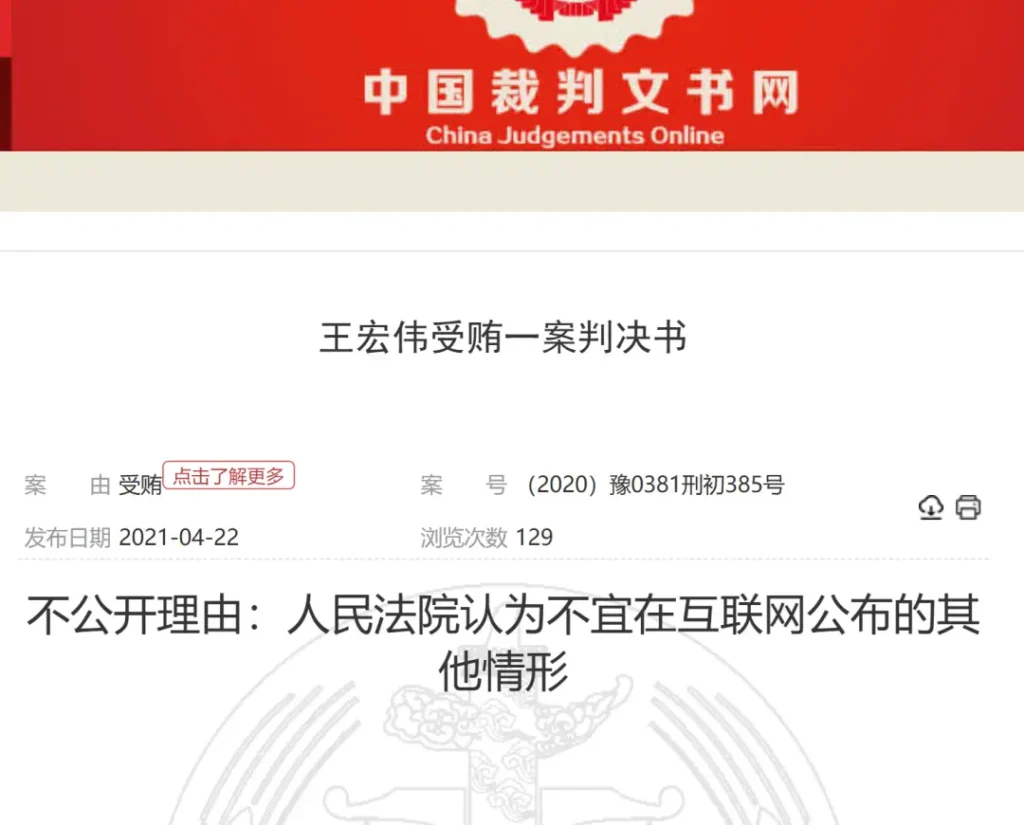
Why does the court consider it inappropriate to disclose the judgment of a former court president who is a corrupt official?
I don't understand. I personally believe that the judgment of such a defendant who violates the law should be disclosed, so that judicial colleagues can review and reflect on it, to avoid the same mistakes, and also to accept public supervision. Of course, I don't have the heart to blame this court, after all, there are not many corrupt officials' judgments that are truly made public. A small court may not be able to withstand such pressure.
It's just that, because of this, I can't understand the reason why the court only sentenced former President Wang to 6 years. There must be a statement in the judgment, what is this statement? Is it justifiable?
Over the years, many corrupt officials have been caught in the anti-corruption campaign, but my conditions are limited and my energy is limited, and my study and research on the specific sentencing of corrupt officials is also extremely limited, so I am increasingly unable to understand. Hopefully, technology doesn't become a kind of "art."
Yesterday's article was gone, and I feel a little down today. I can understand this result, everything is for the greater good, but I can't help but think of the tears that Pang shuling shed when she accepted a video interview many years ago. May Pang's descendants be well, and the support of so many strangers across the country in the past few months, I believe, can also give them more comfort and allow them to heal this long-lasting trauma sooner.
Yo-yo deer calls 20260211