

February 4, 2026

"Upholding the authority of the Constitution means upholding the authority of the common will of the Party and the people; safeguarding the dignity of the Constitution means safeguarding the dignity of the common will of the Party and the people; ensuring the implementation of the Constitution means ensuring the realization of the fundamental interests of the people."
Liu Hu (50 years old) is a well-known investigative journalist for the former Xin Kuai Bao, a symbolic figure in domestic public opinion supervision. In 2013, he was once detained for 346 days for reporting multiple officials by real name. Ultimately, the procuratorate did not prosecute due to insufficient evidence. The case was selected as one of the "Top Ten Media Law Cases in China" in 2015. After leaving the institutional media, he transitioned to self-media, continuously speaking out for vulnerable groups. He has promoted the investigation of major cases such as the Baiyin serial murder case and the Hainan Zhang Jiahui corruption case, and has been conducting in-depth investigations with personal efforts for many years. Wu Yingjiao (34 years old) is a post-90s investigative journalist and photographer. Currently, his child is just one month old. He is the core cooperative author of Liu Hu's self-media account and has been nominated for civil news awards multiple times.
On January 29, 2026, the two published an article on self-media titled "The County Party Secretary of Sichuan Who Forced a Professor to Death, Now Forces a Business to Bankruptcy?" They named and accused Pu Fayou, a representative of the Chengdu Municipal People's Congress and the Party Secretary of Pujiang County, of two issues: allegedly forcing a professor to death by demolition and illegally handling a business, leading it to the brink of bankruptcy. The article stated that Wang Lijun, a Shanxi businessman's postpartum care center project, was interfered with, leading to work stoppage and asset freezing. Local officials may have intended to seize the project and convert it into a kindergarten to extract government funds. Liu Hu's exposure included Wang Lijun's evidence, chat records, and on-site facts. The article was deleted shortly after its release, sparking public attention.
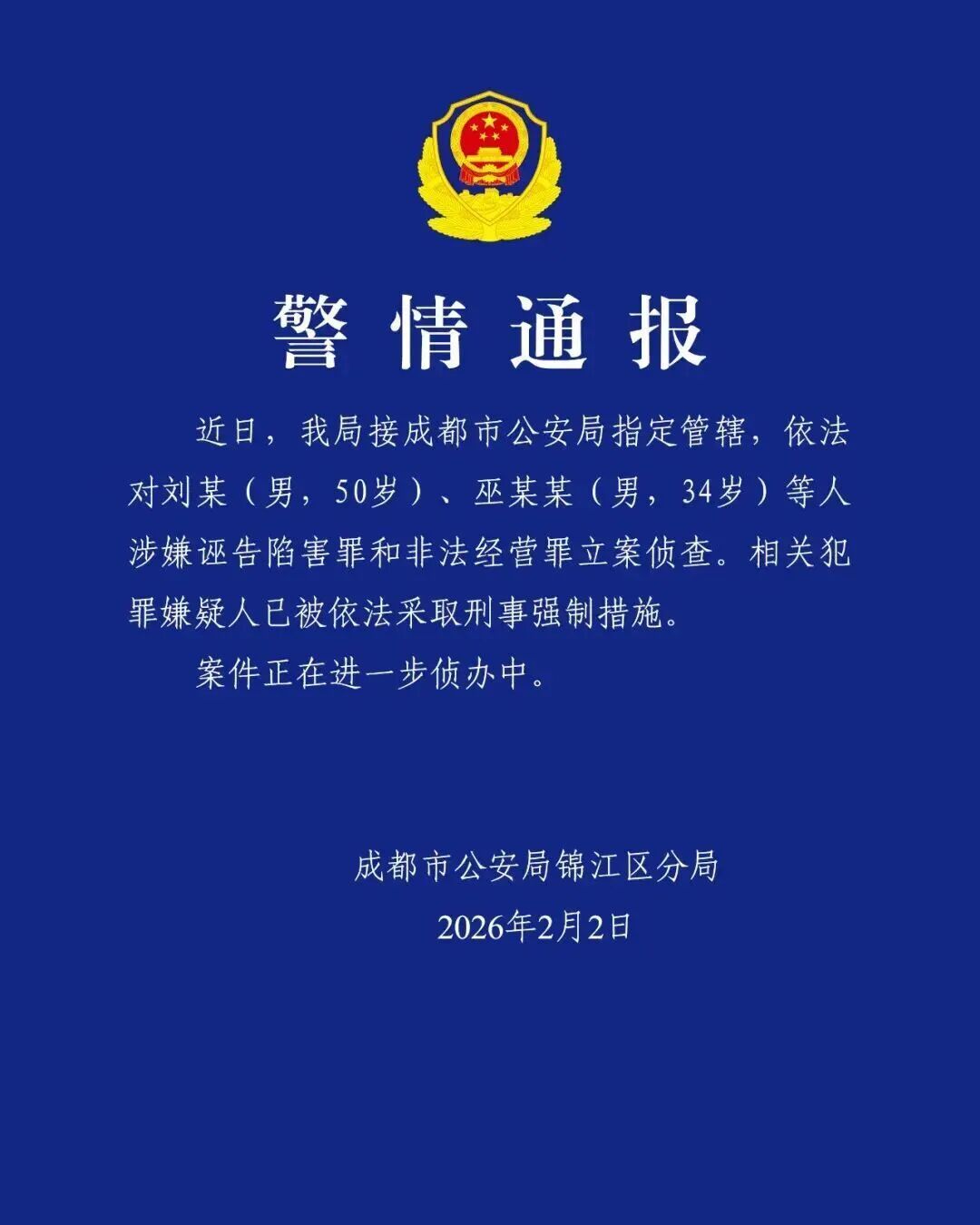
Liu Hu went missing on February 1st on his way to Beijing from Chongqing and was later confirmed to have been taken away by the Economic Crime Investigation Brigade of the Chengdu Municipal Public Security Bureau; his collaborator, Wu Yingjiao, was taken away by Chengdu police in Handan, Hebei on the same day. Both are currently detained in the Chengdu Detention Center. On February 2nd, the Jinjiang Branch of the Chengdu Municipal Public Security Bureau announced that it had filed a case against Liu Hu, Wu Yingjiao, and others for allegedly framing and illegal business operations, and criminal coercive measures have been taken against the two. Wang Lijun, the exposed enterprise involved, was also suspected of being taken away for investigation simultaneously.
The basis for the police's accusations has not been disclosed. Based on speculation, it is likely to include two aspects: first, it is determined that the two fabricated facts to frame Pu Fayou; second, it is accused that they charged fees to speak out for the involved enterprise, Mr. Wang, and are suspected of illegal business operations.
Question: If the police's accusations are recognized by the procuratorate and the court, and the court sentences Liu Hu and Wu Yingjiao for the crimes of framing and illegal business operations, and sentences them to imprisonment, is it possible to infringe upon their basic rights?
"Constitution of the People's Republic of China"
Article 35 Citizens of the People's Republic of China shall have freedom of speech, publication, assembly, association, procession and demonstration.
Article 37 The freedom of the person of citizens of the People's Republic of China shall not be violated.
No citizen may be arrested except with the approval or decision of the people's procuratorate or the decision of the people's court, and by the public security organ.
Unlawful detention and deprivation or restriction of citizens' personal freedom by other means are prohibited, and unlawful searches of citizens' bodies are prohibited.
Article 41 Citizens of the People's Republic of China have the right to criticize and make suggestions to any state organ or state functionary; citizens have the right to lodge complaints, accusations or reports to relevant state organs against any illegal or dereliction of duty by any state organ or state functionary, but they must not fabricate or distort facts to frame others.
Relevant state organs must ascertain the facts and be responsible for handling the complaints, accusations or reports of citizens. No one may suppress or retaliate.
Those who suffer losses due to the infringement of citizens' rights by state organs and state functionaries have the right to obtain compensation in accordance with the law.
"Criminal Law of the People's Republic of China" Article 225
Anyone who, in violation of state regulations, engages in any of the following illegal business activities, disrupts market order, and if the circumstances are serious, shall be sentenced to imprisonment or criminal detention for not more than five years, and shall also, or only, be fined not less than one time and not more than five times the illegal income; if the circumstances are especially serious,
shall be sentenced to imprisonment for not less than five years, and shall also be fined not less than one time and not more than five times the illegal income or have their property confiscated:
(1) Operating without permission the exclusive or monopolized items or other items restricted from sale as prescribed by laws and administrative regulations;
(2) Buying and selling import and export licenses, certificates of origin for import and export, and other business licenses or approval documents as prescribed by laws and administrative regulations;
(3) Illegally engaging in securities, futures, or insurance business without the approval of the relevant competent authorities of the state, or illegally engaging in fund payment and settlement business;
(4) Other illegal business activities that seriously disrupt market order.
"Criminal Law of the People's Republic of China" Article 243
Anyone who fabricates facts to frame others, intending to cause others to be prosecuted criminally, and if the circumstances are serious, shall be sentenced to imprisonment for not more than three years, criminal detention or public surveillance; if serious consequences are caused, shall be sentenced to imprisonment for not less than three years and not more than ten years.
A state functionary who commits the crime in the preceding paragraph shall be punished more severely.
If it is not an intentional framing, but a mistaken accusation, or the report is untrue, the provisions of the preceding two paragraphs shall not apply.
Analysis of Thought:
If the guilty verdict made by the court constitutes interference with the basic rights of Liu Hu and Wu Yingjiao, and the relevant interference cannot be justified, then their basic rights are infringed upon.
I. Scope of Protection
Citizens enjoy the right to supervise state organs and their staff in accordance with Article 41 of the Constitution. Liu Hu and Wu Yingjiao's article constitutes the exercise of the right to supervision.
II. Interference
The court's sentencing of Liu Hu and Wu Yingjiao to imprisonment constitutes interference with their right to supervision.
III. Justification
(I) Legal Basis
There is a legal basis, which is Article 225 and Article 243 of the "Criminal Law of the People's Republic of China".
(II) Constitutionality of the legal basis
Constitutional.
(III) Constitutionality of the application of law
When applying Articles 225 and 243 of the "Criminal Law of the People's Republic of China", an interpretation should be made, and based on this interpretation, it should be judged whether the actions of Liu Hu and Wu Yingjiao meet the factual elements of these two crimes. When interpreting these two articles of the criminal law, an interpretation consistent with Article 41 of the Constitution should be made, and the actions of citizens who legitimately exercise their basic rights should not be included in the scope of criminal acts.
IV. Conclusion
The case assumes that the court determines that the actions of Liu Hu and Wu Yingjiao constitute a crime, indicating that the court may not have made an interpretation of Articles 225 and 243 of the "Criminal Law of the People's Republic of China" that is consistent with Article 41 of the Constitution. In this case, the judgment infringes upon the right of Liu Hu and Wu Yingjiao to supervision.
V. Epilogue
This incident is currently ongoing, and we should have confidence in the judicial organs. As constitutional scholars, we also remind the case handlers and organs to pay attention to Article 41 of the Constitution and protect the basic rights of citizens.