Exposing the Chaos of Coal Gangue Paving at the Shaanxi-Inner Mongolia Border
History shows that where energy gathers, pollution, corruption, power, and business often intertwine, which is a particularly severe test of officials’ humanity. For example, Wang Huishi, the former deputy mayor and former director of the Public Security Bureau of Ordos, Inner Mongolia, was sentenced to 18 years in prison, and Du Zizheng, the former secretary of the Ordos Municipal Party Committee, is under disciplinary review and supervision by the Central Commission for Discipline Inspection and the National Supervisory Commission…
The core area of the Shaanxi-Inner Mongolia border energy belt is the Ordos Basin (including Yulin and Ordos), which is a rare energy-rich area in China and even the world. With its fossil energy reserves accounting for nearly half of the country’s total, more than one-third of the coal and natural gas, and its core role in national energy security, production, and transformation, it is known as China’s Kuwait, the Energy Golden Triangle, and the National Energy Heart.
According to relevant data, the coal gangue production in the three provinces and regions of Shanxi, Shaanxi, and Inner Mongolia accounts for 78.74% of the country’s total, and the Shaanxi-Inner Mongolia border is one of the most core areas. Ordos and Yulin rank in the top two among the top ten cities in the country in terms of coal gangue production. The Shaanxi-Inner Mongolia border energy belt (with Yulin and Ordos as the core) is one of the largest coal gangue producing areas in China. In 2024, the two places produced a total of about 135 million tons of coal gangue, accounting for 16.4% of the national total (825 million tons).
A conservative estimate is that the Shaanxi-Inner Mongolia region illegally disposes of coal gangue each year, accounting for about 1-3% of the total production, which is 1.35-4.05 million tons; of which illegal road paving accounts for 30-50% of the illegal disposal, about 400,000-2 million tons / year; the actual may be higher, because some illegal acts are hidden and have not been discovered or reported.
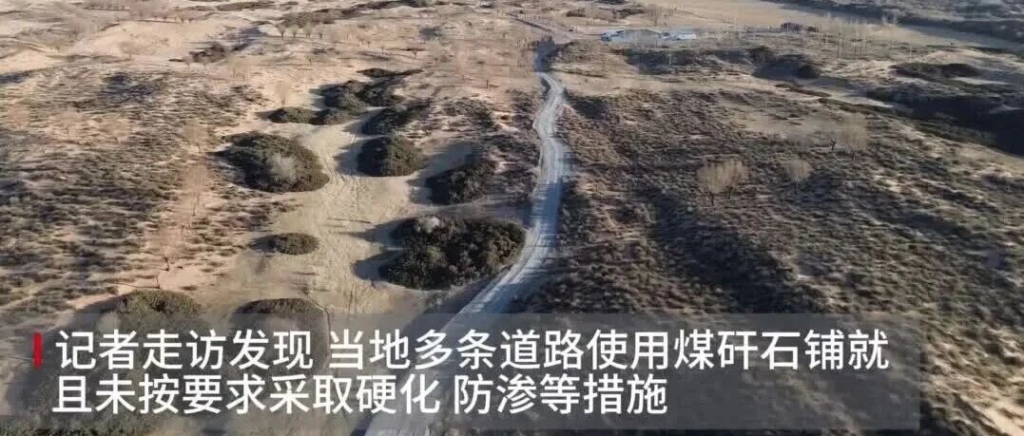
In two towns on the Shaanxi-Inner Mongolia border (Xiaohaotu Township and Tuke Town), part of the coal gangue paving is used for roads in various villages. Preliminary estimates, the total length of coal gangue within Xiaohaotu Township is about 100 kilometers. The area of Tuke Town has not yet been estimated.
Another part is used for roads for the construction and maintenance of wind farms by enterprises such as Shaanxi Investment, CGN, State Energy, and Huadian in Xiaohaotu Township, Shaanxi and Tuke Town, Inner Mongolia. A very conservative estimate is that the total amount of coal gangue consumed by wind power giants directly using coal gangue to pave roads is estimated to be between 2.3 million tons and 2.8 million tons. According to a medium conservative model, the filling volume of 1 kilometer of road is about 10,800 tons, then the total amount of coal gangue consumed is estimated to be 3.88 million tons.
According to relevant laws and regulations, the following situations are all illegal coal gangue paving:
A. Using coal gangue to pave roads in ecologically sensitive areas such as drinking water sources and nature reserves;
B. Coal gangue is not fully oxidized (stored < 3 years) or has a calorific value > 1000 kcal / kg (there is a risk of spontaneous combustion);
C. Failure to take hardening, anti-seepage, and drainage measures, leading to dust pollution and groundwater pollution;
D. Unauthorized use of coal gangue to replace regular building materials without environmental impact assessment approval.
Timeline
2022~2023, a private enterprise in Inner Mongolia (Inner Mongolia Zhuorui Shuyuan Environmental Protection Technology Co., Ltd.) paved coal gangue roads, 11 people were arrested, and after confiscating “illegal income” of 23 million yuan, they were released on bail, and more than 38 million yuan of the company’s funds were directly frozen. In December 2024, the People’s Court of Wushen Banner, Inner Mongolia, issued a “decision of non-prosecution” to the 11 people: “…violated Article 338 of the Criminal Law, constituting the crime of environmental pollution, but the circumstances of the crime were minor, with the circumstances of surrendering and pleading guilty, according to Article 177 of the Criminal Procedure Law, it was decided not to prosecute…”
This major environmental protection case involving a total of 61 million yuan was exposed in the summer of 2024, and the chaos of coal gangue paving at the Shaanxi-Inner Mongolia border came to the surface.
August 15, 2024, after the pollution of the coal gangue road in Xiaohaotu Township was exposed, overnight, more than 40 cadres went to the countryside, mobilizing the villagers of each village to cover all the exposed coal gangue in Xiaohaotu Township, which covers an area of more than 500 square kilometers, with sand. This is really a hot, dusty, unprecedented project.
August 18, the villages of Xiaohaotu Township are urgently pressing sand to cover the coal gangue
August 22, 2024, at more than eleven o’clock in the morning, Wu Yanrong, one of the parties involved in the coal gangue paving case involving 61 million yuan, went to the Wushen Banner Public Security Bureau to submit “evidence materials”: to prove his innocence and request the government to close the case as soon as possible… It stands to reason that such a simple thing as sending materials, he would be back soon, but as of more than 10 o’clock in the evening, Lao Wu was completely out of contact… At 5:42 p.m. on August 23, the police uncle with the mobile phone number 0963 in Yulin, Shaanxi, contacted Lao Wu’s wife again and informed the family by phone: Lao Wu will be detained for 15 days. The reason was “painting red paint on the road.”
August 24, 2024, Nut Brother published an article “Whistleblower Wu Yanrong was detained for 15 days! Why not arrest Nut Brother?”
End of June 2025, Nut Brother and Zheng Hongbin were arrested (Yulin police took the two away from Kunming and Xi’an), and were defined as “picking quarrels and provoking trouble”, and were given 20 days of administrative detention.
Mid-to-late July 2025, the local government paved red bricks on the coal gangue roads in some villages in Xiaohaotu Township, but paving red bricks on the coal gangue roads could not really solve the problem, and this project was subsequently suspended.
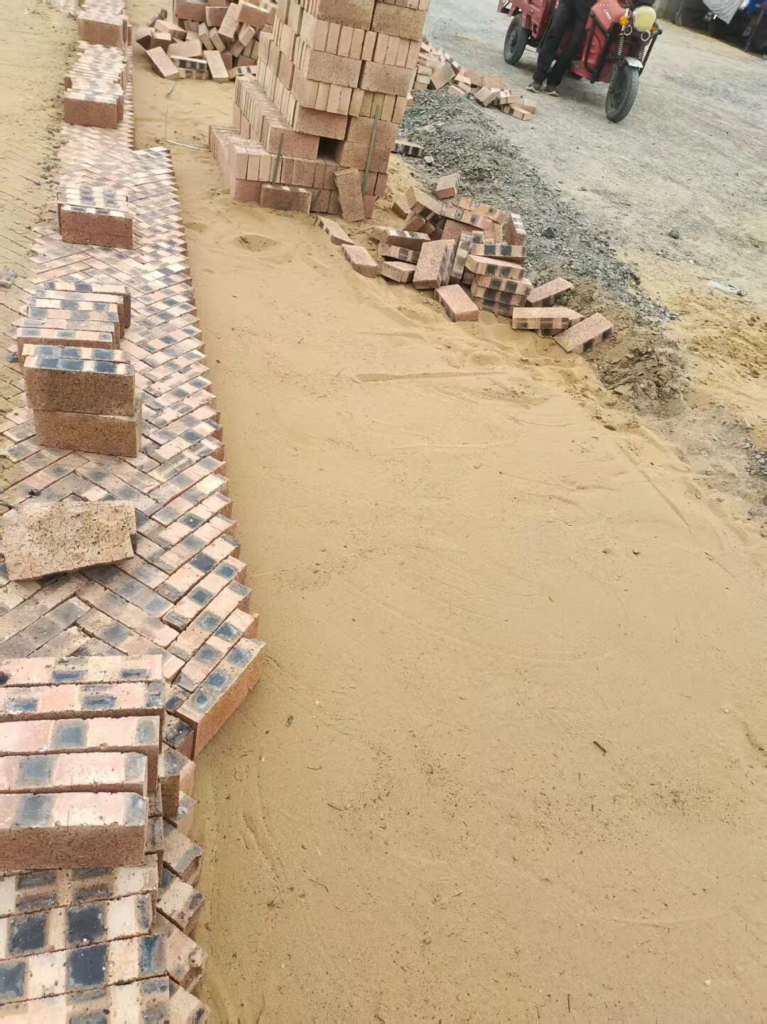
November 24, 2025, the Beijing News reported that Ordos used coal gangue to pave roads without hardening, causing dust to fly everywhere.
January 27, 2026, after on-site investigation and interviews, People’s Daily Online published a report (click to read) “Investigation of the Chaos of Coal Gangue Paving in the Water Source Area of Ordos, Inner Mongolia”.
People’s Direct Hit丨Investigation of the Chaos of Coal Gangue Paving in the Water Source Area of Ordos, Inner Mongolia
People’s Daily Online January 27, 2026 19:06Beijing
Recommendations for the rectification of “Chaos of Coal Gangue Paving at the Shaanxi-Inner Mongolia Border”:
1. Carry out a grid-style investigation and cleaning:
A. Conduct a comprehensive investigation of all coal gangue paved roads at the Shaanxi-Inner Mongolia border, including the huge amount of coal gangue roads built by wind power groups in Tuke Town and Xiaohaotu Township, and establish a “one road one file” exclusive file;
B. Give priority to cleaning up illegal coal gangue roads in sensitive areas such as water sources and nature reserves, and replace them with environmentally friendly materials;
C. Evaluate the coal gangue roads in non-sensitive areas, and rectify them within a time limit if they do not meet the standards (anti-seepage hardening, replacement of materials), and also echo the long-standing demands of the villagers: “The villagers hope that all the coal gangue roads in the township will be hardened and turned from coal gangue roads into cement roads”.
2. Strengthen law enforcement and accountability:
A. Punish the exposed incidents severely, increase the fine to 1-5 million yuan, and hold the responsible persons of enterprises and supervisors accountable;
B. Establish a “blacklist” system, include violating enterprises in the list of joint credit punishments, and restrict their credit and project approval;
C. Give play to the function of public interest litigation by the procuratorial organs, file civil public interest litigation against acts that damage the ecological environment, and recover ecological restoration costs;
D. Establish a three-in-one supervision system of “enterprise self-inspection + departmental spot check + public reporting” to truly implement the reporting reward fund.
Discover more from 自由档案馆
Subscribe to get the latest posts sent to your email.