

By Li Yuchen
At the end of November 2025, in Beijing, two of China's top official media outlets—China Central Television and Global Times—pressed the fast-forward button on a cyber storm almost simultaneously.
They, in an unquestionable posture, pronounced judgment on the political turmoil of Japanese Prime Minister Sanae Takaichi:
Her challenge has failed 'miserably,' and her defense is 'dishonest.'
This seemingly normal international political friction, however, did not result in a diplomatic statement, but a report from Global Times' Global Network, a video with large, emotionally charged, and humiliating text lasting 8 seconds, and a 13-second technical-processed ghost-animal short film produced by CCTV's 'Xiaoyang Video.'
Behind this, lies a carefully orchestrated network witch hunt driven by the state apparatus and followed by countless self-media outlets.
How was this frenzy organized? What forbidden means were used?
When a state-level public opinion machine decides to kill the public image of a female political figure, how many steps will it take?
1
A witch hunt usually begins by establishing an undeniable crime.
In the official media's narrative, Sanae Takaichi's original sin began on November 22, 2025, in South Africa.
The venue of the G20 leaders' summit:
She was about an hour late.
This fact itself may be unremarkable, but in a video released by Red Star News, a subsidiary of Chengdu Media Group, it was rendered into a highly dramatic tragedy.
At the beginning of the video, Sanae Takaichi gets out of her car and steps onto the red carpet. The entire scene is processed into an extremely slow motion, with a sad violin solo playing in the background.
This doesn't look like the appearance of a prime minister, but more like a:
Walk of shame.
Then, as she enters the venue, the camera shoots from behind the crowd, making her look like she's peeking around.
The text unequivocally points out:
She interrupted another leader's speech.
This audio-visual language, like a tragic movie scene, successfully magnifies a procedural flaw that may be caused by various complex reasons such as transportation and security, disproportionately into a public execution concerning personal character and national face.
This rendering cleverly utilizes the public's simple understanding of punctuality, a basic professional ethic, and successfully elevates a procedural issue into a moral stain.
Once the original sin of being late is established, the next step is to find a motive that is full of reasonable explanations for this crime.
2
The public opinion machine quickly found a perfect, gender-colored explanation for Sanae Takaichi's lateness:
She spent several hours the day before choosing clothes.
This information point comes from a post Sanae Takaichi herself shared on social media. She explained that because a senator reminded her that as prime minister, her attire in diplomatic situations represents the national image, and if she wears cheap clothes, she might be looked down upon by the other party.
This personal sharing, which may have been intended to show friendliness or explain work details, was quickly stripped of all context and became evidence in court.
A narrative construction, jointly promoted by Xinhua News Agency, China News Network, Red Star News, and other authoritative sources, began.
Xinhua Daily Telegraph, under Xinhua News Agency, directly defined her motivation in its short video as:
Wanting to gain the upper hand in diplomatic negotiations.
China News Network went further, citing anonymous Japanese analysts to conduct a remote psychological diagnosis for her:
It seems that Sanae Takaichi feels inferior deep down.
At this point, a complete, biased narrative loop is formed: a woman with low self-esteem and a desire to gain the upper hand, due to her superficial and excessive attention to dressing, ultimately made a late professional mistake in an important international setting.
This set of logic is unimpeded because it accurately hits a deep-rooted, ancient prejudice in society:
A woman's original sin begins with her excessive attention to her own image.
Chao News, under Zhejiang Daily Press Group, even pushed this prejudice to the extreme in its news-reporting video. In the clear and articulate broadcast of a professional female anchor, Takaichi Sanae's choice of clothes was portrayed as a kind of vanity, superficiality, and lack of professional competence.
Interestingly, in this set of narratives, male politicians' management of their own image—such as carefully choosing the color of their ties to convey political signals—is usually interpreted as rigorous, detail-oriented, and full of wisdom in body language.
But when it comes to Sanae Takaichi, the same consideration is easily defined as:
Vanity.
This double standard profoundly reveals the misogynistic core of this public opinion attack. It doesn't care about the complexity of the facts, but only cares about how to stuff the target figure into a pre-set, negative stereotype of a female image.
3
When being late and dressing up constructed an unprofessional professional image for Sanae Takaichi, the next step for the public opinion machine was to attack her stability as a person, that is, her emotions.
The target was precisely aimed at her facial expressions:
Smile.
At a press conference during the G20 summit, Sanae Takaichi, before answering questions, politely exchanged eye contact with reporters from different directions and maintained a smile throughout. This normal interaction, lasting less than 10 seconds, was deconstructed into a performance of mental disorder in a video released by 'Qingfeng Xia' under China Youth Network.
At the beginning of the video, at the moment when Sanae Takaichi lowers her head to prepare and then raises her head to smile, a line of yellow subtitles is superimposed on the screen:
(Takaichi OS:) Smile first.
This fictional inner monologue (OS) instantly defines a polite smile as a deliberate, premeditated fake smile.
Then, the video quantifies her smile in a pathological way.
During the reporter's speech, subtitles are constantly added to her face:
(Smile again), (Smile X3).
When she finally found the camera position of the questioning reporter and smiled again, the video repeatedly zoomed in with a strobe light effect and added the counts of 'Smile X5' and 'Smile X6'.
Through this microscopic scrutiny and the repeated counting techniques of online subculture, a coherent smile is cut into a series of mechanical, excessive, and unnatural actions.
The title of the video gives the final pathological diagnosis for this expression trial:
Her expressions are too rich! She changes her face continuously within five seconds, showing her signature awkward smile.
This is a classic stigmatization technique, which transforms political differences or disgust into an attack on her mental state. By implying that the other party's emotions are abnormal, it fundamentally denies the rationality of all their words and actions.
For female politicians, this kind of attack is particularly common and effective because it can easily combine with the social stereotypes of hysteria and emotionality.
Finally, the video, next to a still image of her smiling brightly, puts a panda head emoji with four words written on it:
I don't understand.
This comment does not come from a real netizen, but from the video creator himself. It completes the final judgment on behalf of all the audience: her behavior is so strange that it cannot be understood.
From unprofessional to emotionally out of control, from a professional clown to an emotional madwoman, the first round of the killing of Sanae Takaichi's public image is now complete.
This paves the way for subsequent more insulting and more naked attacks on her personality.
4
If the attacks mentioned earlier still wore a layer of discussing professional competence and emotional management, then the following frenzy completely tore off the disguise and evolved into a naked hunt against Sanae Takaichi's personality and body as a woman.
The core weapon of this hunt is no longer edited facts, but a series of insults that are carefully produced, packaged, and given authoritative certification.
Among all the labels in this public opinion storm, 'Mama-san' is undoubtedly the most core and most vicious one.
Its birth and evolution perfectly demonstrates how a network violence gradually enters the mainstream discourse from anonymous online slang, and finally becomes a professional term accepted by the mainstream.
To archaeologically study the evolution history of this label, a self-media account named 'Hushuo' contributed greatly.
In the video it released, the commentator used a mocking voice to imitate Sanae Takaichi's inner monologue:
My name is Sanae, his name is Trump... When he praises me, I'm as happy as a dog.
Then, on the close-up screen at the beginning of the video, a line of text is displayed:
This face is like a blooming chrysanthemum.
This vulgar comment, which associates a woman's smile with a specific body part, sets the tone for all subsequent sexual harassment narratives. It marks that the attack on Sanae Takaichi has shifted from criticism of her public behavior to the imagination and consumption of her body and sexual appeal.
This malicious seed soon found a more decent way of expression in the public opinion field.
The media brand 'Zhi News' under Shenzhen TV, in its released video, quoted a professional analysis by Taiwan current affairs commentator Tang Xianglong. In the program, Tang Xianglong, with a hint of disdainful smile, compared Sanae Takaichi's initiative and enthusiastic body language in diplomatic situations to a special entertainment venue profession in Japan.
He described the characteristics of this style in detail:
She will take the initiative to rub... will take the initiative to hold your hand... will go around behind you, and suddenly lean her head in front of you, and whisper in your ear.
After completing this set of sexually charged behavioral sketches, he officially awarded this diplomatic style a professional name:
Ginza Mama-san.
This is a perfect stigmatizing label. It simultaneously completes the triple humiliation of Sanae Takaichi as a woman (objectifying her as a service provider who pleases men), a professional politician (defining her diplomatic behavior as improper solicitation), and a Japanese person (using stereotypes of a specific profession).
From then on, the term 'Mama-san diplomacy' began to spread virally online, like a professional term certified by experts.
The self-media account 'Shi Kou Jia', in its video, included the embrace of Sanae Takaichi with Italian Prime Minister Meloni and the interaction with Lee Jae-myung, the leader of the opposition party in South Korea, all within this framework for analysis, and accompanied by a frivolous narration:
The Mama-san's ability is no joke.
After this label was repeatedly tested and its huge dissemination effect was confirmed in the public opinion field of self-media and market-oriented media, it was finally absorbed by more mainstream opinion leaders.
The well-known current affairs IP 'Tang Bohu's Chief Editor' under Phoenix.com, in a grand narrative video analyzing the great power game, although did not directly say it in the main film, but in the Douyin copy as an extension of the video, lightly wrote a summary:
Japanese politics has now become a kind of 'Mama-san diplomacy'.
At this point, the evolution of 'Mama-san' is complete. It started from an anonymous, dirty online slang, was packaged by overseas experts, legally introduced by media with a background of domestic official media, and finally certified by top current affairs IPs.
It is no longer a simple curse word, but has transformed into a professional tool that can be used to analyze and deconstruct international politics.
5
Under the leadership of the core label 'Mama-san', the sexualized interpretation of all Sanae Takaichi's body language has become legitimate.
A history-related self-media account named 'Shihua Fengyun' released a well-produced, highly cinematic video. At the beginning of the video, without any political background introduction, it directly focused the camera on Sanae Takaichi's body and eyes with suggestive words.
In the color-graded, atmospheric slow motion, the narrator said in a magnetic male voice:
'Being embraced in public', with a 'tender' expression, and her eyes are almost 'drawing silk'.
The passive voice of being embraced implies a kind of intimacy that is neither fully accepted nor rejected; the tender expression and drawing silk are the naked definition of normal diplomatic attention as a gaze full of lust.
The narrator of the video continues to push this imagination to a climax. He asked, in a tone of an elder instructing a younger generation, while looking at the scene of Sanae Takaichi gesticulating:
What's up, are you 'chasing stars' here? Sanae, aren't you forgetting that you are also the prime minister of a country?
This posture, which degrades public diplomatic behavior to private star chasing, and affectionately calls her by her name and instructs her in the tone of you are still too young, reveals a typical male-centered perspective, as well as the subconscious desire to judge and regulate female political figures.
The video released by 'Zhinan Finance' summarizes this gaze more theoretically. At the beginning of the video, the narrator gives a shocking conclusion:
Her diplomatic stage is not the parliament, but the show. Pleasing the self is her diplomatic means, and sexy body language is her diplomatic strategy.
Pleasing the self, this idiom, which originates from Chinese classical literature and is rich in male chauvinistic colors, is used here as a professional political analysis term. It rudely defines all the image management of a modern female politician as an act of pleasing men.
Behind this set of logic is an old prejudice:
Women dress up, not for themselves, but for men.
From the eyes drawing silk to pleasing the self, this public opinion campaign systematically strips Sanae Takaichi's body from her political identity, making it a female symbol that can be watched, fantasized about, and consumed.
6
If 'Mama-san' and sexualized gaze are only attacking Sanae Takaichi within the traditional male-female binary framework, then the introduction of the term 'female competition' marks that this network violence has completed the ultimate stigmatization of the internal relationship between women.
In the "Straight Guy Finance" video, which was full of epic feeling, after the narrator described how Sanae Takaichi flattered male leaders, the conversation shifted and the camera focused on her interaction with two other female leaders at the G20 summit - Italian Prime Minister Meloni and EU President von der Leyen.
In the picture, they embraced warmly and talked intimately. This was originally a normal scene showing the unity and friendship between female leaders.
However, the voiceover of the video gave a jaw-dropping definition:
She also launched a "female competition" style diplomatic offensive against Italian Prime Minister Meloni and EU President von der Leyen.
Female competition, this jargon, which originated from the online misogynistic culture and is full of biological and social Darwinism, has the core meaning of the mating rivalry between women in order to compete for male resources (power, wealth, attention).
This is the first time in this investigation that a video has used this term so clearly and systematically in the voiceover to analyze the interaction between female national leaders.
The viciousness of this linguistic innovation lies in the fact that it completely denies the possibility of true friendship, cooperation and political alliance between women.
In its logic, as long as there is more than one woman present, all interactions between them must be a competition around a male who is not present (in the context of this video, it implies Macron, who feels uncomfortable).
It has completely reduced the stage of international politics to a vulgar:
Harem Zhen Huan Biography.
This narrative is not only a great insult to the three female leaders, Sanae Takaichi, Meloni and von der Leyen, but also a systematic depreciation of all women who are struggling in the public sphere.
It attempts to implant an ideological steel stamp in the public's mind:
There is no politics between women, only war.
From the mama-san to the female competition, this online carnival, led by official media and participated by countless self-media, finally completed the stereoscopic and all-round killing of Sanae Takaichi as a woman.
She was successfully portrayed as a monster who only flattered those above (male power) and only competed with those below (other women), and completely lost her political subjectivity.
7
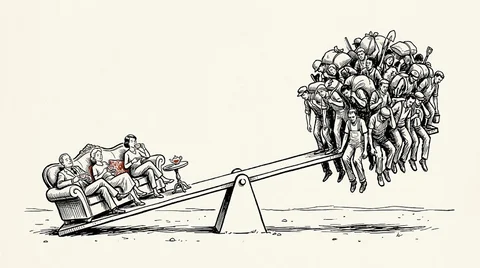
The horror of this online carnival against Sanae Takaichi lies not only in the viciousness of the language, but also in its high degree of organization and coordination. It is not a casual aggregation of a group of rabble, but a well-defined and efficient public opinion machine behind it.
Dissecting the operation mode of this machine is far more important than simply displaying those foul words.
By comprehensively analyzing the sources of these video materials, a clear three-layer narrative pyramid emerges. It shows how a modern online public opinion war sets the agenda from top to bottom, and how it innovates language from bottom to top.
The top of the pyramid is the central-level official media.
Represented by "Xiaoyang Video" under CCTV and "Global Times" under "Global Times", they play the role of the final judge. Their videos are the shortest and the information is the purest. They provide almost no process information, but directly issue the final judgment in an unquestionable manner.
The 8-second big-character poster video of Global Times directly declared:
Sanae Takaichi's embarrassment has been exposed.
Xiaoyang Video's 13-second ghost animal short film declared with technical means that her explanation was:
Dishonest.
These edicts from the top of power provide an irrefutable legitimacy foundation for the entire public opinion storm.
The body of the pyramid is the market-oriented media with official background and top political IP.
Represented by "Red Star News" of Chengdu Media Group, "Tide News" of Zhejiang Daily Press Group, "Direct News" of Shenzhen TV, and "Chief Writer of Tang Bohu" of Phoenix.com, they are the main force of this campaign.
Their task is to package the judgments issued by the top of the pyramid into news stories that are more watchable and easier to spread. They have better production and know how to mobilize the audience's emotions.
Red Star News uses a tragic slow-motion lens to render the belated sense of tragedy; Tide News uses the form of a professional female anchor to increase the authority of the attack; Direct News uses the method of quoting Taiwanese experts to provide a legitimate coat for the insulting labels.
They are the variable speed gears connecting the official will and the public sentiment.
The base of the pyramid is various self-media.
Represented by "Fox Says", "History and Wind and Cloud", "Straight Guy Finance", and "Yinan Finance", they are the front-line scouts and language laboratories of this public opinion war. They are not bound by traditional media, and they are the most daring and outrageous, responsible for producing and testing the most offensive insulting labels.
"Fox Says" contributed the imagination of the chrysanthemum, "History and Wind and Cloud" contributed the description of eye-drawing silk, and "Straight Guy Finance" innovatively introduced the theoretical framework of female competition.
These black words, which have been proven to have a strong dissemination effect at the base, will be quickly observed, screened and absorbed by the media at the body and even the top of the pyramid, and finally complete a legitimate counterattack from the private sector to the official.
These three-layer structures work closely together to form a perfect, self-circulating echo chamber. The top sets the tone, the body amplifies, and the base innovates.
Every actor in it accurately plays his role.
8
In the operation of this machine, a core skill that runs through the whole process is source laundering. Almost all offensive videos try to avoid directly insulting in the first person, but cleverly shift the source of the offensive remarks to a seemingly objective and neutral third party.
The most common method is to quote anonymous:
Japanese netizens.
In the videos of authoritative media such as Tide News, China News Network, and Xinhua News Agency, Japanese netizens' group ridicule has almost become a standard configuration. This method aims to create an illusion that even the Japanese themselves can't stand it, as if the video producer is just a fair international public opinion porter.
As for who these Japanese netizens are, how large the sample size is, and whether the views are representative, no one cares at all.
A more advanced method is to quote:
Taiwanese experts.
The quotation of Tang Xianglong's remarks by "Direct News" is a classic case of this method. It successfully disguised the label of "mama-san", which is extremely localized and full of discriminatory colors, as a professional sharp comment from across the strait.
This strategy of borrowing cannons across the sea can not only achieve the purpose of attack, but also perfectly avoid the responsibility of directly carrying out personal attacks.
More confusing is the official media's:
Internal mutual reference.
Xinhua Daily Telegraph, under Xinhua News Agency, clearly marked in its video that the information source was "Reference News", which also belongs to Xinhua News Agency. Global.com, under Global Times, directly made the title of the article by its own commentator "Beiping Feng" into a video for dissemination.
This constitutes a perfect, authoritative self-circulating argument:
I use my left hand to prove that my right hand is right.
The art of source laundering, its ultimate goal is only one:
To disguise a carefully planned subjective attack as an objective reflection of the real world.
9
When the individual attack on Sanae Takaichi reached its extreme, this public opinion war did not stop there, but began a more grand narrative upgrade.
Its goal is to bind her personal disgrace with the national destiny and historical guilt of Japan as a whole, so as to complete a final leap from character assassination to historical trial.
The long character biography released by "Yinan Finance" is a representative work of this stage.
It attributes Sanae Takaichi's madness to her military education in her childhood and her rebellious personality formed in a patriarchal family. All her choices in politics later were lightly summarized as a sentence:
If you can't beat it, join it.
This cynical mockery completely simplifies a woman's complex survival strategy under the patriarchal system into a kind of opportunism and surrender. Through this narrative of native family determinism and historical determinism, Sanae Takaichi is no longer an independent political individual, but a tragic figure doomed to go to extremes, cursed by history and childhood.
And the video of "Chief Writer of Tang Bohu" pushed this trial to the global stage.
The video directly defines Sanae Takaichi's remarks as the fuse that challenges the post-war international order. The independent diplomatic actions of major countries such as France, the United States, and Russia are all interpreted as taking sides around the core event of China's naming and criticizing Sanae Takaichi.
In the end, the video ends with a condescending question:
Do you (the five permanent members) still want this international order?
Through this extreme dimension-reducing attack, the criticism of Sanae Takaichi's individual is cleverly transformed into a grand narrative concerning global order and historical justice. She was successfully portrayed as a bad woman who endangers world peace.
At this point, this public opinion machine completed its final roar. It not only killed the public image of a female politician, but also used her body as a sacrifice to complete a grand sacrifice of nationalism.
10
Let's go back to the beginning of the story.
The G20 red carpet, which was carefully produced by Red Star News and full of tragic slow-motion lenses; the carefully selected clothing defined by Xinhua News Agency as wanting to gain the upper hand; the party leader debate whose voice was distorted by technical means by Xiaoyang Video; the Global Times big-character poster that finally declared that her embarrassment had been exposed.
These fragmented evidences have been repeatedly spliced, interpreted, and disseminated in the past month, and finally built an unbreakable cage.
Now, we can clearly see that this online carnival, which seems to be aimed at Sanae Takaichi personally, is essentially a systematic online sexual harassment led by the state machine and participated by countless accounts.
The language, visual symbols, and narrative framework it uses fully comply with:
Article 1010 of the Civil Code of the People's Republic of China on the definition of sexual harassment by means of speech, text, images...
What is truly chilling about this carnival is not Sanae Takaichi's political stance, but the iteration of the perpetrator's toolbox. When the highest mouthpiece of a country begins to skillfully use the language and methods of online mobs and package them as news and sharp comments, what it destroys is not only the image of a foreign politician, but also the bottom line and rationality of public discussion in the country.
It sends a clear and cruel signal to everyone, especially all women who are trying to speak out in the public sphere:
Any challenge to power may lead to a complete character assassination against your gender identity, regardless of your political stance.
When hunting a mad woman becomes a politically correct event with huge traffic and shared joy between officials and the people, there is no safe person in this hunting ground.
Therefore, when a sophisticated state machine needs to rely on words like mama-san and female competition to win a public opinion war, what it really shows is strength or weakness?
Li Yucheng's article is in the dust
Written on December 5, 2025
This article has opened quick reprint, welcome to reprint to your public account
Archive to prevent deletion, relay dissemination
Please include the appreciation picture at the end of the article when reprinting, and respect the fruits of labor
If you are willing to lend me your public account to help me publish articles, please read this article