People trapped in the fire
When Chen Yanfang, 67, learned that the community where she lived had caught fire, she was seeing a doctor in the hospital.
The news was told to her by relatives who drove past Hongfu Garden. At just after 3 p.m. on November 26, she rushed to the scene and witnessed the flames climbing the outer walls of the building, “burning upwards like a pillar.” She rushed back to the building where she lived and saw fire trucks parked at the door, and the whole building was shrouded in smoke.
The most serious fire in Hong Kong in more than 70 years has occurred. As of 3 p.m. on November 29, according to data from the Hong Kong Special Administrative Region Government Police Department, the fire has caused 128 deaths, including a firefighter, and another 83 people were injured. Among the missing, 144 people have been confirmed safe, and 150 people are still unaccounted for.
According to news from the Hong Kong Special Administrative Region Government Information Services Department, at 2:51 p.m. on November 26, the Fire Services Department received a fire alarm, and a fire broke out in Hongfu Garden, a community in Tai Po, New Territories, Hong Kong. At that time, the eight 31-story buildings of Hongfu Garden were all undergoing repair work, and the outer walls of the buildings were covered with scaffolding and scaffolding. The scaffolding on the outer wall of the F block Hongchang Court caught fire first, and the flames spread to the fourth floor in just six minutes, and then quickly rose to the high floors and spread to the neighboring buildings.
Within half an hour, the fire spread to the neighboring six buildings. In the end, the fire burned through seven high-rise buildings with more than 200 households, and more than 1,500 households were trapped in the sea of fire.
Tai Po District is located in the northeast of Hong Kong’s New Territories, far from the bustling core areas such as Hong Kong Island and Kowloon. The pace of life here is slow, and it is mainly inhabited by low- and middle-income families and the elderly.
The residents of Hongfu Garden are also mainly from the two generations of the 1960s and 1980s. According to the 2021 population census data from the Hong Kong Special Administrative Region Government Census and Statistics Department, of the 4,643 people living in Hongfu Garden, 36.6% are elderly people aged 65 and over, and 40 to 64 years old account for 30%.
They are mostly low- and middle-income people in Hong Kong. Hongfu Garden opened for application and sale in January 1983. It is the first generation of “Home Ownership Scheme” housing in Hong Kong. It is subsidized housing built by the Hong Kong government and sold to low- and middle-income citizens.
This type of house is called “Home Ownership Scheme” (HOS) for short, and is usually named “Garden”. In those days, the area of each unit in Hongfu Garden was about 50 square meters, and the first batch of sales averaged about 140,000 yuan, which was 50% to 70% off the market price.
In those days, most of the people who moved into the “Home Ownership Scheme” were young people in their twenties and thirties. In a certain sense, they are Hong Kong’s “sandwich class”: they are neither poor enough to apply for another type of subsidized housing that is only rented and not sold (referred to as “public housing”, usually named “Estate”), nor can they afford private housing at market prices.
Nowadays, this group of young people have become elderly people in their seventies, living with their partners and children or living alone in their houses. And their children, many of whom were born and grew up in the Home Ownership Scheme, have entered middle age.
At just after 10 a.m. on November 28, on the platform of the Guangfu Commercial Center on the northwest side of Hongfu Garden, Chen Yanfang picked up a yellow cartoon water cup from the aid supplies. She was still wearing the gray coat and jeans she wore on the day of the incident on the 26th, and the top of her dyed brown short hair had white roots. In the blue bag she was carrying, there were donated clothes from the citizens she picked up at the scene.
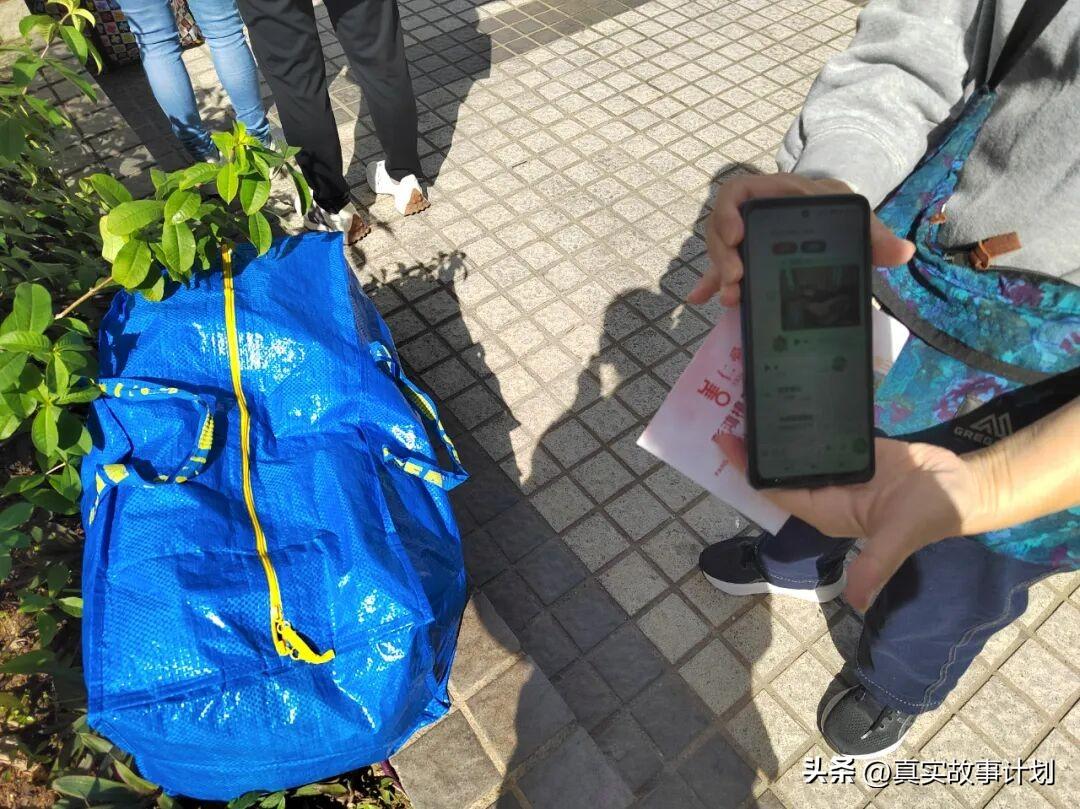
Picture | Chen Yanfang at the Guangfu Commercial Center platform, showing the situation of the resettlement site
This set of houses in Hongfu Garden was bought by Chen Yanfang in 1994, with an area of 50 square meters, two bedrooms and two living rooms, and a price of about HK$500,000.
Living in this house was the first class leap completed by Chen Yanfang and her husband as a low- and middle-income group in Hong Kong within a radius of one kilometer.
Initially, Chen Yanfang and her husband and their eldest son squeezed into their grandmother’s small public housing. It was not until the 1990s that the family of three applied for their own public housing and rented a 30-square-meter, one-bedroom apartment in Guangfu Estate, which is adjacent to Hongfu Garden.
After becoming pregnant again, she quit her clerical job to take care of the family and also began to plan to buy a house with her husband. The family’s income was not enough to buy a better property. The two of them studied the Hong Kong government’s plan again and submitted an application to purchase the adjacent Home Ownership Scheme Hongfu Garden – which not only was bigger and more spacious, but also meant that they finally had the opportunity to buy a home of their own in Hong Kong.
In the 1990s, when land was at a premium in Hong Kong, it was not easy to apply for a Home Ownership Scheme. According to the policy for public housing residents, Chen Yanfang first filled out a certificate of eligibility, and then the Hong Kong Housing Authority decided the priority order by “lottery”.
She waited for two years. Her husband was an ordinary company employee, and his monthly income at that time was HK$6,000 to HK$7,000, half of which was used to repay the mortgage. The remaining funds were saved by the two of them to support their two sons to study.
On the day they moved into Room 805, Block H, Hongfu Garden, the family of four started a new life. Over the past 31 years, Chen Yanfang’s two sons have married and moved out independently, each giving birth. The 50-square-meter space, with 30 years of memories, accompanied the couple into their old age.
On the day of the fire, her husband and Chen Yanfang were out for something. The two survived.
Standing at the door of the building, watching the fire fill the sky. Chen Yanfang suddenly realized that, except for the mobile phone, wallet, and keys in her pocket at the moment, she didn’t take anything with her.
After the windows were closed**
After the fire, on November 27, the three responsible persons of the engineering company Hongye Construction were arrested on suspicion of manslaughter. The Hong Kong Independent Commission Against Corruption (ICAC) established a special task force and launched an investigation into the corruption that may be involved in the repair project. On the 28th, 11 people were arrested, including engineering consultants, scaffolding engineering subcontractors and contractors.
In the cloud of corruption, most of them are low- and middle-income residents of Hongfu Garden, who have long lived in a dangerous confined space.
Since July 2024, the eight residential buildings of Hongfu Garden have started repairs at the same time. The outer walls of the buildings are covered with green scaffolding and bamboo scaffolding, and the outside of the residents’ windows is wrapped with foam. According to Caixin, before the repair work started, the engineering party told the residents that this was a protective measure to avoid debris falling and hitting the glass windows during the project.
According to preliminary investigations by relevant departments, the foam that wrapped the windows was an important factor in the huge casualties caused by this fire. The fire started in the low-level scaffolding, which then ignited the foam and rapidly spread to the neighboring buildings. The ignited foam also caused the glass to burst, and the fire entered the room, causing multiple buildings to catch fire inside and out.
During the one and a half years of repairs in Hongfu Garden, the balcony of Chen Yanfang’s house was closed, and two of the three air conditioners were forcibly removed.
The house was stuffy and humid, and there was no sunlight. She lived a life with a “secret room feeling”, “It’s a good sunny day, I don’t know anything, it’s a windy day, I don’t know anything, it’s so depressing.”
She also thought about moving out. But her two sons have already started families, and she thought it would be difficult to accommodate the two elderly people again.
During the building repairs, 71-year-old Lin Li and Chen Yanfang lived similar lives. Besides staying in Hongfu Garden, he “had no choice”.
In 1983, Lin Li bought a one-bedroom apartment on the 21st floor of Block E of Hongfu Garden. After retirement, he lived in the same house with his son. In his later years, Lin Li was in poor health and could not continue to work, and had no stable source of income, so he lived on his retirement pension.
More faces covered by foam flashed in the missing person help web pages: a 90-year-old man in a wheelchair and his caregiver. An 80-year-old woman living alone. An elderly couple in their seventies and eighties. An elderly man trapped in the toilet with a dead mobile phone. A father who sent the last message at 6 a.m. And several 15-month-old babies who had not been fed milk for several hours.
The eight 31-story buildings of Hongfu Garden have eight households on each floor. As a Home Ownership Scheme, one of the original intentions of the community design was to accommodate the most people in the smallest space. In a space of less than 50 square meters of usable area per household, two bedrooms, a toilet and a living room are separated, and an average of 3 to 4 people live in a family.
This logic also extends to each household. In the visible pictures, people are striving to build a life in the cramped space, with the ultimate use of indoor space.
Only a turning space is left at the entrance. Then, closely against the storage rack and shoe rack, avoiding the umbrellas, sundries, and plastic bags like eye-catching vines, turning around and raising your hand to turn on the lights in the hall.
After the kitchen is filled with a refrigerator, a sink, and a stove, there is only a space for one person to stand. The bowls and chopsticks are placed in the air, the exhaust fan is as thin as paper and pasted on the window, and the colander, spatula and other items are hung on the empty wall.
The dining room and living room are combined into one, which is a shared area for some multi-generational families and caregivers. All furniture adheres to the principle of small size, three sofas are not allowed to lie down, the square dining table is piled with plastic storage boxes, the TV is close to the wall, and the high-altitude TV cabinet is used to create a cat’s nest.
Anyone who wants to go back to the house to rest in advance only needs to get up and go around others, and the living room and dining room will immediately become much more spacious. However, in the secondary bedroom, which is three steps long and two steps wide, and a slightly larger master bedroom, in addition to the bed, it is also necessary to store the items accumulated by the whole family over the past decades.
Some residents shared that outside the high-rise windows of Hongfu Garden, before the repairs, they could see Tolo Harbour, Ma Shi Chau, and the peninsula and hilly terrain of Hong Kong, which hinted at the vastness of the world, which was why they loved it here.
During the one and a half years of repairs, many residents, like Chen Yanfang and Lin Li, lived in houses that were isolated from light and airtight, enduring the darkness and humidity. A video posted on social media, taken in October 2024 in Hongchang Court, Hongfu Garden, showed that the seven windows in the kitchen, living room, and bedroom were all pasted with foam. Even during the day, all four lights in the room were turned on.
On June 30, 2025, an owner claimed to be a “netizen” on social media, expressing his expectation for the end of the project, “I have been a netizen for a whole year, looking forward to the day when I can see the light again.”
They finally saw the fire. A photo taken by a resident showed that when the fire spread, the firelight from outside the window penetrated the foam and reflected the entire bedroom. On the bookshelf against the wall of the fire, there were fifty or sixty cloth dolls, and clothes and bedding were piled on the bed, and four Labubu in dust bags were hanging in front of the window.
When the flames burned through the foam that sealed the windows, the fire that climbed from outside the building invaded the room, and the narrow space that they had tried their best to fill with items and memories for decades instantly turned gray.
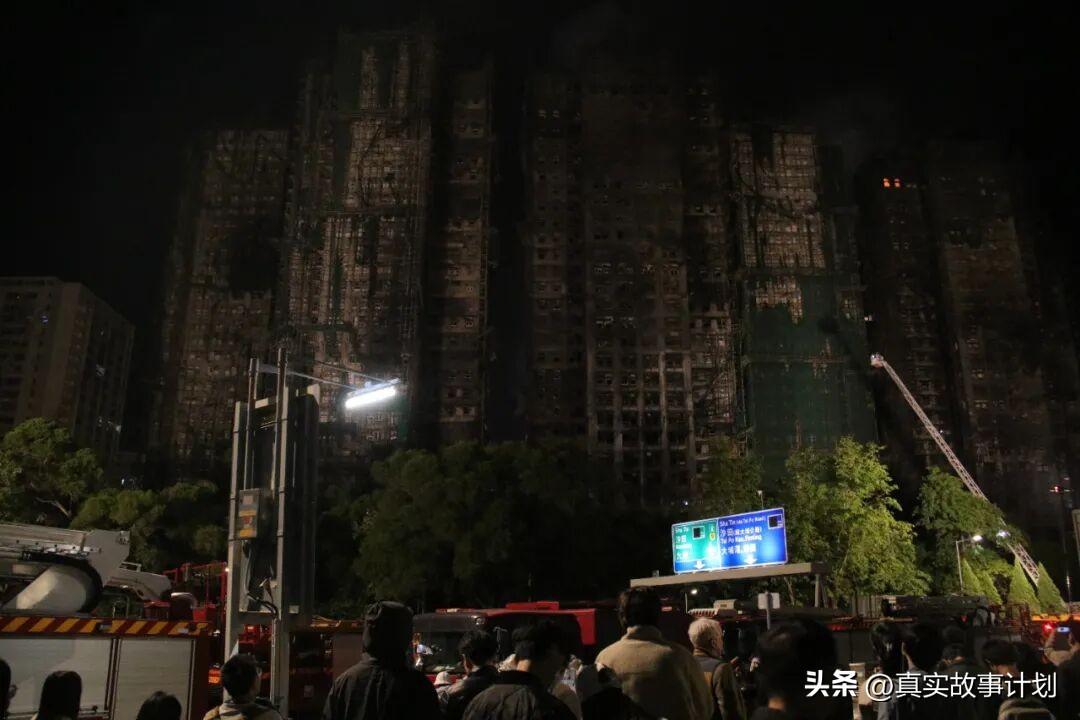
Picture | On the evening of November 27, smoke still came out from the top of Hongfu Garden
Chronic diseases and hidden worries
At the beginning of seeing the news of the fire, Zhang Jiawei, 35, who also grew up in a Home Ownership Scheme, had a premonition that “it would be very serious”.
In the past one and a half years of being a real estate agent in Hong Kong, whenever someone came to Zhang Jiawei to consult about buying a house in Hongfu Garden, his answer was only one: “I don’t recommend buying it.”
He believes that people of his age and the previous generation all know the hidden dangers of the Home Ownership Scheme, “they all came out of this”. “If I sell it to others and something like this happens (fire), can I not feel guilty?”
Zhang Jiawei’s parents are from Guangdong. After coming to Hong Kong to work in the 1980s, they bought a Home Ownership Scheme in Tuen Mun. He spent his summer and winter vacations there during his adolescence. The Home Ownership Scheme carries his childhood memories and is also the place he is most familiar with in Hong Kong.
In the past few years of shuttling through various buildings in Hong Kong, he realized that many Home Ownership Schemes have similar structural flaws: in addition to the chimney effect that is extremely easy to accelerate the fire, most Home Ownership Schemes do not have fire partitions.
In addition to the hidden dangers of structural design, the repair projects of old buildings also contain the more fundamental clues of the disaster. Since 2012, Hong Kong has implemented a “Compulsory Building Inspection Scheme”, and thousands of buildings in the city that are more than 30 years old must be inspected and repaired in accordance with regulations.
Hongfu Garden, which is 42 years old, received the government’s compulsory building inspection order in 2016, requiring repairs to the public areas and outer walls.
The Hong Kong Home Ownership Scheme implements a three-tier structure of the Housing Authority’s overall supervision, private property execution, and the owners’ corporation’s autonomy. Once the Home Ownership Scheme is required to be repaired, the owners’ corporation must take the lead in making repair decisions and raise the funds.
In 2024, the repair plan passed by the Hongfu Garden Owners’ Corporation attracted much attention. Local media reported that the total cost of the project of the contractor Hongye Construction Engineering Company was HK$330 million, which was shared by 1,984 households, with an average of HK$160,000 to HK$180,000 per household. The residents must pay the full amount within about half a year, otherwise they may be sued in court.
Many residents have had intense conflicts with the Owners’ Corporation. They questioned the unreasonable price, the rapid charging, and even suspected that there was a transfer of interests between the contractor and the Owners’ Corporation.
In addition to the possibility of corruption, Zhang Jiawei believes that the cost of HK$330 million has another reason. The outer walls of old buildings are made of tiles or cement. Once they age and fall off, large scaffolding must be built for safe repairs, and scaffolding is the most expensive part of the entire repair process. In contrast, the outer facades of newly built glass curtain wall buildings are durable materials, which do not require frequent major repairs, so the cost is much lower than that of old buildings. He believes that this high price is the concentrated outbreak of historical problems, and the result of the lack of daily repairs and maintenance of old buildings for decades.
At that time, Lin Li, who only had a retirement pension as his monthly income, felt that the repair costs constituted a considerable pressure. Some residents found that the repair costs were even higher than the price of the house they bought that year. Someone asked the Owners’ Corporation, “If I can afford the money, I won’t live here. Think about it, right?” The paradox was ignored. The repair project was carried out in controversy.
Only the low- and middle-income groups can live in the cheap “Home Ownership Scheme”, and after becoming old buildings that must be repaired, it also brings them an overload of pressure. This is a predicament unique to the “sandwich class”: those residents who rent “public housing” do not have to worry about the repair costs.
On the evening of November 27, two subway stations away from Hongfu Garden, also in the Home Ownership Scheme, Sui Wo Garden, an emergency residents’ meeting was held.
Many residents expressed their concern that the tragedy would be repeated. A notice was posted at the elevator entrance on the first floor of Sui Wo Garden, “Smoking is prohibited on the scaffolding and in the building.”
After the Hongfu Garden fire, Zhang Jiawei went to Sui Wo Garden and found that this 45-year-old community was almost facing a similar situation as Hongfu Garden before the incident.
Nine buildings are surrounded by green scaffolding due to repairs, and one of them has begun to dismantle the scaffolding and the net. Inside the building, you can see the bamboo scaffolding set up outside each floor, and the view outside the windows is covered by green scaffolding, and debris occasionally falls down. Some residents publicly stated that the kitchen windows in their homes were sealed with white boards of unknown material.
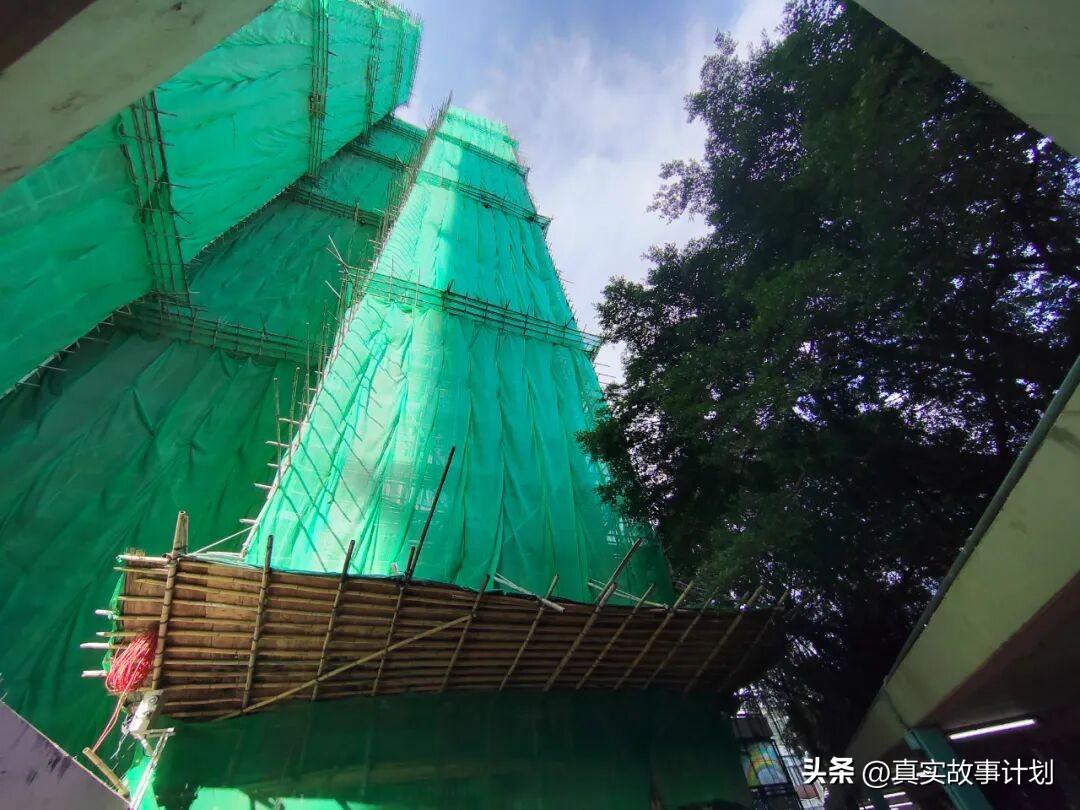
Picture | Outside Sui Wo Garden, surrounded by green scaffolding due to repairs
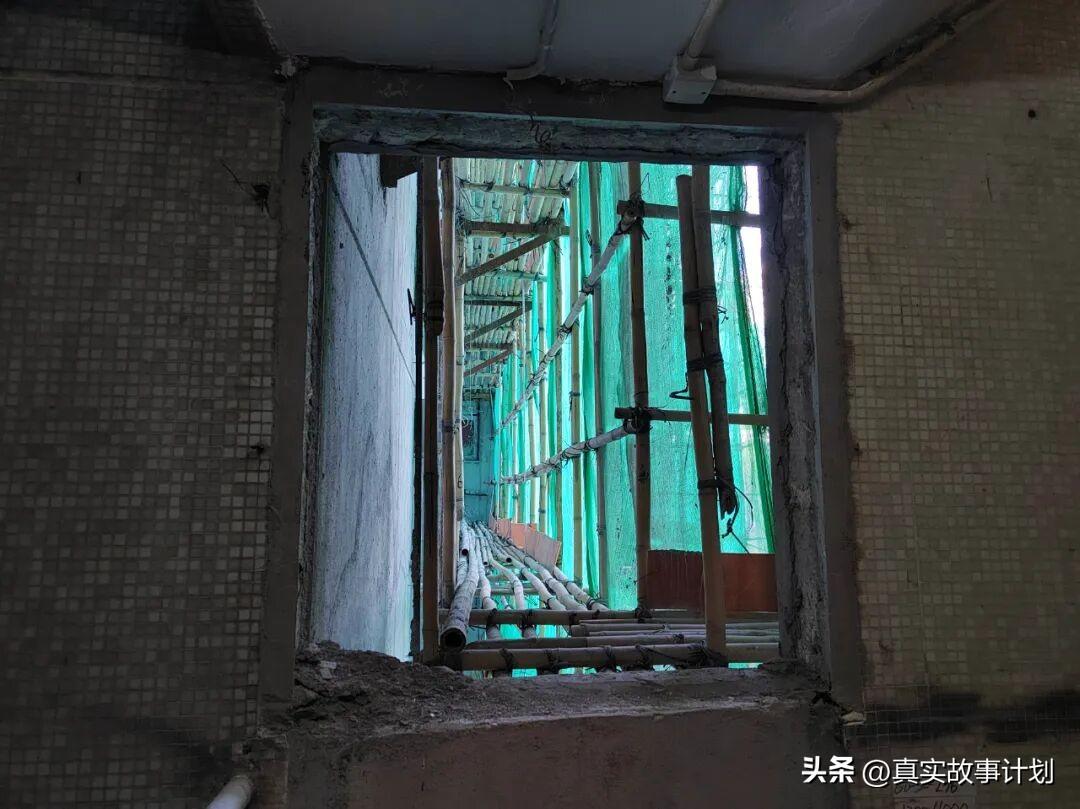
Picture | Internal view of Sui Wo Garden, the view outside the window is covered by green scaffolding
According to public information, Sui Wo Garden adopts a staggered cross-shaped design, with one elevator shared by every three floors, and one staircase shared by every three units. Similar designs can also be found in later-completed communities such as Tsui Yiu Garden, Hing Man Estate, and Ki Tak Tsuen New Village. Hongfu Garden, on the other hand, adopts a flexible cross-shaped design, with eight independent residential units arranged around the central staircase and elevator shaft on the same floor, which can accommodate eight families, and is commonly known as “eight-sided wind” by Hong Kong residents.
Many Home Ownership Schemes completed between 1981 and 1991 adopted a similar structure. However, this type of design also has fire hazards. For example, Hongfu Garden has a trough-type ventilation skylight on the outer side of the toilet and kitchen. Although it is conducive to ventilation and lighting, once a fire occurs, the skylight will form a strong chimney effect like the elevator shaft, causing the fire to spread rapidly upwards.
Some industry insiders analyzed that the difficulty of the five-level fire fighting in Hongfu Garden was precisely due to the chimney effect formed inside the high-rise building. Vertical passages such as stairwells and elevator shafts become the path for smoke and fire to rise rapidly in a fire, accelerating the burning of the entire building.
Many of the old neighbors living in Sui Wo Garden also believe that the Home Ownership Scheme has fire hazards. But even so, they are reluctant to move away from here.
These old Home Ownership Schemes carry their half-life memories. They are used to going to the familiar vegetable market in the morning, and then having a morning tea on the way, and chatting with the familiar old neighbors downstairs. The elderly who have saved money will subsidize their children and help them buy new properties; for families who have not saved money, their children will stay here, generation after generation.
On the morning of November 28, 71-year-old Lin Li stood at the door of the Dongchang Street Community Hall. There were many mattresses spread in the hall, and a full sign was posted at the door.
In addition to this community hall, after the fire, several shelters were opened in Tai Po District. The government has identified nearly 1,000 temporary units for the victims to live in for 1-2 weeks, and plans to arrange about 1,800 transitional houses and Housing Association units later. After the disaster, the Hong Kong Special Administrative Region Government invested HK$300 million to distribute emergency subsidies, consolation money, etc., and coordinated the psychological, medical, funeral and other forces to provide support. In addition, the relevant departments are inspecting all buildings in Hong Kong that are undergoing external wall repairs and erecting scaffolding to check the material flame retardant standards.
At 9 p.m. on November 27, 30 hours had passed since the fire. Outside the Tai Po Market MTR station, which is closest to the affected Hongfu Garden, was crowded with Hong Kong residents who voluntarily donated supplies.
After the fire, this became a material collection station. Daily necessities such as toothpaste, paper towels, and instant noodles will gather here, and then be transported to various rescue stations by volunteers. A Hong Kong citizen hurried to the scene with a bag of old clothes sorted from home. After work, she ran all over the nearby emergency shelters, all of which claimed that the supplies were sufficient.
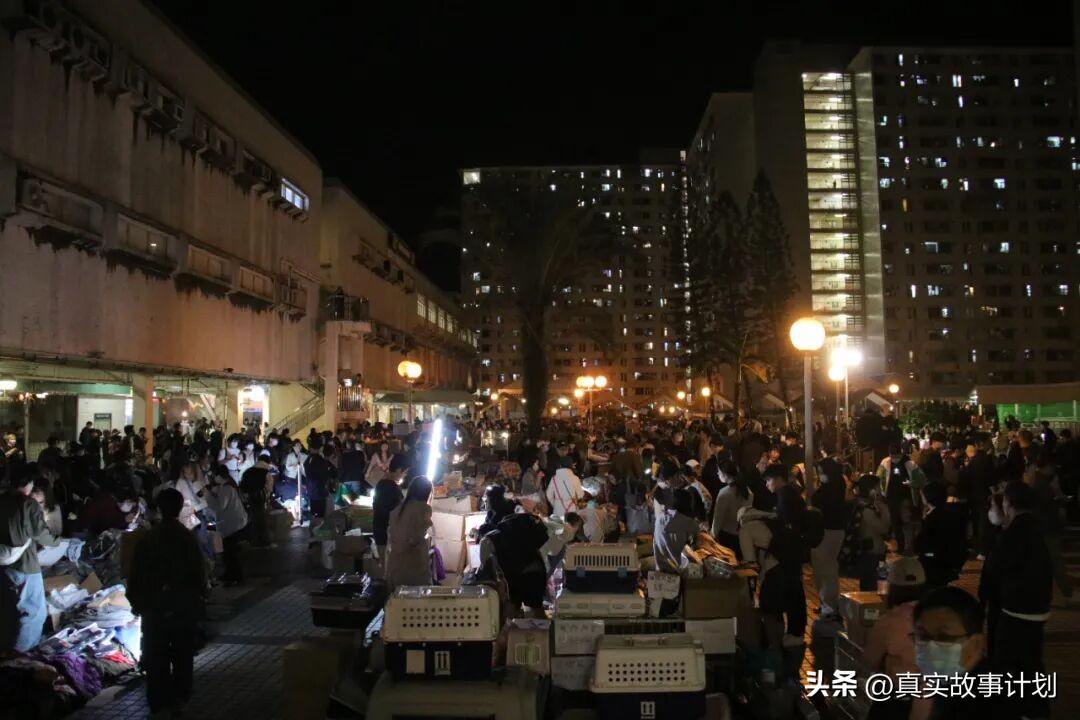
Picture | On the evening of November 27, volunteers gathered on the Guangfu Commercial Center platform
On the Guangfu Commercial Center platform, the volunteers were busy all night. People from all over the place gathered here, carrying boxes of supplies. The affected residents took the supplies they needed here. Psychological counseling, trauma relief and other services were provided on site.
Chen Yanfang, who was holding the yellow cartoon water cup, waited for her husband to come and meet her, and went to the resettlement site together. She learned that there were only two beds and a desk there, and the residence time was limited to two weeks. Chen Yanfang hasn’t figured out what to do next.
Lin Li, in the Dongchang District Community Hall, is waiting for his son to pick him up to a new place.
At the age of 29, he bought this one-bedroom apartment in Hongfu Garden. At that time, he was engaged in equipment maintenance work, and his monthly income was HK$2,000 to HK$3,000. As one of the earliest residents of the community, for 42 years, Lin Li has started a family and established a business in Hongfu Garden, and gave birth to children, “I thought I would always live here.”
When the fire broke out, Lin Li had just gone out for five minutes. Later, he learned that Hongtai Court, where he lived, was one of the most violent areas of the fire.
Discover more from 自由档案馆
Subscribe to get the latest posts sent to your email.