When I saw the news of the fire at Hong Kong’s Hung Hom Estate, my first reaction was that long-lost, gray-toned shock. That’s Hong Kong, a city in our hearts that symbolizes order, modernity, prosperity, and a benchmark for Asia. Now, it’s telling the world with a sky full of flames that the former Pearl of the Orient has become this mess.
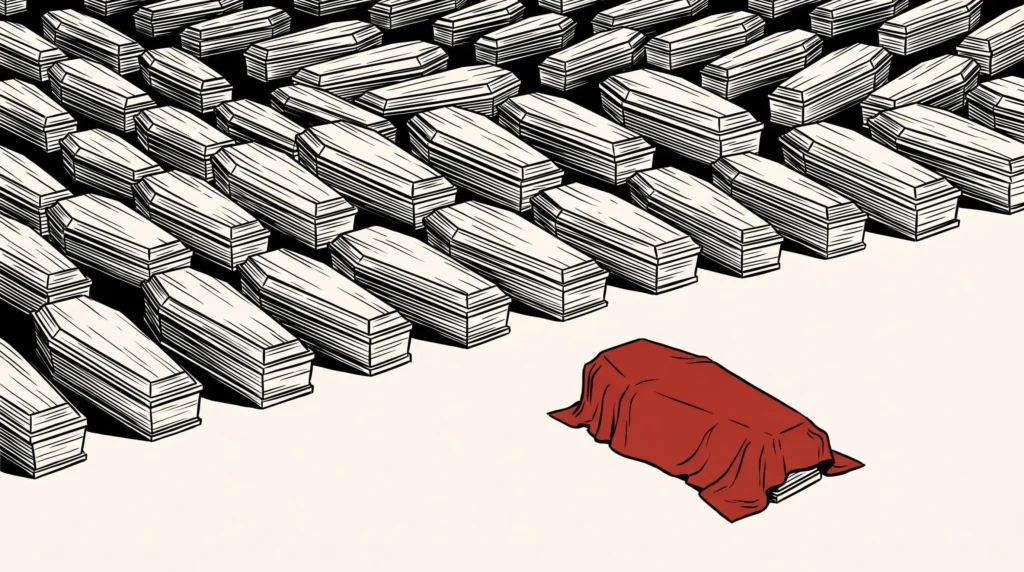
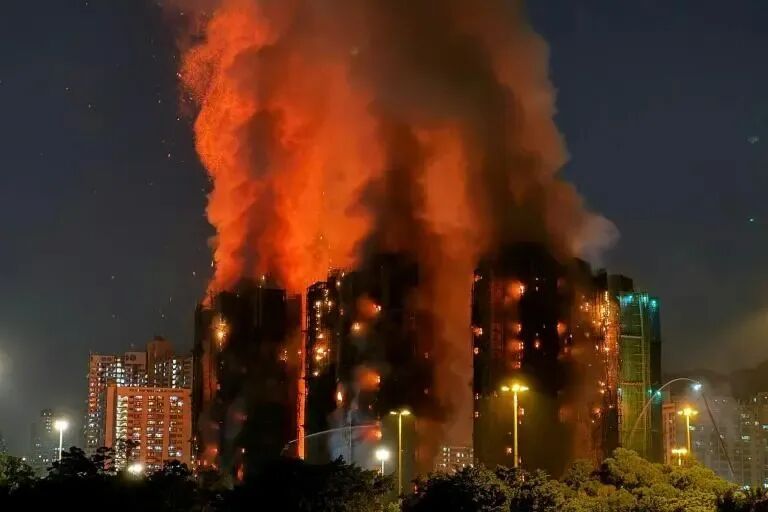
This fire is the most serious fire since Hong Kong’s return, and also the second most tragic urban disaster since the last century. In 1918, the Happy Valley Racecourse fire in Hong Kong resulted in over 600 deaths. This time, eight buildings caught fire, totaling 1,984 households, with 44 confirmed deaths and 279 people missing. Given the escape conditions in a high-density city like Hong Kong, being missing basically means death. This number is considered a super disaster anywhere.
What’s heartbreaking is that a large number of the missing are elderly people. Hong Kong’s aging rate is much faster than that of the mainland, and many old buildings are home to frail, slow-moving elderly residents. They cannot evacuate as quickly as young people, nor do they have the strength to push open doors, break glass, or rush down the stairs.
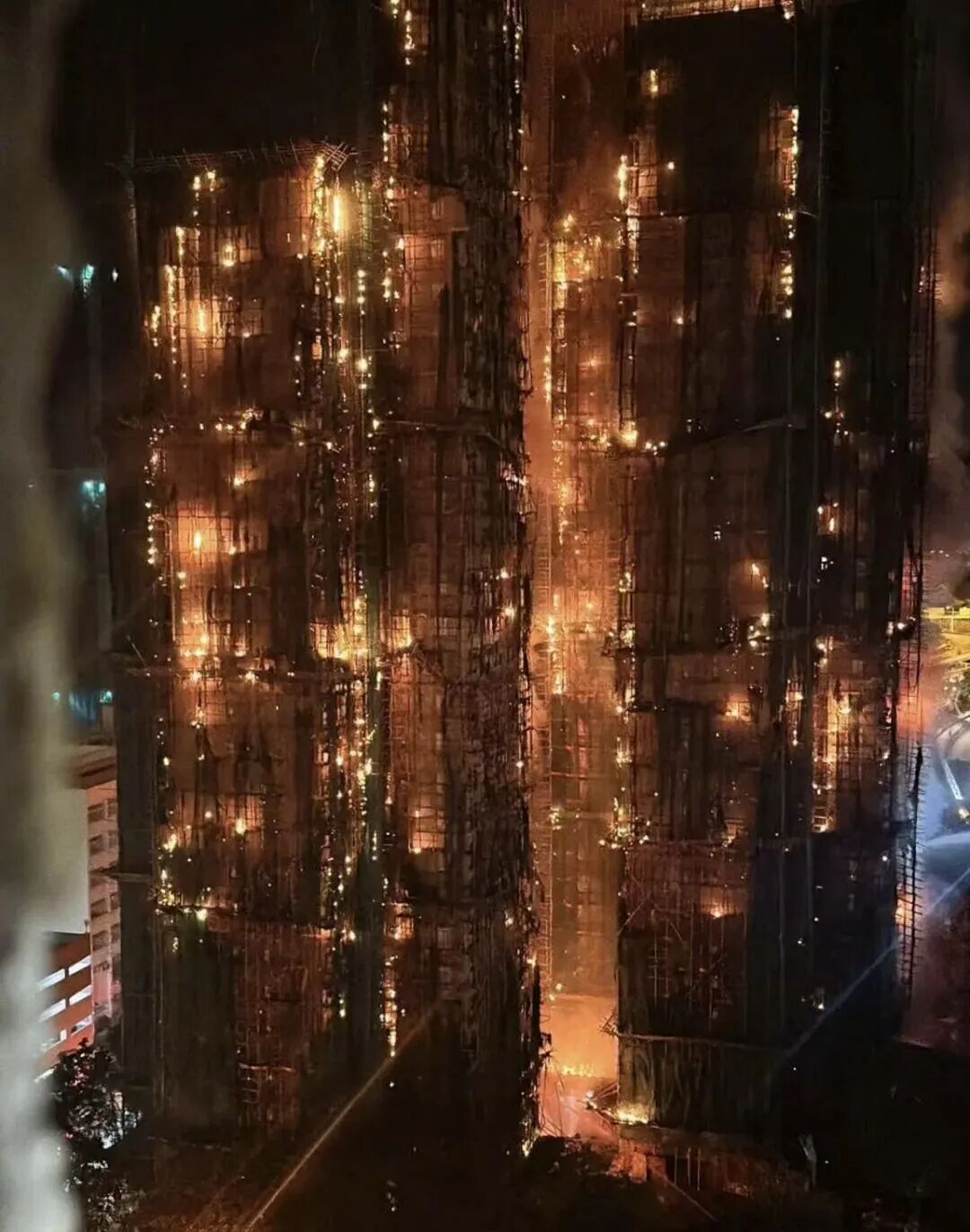
Foreign media has a photo from the scene, which is truly worth a thousand words.
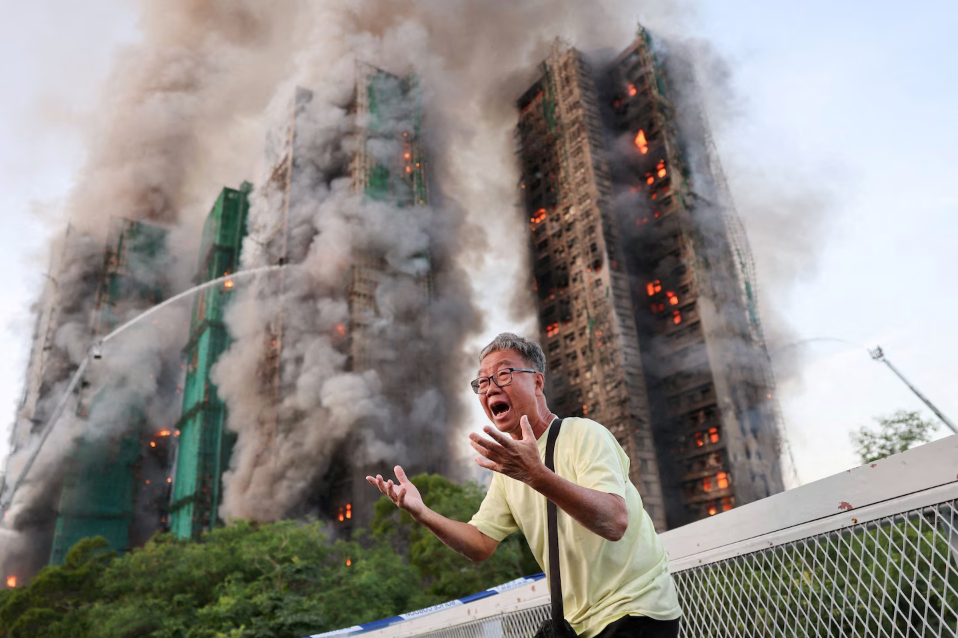
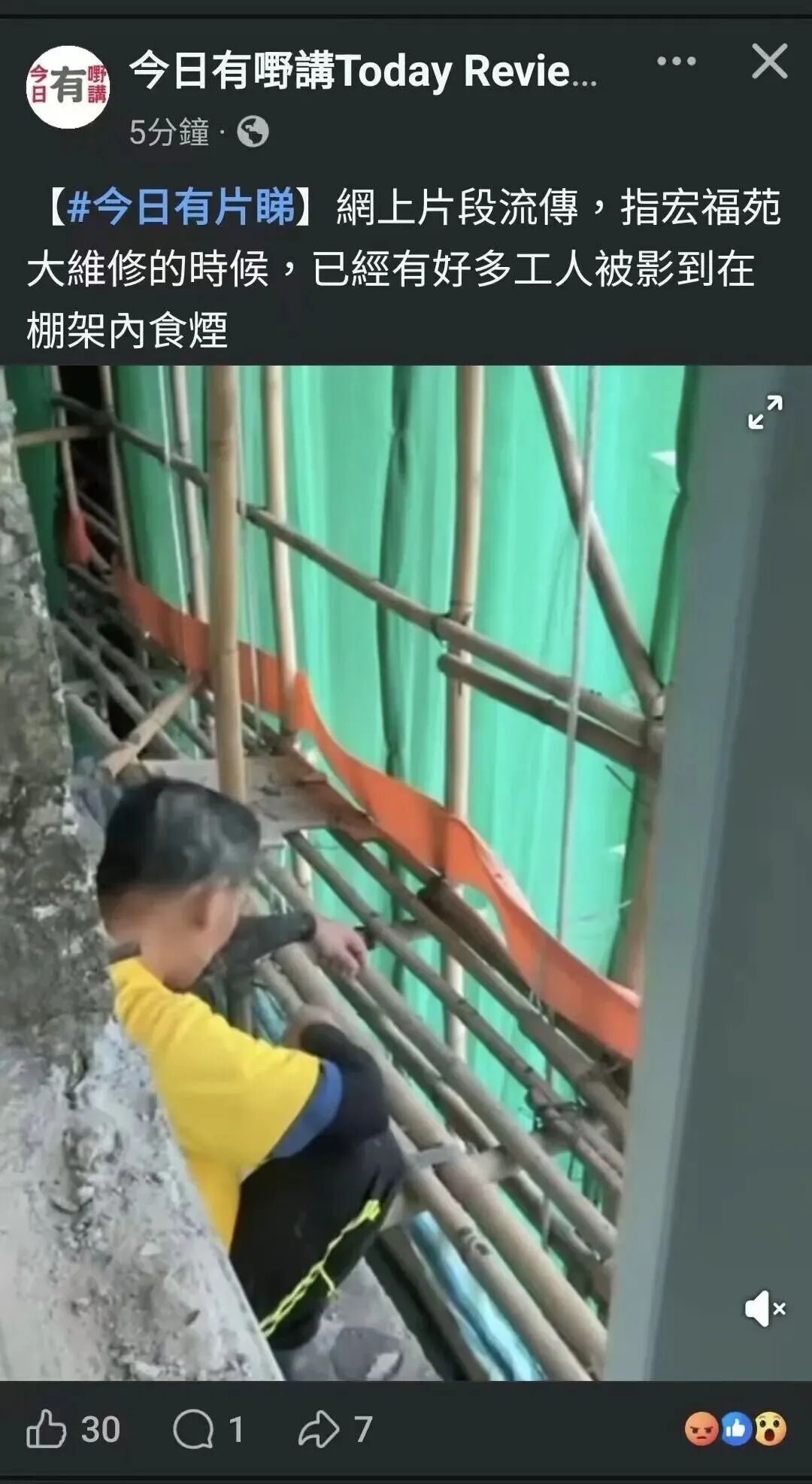
Hung Hom Estate was built in 1983, and most of the residents are middle-aged and elderly locals. Aging, high building age, and high residential density were originally part of Hong Kong’s urban fabric, and should not have become the trigger for the disaster. However, the bamboo scaffolding used in the exterior wall renovation project, plus a layer of cheap, flammable nylon netting, coupled with several days of unusually dry and windy weather, and possibly workers smoking, these conditions combined to create a rare disaster.
Bamboo scaffolding has always been regarded as a “Hong Kong characteristic.” In urban image promotion, it is a local craft and traditional wisdom. Trade unions have also long emphasized that bamboo scaffolding is low-cost, flexible, and has a mature team of technicians, making it a cultural asset of Hong Kong’s construction industry. But if you look at the major fires in Hong Kong over the past 20 years, you will find that bamboo scaffolding and flammable netting are almost always present.
A fire-retardant net costs 90 Hong Kong dollars, while a nylon net costs 50. Fire-retardant nets are prone to degradation after sun exposure and cannot be reused; nylon nets can be repeatedly put on and taken off, so construction teams will definitely choose this to save costs. Hong Kong’s fire regulations are clearly stated, but in practice, they are widely used. Isn’t this a systemic dereliction of duty by Hong Kong’s management?
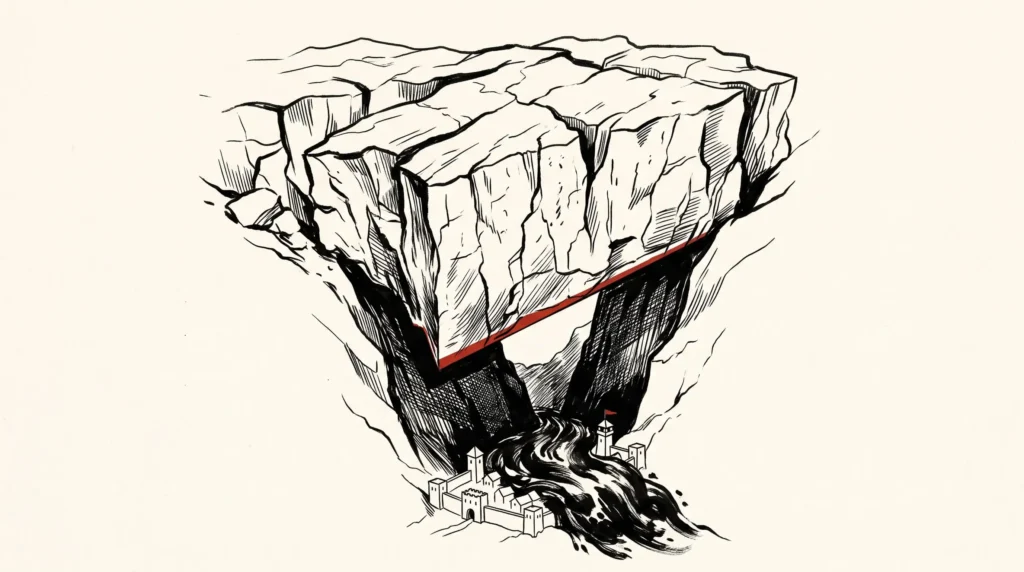
The tragedy of this fire is the result of the overall decline in Hong Kong’s urban governance capabilities.
Hong Kong was once known for its strict building regulations and strong regulatory system. Exterior walls of buildings need to be renovated, scaffolding needs to be erected, and materials need to be replaced, and every step requires application, approval, and acceptance. But in today’s Hong Kong, the regulations are still there, but the enforcement is becoming more and more lax. The regulatory departments have reduced staff, outsourced processes, and shifted responsibilities, and all parties are unwilling to bear the cost of supervision.
I wonder if anyone realizes that if it weren’t for this five-alarm fire, how many people would remember Hong Kong today?
In the past, “Hong Kong, Macau, and Taiwan,” Hong Kong always ranked first—the financial center, cultural center, film center, and bridgehead of the Chinese-speaking world. Hong Kong dramas, Hong Kong films, Hong Kong stars, the Hong Kong system, the efficiency of the Hong Kong government, the professionalism of the fire department, the cleanliness of the buildings, and the prosperity of society… It was once the most concrete template for the Chinese-speaking world to imagine a modern city. Today, the vocabulary related to Hong Kong in the news is like this: the housing market is frozen, the emigration wave, the wealth gap, the industrial hollowing out, young people going north, security incidents, and the decline of government governance capabilities… None of them are good labels.
Over the past decade or so, Hong Kong’s international status, economic momentum, social order, and administrative efficiency have been declining continuously and visibly.
From the decline in airport flights to the loss of talent in higher education; from the fiscal deficit to the housing market downturn; from social division to the decline in the quality of public services, Hong Kong reveals a collective anxiety everywhere. It’s just that Hong Kong people have never had time to stop and reflect, because events come one after another, and storms follow one after another.
After this fire, can Hong Kong’s construction industry regulatory departments escape accountability? It’s difficult. Eight buildings were burned down in one fire, which is a natural disaster, but also a man-made disaster. A disaster of this level in a city cannot be without political consequences. So who should be responsible? I won’t name names here.
I’ll use Cantonese to scold these Hong Kong officials:
又唔识做,又唔肯做,打工都係交行货,真係班废柴.
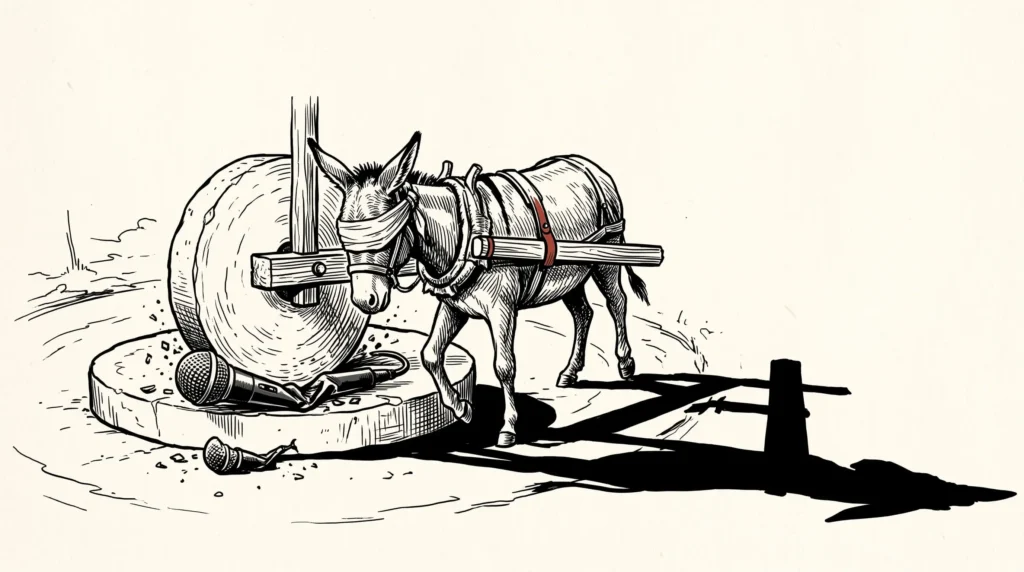
The Hong Kong media used to be very powerful. The old meme of “too simple, sometimes naive” was born because of the Hong Kong media. Is today’s Hong Kong media still as sharp as before? I hope they rise up.
This time, the exterior wall renovation of Hung Hom Estate has a budget of over 330 million Hong Kong dollars. Averaged out to 160,000 to 180,000 Hong Kong dollars per household, which is 150,000 yuan. This is not a small amount, and many Hong Kong people, especially those living in these old buildings, may not be able to afford it.
Then the question arises, what if it’s not repaired?
If it’s not repaired, it means that the exterior walls will fall and kill people, water will seep in and corrode the steel bars, and the structure will be damaged and become a dangerous building. Hong Kong has therefore enacted legislation requiring residential buildings that have exceeded a certain age to be compulsorily repaired.
Hong Kong has a shortage of land and a large population, with high-rise buildings everywhere, which is unavoidable, but the mainland is different. The mainland does not lack land, but it has also been building high-rise buildings like crazy in recent years. Thirty stories, forty stories, fifty stories, often with thousands of households. From 2010 to 2020, it was a decade of explosive construction of high-rise residential buildings in China. Everything looks good now, but what will happen when they reach thirty or forty years of age?
As long as you live long enough, many people will face these problems—
If you repair, each household has to pay tens of thousands, can you and your neighbors afford it?\
If the government enforces it, how much social conflict will it trigger?\
If the government doesn’t enforce it, how many safety hazards will be buried?
The population density in the mainland is not as high as in Hong Kong, but there are more high-rise buildings, more complex materials, and uneven construction quality. Once they enter the aging cycle, the risks will only be greater. Over the past decade, real estate has become the main engine of China’s economy, and everyone thought they were buying an asset that could be passed down through generations. But the reality is that the lifespan of high-rise buildings is not unlimited, and at some point, the cost of repairs will even exceed the value of the house.
This is an old problem that urbanization must face, and we have just entered this cycle.
May the deceased rest in peace, may Hong Kong wake up, and may we all see the future from this fire.
Discover more from 自由档案馆
Subscribe to get the latest posts sent to your email.