

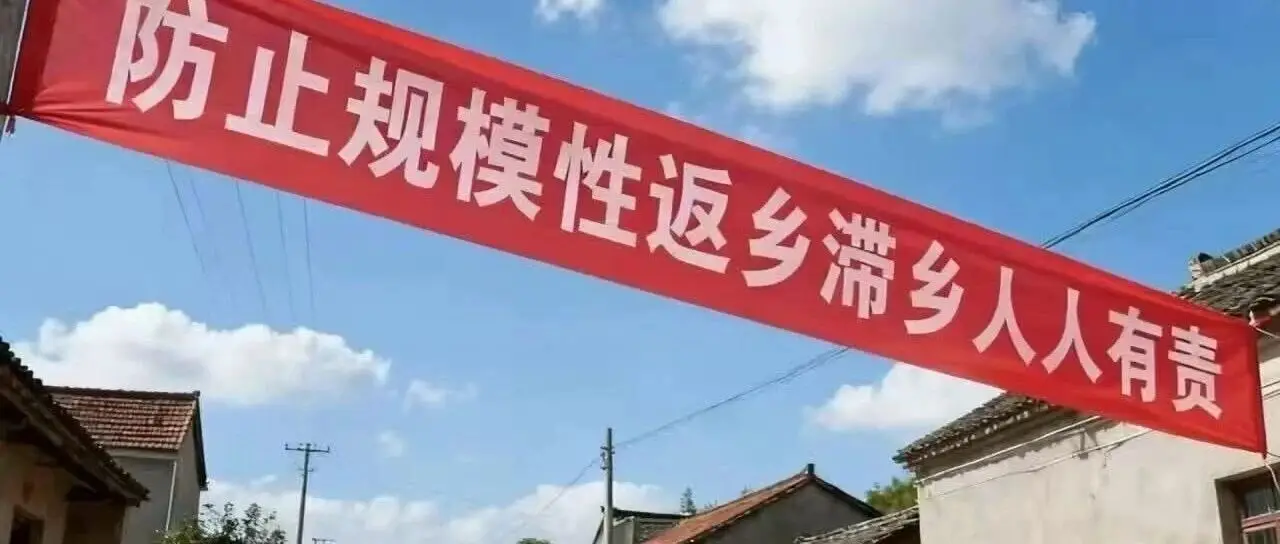
Seeing such a banner alone makes one think:"
Are they going to ban migrant workers who can't find jobs from returning to their hometowns? Are they going to drive out those who are "lying flat" in their hometowns and returning to work?
However, if you carefully understand the background of this sentence, you will understand that it means roughly the same thing, but the method is not what everyone thinks.
According to my investigation, this sentence was first proposed by the Ministry of Agriculture at a meeting held in Yunnan. The background is to require all regions to find ways to promote employment for people who have already been lifted out of poverty, to prevent a large-scale return to poverty due to unemployment, and then lead to a large-scale return to their hometowns, preventing the formation of a situation where a large number of unemployed and impoverished people stay in the countryside.
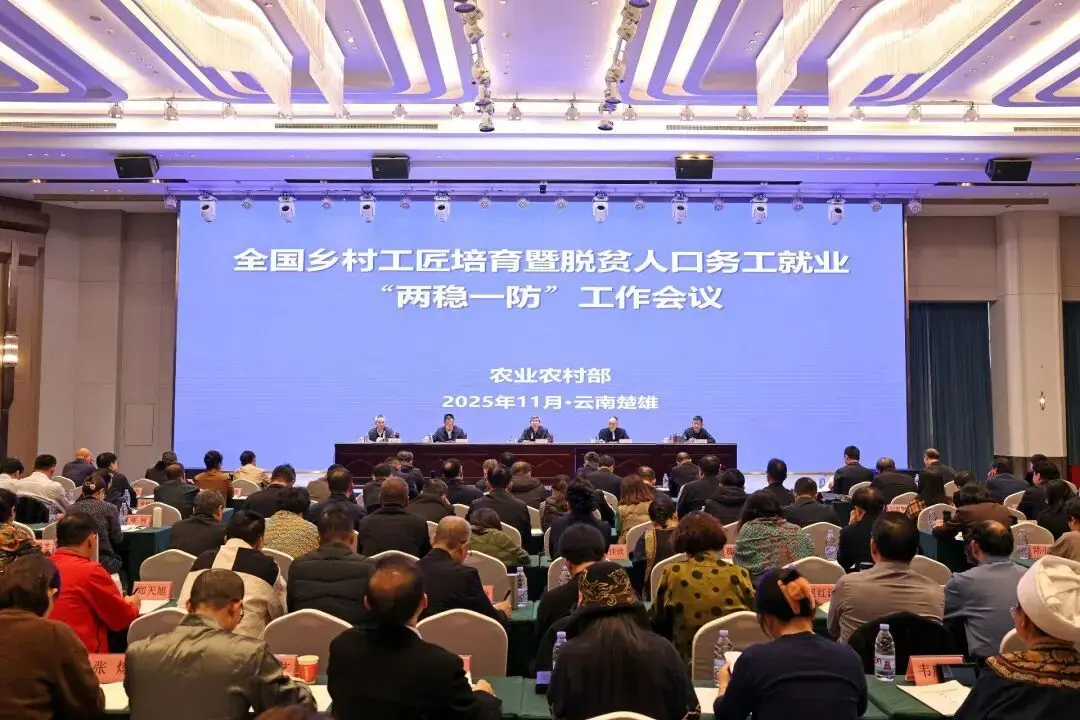
At this meeting, the Ministry of Agriculture required all regions to strengthen the development and management of public welfare positions in rural areas, support the upgrading of employment assistance workshops, improve the effectiveness of employment skills training, and continuously promote the rectification of problems found in the assessment. It is also necessary to increase the efforts of employment assistance in key counties for rural revitalization, relocation areas for poverty alleviation, and disaster-stricken areas, and focus on stabilizing the scale and income of employment for people who have been lifted out of poverty.
It seems that there are many things that can be done and many methods that can be used, right?
Hmmmm……
I will analyze these measures one by one to help everyone understand the actual situation.
Strengthening the development of public welfare positions in rural areas, simply put, is the cleaning of villages, the maintenance of ancestral halls, the patrolling of collective forest land, etc. There is indeed room for development, but how to say it, it is very small. Villages with better economic conditions have already set up these positions in the past few years. In villages with not so good economic conditions, if you want the village collective to take out money to add new positions in the past two years, the village collective will definitely reach out to the government for subsidies. After going around, the pressure still has to return to the central finance.
Supporting the upgrading of employment assistance workshops means that some factories that have accepted a large number of poverty-alleviated migrant workers for employment should be given some subsidies to help them upgrade their equipment, thereby stimulating and improving the enthusiasm of other factories to arrange employment. Not to mention whether the workshop will lay off workers immediately after upgrading equipment and improving efficiency, the question of where the subsidy money comes from is a big problem.
Improving the effectiveness of employment skills training is of course a good direction, but it may be a little far from the core of the problem...
On the one hand, the vast majority of the population that has just been lifted out of poverty in the past few years are actually employed in general workers in factories, the construction industry, or basic service industries. These positions basically do not require any professional skills. They are now losing these positions not because of lack of skills, but because of other reasons that are not convenient to disclose. Training skills cannot help this group regain their positions.
On the other hand, this group is limited by their educational level and past work experience, and the space for training and improvement is actually very limited. The popular employment training on the market now includes tea artists, public nutritionists, and childcare workers, etc. Most of them are not prepared for unemployed migrant workers.
Increasing the efforts of employment assistance work, this sentence is the familiar cliché. Increasing the efforts of work is nothing more than two directions, either adding people or adding money.
Under the current situation, it is basically impossible to increase the staffing positions and employment positions of employment assistance agencies. The road of adding people is not feasible. What about adding money? Can we increase some special financial funds to promote employment? Well, this goes back to the original point of the problem. If the finances are more relaxed...
Therefore, what the Ministry of Agriculture can actually do is mainly one thing:
Continuously promote the rectification of problems found in the assessment.
Continuously promoting the assessment means that the various provinces and cities originally had to sort out and report the employment promotion and employment assistance work carried out in their jurisdictions every year, and then it will be changed to reporting every quarter, and if that doesn't work, it will be changed to reporting every month, every week, until every day.
As for how the regions should carry out the work and where to find resources to carry out the work, that is something that the regions need to figure out themselves. The above has already strengthened the assessment, that is, strengthened the work efforts, and if it is not done well, it is definitely not the responsibility of the above.
Reading this, everyone understands how to prevent the large-scale return and stagnation of the population lifted out of poverty, right?
Share some constructive opinions:
In fact, peace is the most important foundation for development.