


On September 26, the Hongfan Institute held an online seminar on "How to View and Protect Citizens' Right to Attend Hearings." Wu Yunpeng, who had just been released, watched this seminar "caused by him" and published a "hearing record" of the seminar on his personal public account. At the end of the article, he confessed: "My idea is very simple, I like to pursue the truth, I attend and record the court, in order to spread the truth of the court, and also to popularize the law, that's all."
On September 10, in the People's Court of Guancheng Hui District, Zhengzhou City, this was the third day of the public trial of the case of Wang Yingchao and others "involving organized crime", and Wu Yunpeng disappeared. The hearing seat prepared for him was empty for a whole day.
The news that he was taken away by the police was not revealed until the next day. Wu Yunpeng, who was nearly sixty years old, had a very short haircut, wore a pair of silver-rimmed glasses, and often appeared in the group photos of lawyers before and after the trial. He was acquainted with many lawyers because he liked to attend hearings.
The police station staff informed the lawyers who went to visit that Wu Yunpeng was summoned for two reasons: one was to impersonate the family members of the defendant to attend the hearing, and the other was that the "hearing record" (citizens record what they see and hear during the hearing) "content was untrue." Wu Yunpeng said on the spot that he volunteered to attend the hearing, and the hearing list was strictly controlled, so it was a last resort to impersonate family members to attend the hearing, and 90% of what he wrote was the exact information he heard in court. According to Aquarius Era, Wu Yunpeng was detained in the police station for twenty-four hours, and then was notified of five days of administrative detention.
From the perspective of public law, attending court hearings is part of citizens' right to know, which can improve and strengthen the legitimacy of the exercise of state power. The interviewed lawyers all told Aquarius Era that in the past few years, in order to reduce the exposure of trials, there have been many incidents of large courts being changed to small courts, courts sending people to occupy seats in advance, and even obstructing reporters and lawyers from attending hearings. An extreme case is the incident in December 2024, when lawyers Guo Rui and others were sprayed with pepper spray by the court police of the "Xueli Planet Case" while attending the hearing.
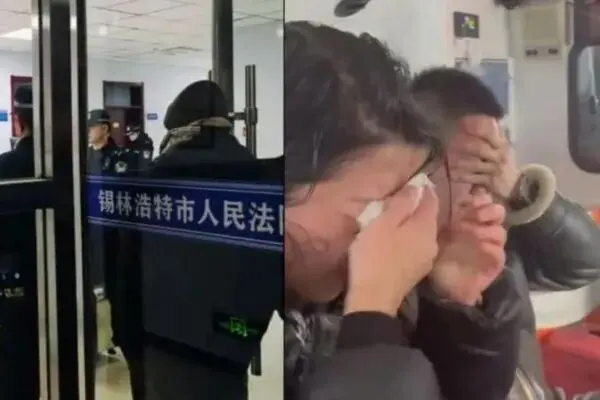
On December 25, 2024, the "Xueli Planet Case" was tried for the third time in the court of Xilinhot City, Inner Mongolia. When Guo Rui, Yang Xiao, Wang Xingwei, Li Qingduo, and Leng Hui, five lawyers, went to the court to attend the hearing, they were sprayed with pepper spray by the court police. (Picture_Network)
From being blocked from entering the court to the physical conflict between the court police and the audience, and then to being detained for writing "hearing records", the space for public opinion supervision represented by the right to attend hearings is becoming increasingly narrow.
"Hearing enthusiasts" were detained, and lawyers were complained about
Wu Yunpeng, 57 years old, is a legal enthusiast from Qingdao. According to his friends, Wu Yunpeng passed the legal professional qualification examination many years ago, and once worked as an engineer in the system. After retirement, he traveled around to attend hearings, and published "hearing records" and personal thoughts on his personal public account "Hearing Enthusiast".
Article 9 of the "Rules of the People's Court of the People's Republic of China" stipulates that citizens can attend public trials. When the number of seats for the hearing cannot meet the needs, the People's Court may issue hearing certificates according to the order of application or through methods such as drawing lots or drawing numbers, but should give priority to the close relatives of the parties or others who have an interest in the case to attend the hearing.
A lawyer who participated in the trial told Aquarius Era that the trial of the case of Wang Yingchao and others "involving organized crime" was held in a large court, and there were sufficient hearing seats, but the court only allocated three hearing seats to the family members of the defendants.
Aquarius Era learned that before the trial of this case, Wu Yunpeng contacted Zhang Jinhong, the defendant's agent lawyer, and expressed his desire to attend the hearing. Zhang Jinhong considered that the defendant's family members were more than sixty kilometers away from the court, and generally the family members would not come for three people. After communicating with the family members, the other party said that one person would come to attend the hearing, and could give up a seat. Zhang Jinhong reported the hearing list to the court in the WeChat "Case Communication Group", including Wu Yunpeng.
The case of Wang Yingchao and others "involving organized crime" was tried on September 8. The case occurred in Hua County, Henan Province in 2011, and was closed as an administrative case in 2013. In September 2024, the Zhengzhou Municipal Public Security Bureau believed that the case involved organized crime and restarted criminal review, and then transferred it for review and prosecution. On the trials on September 8 and 9, Zhang Jinhong and other agent lawyers raised objections to jurisdiction, which were rejected by the court.
September 8 and September 9 were the first two days of the trial, and Wu Yunpeng entered the court without any obstruction with his ID card.
Regarding the hearing, Wu Yunpeng wrote two "hearing records", one with a few hundred views, and the other with no more than two thousand views, which have all been deleted from the public account. A lawyer who participated in the case confirmed to Aquarius Era that the content of the "hearing record" was indeed the general situation of the trial. "What he said in the article, 'the black society that was snatched', and the court had to push the case, this is really not what he wrote himself, it was what we said in court."
The trial on the third day was still proceeding as usual. The lawyers who participated in the trial saw that before entering the court, Wu Yunpeng also went through the security check and handed in his mobile phone as usual. When they entered the court, they did not see Wu Yunpeng. Wu Yunpeng later told the lawyers that the court police had called him away from the court, first sent him to the Criminal Police Brigade, and then sent him to the police station in the evening. A lawyer recalled that the police station staff told other lawyers who went to visit Wu Yunpeng, "They don't know this case either, it's not criminal, it's not administrative."
But in the end, Wu Yunpeng was given five days of administrative detention.
Zhao Jun, a former judge and now a criminal defense lawyer, said that in the case of Wu Yunpeng, the court's control of the audience violated the principle of open trial established by the "Constitution" and the "Criminal Procedure Law". The law clearly stipulates that except for cases involving state secrets, commercial secrets, personal privacy, minors, etc. that cannot be tried in public, other cases must be tried in public. "Open trial is open to everyone, not conditionally open, only allowing the close relatives or direct relatives of the defendant to attend the hearing, this restriction is obviously illegal."
In Zhao Jun's view, Wu Yunpeng's hearing behavior occurred during the court trial, and the "hearing record" was directly related to the court trial. If there was a problem, it should also be handled by the court in accordance with the provisions of the "Rules of the People's Court". The document did not make any provisions on writing "hearing records". "This matter was finally handled by the public security, and the handling subject was problematic." In addition, he also believes that attending hearings and writing "hearing records" are forms of exercising citizens' right to supervision, and there is no violation of the law. "Whether it is the court or the public security to handle it, it is obviously against common sense to regard citizens' attendance and writing 'hearing records' as illegal."
Wu Yunpeng was released from the Zhengzhou No. 1 Detention Center on September 16. After Wu Yunpeng was released, he received the "Detention Notice" from the police station. The "Release from Detention Notice" shows that the reason for his detention was "fabricating facts and disrupting public order".
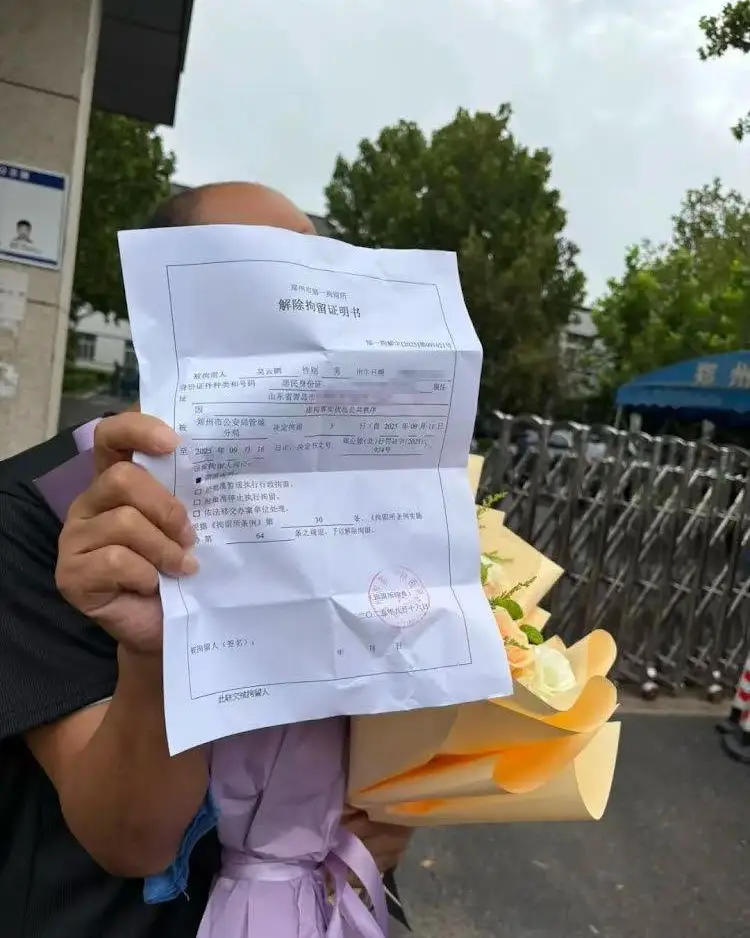
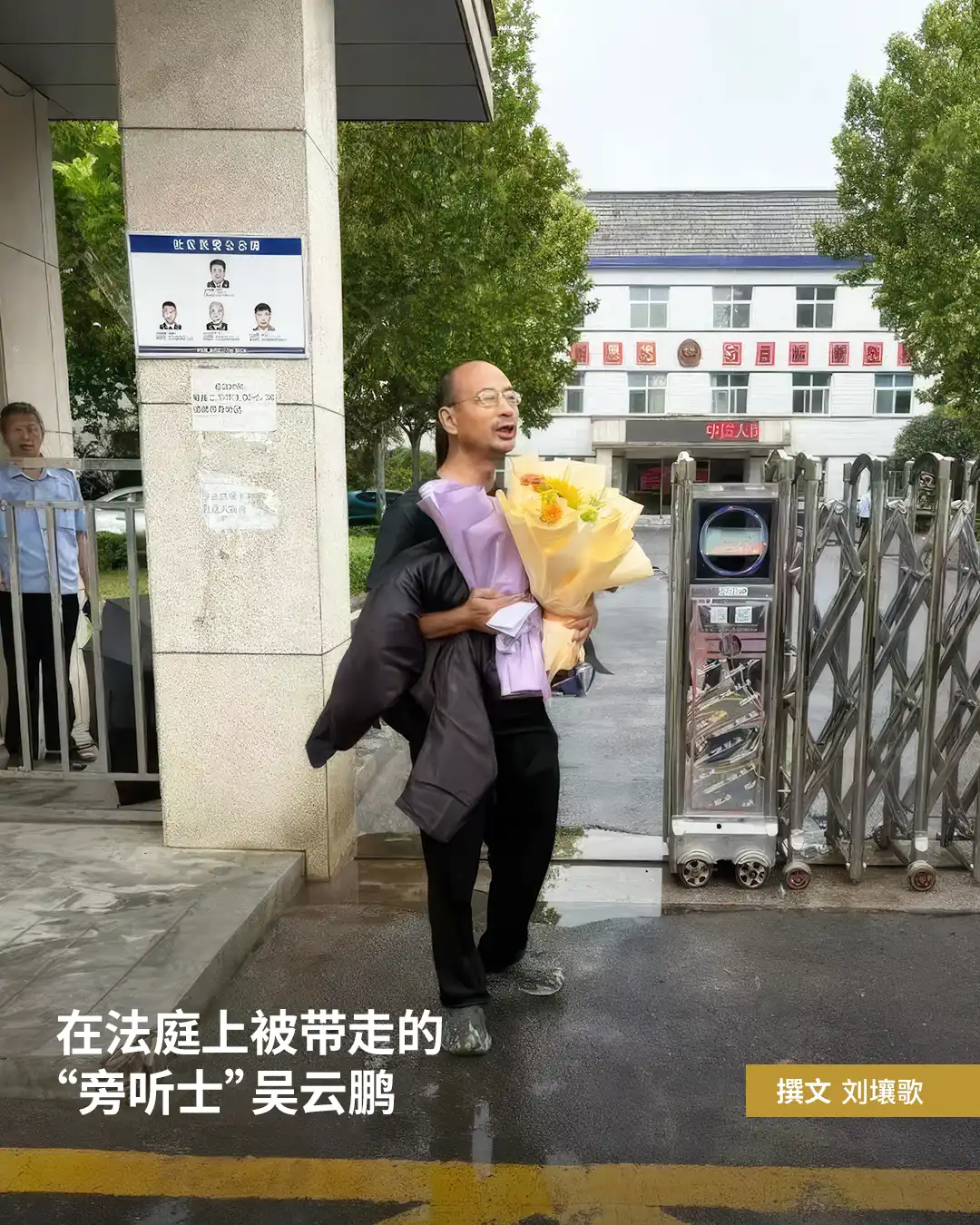
On September 16, 2025, the day Wu Yunpeng was released, he displayed the "Release from Detention Certificate" he received at the gate of the Zhengzhou No. 1 Detention Center. (Picture_Network)
Zhang Jinhong, who helped Wu Yunpeng attend the hearing, was also investigated by the Lawyer Disciplinary Committee. People close to Zhang Jinhong revealed that he was accused by the court of "inviting Wu Yunpeng to attend the hearing, sending him the relevant indictment and other case materials, and also helping him revise articles and publish them online, maliciously hyping the case".
The above-mentioned people close to Zhang Jinhong revealed that the basis for the court's accusation against Zhang Jinhong may be Wu Yunpeng's confession during his detention. After Wu Yunpeng was released, he refused to come forward to testify for Zhang Jinhong, or to conduct administrative reconsideration to clarify that the confession was inconsistent with the facts, and also publicly stated that he would no longer respond to external inquiries. "He has promised the relevant personnel not to reconsider or sue," people close to Wu Yunpeng told Aquarius Era. Wu Yunpeng has gone through retirement procedures and now lives on the retirement salary within the system, and his family's financial situation is not well-off, and his children are still in school.
When Aquarius Era contacted Wu Yunpeng, he refused to mention the details of the hearing incident again. But he described his situation like this: "I am a person with strong principles, I will not say what I cannot say, even if they force me again, I think I should do what I should do. Some people say that my behavior will make it more difficult to attend hearings in the future, but I am not flustered, I have the right and method to deal with it myself. The spillover effect brought about by the exercise of individual rights makes individual affairs public, and publicization may make the rights of other individuals be damaged, this kind of mutual influence is unavoidable, some people scold me, I choose not to defend."
Hearing, hype and the right to supervision
In Zhao Jun's view, the reasons for the court's control of the audience are very complex. "The most critical point may be to prevent the audience from spreading the trial situation. With uncontrolled audience, the illegal situation of public power is more likely to be exposed to the public, and the court does not want to see this situation, so it is manifested as refusing to accept supervision."
In recent years, it is not uncommon for the Lawyers Association and the Judicial Bureau to investigate and punish lawyers for "hyping cases".
In 2021, the All China Lawyers Association issued the "Rules on Prohibiting Irregular Hype of Cases (Trial)". This document is specifically to restrain lawyers from using the Internet or through the media to illegally put pressure on the case-handling organs and affect the handling of cases in accordance with the law. The definition of "hyping cases" is vague and criticized by lawyers. According to "Southern Window" report, some lawyers said, "'Hyping cases' generally includes two elements, 'malice' and 'fabricating facts', 'malice' is more difficult to judge, and the standards are somewhat vague." A lawyer who did not want to be named once asked an official of the Judicial Bureau "What is hype", and the other party also answered vaguely.
"Hyping cases" has become a Damocles' sword hanging over the heads of lawyers. Professor Han Xu of the School of Law of Sichuan University once wrote that in many cases, the trend of public power "retaliatory complaints" against lawyers has already emerged. "If the lawyer reveals the real existing illegal acts, it is not only not misleading, but also satisfies the public's right to know... If the lawyer points out procedural matters such as overdue detention, improper detention, torture to extract confessions, illegal evidence collection, improper case allocation, restriction of hearings, and failure to transfer synchronous audio and video data, it does not belong to the category of 'irregularly hyping cases'. These all belong to the category of 'procedural defense' matters, which is the embodiment of the defense lawyer's performance of his duties."
Dealing with court complaints has become a heavy burden for lawyers. "The director of the Judicial Bureau, who has a lot of dealings with us, said that you are always complained by the public security, procuratorate, and law, and the parties never complain about you." A criminal defense lawyer who did not want to be named said that after being complained, the lawyer must cooperate with the relevant departments to investigate and make notes, and write defense materials, and in serious cases, they can be suspended from business. Generally, lawyers will go through internal complaint channels and send letters and petitions to multi-level relevant departments. "We have been to the petition halls of the Discipline Inspection Commission, the Public Security Department, the Political and Legal Committee, and the People's Congress."
Even if lawyers attend the court hearing of cases unrelated to themselves for the purpose of learning, they may face complaints of "hyping cases" like the case-handling lawyers - as long as they write "hearing records" and disclose the trial content to the outside world, even if the case is "open trial". Another lawyer who did not want to be named said that if the lawyer attends the hearing and does not disturb the court order, the court has no right to complain about the lawyer. If the lawyer writes "hearing records", the parties involved will complain about the lawyer because the hearing may damage their rights.
Lawyer Hu Nan revealed at the online seminar held by the Hongfan Institute on September 26 that when he and many lawyers attended the public trial of a fraud case in a certain court, the court police did not allow them to record, and took away the pens and papers of the lawyers. Seeing this, he secretly brought the pens and papers into the court. Later, when he published the first "hearing record", the person in charge of public opinion of the court found him and first told him "your 'hearing record' is very good", but then changed the subject and said that he did not want the trial content to be spread. When he wrote the second article, the court complained about him. "Fortunately, the Beijing Lawyers Association withstood the pressure and finally objectively recognized and rejected the complaint."
Hu Nan regards writing "hearing records" as an extension of the lawyer's right to defense, and publishing "hearing records" is the dissemination of "extra-court defense". "Extra-court defense" extends the lawyer's defense stage beyond the court, and maintains the legitimate rights and interests of the criminally prosecuted by publishing opinions on the facts, evidence, applicable laws and judicial procedures of the case outside the court. Professor Yi Yanyou of the School of Law of Tsinghua University once wrote that under the freedom of speech stipulated in the Constitution, the lawyer's "extra-court defense" speech is the performance of the lawyer's right to defense, which is an intrinsic part of the right to defense.
"The court is really afraid of this," Hu Nan said. Cases involving organized crime are typical cases that can be written in "hearing records", "because the problems in the court are basically not solved."
In fact, the court's strict preparation for the audience is not a universal situation. As a former judge, Zhao Jun believes that in most ordinary criminal cases, the court will not restrict the hearing. The cases with restricted hearing rights are mostly those that are sensitive in themselves, and those in which the parties or their families are appealing for grievances on self-media, which has caused public opinion risks. "They (the judges) feel that there will be pressure." He pointed out that many years ago, in some sensitive cases, the court would also arrange for some internal people to occupy seats first, "but in terms of the total number, there are not many, maybe one or two out of one or two hundred cases, but it is difficult to say whether the situation has changed in these years."
Zhao Jun analyzed that the judges restrict the hearing, on the one hand, the degree of freedom within the system is getting smaller. "A few years ago, the judges might still post on Moments, but now they feel that the environment is different, and they basically don't post anymore, which should be the same for the cases. In the past, they could attend the hearing, but now they may not be allowed to do so"; on the other hand, for the rapid spread of the mobile Internet and self-media, the judges will definitely have a psychological resistance and self-defense.
But he believes that since it is a public trial, the court must face the public's trial. "Hearing records" are an important channel for the public who have not been able to attend the hearing to understand the trial situation. "This is not only part of the fundamental right of supervision stipulated in the 'Constitution', but also part of the public's right to know." Zhao Jun pointed out that if the court does not treat the public's right to attend the hearing fairly, "if you don't make sense on such a small issue, then do you dare to expect the parties to believe that you can handle it in accordance with the law on big issues, on the results of the judgment, and on other more important procedural issues?"
"The soft persimmon that hurts the most"
The interviewed lawyers generally believe that in recent years, institutional media have reported less and less on judicial cases, which has pushed lawyers and the audience to the front, and they, as "wild court reporters", lack the support of media institutions and have become the "soft persimmon that hurts the most".
In sharing the experience of how to avoid risks when writing "hearing records", Hu Nan specifically mentioned that attention should be paid to the public opinion environment and time point of publishing "hearing records". "If institutional media have already paid attention and published articles, and the audience is not the first to bear the brunt, it will be relatively safe."
Lawyer Lu Yijie has been a legal journalist for many years and has personally experienced some scenes where the right to attend hearings was restricted. He told Aquarius Era that in 2015, when the case of a departmental-level cadre's crime of duty was tried, he did not apply to attend the hearing in advance. After arriving at the court, he was not allowed to enter because the court strictly checked the identity of the audience. He learned that a reporter from a Beijing media who went with him had applied to the court's publicity department to attend the hearing in advance, but was not allowed to enter on the grounds that the hearing seats were full.
Also in 2015, when Lu Yijie attended the hearing of another departmental-level cadre's crime of duty, some of his colleagues showed their press cards and were not allowed to enter the court, and some went to the court's publicity department to negotiate, but to no avail. He observed that some local people's congress deputies and CPPCC members who had obtained hearing certificates did not attend the hearing throughout the whole process. Some family members, because they could not enter the hearing, begged in front of the court door with a crying tone, which moved a deputy or member, who secretly gave the family member his hearing certificate. This hearing certificate became the certificate for reporters to take turns attending the hearing.
In 2016, a court retried a major criminal case that attracted high social attention. After Lu Yijie and several colleagues entered the court, several of them were quickly identified and driven out. Later, it was learned that the court had arranged for people to sit in the court seats, and then focused on checking the people between the seats. The reporters showed their skills, some took the opportunity to mix in again after the inspection was completed, and some sat in the staff work area in the last row, and finally listened to the trial.
Lu Yijie switched to being a lawyer in 2019. In addition to preparing hearing certificates in advance and verifying the identity of relatives and friends attending the hearing in advance, what impressed him most was that in a case involving organized crime in a certain province in the Central Plains, the court dismantled many rows of seats in the hearing seats in advance, and then, on the grounds that the on-site hearing seats were not enough, arranged for the masses who wanted to attend the hearing on-site to the video hearing room.
Lu Yijie said that today's institutional media are tightening legal reporting. In recent years, some institutional media have been affected by factors such as topic selection risk assessment and reporting scale control, and the investment and output of trial-related legal topics have decreased significantly, and the reporting tentacles have been actively or passively retracted. The role of "trial information transmitter", which was originally undertaken by professional media, has a gap, and cannot fully meet the public's demand for judicial information.
On the other hand, he also pointed out that the risk of defense lawyers releasing information has increased, and they are facing complaints such as "extra-court hype" and "affecting judicial fairness", which makes many lawyers more cautious when disclosing trial information publicly, and actively reduce the frequency and content depth of information output.
In Lu Yijie's view, "hearing records" play a supplementary role in the judicial information circulating in the public domain. This kind of content based on personal experience can make up for the generality of official reports and the lack of professional reports caused by real factors, and avoid misunderstandings of public opinion caused by information asymmetry.
On September 26, the Hongfan Institute held an online seminar on "How to View and Protect Citizens' Right to Attend Hearings." Wu Yunpeng, who had just been released, watched this seminar "caused by him" and published a "hearing record" of the seminar on his personal public account. At the end of the article, he confessed: "My idea is very simple, I like to pursue the truth, I attend and record the court, in order to spread the truth of the court, and also to popularize the law, that's all."
Aquarius Era learned that the shock of being detained for attending the hearing has not yet dissipated in the legal world, but Wu Yunpeng has been trying to return to his "hearing enthusiast" track, and he still insists on carrying a pen and paper to attend and record the trial at court hearings in various places.